
5 Ways Marketing Teams Can Protect Data and Personalize Responsibly

Privacy is not the opposite of personalization. The data privacy best practices for marketing teams in 2026 start with a clear rule: collect only what you need, explain how you’ll use it, and respect each person’s choices across your marketing systems. Privacy governs how personal information is collected, shared, stored, and used; security protects it from unauthorized access.
Marketing teams already know that relevant experiences depend on useful data. The challenge is creating them without collecting more than necessary or losing sight of consent and governance. Use these controls and regulations to guide five practical ways to manage permissions, minimize data, and build responsible personalization. Consent management and analytics tools can support this work and make privacy part of campaign operations rather than a barrier added afterward.
Key Takeaways
- Make consent part of your marketing data flow, so tracking and audience activation reflect people’s choices.
- Map where customer data enters, where it is stored, and how long it is kept to expose gaps in governance.
- Check which privacy rules apply to your audiences and adapt consent and data practices to those requirements.
- Personalize with purpose: collect only relevant information and keep it only as long as needed.
- Use privacy management tools to improve visibility, manage consent, and measure how your controls support responsible marketing.
1. What is data privacy in marketing?
Marketing data privacy governs how a business collects, shares, stores, and uses personal information. Data security focuses on protecting that information from unauthorized access. For a campaign, privacy asks whether each data point serves a clear purpose, such as sending a requested product update. Security asks whether access to the customer record is controlled. Both matter: careful collection does not protect information exposed by poorly secured systems.
Consent and opt-out rules depend on a person’s location, the channel, and how the data is used. The GDPR requires explicit opt-in consent before processing personal data, while the CCPA gives consumers the right to opt out of the sale of their personal information. The GDPR and CPRA also require consent to be revocable and contextual. For email, SMS, cookies, pixels, and targeted ads, track the relevant permission or opt-out for each channel and make the choice effective across connected systems.
Privacy-first analytics connects measurement to those choices. A practical setup uses consent-aware collection, aggregated reporting, and removes identifying details when individual-level data is unnecessary. For example, a campaign report can compare landing-page visits by campaign without retaining a person’s full browsing history. When consent changes, update the permission record and synchronize it with the systems used for email, advertising, and analytics.
Google Consent Mode v2 can support consent-aware signals in Google-related measurement and advertising workflows. It does not replace the work of presenting clear choices or honoring them. A consent management platform can capture preferences and pass signals to connected tools; teams should still test that rejected or withdrawn consent changes the relevant tags and data flows. Google Consent Mode v2 integration addresses this kind of consent signaling.
Automated consent and rights-request workflows reduce the risk of records becoming inconsistent. Connect a preference change or deletion request to the systems holding the person’s information, then test whether each system updates or removes the record. A consent management platform can manage banner choices; a DSAR workflow should route access or deletion requests, track their status, and record completion across connected systems.
AI marketing tools, data brokers, and third-party ad platforms can create exposure if they receive more personal information than a campaign needs. Risks include unauthorized access, unexpected reuse, and re-identification of data believed to be anonymous. Before sharing customer records with an AI tool or advertising platform, define the permitted purpose and limit the fields transferred.
For a vendor audit, inventory the data shared, its purpose, retention, access, and deletion path. Review the vendor’s processing terms and document permitted uses, safeguards, subprocessors, and support for rights requests in the data processing agreement. Then test a consent change and a deletion request from start to finish. A signed agreement alone won’t show whether connected systems actually honor the customer’s choice.
2. Customer data platforms and privacy controls
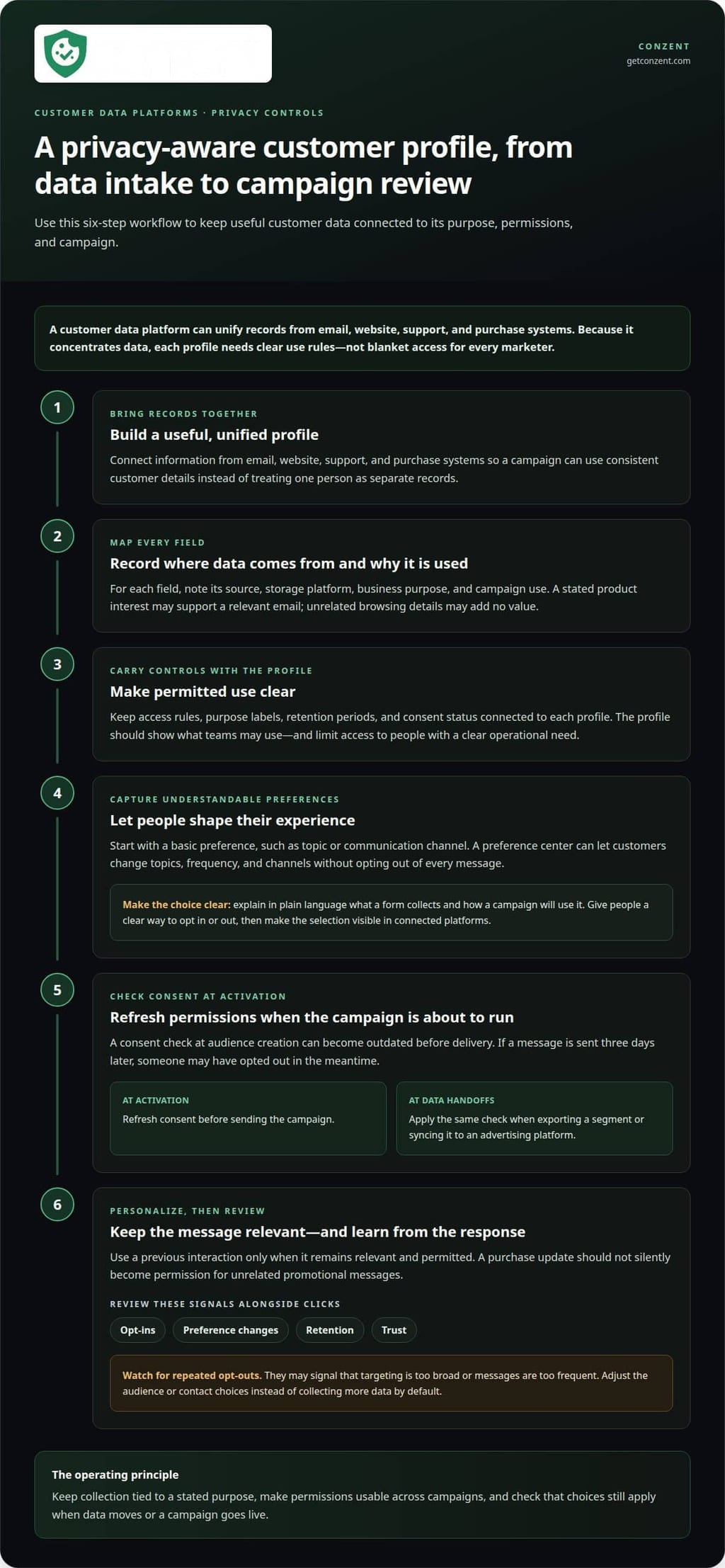
A customer data platform can bring records from email, website, support, and purchase systems into unified customer profiles. This view helps a campaign use consistent information instead of treating one person as separate records. It also concentrates data, so access rules, purpose labels, retention periods, and consent status need to travel with each profile. A unified profile should clarify what teams may use, not make every field available to every marketer.
Start with a data map. Record where each field came from, which platform stores it, why the business collects it, and which campaign uses it. For example, a customer’s stated product interest may support a relevant email, while unrelated browsing details may add no value. Identify fields required for a specific purpose, and restrict access to teams with a clear operational need.
Timing matters. An audience filtered for consent when a campaign is built can become outdated before delivery. If a message is sent three days later, someone who opted out in the meantime could still receive it. Set the campaign workflow to refresh consent at activation, not just at audience creation. Apply the same check when teams export a segment or sync it to an advertising platform.
Personalization should develop with the relationship, not race ahead of it. Start by asking for a basic preference, such as a topic or communication channel. A preference center can let people change topics, frequency, and channels without opting out of every message. Use a previous interaction only when it remains relevant and permitted. A purchase update, for instance, should not silently become permission for unrelated promotional messages.
Trust depends on understandable choices. Explain in plain language what information a form collects and how a campaign will use it. Give customers a clear way to opt in or out, then make their selection visible in connected platforms. A short, human-readable explanation is more useful than a broad statement that leaves people guessing. Keep the preference record available to the systems that send messages and measure responses.
Privacy and loyalty can reinforce each other when controls shape the customer experience. Measure opt-ins, preference changes, retention, and trust alongside clicks. If a campaign earns clicks but prompts repeated opt-outs, its targeting may be too broad or its messages too frequent. Review these signals in light of the campaign’s purpose, then adjust the audience or contact choices rather than collecting more data by default.
For teams assessing how consent controls fit into their marketing operations, review the available platform options. A well-governed platform should make permissions usable across campaigns while keeping collection tied to a stated purpose. The standard is practical: a profile supports relevant communication, and each connected system respects the customer’s choices.
3. International and regional marketing privacy regulations
Marketing teams need a location-aware approach because privacy laws can apply based on where a consumer lives, not only where a company operates. The General Data Protection Regulation (GDPR) came into force in 2018, according to the European Union. California’s CCPA and CPRA, Virginia’s VCDPA, Colorado’s CPA, Brazil’s LGPD, and the United Kingdom’s DPA are other frameworks that can affect marketing practices.
The rules don’t create one universal playbook. The GDPR applies based on the data subject’s location, while the CCPA applies based on business characteristics and California residency. In 2026, comprehensive consumer privacy laws were in effect in 20 U.S. states, and 24 states had enacted them. Map the locations of your audiences, then identify which privacy laws apply to each campaign and data flow.
Consumer rights also shape operational workflows. The European Union says the GDPR grants individuals a right of access under Article 15 and a right to be forgotten under Article 17. Virginia requires a response to a consumer rights request within 45 days, according to the Virginia General Assembly. Build processes that route requests to the right teams, locate records across relevant systems, and track responses against each applicable deadline.
For marketing data collection and sharing, make the privacy notice explain what information you collect, why you collect it, and the types of parties that receive it. Use language customers can understand, and connect each notice to the form, cookie choice, or campaign where data enters. Since disclosure rules vary across regulations, maintain a jurisdiction-to-notice map and update it when a campaign changes its data use.
Multi-region campaigns need more than translated copy. Adapt consent choices, privacy notices, and rights-request paths to the applicable rules for each audience. For example, a global signup form can present localized explanations while maintaining a consistent record of the customer’s selected purpose and channel. Test that each regional version offers the same clear choices and sends accurate signals to connected marketing platforms.
Enforcement has included both financial penalties and investigations into opt-out practices. European regulators imposed more than €1.2 billion in GDPR fines during 2025. On September 9, 2025, California, Colorado, and Connecticut announced a joint investigative sweep targeting businesses that ignored Global Privacy Control opt-outs. In 2026, California required visible confirmation when businesses honor a Global Privacy Control signal.
The GDPR can impose penalties of up to 4% of an organization’s annual revenue for violations, according to the European Union. Treat compliance as an ongoing process: measure whether notices match actual data flows, whether opt-outs reach campaign systems, and whether rights requests move through the correct workflow. A clear regulatory map gives marketing, legal, and technology teams a shared basis for those checks.
4. Personalization and data minimization
Personalization works best when each data point helps deliver a specific customer benefit. Start with the action a campaign should enable, such as recommending relevant products or sending an update someone requested. Then identify the personal data needed for that action. If a birthday, precise location, or full browsing history won’t change the message, leave it out. Collecting more can add risk without making the experience more useful.
Set limits at the destination, not only at collection. An email platform may need an address and a chosen topic, while an advertising platform may need a consent signal and a limited audience segment. Before a transfer, define which fields the destination can receive and what it can do with them. Remove fields that don’t support the stated purpose. This reduces unnecessary exposure if a partner account or integration is misused.
Personalization can also rely on broad preferences instead of detailed profiles. A customer who selects “running” as an interest may receive relevant content without sharing a detailed activity history. A reader who chooses product updates can receive them without being placed in unrelated promotional campaigns. Use the least detailed source that still supports the intended experience, and keep the choice connected to the relevant action.
Retention limits matter too. Set a reason and review point for each category of personal data. For example, keep an event-registration list while it supports event follow-up, then remove or anonymize records that no longer serve that purpose. Apply the same logic to campaign exports, test audiences, and duplicate records. Deleting a profile from one platform is not enough if an old copy remains elsewhere.
Make this operational with a field-level review. For every form or personalization rule, record the data source, business purpose, receiving platforms, and deletion trigger. Marketing teams should review collection forms quarterly to confirm they request only necessary information and use appropriate consent language. When a new campaign adds a field, assess its impact before launch instead of carrying it forward automatically.
Organizations can preserve useful personalization while reducing data exposure by choosing less intrusive methods. Use contextual content based on the page or campaign topic when individual history isn’t needed. Use aggregated results to measure campaign performance without retaining identifiable event-level records. If a team tests two messages, compare their overall outcomes instead of attaching extra personal details to every interaction.
Finally, treat data minimization as a design decision for each customer journey. Map the source, purpose, destination, and retention rule before collecting or transferring personal data. Remove information that does not change the customer’s experience or the team’s decision. The result is not less thoughtful personalization. It is a deliberate match between the data collected and the action it supports.
5. Privacy management and data governance tools
Privacy tools create value when they turn scattered records into operational decisions. Start with a data inventory that records each source, category, purpose, storage location, owner, and retention rule. For example, a campaign contact field should show where it came from and which systems receive it. This map helps teams identify duplicate collections, unclear ownership, and data flows that no longer serve a business purpose.
Classify information by sensitivity and use. A contact detail may support email delivery, while behavioral records may require tighter access controls. Assign an owner to each category, then document who can access, change, export, or delete records. These controls give marketing, privacy, and technology teams a shared view of how customer information moves between platforms.
Choose tools based on the work they need to support. Data discovery helps locate personal information across systems. A governance catalog records definitions, owners, and permitted uses. Risk assessment tools help prioritize gaps, while consent controls connect customer choices to marketing activity. Analytics can surface useful insights without exposing individual records when aggregated results answer the business question.
Make privacy compliance measurable. In 2026, 60% of organizations monitored privacy program effectiveness by performing a privacy risk assessment. Link each identified risk to an owner, corrective action, and completion record. If a campaign export includes unnecessary fields, document the issue, restrict the export, and retest the workflow.
Rights-request handling needs clear ownership and evidence. Connect request intake to the systems that search, correct, or delete records, then track each handoff. If your team handles more than 10 requests per week, automate the workflow to organize requests and follow their progress. Test requests across integrated platforms, including archived exports and connected tools.
Audit governance controls regularly. Marketing, IT, security, and customer service each see different data flows and potential failure points. An annual review of technology stacks and process documentation can reveal new integrations, outdated access, and retention gaps. Add a focused review when a campaign introduces a new platform or data use, then record decisions in a central log.
These are practical data privacy best practices for marketing teams in 2026: make consent records usable, reporting meaningful, and controls visible in daily campaign work. If you’re evaluating consent management for your marketing operations, explore the available platform options.
Conzent
Conzent helps marketing teams put consent choices into practice across digital campaigns. Its Managed Cloud Consent Platform and Self-Hosted Open Consent Infrastructure support different approaches to consent management. Teams can also use Consent A/B Testing to compare banner variations and Revenue Impact Analytics to examine how consent choices relate to campaign outcomes. These tools are useful when your team needs clearer consent workflows and better visibility into their marketing impact, alongside the governance practices covered above. They support privacy operations, but they don’t replace legal advice or a team’s responsibility to understand the applicable rules. Explore Conzent’s consent platform and choose the cloud or self-hosted approach that fits your workflow.
Make privacy part of your next campaign decision
The next step is to make privacy a working criterion, not a final approval gate. Before a campaign launches, bring marketing, technology, and privacy stakeholders together to decide what the experience needs, what data supports it, and how consent will shape measurement. This review can show teams where to reduce data collection and what to change before launch.
Applying data privacy best practices for marketing teams in 2026 also means treating governance as an ongoing capability. New channels, tools, and campaign goals can change how information moves. Keep the decision process clear enough for the people running campaigns to use, and revisit it when those workflows change. For organizations that need strategic guidance navigating these evolving workflows, consultancies like ContentFactory help businesses balance responsible digital marketing with digital transformation and growth. Responsible personalization doesn’t require choosing between relevance and respect. It requires making the customer’s choices part of the system.
If you’re ready to assess consent management options for your marketing setup, explore the available options. Start with the needs of your team and the consent workflow you want to improve. Use the campaign review to identify which workflow fits your team and what changes to make before launch.
Frequently Asked Questions
What is data privacy in marketing?
It means giving people meaningful control over how marketing uses information about them. For example, a signup form can separate a required email address from an optional product-interest question. That distinction helps teams avoid treating every useful detail as essential. A practical test is to ask whether removing a field would prevent the promised message or service. If not, collecting it may add exposure without improving the customer experience.
Does a "Do Not Sell" opt-out actually stop my retargeting ads?
It can require changes to advertising data flows, but the result depends on the applicable law, the platform, and how the business uses the data. California consumers have a right to opt out of the sale of personal information, and California’s 2026 rules require visible confirmation when a business honors a Global Privacy Control signal. Make sure the opt-out reaches audience exports and ad-platform connections, not just a website preference screen.
How is "sharing" different from "selling" personal data under these laws?
The terms can have specific legal meanings that vary by jurisdiction, so a business shouldn’t assume that no payment means no regulated disclosure. For a practical review, document which data goes to an advertising partner, what the partner does with it, and whether the transfer supports cross-site targeting or another purpose. Then assess the relevant law’s definitions and opt-out rules for that use. A contract label alone doesn’t settle the question.
What Compliance Practices Should Marketing Teams Implement?
Build a repeatable review around each campaign’s data source, intended use, audience, and destinations. Before launch, confirm that the notice describes the actual activity and that the campaign respects the current permission record. Keep a decision log showing who approved the data use and what changed. After launch, test a withdrawal or opt-out across the connected systems. This can reveal a stale audience or a platform that missed an updated preference.
What Tools Help Marketers Maintain Compliance Across Jurisdictions?
Use tools that solve distinct operational problems: a consent management platform for capturing choices, a data inventory for locating information, and request-management workflows for handling access or deletion tasks. A regional rules matrix can connect audience locations to notices and campaign settings. Conzent’s consent platform includes customizable banners, consent A/B testing, and integrations such as Google Consent Mode v2, which can help teams manage consent signaling in advertising workflows.
What is the primary difference between GDPR and CCPA for marketers?
Their scope and consumer rights differ. The GDPR applies based on the location of the data subject, while the CCPA applies based on business characteristics and California residency. For campaign planning, map the audience and business context before selecting a notice or opt-out flow. A global campaign may need different choices for different visitors, so don’t treat one default setting as a universal answer.
What data privacy laws affect U.S. marketing teams in 2026?
Relevant laws can include California’s CCPA and CPRA, Virginia’s VCDPA, Colorado’s CPA, and comprehensive privacy laws in other states. In 2026, 20 U.S. states had comprehensive consumer privacy laws in effect, while 24 had enacted them, including laws not yet in force. Which rules apply depends on the audience and the business. Keep a state-by-state applicability map and connect it to campaign and opt-out workflows.
What are the 2026 requirements under state consumer privacy laws for marketing data?
There isn’t one identical set of requirements across every state. The applicable law can shape consumer choices, disclosures, and response processes. For example, Virginia requires a response to a consumer rights request within 45 days, according to the Virginia General Assembly. California required visible confirmation when businesses honor a Global Privacy Control signal in 2026. Track each state’s applicable rules and test that the relevant workflows carry choices through to campaign systems.