
Avoiding vendor lock-in with CMPs through portable data

Avoiding vendor lock-in with CMPs starts with keeping consent data portable and integrations loosely coupled. Choose a platform that lets you export data in usable formats, connect through documented interfaces, and plan a practical exit before you sign. That gives your business more control if its needs or providers change.
It’s reasonable to focus on the banner and consent features a CMP delivers today. But your choice also affects future migration work, contract flexibility, and how easily your systems can adapt. This article explains how integration design and data formats shape portability, what to include in an exit plan, which contract terms matter, and where lock-in can create financial and operational pressure. You’ll have a clearer way to weigh the trade-offs and choose a CMP that meets current needs without closing off future options.
Key Takeaways
- Use open standards, documented data models, and exportable formats to make consent data easier to move between systems.
- Plan an exit before signing: map dependencies, migration steps, responsibilities, and continuity needs.
- The EU Data Act has applied since September 12, 2025, according to the European Union.
- Clarify data ownership, export rights, termination notice, renewal terms, migration support, and exit costs in contracts.
- Assess lock-in as an operational risk as well as a financial one, including how it can constrain future technology choices and negotiations.
1. Integration flexibility and data portability
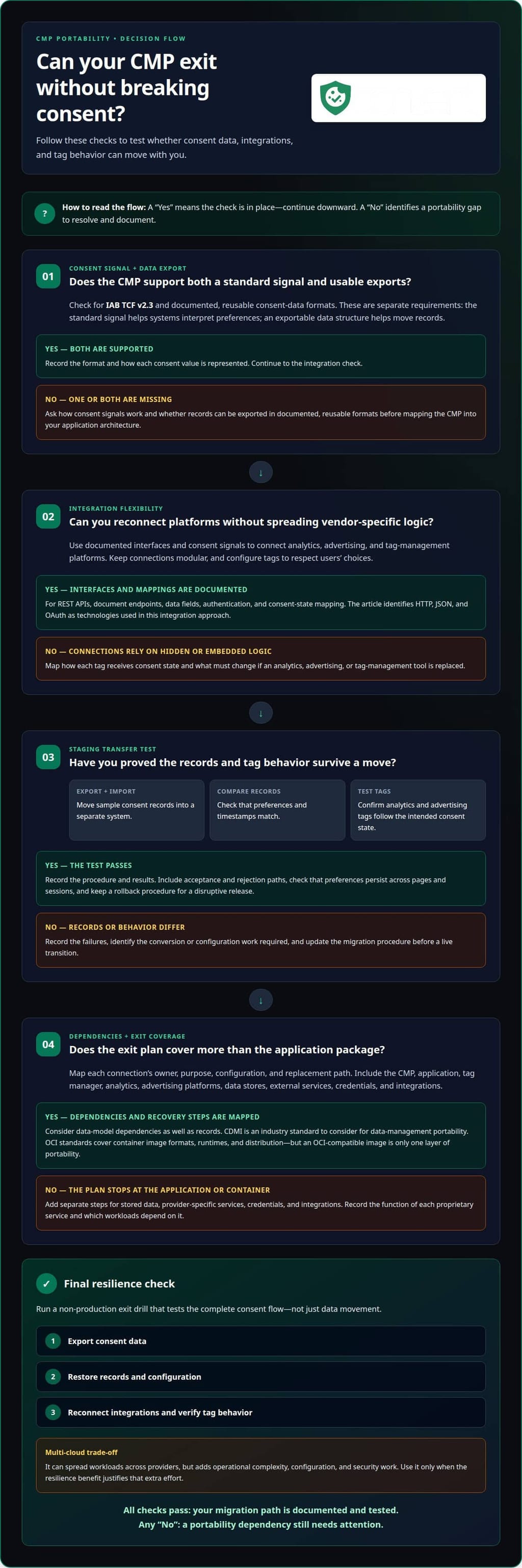
Which CMPs support data portability and standard consent formats? Look for a platform that supports IAB TCF v2.3 and provides consent data in documented, reusable formats. These are separate checks: a standard consent signal helps systems interpret preferences, while an exportable data structure helps move records. Ask how the CMP handles both before mapping it into your application architecture.
How can a CMP integrate with multiple analytics, advertising, and tag-management platforms? Use documented interfaces and consent signals to connect each platform, then configure tags to respect users’ choices. For example, a tag manager can use the CMP’s consent state to control whether an analytics or advertising tag runs. Keep these connections modular instead of embedding vendor-specific logic throughout your site.
Open standards make this separation more practical. REST APIs using HTTP, JSON, and OAuth can connect application components without tying every integration to one provider’s infrastructure. Document the endpoints, data fields, authentication method, and consent-state mapping. This gives technical teams a clearer migration path when analytics, advertising, or tag-management tools change.
Portability also depends on the data model. Record what each consent value means, how it is represented, and which system owns it. Standardized formats can reduce conversion work, but they don’t automatically transfer configuration, history, or custom logic. Document those dependencies, too. Cloud Data Management Interface, or CDMI, is an industry standard to consider when assessing data-management portability.
Test portability before a live migration makes it urgent. In a staging environment, export sample consent records, import them into a separate system, and compare the resulting preferences and timestamps. Then test a page with analytics and advertising tags. Confirm that each tag follows the intended consent state after a platform change. Record any failures and update the migration procedure.
Containers can make applications easier to move, but they don’t solve every dependency. The Open Container Initiative defines open standards for container image formats, runtimes, and distribution. An OCI-compatible image can package application components consistently across environments. Still, the CMP’s external services, stored data, credentials, and integrations may need separate migration steps. Treat the image as one layer of portability, not the entire exit plan.
When avoiding vendor lock-in with CMPs, resilience drills should test the full consent flow: export, restore, integrations, and tag behavior. A multi-cloud approach can spread workloads across providers, but it also adds operational complexity. Choose it only when the resilience benefit justifies the extra configuration and security work.
Look for CMPs that support IAB TCF v2.3 and provide consent data in documented, reusable formats. Check both the standard consent signal and whether records can be exported.
2. Cloud exit planning and business continuity
A CMP exit plan should preserve consent decisions as the platform changes. Start by mapping the production architecture: the CMP, website application, tag manager, analytics tools, advertising platforms, and each data store. For every connection, record its owner, purpose, configuration, and replacement path. This dependency map gives engineering and security teams a shared view of what must keep working during a transition.
What US privacy laws should businesses consider when choosing a CMP? Identify the state and sector requirements relevant to the business, the people it serves, and the data it handles. Translate each applicable requirement into system needs, such as recording consent choices or controlling tags. A US business serving people across multiple states should map those obligations before choosing a deployment or migration plan.
Replacing a CMP can erase stored consent choices, misread preference signals, or disrupt analytics and advertising tags. A tag might fire before the new platform applies the intended consent state, or remain blocked after a valid choice. Test both acceptance and rejection paths in a staging environment, then check that preferences persist across pages and sessions. Include a rollback procedure so teams can restore the previous configuration if a release disrupts tracking or consent controls.
Automated assessment tools can scan cloud accounts and configuration records to identify dependencies. Include virtual machines, managed databases, identity services, network rules, secrets, and provider-specific APIs. An inventory that lists only servers misses software dependencies that could block a move. For each proprietary service, record its function, the workloads that depend on it, and whether replacing it requires application changes. Review the inventory after deployments, not just during annual planning.
Choose a deployment architecture based on continuity needs. A cloud deployment can simplify centralized operations, while hybrid cloud combines public and private services. On-premises deployment keeps infrastructure in the organization’s own environment. Each model changes who operates the underlying systems and how teams restore service. Multi-cloud can distribute workloads across providers, but it also adds configuration and security work. Availability across cloud locations depends on the design of the application, data, and recovery procedures, not merely on the number of locations.
Run an exit drill in a non-production environment. Simulate losing a cloud account or proprietary API, then record which functions fail and how teams restore them. Test data export, access credentials, configuration recovery, and tag behavior. Assign owners and update the runbook after each exercise. This makes resilience an operational practice rather than a document that sits unused.
A practical approach to avoiding vendor lock-in with CMPs also weighs deployment control against ongoing operating effort. Compare the CMP deployment and pricing options as part of that decision, alongside your recovery and support requirements.
3. Proprietary standards and data format compatibility
A consent record may be portable in theory but difficult to reuse in practice. Its format might preserve a choice but omit timestamps, policy versions, or identifiers another system needs. Map each field to its meaning before migration. For example, document whether an “accepted” value applies to analytics, advertising, or both. This reduces ambiguity when a new platform interprets historical records.
Proprietary interfaces create another barrier. A cloud provider may store consent events in a format its own tools can read easily, while another platform needs conversion. Before signing, define which records the business owns, the export format it receives, and whether exports include configuration and audit history. Test a sample export with the systems expected to receive it. A readable file is useful only if its fields retain their meaning.
The EU Data Act has applied since September 12, 2025, according to the European Union. Until January 12, 2027, the EU Data Act limits switching charges, including egress, to the provider’s direct costs, according to the European Union. The European Union states that the EU Data Act bans switching charges after January 12, 2027. These rules make contract language and migration procedures especially important for businesses planning cloud exits.
Contracts should explain how to request an export, which formats are available, and how long access continues after termination. They should also define the provider’s migration assistance, the customer’s responsibilities, and any costs beyond switching charges. For a CMP, specify how consent records and related configuration will be delivered. Clear terms reduce disputes about whether an export is complete or the provider must help transfer it.
Data egress costs are only one part of migration effort. The volume and format of stored data, the number of connected services, and the conversion work all affect the transition. As data accumulates with one cloud provider, data gravity makes it harder to move: dependent applications and services become costly to relocate alongside it. Map those dependencies before choosing a destination or setting a migration schedule.
Review the exit path in a practical sequence. Identify proprietary services, estimate the data and configurations they hold, and map each dependency to a replacement. Then test an export, validate the records in the destination, and confirm that access remains available during the transition. Include these steps in contracts and internal runbooks. This turns switching from an urgent technical problem into a planned operational process, with responsibilities and data formats agreed in advance.
4. Contract exit strategies and deconversion assistance
An exit strategy works best before an enterprise signs its first service agreement. Define the trigger for leaving, such as a changed business need, a continuity concern, or an infrastructure decision. Then map who approves termination, who leads the technical transition, and which teams depend on the service. A written plan turns “we can switch later” into assigned work with clear responsibilities.
Contracts should make the way out as clear as the way in. Review termination conditions, required notice, automatic renewal, early-exit penalties, and post-termination access. For a CMP, specify how the business receives consent records and configuration, in which formats, and for how long access continues. These terms help prevent a locked account or unexpected renewal from delaying a planned migration.
Deconversion assistance deserves its own clause in the service-level agreement. Define what support the vendor provides, when it begins, and which party handles each task. For example, the vendor may prepare an export while the customer’s technical team maps fields into the replacement system. The agreement should also describe how the parties handle access credentials, open support requests, and data deletion after transfer.
Build the exit process around practical checkpoints:
- Record notice deadlines, renewal dates, termination rights, and any exit costs.
- Assign owners for data export, migration, testing, and communications.
- Document the required data format, configuration files, and access permissions.
- Set acceptance criteria, such as successful import and correct consent behavior.
- Define how long the old service remains available during transition.
These practices reduce reliance on proprietary features that work only within one vendor’s infrastructure. Keep business rules and integration documentation under your control. If a workflow relies on a vendor-specific function, record its purpose and identify how a replacement will handle it. This makes switching a planned technical change, not a rushed redesign.
Test the strategy before termination becomes urgent. Use a staging environment to rehearse export, transfer, validation, and rollback. Have the vendor’s deconversion support and internal owners follow the same runbook. Record failed steps, revise responsibilities, and store the updated plan where operations and security teams can access it. A repeatable drill reveals gaps that contract language alone cannot expose.
For organizations seeking more control over deployment, self-hosted open consent infrastructure is one model to consider alongside contractual exit rights. It changes who operates the infrastructure, so include hosting, maintenance, and recovery responsibilities in the strategy. The right practices align the contract, technical architecture, and business continuity plan before either party needs to act.
5. Financial and operational costs of vendor lock-in
Vendor lock-in costs more than a monthly invoice. A single vendor can limit an organization’s bargaining power, slow technology changes, and make workloads harder to move. If a CMP is tightly connected to analytics and advertising tools, replacing it may require engineering time, testing, and changes to tracking configurations. Include those operational costs when comparing options, not just the contract price.
Price increases are harder to challenge when switching requires a major rebuild. A business dependent on one platform may accept new terms because migration could disrupt consent handling or reporting. Track contract charges alongside staff time, integration maintenance, and data-transfer work. That fuller view helps decision-makers compare the cost of staying with the effort of changing.
Build a simple cost model around the systems your organization actually uses. List the CMP, tag manager, analytics platforms, advertising integrations, and internal teams involved. For each dependency, estimate the work needed to export settings, adapt connections, validate consent behavior, and restore reports. Treat these estimates as planning inputs, then update them after a staging migration reveals where the effort lies.
Operational impact can continue after the transfer. If consent signals fail during a change, analytics may lose events or advertising tags may behave incorrectly. Teams may also need to reconcile reporting across the old and new platforms. Include these risks in the migration plan, with owners for testing, rollback, and communicating changes to affected teams.
Relying on one provider can also limit future choices. A new analytics product may offer a useful capability, but proprietary integrations can slow adoption or require extra development. Map which workloads depend on vendor-specific features, then separate essential functions from optional ones. This helps the organization focus investment on the dependencies that create the greatest switching effort.
Review your options before renewing a contract. Compare the cost of staying, the work required to transfer, and the operational impact of delaying a change. Include termination terms and renewal dates, then record who approves each path. For example, marketing may own tag requirements while engineering manages integrations. A shared view prevents hidden work from surfacing only after a decision.
Consent architecture can also affect the balance between operational control and ongoing work. Google Consent Mode v2 integration is one consideration when evaluating how consent signals connect with Google services. Compare deployment options against your team’s ability to maintain the system, rather than treating infrastructure choice as a price decision alone.
To assess the trade-offs for your setup, review CMP deployment options alongside integration effort, transfer needs, and internal operating capacity.
Conzent
Conzent helps businesses choose a consent platform that fits their operational needs and deployment preferences. Its Managed Cloud Consent Platform offers a managed option, while Self-Hosted Open Consent Infrastructure lets organizations run the platform on their own infrastructure. These choices can inform how your team plans ownership, integrations, and a future transition. They don’t replace careful contract review or an exit plan.
Conzent’s Consent A/B Testing and Revenue Impact Analytics help teams assess banner performance and understand its relationship to revenue. These tools support informed consent-operations decisions, while portability still depends on your architecture and exit planning. If you’re weighing CMP options or planning a change, explore Conzent’s managed cloud and self-hosted platforms.
Make portability part of your next CMP decision
Vendor independence isn’t a feature to add after a platform is in place. It’s a design choice that shapes how your organization adapts as its systems, priorities, and needs change. Treat portability as an ongoing operating principle: keep ownership clear, document dependencies, and make exit planning part of procurement and renewal decisions.
Bring your technical and business teams together around a practical question: could you move your consent operations without losing control of essential data or disrupting your processes? Their answers can guide your requirements and help you choose a deployment model. That’s the foundation of avoiding vendor lock-in with CMPs: preserving meaningful choices, not planning to leave for its own sake.
If you’re assessing your next CMP or reconsidering your current setup, contact Conzent to discuss your CMP and the needs behind your decision. A thoughtful choice now can leave your organization better prepared for what comes next.
Frequently Asked Questions
How does vendor lock-in affect businesses?
Vendor lock-in can shift decision-making power away from the business that depends on a platform. For example, teams may have to align campaign timelines with a vendor’s release schedule or support process. That dependence can affect budget planning, procurement approvals, and the pace of internal projects. Track these effects alongside technical concerns: they show how provider dependence reaches beyond IT and influences everyday business decisions.
How do competitors minimize vendor lock?
Consent-platform providers take different approaches, so compare practical trade-offs rather than relying on broad claims. An open-source platform, for example, lets technical teams inspect its code, while a managed service reduces the customer’s infrastructure workload. Ask how each approach affects internal skills, release control, and operational responsibility. A useful comparison spells out what your team would own and maintain under each model.
What is a CMP and how can it create vendor lock-in?
A CMP presents consent choices and communicates them to a website’s technologies. Lock-in can grow when an organization’s policy categories, regional rules, and review processes become closely tied to one platform’s configuration model. For example, a privacy team may build its approval workflow around fields another system represents differently. Documenting business decisions separately from platform settings makes them easier to carry forward.
How can consent data be exported from a CMP?
Start by identifying which records the business needs for audits, reporting, or operational continuity. A useful export should preserve context such as event time, consent category, and applicable policy version, where the system records those fields. Keep an export specification with the file so another team can interpret its columns. Restrict access to exported data, since consent records may require careful handling.
What consent-management standards help reduce CMP lock-in, such as IAB TCF and Google Consent Mode?
IAB TCF and Google Consent Mode address different integration needs. TCF structures consent information for participating advertising vendors, while Google Consent Mode communicates consent states to Google services. Map which systems consume each signal and how they interpret it. Standards help align these interactions, but they don’t define your internal approval process, banner wording, or regional policy decisions.
How do CMP contracts handle data ownership, export, and termination?
Make contract language operational by defining what a complete handover looks like. For example, specify the expected file structure, delivery channel, responsible contacts, and a process for resolving missing or unreadable fields. Include a clear way to confirm that transferred material has arrived and that any agreed deletion steps are complete. These details give procurement, privacy, and technical teams a shared basis for closing the service relationship.
What are the costs and migration steps for switching CMP providers?
Switching effort depends on internal labor, configuration complexity, reporting needs, and whether teams must operate systems in parallel. To estimate it, separate engineering work, privacy-team review, campaign coordination, and staff training. Account for reconciling reports across the transition, too, so performance comparisons remain meaningful. Before cutover, define who approves the change and what evidence they need, such as sign-off from marketing, privacy, and engineering.
How do CMPs compare on APIs, integrations, customization, and portability?
Compare CMPs using a representative use case, such as updating a consent category and reflecting that change in an analytics workflow. Review API documentation for authentication, error responses, versioning, and rate limits. For customization, note which changes require code and which teams can manage them. Record how each platform handles integration failures and configuration changes. This reveals day-to-day implementation differences beyond feature labels.