
Build vs. Buy Cookie Consent Management: Choose the Right Approach

What if the hardest part of cookie consent isn’t launching the first banner, but owning every update and decision that follows? The build vs buy cookie consent management choice often starts with a desire for control. That’s reasonable. A custom system can fit specific requirements, while a purchased platform raises questions about flexibility, ongoing work, and long-term cost.
The comparison is broader than development hours versus a subscription. It includes infrastructure, maintenance, updates, integrations, and the team capacity needed to keep consent operations working over time. And “self-hosted” doesn’t necessarily mean custom-built: you can run open consent infrastructure on your own systems without creating every component from scratch.
This article compares custom development, self-hosted platforms, and managed cloud services using a practical ownership and total-cost framework. You’ll see where each approach offers control, what ongoing work it leaves with your team, and how to match the choice to your technical needs. The goal is a sustainable fit, not simply the fastest route to a banner.
Key Takeaways
- The build vs buy cookie consent management decision is about who owns updates, testing, integrations, and maintenance after launch, not just who creates the banner.
- Compare total ownership costs over the same planning period, including engineering time, infrastructure, monitoring, and future maintenance.
- Buying a consent platform doesn’t automatically mean giving up control. Configuration and deployment choices determine how much your team manages.
- Separate custom development from self-hosting: open consent infrastructure can run on your own systems without building every component from scratch.
- Document requirements, assign owners, compare cost inputs, and test integrations before choosing a model that fits your team’s capacity.
Build vs. buy cookie consent management: what decision are you making?
The build vs buy cookie consent management decision is about who owns the system after launch. You can develop and maintain the software in-house, or adopt a consent management platform (CMP). Either way, the banner is only the visible interface. The wider system may also manage user preferences, consent records, and integrations that carry choices through to other tools.
Cookie consent management connects user choice with the systems that apply and record it. So the practical comparison isn’t just how quickly a banner goes live or how closely its design matches your site. It’s also who handles testing, updates, infrastructure, and integration changes over time.
Keep four approaches distinct:
- Custom-built: Your team develops the consent software and owns its ongoing changes.
- Third-party CMP: You configure a platform developed by another organization.
- Self-hosted platform: You run an existing consent platform on infrastructure you manage.
- Managed cloud: The platform runs as a managed service, with infrastructure upkeep included.
Self-hosting isn’t the same as building from scratch. A source-available platform gives your team access to the software, while your organization remains responsible for the environment it runs in.
What does it mean to build cookie consent management?
A custom build means your organization develops the banner, preference flows, and consent handling. Your engineers also own the code, testing, documentation, and future changes. Connecting the system to analytics, advertising, or other tools adds integration work. Those connections need retesting when your website, tools, or consent implementation changes.
Custom code can give you control over implementation. It doesn’t automatically provide stronger privacy protection or ensure that the system behaves as intended. Your team remains responsible for maintaining and testing what it builds.
What does buying a CMP include beyond a cookie banner?
A CMP can bring banner configuration, preference workflows, consent records, and integrations into one platform. But buying access to software doesn’t necessarily include managed hosting. With a self-hosted platform, your team operates the infrastructure. With managed cloud, the service handles infrastructure maintenance and updates. For a deeper look at that model, read the managed cloud consent platform guide.
Conzent offers self-hosted open consent infrastructure and a managed cloud platform, along with IAB TCF v2.3 integration and Google Consent Mode v2. Neither deployment choice removes the need to assess how consent is configured and applied. The next sections compare the ownership effort and costs behind each approach.
Compare build vs. buy cookie consent management by control, capability, and upkeep
A useful build vs buy cookie consent management comparison tracks more than feature lists. It shows who can change the system and who must keep each part working. The right choice depends on your required integrations, engineering capacity, and willingness to operate software over time.
| Area | Custom build | Self-hosted CMP | Managed cloud CMP |
|---|---|---|---|
| Control | Direct control over the code and implementation. | Control over deployment, with features shaped by the platform and its configuration. | Control over configuration, while the provider operates the hosting environment. |
| Engineering effort | Your team develops and maintains the consent system. | Your team deploys and operates the platform. | Your team configures the platform and integrations. |
| Updates and testing | Your organization owns code, testing, documentation, and future changes. | Your team manages the hosting environment and platform updates. | The managed service handles infrastructure maintenance and automatic updates. Your team still tests its configuration and integrations. |
| Integrations | Your engineers build and maintain connections. | Your team configures and tests connections in its environment. | Available integrations depend on the platform. Your team tests how they work with its systems. |
| Analytics | Your team decides what to measure and maintain. | Analytics depend on the platform and deployment. | Cloud analytics dashboards are included with the managed service. |
| Operational ownership | Your internal team owns the application and its operation. | Your team owns the infrastructure and deployment. | The provider operates the managed infrastructure. Your organization owns its consent configuration and use. |
Which approach gives your team more control?
Custom development gives your team direct access to the code, but control comes with responsibility for every change. A platform offers a different kind of control through configuration, supported features, and sometimes a choice of hosting environment. Source availability and self-hosting are separate considerations. Source availability gives you visibility into the software; self-hosting puts deployment on your infrastructure. Explore self-hosted consent infrastructure to understand that option.
Buying can transfer platform operations, but your organization remains responsible for its consent setup. A platform doesn’t decide how your site should present choices or prove that integrations apply them correctly. For context on requirements that may shape those choices, see GDPR cookie requirements.
Who owns updates, integrations, and ongoing maintenance?
With custom development, your team owns software updates, integration work, documentation, and testing. Self-hosting adds platform deployment and infrastructure upkeep to that workload. Managed cloud reduces infrastructure work, but your team still needs to review configuration, test integrations, and interpret available analytics. No model removes the need to track technical changes and verify that the system continues to work as intended.
To compare the managed option with your requirements, review managed cloud platform details.
Calculate the total cost of building or buying a consent management system
Compare the full cost over the same planning period, such as the period your team uses for technology budgets. Don’t weigh a development estimate against a platform subscription alone. Include the work and infrastructure each option requires after launch, then separate known costs from effort that’s harder to predict.
A useful model is: total cost = initial work + recurring work + infrastructure and service costs. Use your team’s own labor estimates and infrastructure figures. If future maintenance is uncertain, record the assumption instead of treating that work as cost-free.
Which costs should an in-house build include?
For a custom system, estimate design and development, release testing, and documentation. Then account for ongoing engineering updates, changes to browser behavior, integration maintenance, monitoring, and internal support. Your organization owns the code and the work required to keep it functioning.
Make the estimate concrete by separating:
- Measurable inputs: Planned engineering and testing hours, infrastructure expenses, and known integration work.
- Uncertain effort: Future changes, unexpected issues, and time spent investigating new requirements.
Review those assumptions with the people who would maintain the system. A low initial development estimate can hide substantial internal ownership costs when ongoing work is left out.
How should you compare CMP subscription costs fairly?
Start with the service terms over the same planning period. Identify what the subscription includes, such as hosting, infrastructure maintenance, updates, and analytics. Then add your team’s time for configuration, integration testing, governance, and any remaining operational tasks. A subscription fee isn’t the total cost if your team still has meaningful setup and upkeep to do.
Compare deployment models separately. Self-hosting may reduce platform fees, but your organization still needs to account for infrastructure and the work of operating it. Managed cloud shifts infrastructure maintenance and updates to the service, while your team remains responsible for configuration and use.
Conzent’s managed cloud pricing uses a sponsorship-supported model, with pricing decreasing as sponsorships increase. Review the managed cloud pricing and sponsorship model alongside your internal cost estimates. This gives you a clearer comparison without assuming a particular saving or outcome.
Finally, assess value against your requirements, not just the lowest total. A consent platform may include analytics or testing, but those features are evaluation criteria, not guaranteed returns. Record which costs are known, which are estimates, and who will own each task. That makes the build-or-buy decision easier to revisit as your needs change.
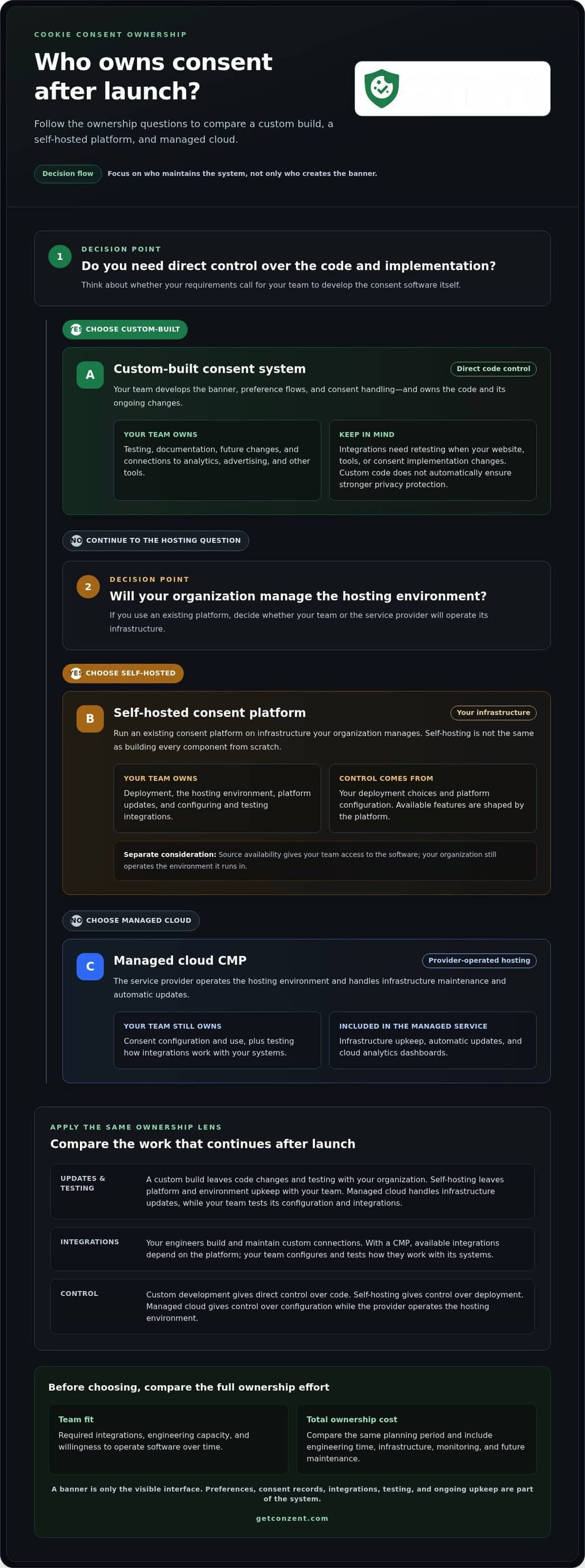
When does building cookie consent management make sense, and when does buying?
The best choice depends on what your team needs to control and what it can maintain. Buying a CMP doesn’t automatically mean surrendering control. A platform may offer configurable features, source availability, and deployment choices. The key distinction is between controlling the software itself and controlling how it’s configured, hosted, and connected to your site.
Use this decision matrix to make the trade-offs concrete:
- Engineering capacity: Build when your team can own development, testing, documentation, and ongoing changes. Buy when you want to use established platform capabilities instead of creating each component.
- Required integrations: Build when essential workflows need functionality that available configuration can’t support. Buy when the platform’s integration options match your technical requirements.
- Control needs: Custom code gives direct control over implementation. A source-available CMP and self-hosting can provide visibility into the software and control over deployment without requiring a full custom build.
- Maintenance appetite: Choose a custom build only if your team can sustain its upkeep. A managed service reduces platform operations; self-hosting leaves infrastructure operations with your team.
When is an in-house build a practical choice?
A custom build can fit an organization with distinctive consent workflows that standard platform configuration can’t address, plus the engineering capacity to maintain them beyond launch. For example, a team may need consent handling tightly integrated with internal systems in a way an off-the-shelf setup doesn’t support. That flexibility has a cost: your organization owns the code, testing, integrations, and future changes. Control isn’t cost-free.
When is a CMP or self-hosted platform a better fit?
A CMP is often a stronger fit when your needs align with established capabilities and integrations, and you want to limit how much platform software your team operates. Managed cloud suits teams seeking hosted operations, automatic updates, and cloud analytics. Self-hosting suits teams that prefer to run a platform on their own infrastructure and take responsibility for that environment. Explore self-hosted consent infrastructure to see how that deployment model works.
Conzent’s source-available platform offers both self-hosted and managed cloud deployment. Teams can choose between operating the infrastructure themselves and using a managed service, without treating custom development as the only path to control.
Technical fit and legal suitability are separate questions. A platform can support consent workflows, but it can’t determine whether your organization’s choices meet its legal requirements. Have qualified legal counsel review those requirements; use this comparison to assess your technical and operational fit.
If managed cloud fits your team’s needs, review the managed cloud pricing options.
Choose a cookie consent management model that fits your team
Turn your comparison into a decision your team can own. The build vs buy cookie consent management choice gets clearer when you define what the system must do, who will run it, and how much operational work your team can sustain. Use this sequence before committing to custom development, a self-hosted platform, or managed cloud.
A five-step decision process for your organization
- Document requirements. List the consent journeys your site needs, required integrations, reporting needs, and deployment preferences. Specify which systems must receive or act on consent choices.
- Map ownership. Assign responsibility for configuration, updates, infrastructure, integration testing, and ongoing review. A task without an owner is likely to become unplanned work.
- Compare full costs. Set a planning period and compare internal engineering and operational effort alongside platform fees and included services. Separate known costs from estimates.
- Test workflows and integrations. Check how the banner, preference flows, and connected systems behave together. Test relevant consent choices across the workflows your site uses.
- Select the deployment model. Choose custom development if your needs are genuinely distinctive and your team can maintain the software. Choose a platform when its capabilities fit and you want to avoid building every component yourself.
Compare Conzent’s self-hosted and managed cloud options
Conzent is a source-available consent platform with two deployment choices. With self-hosting, your organization runs the platform on its own infrastructure and manages that environment. With managed cloud, infrastructure maintenance and automatic updates are included, along with cloud analytics dashboards. The difference is operational, not a choice between custom software and a platform.
The platform includes customizable banners, consent A/B testing, revenue impact analytics, IAB TCF v2.3 integration, and Google Consent Mode v2. Use testing and analytics to evaluate your setup, not as promises of a particular business result. A platform can support consent workflows, but it doesn’t by itself determine whether your organization meets its legal requirements.
For more context, see the GDPR consent requirements overview. It’s informational, not legal advice; discuss your organization’s legal obligations with qualified counsel.
Once you’ve matched requirements and ownership to a deployment model, compare the available options. Compare Conzent plans for the self-hosted and managed cloud paths.
Choose the model your team can sustain
The build vs buy cookie consent management decision comes down to long-term ownership. A custom build can suit distinctive requirements when your team has the capacity to maintain it. A CMP provides established capabilities, while self-hosting and managed cloud offer different ways to divide control and operational work.
Compare total costs, not just development or subscription costs. Include the engineering, infrastructure, integrations, testing, and updates your team will own. Then check how each option handles your required workflows and reporting.
Conzent offers a source-available platform with self-hosted and managed cloud deployment. Its capabilities include customizable banners, A/B testing, revenue impact analytics, IAB TCF v2.3, and Google Consent Mode v2. Managed cloud includes infrastructure maintenance, automatic updates, and cloud analytics dashboards. These tools support consent operations, but they don’t guarantee legal compliance.
Ready to compare deployment paths? Compare Conzent plans and find an approach that fits your team’s needs and capacity. A sustainable choice gives your team a clear view of both control and responsibility.
Frequently Asked Questions
Is it cheaper to build or buy cookie consent management?
Neither option is always cheaper; compare the full cost over the same planning period. A custom build includes development, testing, infrastructure, integrations, monitoring, and ongoing maintenance. A CMP adds platform fees but may include hosting, updates, or analytics, depending on its service model. Include your team’s configuration and testing time too. The build vs buy cookie consent management decision should reflect total ownership costs, not just launch expenses.
Can a company build its own cookie consent management system?
Yes. A company can develop its own banner, preference flows, consent handling, and integrations. It also takes responsibility for the code, testing, documentation, and future changes. Before building, identify who will maintain the system after launch and how the team will respond when technical requirements or connected services change. Custom development can provide implementation control, but it doesn’t automatically make the system more privacy-protective or guarantee legal compliance.
What does a cookie consent management platform need to handle?
A platform should connect the choices people make with the systems that apply and record those choices. Assess how it presents consent options, stores preferences or consent records, and communicates those settings to relevant integrations. Consider whether your team can configure the experience and review how it behaves across your website. A banner alone isn’t the whole system; test the connected workflows that matter to your site.
How much ongoing work does a custom cookie consent system require?
There’s no fixed amount; it depends on the system’s scope, integrations, and how often those components change. Your team should plan for maintenance, testing, documentation, monitoring, and internal support, as well as updates to the code and integrations. Browser behavior and connected tools can also change. Estimate known work from your planned implementation, then record future effort as uncertain rather than assuming it will be negligible.
Does buying a CMP mean giving up control of consent data and configuration?
No, buying a CMP doesn’t automatically mean giving up all control. Teams can often configure consent experiences, and deployment choices affect who operates the infrastructure. A self-hosted platform runs on your own infrastructure; managed cloud shifts infrastructure operations to the service. Control over consent data depends on the platform’s architecture and service terms, so review those details alongside configuration and hosting responsibilities before choosing.
Is self-hosting a cookie consent platform the same as building one?
No. Building means developing and maintaining the consent software yourself. Self-hosting means deploying an existing platform on infrastructure your organization operates. A source-available platform can let your team inspect the software and choose its hosting environment without creating every component from scratch. Self-hosting still involves operational responsibility, including managing the environment and planning platform updates and integration testing.
Can a cookie consent platform guarantee GDPR compliance?
No. A consent platform can support consent workflows, but it can’t guarantee that an organization complies with GDPR. The outcome depends on how the platform is configured, how the website and integrations apply user choices, and the organization’s broader practices. Use the platform to support your technical processes, then have qualified legal counsel assess your organization’s obligations. Software functionality is not a substitute for legal review.