
Business case for a CMP: Which businesses may need one

A consent banner is only the visible part of consent management. The business case for a CMP is strongest for organizations that use cookies or other tracking technologies and need to present clear choices, respect them, and let people revisit them. A CMP helps manage this process, but it doesn’t replace a privacy review.
The rules depend on where people are and how their data is used. According to the European Union, GDPR consent must be freely given, specific, informed, and unambiguous, and people must be able to withdraw it as easily as they gave it. In the United States, the CCPA and CPRA require businesses to offer ways to opt out of the sale or sharing of personal data, or its use for targeted advertising or profiling.
This article explains what a CMP does, how privacy laws shape consent, and which business risks a well-managed consent process can address. It considers which organizations may benefit, from advertising-supported websites to companies serving audiences in multiple regions. The aim is a practical way to assess whether a CMP fits your operations, not a one-size-fits-all answer.
Key Takeaways
- A CMP helps manage consent choices and gives people a way to revisit or change them.
- Privacy requirements vary by jurisdiction, so consent processes should reflect the laws relevant to your audience and data use.
- Assess how tracking, advertising, and consent records affect your organization’s privacy and operational risks.
- Consider your website’s use of cookies, audience locations, and consent workflows when deciding whether a CMP fits.
- Measure value through practical outcomes such as consent management effort and revenue impact, rather than assuming a fixed payback period.
CMP definition and consent-management functions
A consent management platform (CMP) organizes how a website presents privacy choices and applies them to tracking technologies. Its value comes from connecting the choices people make with the website’s consent process.
CMP Functions and Purpose
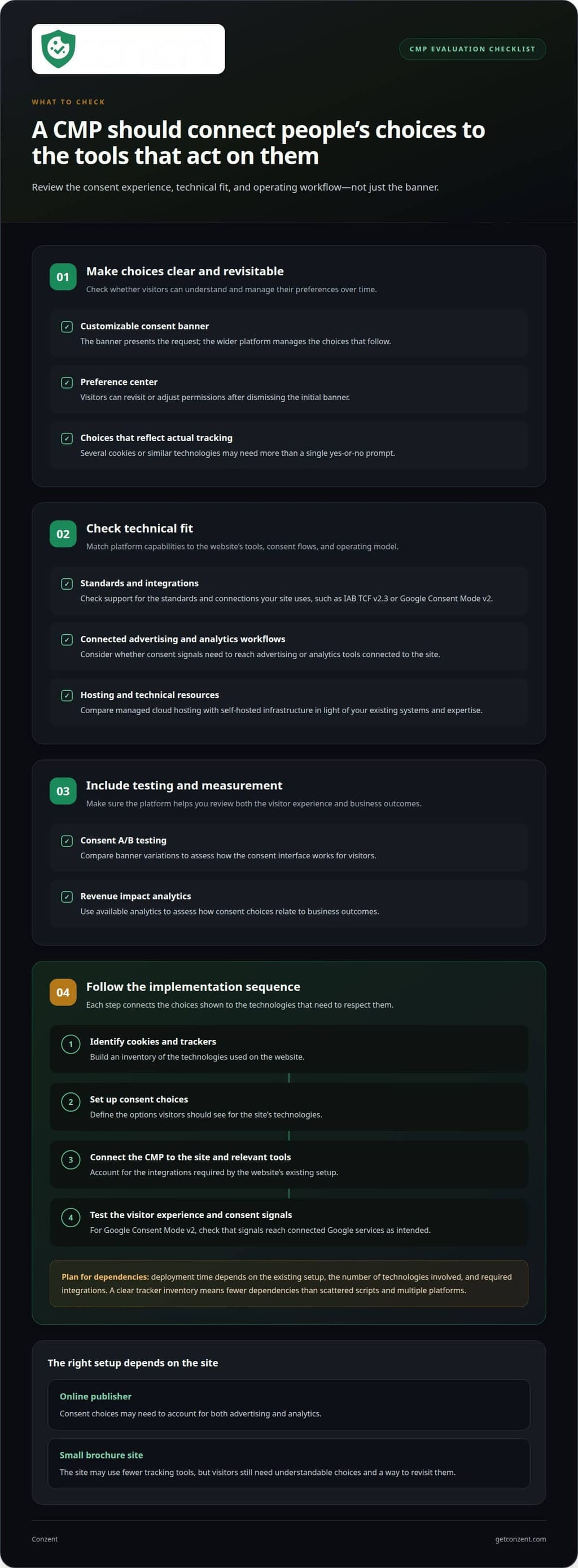
A CMP presents a consent interface, records a visitor’s choice, and provides a way to revisit or change it. For example, a preference center lets someone adjust permissions after dismissing the initial banner. This is useful when a website uses several cookies or similar technologies, since a single yes-or-no prompt may not reflect the choices the site needs to offer.
A CMP does more than display a banner: the banner presents the request, while the platform supports the wider process of managing choices. Compared with a manually maintained notice, a CMP can bring consent options and preference changes into a managed workflow. A spreadsheet can document internal decisions, but it cannot present choices to website visitors.
Evaluating CMP Features
Feature evaluation means checking whether a platform fits the website’s consent flows, technology stack, and operating model. Look for customizable banners, a preference center, and clear controls for changing choices. Then assess whether the CMP supports the standards and integrations the site uses, such as IAB TCF v2.3 or Google Consent Mode v2. Those connections can matter for advertising and analytics workflows.
Consider how the CMP handles testing and measurement, too. Consent A/B testing can compare banner variations, while revenue impact analytics can help assess how consent choices relate to business outcomes. Hosting also affects operations: a managed cloud platform and self-hosted infrastructure place different demands on an organization’s technical resources. The right approach depends on the systems and expertise already in place.
Implementation usually involves several connected steps: identify the website’s cookies and trackers, set up the consent choices, connect the CMP to the site and relevant tools, then test the visitor experience. For a site using Google Consent Mode v2, integration testing should include whether consent signals reach the connected Google services as intended. Deployment time depends on the site’s existing setup, the number of technologies involved, and the integrations required. A straightforward site with a clear tracker inventory has fewer dependencies than one with scattered scripts and multiple platforms.
For example, an online publisher may need consent choices that account for advertising and analytics, while a small brochure site may use fewer tracking tools. In either case, the CMP should make choices understandable and provide a way to revisit them. A preference center supports ongoing control, but it does not replace decisions about which technologies the site uses or how its consent process should work.
Privacy laws and consent requirements
Consent requirements depend on where a business operates, whom it serves, and how it uses personal information. A website serving people in several countries may need consent flows that reflect multiple legal frameworks. With privacy laws varying across regions, one identical notice may not suit every audience. Map the regions your site serves and the technologies that collect data before deciding which choices to present.
In the European Union, GDPR consent must be freely given, specific, informed, and unambiguous. People must also be able to withdraw consent as easily as they gave it. In practice, a visitor who can accept through a clear control should have a comparably clear way to withdraw or change that choice later. Hiding the withdrawal path undermines that balance.
In California, the CCPA and CPRA require businesses to offer users a way to opt out of the sale or sharing of personal data, or its use for targeted advertising or profiling. A consent interface may therefore need to provide an opt-out path, not just an acceptance choice. The right design depends on the business’s data practices and audience. Treating every interaction as a request for permission can overlook the distinct opt-out choices these laws describe.
Other frameworks add different considerations. Brazil’s LGPD and South Africa’s POPIA reflect a shift toward privacy by design, so privacy considerations belong in systems and workflows, not only in notices. PIPEDA is another law to consider when choosing a CMP. In Canada, consent forms may need to vary with the circumstances and type of information, and organizations must consider sensitivity, according to the Department of Justice Canada.
For a practical review, connect each data practice to the choice it requires. Distinguish analytics from targeted advertising, identify which regions receive each version of the notice, and record how visitors respond. Then test whether the site respects a changed choice across connected tools. If a preference changes in the interface but not in downstream systems, the processing no longer matches the choice presented.
Keep the process reviewable as your site, audience, or tracking changes. A new advertising tool, market, or data use can affect which choices the site should present. A CMP supports the consent workflow, but it does not determine which laws apply or replace legal analysis. If cost is part of your assessment, review the platform pricing structure alongside the operational fit.
Business risk and privacy compliance
Assess a CMP’s costs and benefits by comparing implementation and operating effort with the work it could streamline. Include setup, integrations, staff time, ongoing maintenance, and the value of clearer consent records.
Start by documenting the current process. Note how staff handle consent updates, investigate tracking issues, and prepare reports. Then estimate how a centralized workflow could change that work. Compare the same activities after implementation rather than assuming the platform will deliver a specific financial return.
A CMP can support privacy operations, but it doesn’t guarantee compliance or eliminate legal risk. Common implementation failures include an incomplete tracker inventory, unclear ownership, incorrect configuration, and testing only the banner instead of the full consent flow. A choice shown on screen must also be respected by the tools that use it.
Consider a site that adds an analytics tag without updating its consent setup. The banner may still appear, but the site’s behavior may no longer match the choices it presents. Assigning responsibility for tracker changes and testing them helps prevent this mismatch. Record what changed, who approved it, and how the updated flow behaved.
A risk review should cover both the interface and the systems behind it. A practical checklist includes:
- Choice clarity: Does each option describe the relevant data use in plain language?
- Choice application: Do connected tags respond to the visitor’s selection?
- Change handling: Can a later preference update reach the relevant tools?
- Operational ownership: Is someone responsible for reviewing new trackers and site changes?
- Reporting: Can the organization understand consent activity and investigate a reported issue?
These checks make the business case more grounded. A publisher using advertising and analytics tools, for instance, may need to coordinate several systems. A small site with few trackers may face less operational complexity. In either case, the value depends on the current process, the number of integrations, and the effort needed to keep settings accurate.
Include technical and organizational costs, not just the platform itself. A complex site may require more integration work, while unclear ownership can create continuing maintenance demands. Reviewing pricing information can be one part of assessing the platform’s financial fit, alongside those internal costs and expected workflow benefits.
Treat implementation as ongoing work, not a one-time banner launch. Test representative consent choices after configuration, repeat the tests when tracking changes, and use reporting to spot mismatches. This makes the CMP a maintained part of privacy operations, not just a visible screen.
Consider PIPEDA in Canada as part of your privacy-law review when choosing a CMP. A CMP can help organize consent operations, but the relevant law and the organization’s actual practices still need review. Keep other compliance work separate, too. Revisit your assessment when obligations, systems, or ownership change.
Businesses and organizations that may use a CMP
A CMP may suit an organization whose website uses tracking tools across teams, services, or digital properties. The business case is stronger when those tools need coordinated consent handling. For example, a group operating several regional websites may need a consistent process while preserving differences in each site’s setup. Operational complexity, not company size alone, is the key consideration.
Travel booking platforms can combine search tools, booking flows, maps, and marketing analytics, with different pages relying on different technologies. A CMP can help manage consent across these experiences, while teams document which tools appear at each stage of the booking journey.
Recruitment firms may run job listings, candidate portals, and employer-facing services. Separate teams can add analytics or campaign tools to different properties. A CMP can help coordinate consent workflows across those sites, particularly when several departments are responsible for website changes.
Franchise groups often let local operators manage their own pages while maintaining shared brand systems. This can lead to uneven tracking setups across locations. A CMP can support a more consistent approach when the group establishes clear ownership for local changes and shared settings.
Event organizers may use registration pages, session schedules, and attendee portals, with campaign pages relying on different tools from the main event site. Reviewing these properties together helps teams identify where consent workflows should match and where each site has distinct technical needs.
Signals that may support a business case for a CMP include:
- Several digital properties: Separate services or regions need coordinated oversight.
- Local publishing control: Distributed teams can change site tools independently.
- Different user journeys: Booking, registration, or application flows use distinct technologies.
- Shared technology ownership: Multiple departments manage scripts or analytics.
- Frequent campaigns: New landing pages can introduce tools outside the usual review process.
A CMP may add little value to an organization with one tightly controlled site and few tracking tools. A small professional practice with a basic online presence, for example, may already manage its technology through a simple, stable process. Base the decision on actual site operations, not an industry label.
To assess fit, document each digital property, the team responsible for it, and the tools used on key journeys. A regional travel company might map booking, destination, and account pages separately. This shows whether the current process can keep consent settings aligned as teams add or change tools.
What ROI and payback period can businesses expect from a CMP?
A CMP has no universal return on investment or fixed payback period. Results depend on implementation effort, ongoing operating costs, and measurable changes to workflows or revenue. Compare your current process with the expected process after deployment rather than assuming a guaranteed financial gain.
Start by defining the costs. Include the platform, setup, integration work, staff time, testing, and ongoing maintenance. A retailer, for example, may need to connect consent settings across its storefront, analytics, and advertising tools. The effort depends on the existing setup and how many systems need coordination.
Next, identify benefits you can observe and measure. A CMP may reduce repetitive manual work, make consent records easier to review, or help teams understand how consent choices relate to analytics and advertising activity. Pair each benefit with a measure your organization already tracks, such as staff hours spent handling preference updates or investigating inconsistent settings.
A simple model compares total costs with the value of measured benefits over a chosen period. Payback occurs when cumulative benefits equal or exceed initial and ongoing costs. If a publisher spends less staff time reconciling consent across advertising tools, include that saved effort. If revenue changes after banner adjustments, compare the result with a suitable baseline and account for other factors affecting performance.
Keep direct savings separate from operational or risk-related value. Estimate saved staff time using recorded work. Better visibility into consent activity can support investigations, but do not count it as avoided penalties or guaranteed legal protection. A CMP cannot ensure a particular financial outcome or replace legal analysis.
Useful measures include:
- Implementation effort: Track integration, configuration, and testing work.
- Ongoing workload: Record time spent maintaining settings and handling consent changes.
- Operational consistency: Monitor whether connected tools respond to recorded choices.
- Revenue indicators: Compare relevant advertising or analytics outcomes before and after changes.
- Total ownership cost: Include platform expenses and internal resources over the review period.
Establish a baseline before rollout. A subscription business, for example, can document its current staff workload and consent-related reporting process, then compare those measures after deployment. Keep the comparison focused: revenue may also change because of seasonality, campaign mix, or traffic sources. Record those factors rather than attributing every change to the CMP.
To assess the financial fit for your organization, review platform pricing information alongside implementation effort and expected operating changes. A sound business case rests on costs and benefits your team can explain, measure, and revisit as its website evolves.
Conzent
Conzent helps organizations turn consent requirements into a practical website workflow. Its managed cloud and self-hosted options support different operational needs, while consent testing and revenue impact analytics help teams assess how their consent experience performs. These tools can support the business case when a website needs a more consistent way to manage choices and understand their effects.
Conzent can suit teams that want to manage consent without piecing together a process from separate tools. The platform supports privacy operations, but it doesn’t replace legal advice or determine which requirements apply to your organization. The right fit depends on your site, tracking setup, and internal resources.
To discuss your consent-management needs, contact Conzent.
Make consent part of your next planning cycle
Consent management works best as ongoing digital infrastructure, not a banner added once and forgotten. As your site changes, include consent reviews in the same planning conversations as analytics, advertising, and new features. This keeps privacy choices connected to how the website actually operates.
A business case for a CMP becomes actionable when it sets a clear purpose for the investment and explains how the organization will assess its fit. Assign ownership, choose practical measures, and revisit them as your website and operations evolve. The goal is a consent process that remains understandable and manageable as your needs change.
Conzent offers a Managed Cloud Consent Platform and Self-Hosted Open Consent Infrastructure, along with Consent A/B Testing. These options give organizations different ways to manage consent and evaluate changes to the consent experience.
Explore Conzent’s pricing options as you plan your next step. A thoughtful evaluation can help you build a consent process that serves both your organization and the people who use your site.
Frequently Asked Questions
What is a CMP in a business context, and what problems does it solve?
A consent management platform helps a business handle website visitors’ privacy choices across its digital tools. If a marketing team adds an analytics tag, for example, the CMP can help keep the consent experience aligned with the site’s tracking setup. It can address fragmented workflows, such as separate teams managing different banners or preference settings. It supports consent operations, but it doesn’t decide which laws apply to a business.
What are the main business benefits of implementing a CMP?
A CMP can give teams a more consistent way to manage consent workflows and evaluate their effects. A publisher, for example, can test different banner wording, compare how each version performs, and use revenue impact analytics to examine related business outcomes. This helps teams make decisions based on observed results rather than assumptions. The practical benefit depends on the site’s tools, existing workflow, and how the organization measures performance.
What privacy laws and compliance requirements affect CMPs in the United States?
In the United States, requirements depend on the laws that apply to a business and its data practices. The California Consumer Privacy Act (CCPA) and California Privacy Rights Act (CPRA) require businesses to offer opt-outs from the sale or sharing of personal data, or its use for targeted advertising or profiling. A CMP can help present and apply those choices. It doesn’t determine whether a law applies to your business.