
CMP for Programmatic Ads: 2026 Guide to Compliant Ad Ops

In programmatic advertising, a CMP is not just a banner; it is the infrastructure that validates your right to monetize. If your CMP for programmatic advertising fails to transmit a valid TC string, your premium inventory effectively vanishes from high-value DSPs. You've likely seen revenue drop as opt-in rates fall or felt the technical weight of TCF v2.3 and Google Consent Mode v2 slowing down your site. It's a common struggle to balance privacy rights with the mechanical realities of the bidstream.
We believe that technical complexity shouldn't be a barrier to digital rights or profit. This guide provides the roadmap to master the intersection of privacy compliance and real-time bidding to protect your revenue and user trust. We'll cover the mandatory February 28, 2026, deadline for TCF v2.3 and the logic behind the new disclosedVendors segment. You'll learn how to achieve high consent string transmission rates and ensure seamless integration with your SSP partners. It's time to stop reacting to regulations and start owning your privacy infrastructure.
Key Takeaways
- Understand how a CMP for programmatic advertising acts as the essential technical bridge between user privacy choices and the OpenRTB ecosystem.
- Prepare for the mandatory February 28, 2026, deadline for IAB TCF v2.3 to avoid invalid TC strings and lost revenue.
- Compare the transparency of Managed Cloud and Self-Hosted infrastructure against traditional "black box" SaaS models that gate your data.
- Use Revenue Impact Analytics and A/B testing to optimize banner performance and recover ad revenue lost to low opt-in rates.
- Discover how shifting to Open Consent Infrastructure (OCI) turns privacy compliance from a cost center into a performance lever.
The Role of a CMP in the 2026 Programmatic Ecosystem
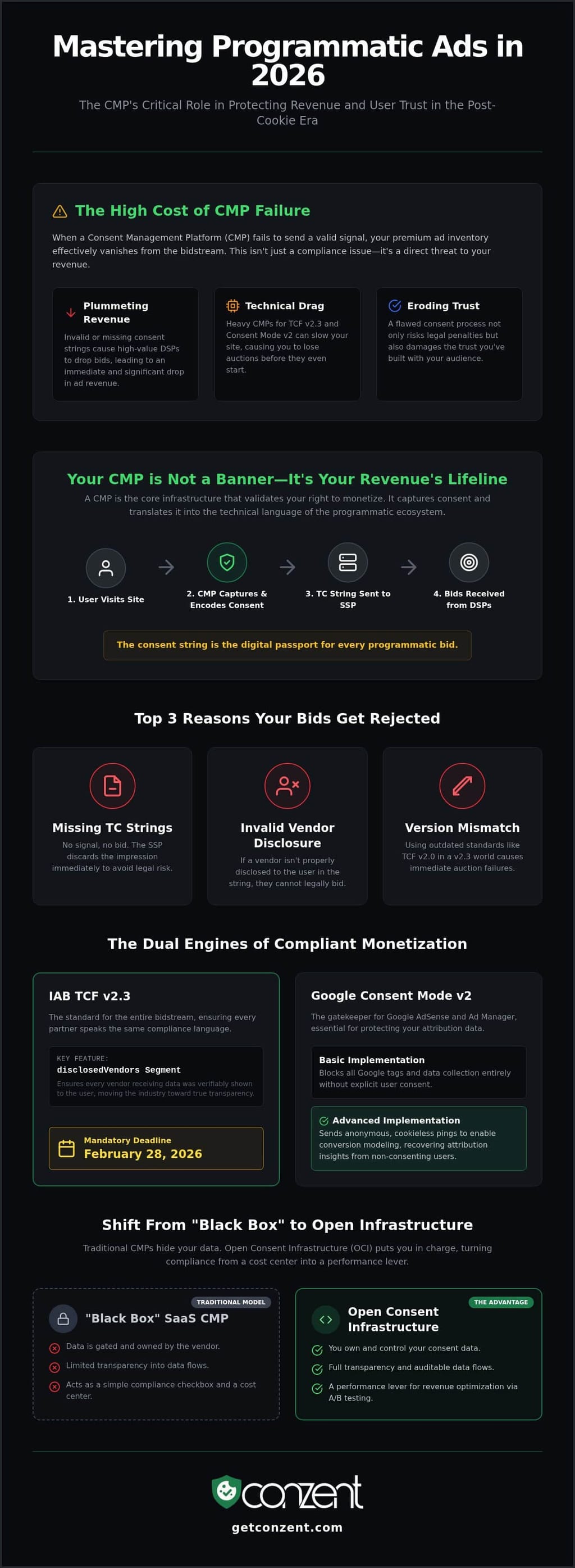
A Consent Management Platform (CMP) is the technical bridge between user choice and the ad tech stack. It is not a cosmetic addition. It is a functional necessity. The CMP captures granular user preferences and encodes them into a standardized string for the OpenRTB ecosystem. This string tells every vendor in the chain exactly what they can and cannot do with user data. Without this signal, Supply-Side Platforms (SSPs) often drop bids immediately to avoid legal risk. As third-party cookies continue to vanish, the ability to signal consent is the only way to maintain addressability. In 2026, a robust CMP for programmatic advertising is your primary defense against total identity loss.
Consent Management vs. Creative Management
The ad tech industry uses the "CMP" acronym for two distinct technologies. Creative Management Platforms focus on the production and scaling of ad visuals. Consent Management Platforms focus on the legality and transmission of data permissions. Programmatic advertisers specifically require a consent-focused platform to maintain access to premium demand. We have moved past the era of simple "cookie banners" that merely record a click. We have entered the era of consent infrastructure. A banner is a decorative element. Infrastructure is the underlying logic that powers your revenue and protects user rights. Infrastructure is about ownership. It means you control the data flow rather than renting a black box from a vendor.
How the CMP Interacts with SSPs and DSPs
The interaction between your CMP and the bidding chain occurs in milliseconds. When a user lands on your page, the CMP fires to check for an existing consent state or request a new one. Once captured, this data is formatted into a TC string. This string is passed to the SSP and included in the bid request sent to thousands of DSPs. This process must be lightweight. If your CMP script is too heavy, the bid request arrives late, and you lose the auction anyway. If this signal is missing or invalid, it becomes the leading cause of unfilled ad impressions. Demand-Side Platforms (DSPs) ignore traffic that lacks a verifiable legal signal to protect their own compliance.
The consent string serves as the digital passport for every programmatic bid.
Common reasons for bid rejection include:
- Missing TC Strings: No signal means the bid is discarded.
- Invalid Vendor Disclosure: If a vendor isn't in the string, they cannot bid.
- Version Mismatch: Using outdated standards like TCF v2.0 in a v2.3 world causes immediate failures.
By treating your CMP as a core piece of your ad ops stack, you ensure that every impression has the legal authority to be sold at its full value. You aren't just checking a compliance box. You are protecting your bid density.
Technical Standards: IAB TCF v2.3 and Google Consent Mode v2
Standards are the rules of the road. In 2026, IAB TCF v2.3 and Google Consent Mode v2 are the dual engines of compliant monetization. They are not interchangeable. They are complementary. A modern CMP for programmatic advertising must synchronize these protocols perfectly. If they drift, your attribution breaks. If they fail, your revenue stops. Using a non-certified CMP is no longer a viable shortcut. It is a technical liability that will lead to blocked ad requests in the EEA and UK.
IAB TCF v2.3: The Publisher Advantage
The IAB Europe Transparency & Consent Framework provides the standardized language for the entire bidstream. The jump to v2.3 introduced the mandatory disclosedVendors segment. This ensures that every vendor receiving data was actually shown to the user. It moves the industry toward verifiable consent. For publishers, this version offers a clear IAB TCF 2.3 Compliance Guide for managing "legitimate interest" processing. It allows for data use in specific scenarios without an explicit opt-in, provided the legal requirements are met and documented. This framework is a necessity, not a premium feature.
Google Consent Mode v2: Protecting Your Attribution
Google Consent Mode v2 is the gatekeeper for Google AdSense and Ad Manager. It uses two key parameters: ad_user_data and ad_personalization. You have two choices for implementation. Basic implementation blocks all data collection without consent. Advanced implementation is more sophisticated. It sends anonymous, cookieless pings to Google. This allows for conversion modeling to fill the gaps left by non-consenting users. Without this modeling, your attribution data becomes a fragmented mess. Common debugging steps include checking for "consent_default" tags firing before the CMP script and verifying that "ad_storage" signals are correctly mapped to user choices.
Certification is a hard requirement. By February 28, 2026, any TC string not in the v2.3 format will be considered invalid. This isn't just about avoiding fines. It's about maintaining the technical right to bid. If your infrastructure isn't certified by both Google and the IAB, your ad requests will default to "Limited Ads." These don't use cookies for personalization and significantly reduce your yield. You can find a model that fits your scale by checking transparent pricing options for certified infrastructure.
Infrastructure Choices: Self-Hosted vs. Managed Cloud CMPs
Choosing a CMP for programmatic advertising is a decision about ownership. Most traditional SaaS vendors operate as black boxes. They own your data. They charge you for every pageview. They gatekeep the very signals you need to monetize. This model is extractive. It treats compliance as a tax rather than a standard. You must evaluate your infrastructure based on three pillars: latency, data ownership, and total cost of ownership (TCO). In 2026, the choice between managed cloud and self-hosting defines your operational independence and your ability to scale without permission.
The Case for Managed Cloud Consent
Managed cloud infrastructure offers the speed of traditional SaaS without the lack of transparency. It provides zero-maintenance compliance. The cloud provider handles the technical heavy lifting of automatic IAB TCF and Google Consent Mode updates. Performance is the primary metric here. Lightweight, cloud-hosted scripts often outperform local implementations on Core Web Vitals. Speed is not a luxury. A slow-loading banner kills the bid request before it even starts. Conzent uses an egalitarian pricing model. We don't believe in predatory per-pageview fees that punish growth. Instead, we offer a mission-driven approach where sponsorships lower costs for everyone. It is about technical efficiency, not corporate extraction.
Self-Hosting for Maximum Sovereignty
Enterprises with strict security requirements often require ultimate data sovereignty. This is where the Open Consent Infrastructure (OCI) becomes essential. Self-hosting means you keep consent data within your own cloud perimeter. You don't send user signals to a third-party server to be processed. This eliminates a significant point of failure and a potential privacy leak. You gain full control over the database. You own the audit trail. For organizations that view data as a core asset, Self-Hosting Your CMP Infrastructure is the only way to ensure privacy is a public good rather than a paywalled luxury.
The choice between these two models depends on your internal resources. Managed cloud is built for speed and ease. Self-hosting is built for control and security. Both options provide a path away from the black-box vendors that have dominated the market for too long. You should not have to choose between compliance and performance. Whether you manage it in our cloud or yours, the infrastructure should be transparent, lightweight, and entirely under your direction. Stop renting your compliance. Start building your foundation.
Revenue Recovery: Optimizing for High-Stakes Ad Ops
Compliance is not a revenue killer. It is a performance lever. If your CMP for programmatic advertising is treated as a simple legal checkbox, you are leaving money on the table. Optimization is the process of reclaiming the bid density lost to friction, technical latency, and poor user experience. In high-stakes ad ops, every percentage point of opt-in growth translates directly to your bottom line. You aren't just following rules. You are protecting your yield and ensuring that your inventory remains accessible to premium demand.
A/B Testing Consent UI for Better Opt-Ins
Design influences behavior. The visual hierarchy of your consent banner determines whether a user engages or bounces. You can refine colors, button placement, and micro-copy to find the layout that resonates best with your specific audience. This optimization must occur without resorting to "dark patterns" that deceive users. Ethical design is a requirement for long-term trust. It is about clarity, not trickery.
The technical balance between "Accept All" and "Manage Preferences" is critical for programmatic bidding. If your interface is too complex, users will abandon the site. This results in a bounce that provides zero monetization value. By utilizing Cookie Consent A/B Testing Features, you can test different UI patterns to find the one that maximizes consent without sacrificing site performance. Industry professionals often observe significant improvements in opt-in rates after moving away from generic, non-optimized templates. Testing allows you to make data-driven decisions rather than relying on aesthetic guesses.
Analytics: Connecting Consent to the Bottom Line
You cannot optimize what you do not measure. Most publishers track total revenue but fail to calculate the specific financial cost of non-consent. You need to visualize the drop-off point. You must identify exactly where bid opportunities are vanishing in the journey from page load to bid request. Transparency in your data infrastructure is the only way to see the full picture of your programmatic health.
Revenue impact analytics turn a legal necessity into a strategic business case. This data allows you to justify infrastructure spend to stakeholders with concrete evidence. Conzent tracks the delta between consenting and non-consenting user revenue to provide a transparent view of your actual ROI. It reveals the true impact of consent signals on your CPMs and fill rates. This level of detail helps you identify if a specific SSP is dropping bids due to signal issues or if your banner placement is driving away high-value users. To see how these analytics can transform your ad ops strategy, explore our transparent pricing options today.
Conzent: Transparent Infrastructure for Programmatic Growth
Conzent is not just another vendor. We are a mission-driven infrastructure provider. Our Open Consent Infrastructure (OCI) ensures that privacy is a public good rather than a paywalled luxury. We believe in transparency over extraction. When you choose a CMP for programmatic advertising, you shouldn't have to compromise on your values or your site performance. Our Managed Cloud services offer enterprise-grade reliability for high-traffic publishers who need speed without the overhead of self-management. We operate on a principled pricing model. As our community of sponsors grows, we lower costs for everyone. This is egalitarian infrastructure built for a healthier digital ecosystem.
Why Ad Tech Professionals Choose Conzent
Ad ops teams prioritize speed and accuracy. Our lightweight scripts ensure you won’t tank your programmatic auction latency. A delayed bid request is a lost bid. We offer native integrations with major platforms like WordPress, Drupal, and Shopify to simplify deployment across your entire portfolio. You don't need a custom build to get custom-level performance. Our support team actually understands the IAB TCF v2.3 technical spec. We don't read from a generic script. We provide technical expertise that helps you solve real-world bidding issues and maintain your addressability.
Getting Started: From Audit to Implementation
Moving to a more transparent model is a streamlined process. It starts with a clear assessment of your current stack to identify gaps in your consent signals. We help you move from a restrictive "black box" to an open standard that respects both your users and your bottom line.
- Step 1: Audit your current vendor list against TCF v2.3 standards. Ensure every partner is disclosed correctly to maintain your legal right to bid and avoid "Limited Ads" status.
- Step 2: Deploy the Conzent managed cloud script in minutes to finalize your CMP for programmatic advertising setup. Our infrastructure handles the complexity of signal transmission while you focus on growth.
The transition to open infrastructure is the most significant performance lever available in 2026. It is about technical efficiency, not corporate extraction. Stop renting your compliance from vendors who hide behind complexity. Start owning your future with a platform designed for the open web. View Pricing and Sponsorship Options to join a community that values digital rights and technical excellence.
Future-Proofing Your Ad Operations
The landscape of 2026 demands more than a passive response to privacy regulations. Your CMP for programmatic advertising is the technical foundation that ensures your inventory remains liquid and user trust remains intact. We have moved past the era of black-box vendors. You now have the choice between managed cloud efficiency and the total sovereignty of self-hosted infrastructure. By prioritizing IAB TCF v2.3 certification and Google Consent Mode v2 integration, you aren't just avoiding penalties. You are optimizing bid density and reclaiming revenue through transparent analytics.
We invite you to join a community that views privacy as a public good. Conzent provides IAB TCF v2.3 Certified, source-available infrastructure backed by Danish privacy expertise. This isn't a paywalled luxury. It's a necessary standard for a fair and functional open web. You can secure your ad ops future without sacrificing performance or ownership. Deploy Your Managed Cloud CMP with Conzent today. Take control of your data flow and build a resilient foundation for growth.
Frequently Asked Questions
What is the difference between a CMP and a cookie banner?
A cookie banner is a visual interface; a CMP is the underlying technical infrastructure. While a banner merely collects a click, a CMP for programmatic advertising encodes that choice into a standardized string. This string communicates permissions to the entire ad tech stack. Without the CMP logic, a banner is just a decorative element that fails to transmit the legal signals required by SSPs and DSPs.
Is a CMP required for programmatic advertising in the US?
While there is no single federal mandate, state laws like the CCPA and CPRA make a CMP a practical necessity. Most major ad exchanges and demand partners now require standardized signals to process bids for users in regulated states. Using a CMP ensures you don't lose access to premium demand from advertisers who prioritize legal safety and verifiable consent in the American market.
How does a CMP affect my website’s loading speed?
The impact depends entirely on script weight and execution logic. Heavy, legacy scripts can increase latency and damage Core Web Vitals, which often delays bid requests. Conzent uses lightweight scripts designed for speed. By choosing managed cloud infrastructure or self-hosting, you minimize the execution time of the consent logic. This ensures your privacy foundation doesn't become a bottleneck for your programmatic auction.
Can I use a free CMP for IAB TCF v2.3 compliance?
Free tiers often lack the mandatory certifications required for IAB TCF v2.3 or Google Consent Mode v2. Many free plans also cap traffic at low levels, such as 1,000 to 10,000 monthly sessions. For programmatic growth, you need a certified platform that doesn't gate essential features or penalize you for increasing your traffic. Compliance should be a standard, not a paywalled luxury.
What happens to my ad revenue if a user denies consent?
Revenue typically decreases as inventory defaults to "Limited Ads" which lack personalization. This results in lower CPMs. However, implementing Google Consent Mode v2 allows for conversion modeling through cookieless pings. This recovers data gaps for your attribution and bidding. A robust CMP for programmatic advertising helps you maintain the highest possible yield even when users choose to opt out of tracking.
Does Conzent support Google Consent Mode v2?
Yes, Conzent is fully integrated with Google Consent Mode v2. We support both Basic and Advanced implementation methods. Our infrastructure correctly maps user choices to the ad_user_data and ad_personalization parameters. This ensures you meet Google's mandatory requirements for EEA and UK traffic. It allows you to maintain critical remarketing and auto-bidding capabilities without compromising on transparency or user rights.
Can I self-host Conzent on my own AWS or Azure infrastructure?
You can self-host using our Open Consent Infrastructure (OCI). This model provides ultimate data sovereignty by keeping user signals within your own cloud perimeter. It eliminates the need to send sensitive data to a third-party vendor for processing. This is an ideal solution for enterprises that view privacy as a core component of their own security stack rather than an outsourced service.
How often does Conzent update its TCF vendor list?
Updates occur automatically in real-time. As the IAB Europe Global Vendor List changes, our infrastructure syncs the data to ensure your disclosed vendors are always accurate. This is critical for TCF v2.3 compliance, where the disclosedVendors segment must be verifiable. You don't have to manually track vendor changes; the system maintains the technical integrity of your consent strings for you.