
Consent Banner A/B Testing: Improve Decisions Without Manipulating Visitors
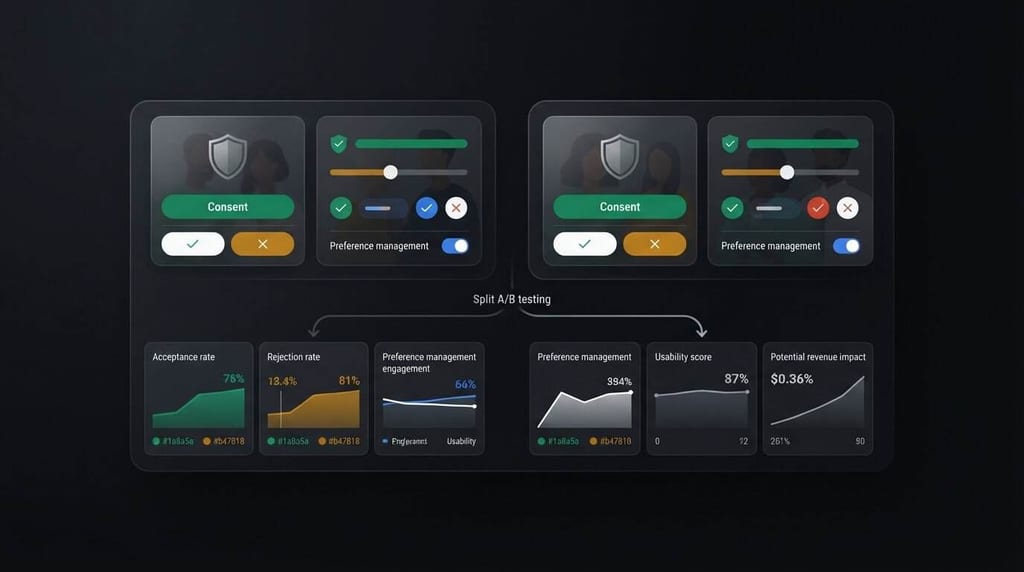
What if the best consent banner test isn’t the one that gets more people to accept? Consent banner A/B testing should help visitors understand their choices, not pressure them toward a preferred answer. To choose what to test and interpret consent rates alongside revenue, measure more than clicks.
Start with a clear question: does a simpler explanation, clearer button label, or more accessible layout help people make an informed choice? Both versions should present the available options fairly. A higher acceptance rate alone doesn’t show that a banner is clearer or better.
This guide covers how to form a testable hypothesis, choose meaningful measures, and interpret consent patterns alongside revenue without confusing correlation with cause. It also explains how to avoid experiments that skew results or obscure visitor choices. Conzent combines consent A/B testing with revenue impact analytics, helping teams review banner performance alongside privacy-focused user experience. The goal is better evidence, clearer choices, and decisions you can explain.
Key Takeaways
- Set a clear hypothesis about visitor understanding, not just whether more people accept.
- Compare one meaningful design change at a time to make results easier to interpret.
- Review acceptance, rejection, and preference-management interactions together.
- Check usability and technical behavior alongside business outcomes before deciding what a result means.
- Document the test question, measures, findings, and next decision to guide improvements.
Consent Banner A/B Testing: What It Can Improve, and What It Must Not Change
Consent banner A/B testing compares banner versions to learn how a design change affects visitor understanding and behavior. You might test clearer wording, a different information order, a revised layout, or how easy it is to see preference controls. The aim is to find which version helps people make informed choices, not simply which one produces more acceptance.
A higher acceptance rate, by itself, doesn’t show that a banner is clearer, easier to use, or more trustworthy. It could reflect a design that makes one choice easier to notice than another. Responsible testing looks at how visitors use the available options and whether the banner explains them clearly. A/B testing provides the general method: compare versions under controlled conditions, then assess the result against a defined question.
Responsible consent testing improves the path to an informed choice. It doesn’t optimize acceptance at any cost.
What does a consent banner experiment actually test?
A useful experiment compares the current banner with a deliberately changed version. Start with a specific visitor problem, such as people overlooking preference controls or struggling to understand a button. Then test one main change, such as replacing vague button wording with a direct label. Keeping the other elements stable makes it easier to interpret any difference. Conzent’s consent banner A/B testing supports this structured comparison.
Which parts of the visitor experience should remain protected?
In every version, keep the available consent choices understandable and visible. Don’t make acceptance the only obvious action or add extra friction to rejecting or adjusting preferences. Preserve the information visitors need to distinguish their options, even when testing copy or layout. A test can show how a design performed, but it can’t establish that the design meets every requirement in every context. Legal review remains specific to the circumstances and isn’t replaced by an experiment.
That boundary helps define what belongs in a test. Improve clarity, hierarchy, and access to controls. Don’t remove meaningful information or make a choice harder to exercise just to shift the acceptance rate. If a variant raises acceptance but makes rejection less visible, that isn’t evidence of a better consent experience. Reassess the design and the measures used to judge it.
How to Design a Consent Banner A/B Test You Can Interpret
A useful consent banner A/B testing plan begins with a visitor problem, not a preferred outcome. If people seem unsure what a control does, test whether clearer wording helps them understand and use it. Replace “How can we raise acceptance?” with a question the result can answer without making any choice harder to find.
Choose a hypothesis and one banner change
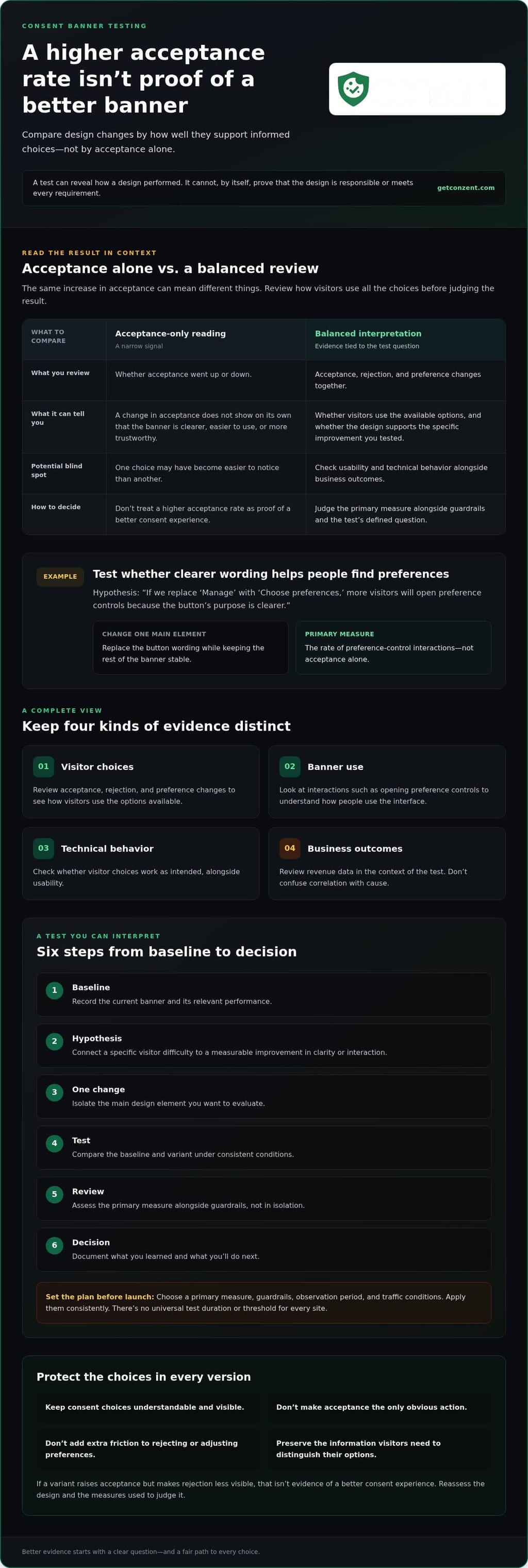
Use an observed point of friction to form a measurable hypothesis. For example: “If we replace ‘Manage’ with ‘Choose preferences,’ more visitors will open preference controls because the button’s purpose is clearer.” Measure the rate of preference-control interactions, not acceptance alone. Where practical, change one main element, such as button wording, while keeping the rest of the banner stable. Conzent’s consent A/B testing supports structured comparisons.
Set the comparison and measurement plan
Keep the current design as the baseline and record exactly what the variant changes. Before launch, choose a primary measure tied to your hypothesis and guardrails that can reveal trade-offs, such as whether visitors continue to use the other controls. Set the observation period and traffic conditions in advance, then apply them consistently. There’s no universal test duration or threshold for every site.
Use this sequence to keep the experiment interpretable:
- Baseline: Record the current banner and its relevant performance.
- Hypothesis: Connect a specific visitor difficulty to a measurable improvement in clarity or interaction.
- One change: Isolate the main design element you want to evaluate.
- Test: Compare the baseline and variant under consistent conditions.
- Review: Assess the primary measure alongside guardrails, not in isolation.
- Decision: Document what you learned and what you’ll do next.
Record the test context, exclusions, dates, and any implementation changes. These details help you interpret results if traffic conditions shift or another site change overlaps with the experiment. A result is evidence about a specific setup, not a universal rule about visitor preferences. Ethical design matters too: the discussion of the ethical terrain of online social experiments is a reminder that a measurable outcome doesn’t, by itself, make an experiment responsible.
Conzent’s pricing details for its consent platform can help teams assess how to put a testing workflow into practice.
Which Consent and Revenue Metrics Belong in the Analysis?
A sound analysis keeps four kinds of evidence distinct: what visitors choose, how they use the banner, whether their choices work as intended, and what happens to business outcomes. In consent banner A/B testing, no single rate tells the whole story. Interpret acceptance alongside rejection and preference-management activity, then review technical and revenue data in the context of the test.
| Metric group | What to review | What it helps explain |
|---|---|---|
| Consent behavior | Acceptance, rejection, and preference changes | How visitors use the choices available |
| Usability signals | Preference-panel opens, completion, or abandonment | Whether people can find and use controls |
| Technical checks | Whether recorded choices reach relevant systems | Whether the experience works beyond the banner |
| Business outcomes | Revenue and other selected business measures | What changed commercially during the test |
Read consent behavior without reducing it to one rate
Acceptance alone can conceal important differences. If it rises while rejection and preference changes fall, investigate the pattern rather than labeling it an automatic win. Review the full mix of choices and interactions using the same event definitions and reporting window for each variant. The consent categories shown and the implementation context can also affect comparisons, so record those details before interpreting a shift.
Connect revenue signals to consent data carefully
Keep consent events, technical signals, and revenue outcomes as separate measures. A revenue change during a banner test is an observation, not proof that the banner caused it. Traffic mix, campaigns, seasonality, or concurrent site changes may also affect results. Before drawing conclusions, check whether those conditions differed between variants or changed during the observation period.
Conzent’s revenue impact analytics help teams review commercial outcomes alongside consent patterns. Use the analysis to identify associations and questions for further investigation, not to assume a particular banner design will raise revenue. A careful report states what moved, what stayed stable, and what other explanations remain plausible.
Consent Banner A/B Testing Examples: Improve Clarity Without Dark Patterns
Good consent banner A/B testing addresses a real point of confusion while keeping every meaningful option easy to find. Treat the results below as clues about usability, not proof that one design is universally better. For each test, define the visitor problem, isolate the change, and decide in advance which interaction would help answer the question.
Test clearer wording and information hierarchy
- Unclear copy: Visitors may not understand what a button does. Compare a short, direct explanation with the current wording while preserving its essential meaning. Measure clicks on the relevant control and review visitor feedback where available. More use may suggest clearer wording, but check that other choices remain visible and understandable.
- Hard-to-scan information: Visitors may miss how to manage preferences. Keep the same information, but move the explanation of available choices closer to the controls. Measure preference-panel opens and task completion. More completed preference changes may indicate that visitors found the controls more easily, but won’t show which choice they preferred.
Test preference controls and return visits
- Controls are easy to overlook: Make the preference link or button more visible without giving it greater prominence than other choices. Measure how often visitors open and use preference settings. Increased interaction can signal better discoverability, provided refusal and acceptance remain similarly easy to access.
- Returning visitors can’t find settings: Test a clearer route for revisiting and changing consent choices. Measure successful preference updates on return visits. If visitors find the controls but don’t complete a change, investigate the steps or wording rather than removing options.
Reject variants that hide refusal, delay access to preferences, or make one choice visually dominant. Those changes test pressure, not clarity. A higher acceptance rate after making rejection harder to see isn’t evidence of a better experience.
Design review needs context. Requirements can vary by jurisdiction and implementation, so consider the relevant circumstances when assessing a variant. Conzent’s GDPR compliance information can inform that review, but experiment results alone don’t establish legal compliance.
Use your findings to improve wording, information order, and control visibility while protecting visitor choice. To explore Conzent’s consent platform, review platform pricing.
Turn Test Results Into Better Consent Decisions With Conzent
A test is useful when the team can explain what it asked, what changed, and what the result supports. Keep a short record for each experiment: the visitor problem, hypothesis, baseline, variant, primary measure, guardrails, test conditions, and outcome. Then record the next decision: adopt the variant, revise it, or retire it.
Build a repeatable review process after each experiment
Review the result against the original hypothesis, not just the most favorable metric. For example, a variant may lead more visitors to open preference controls without changing the balance of acceptance and rejection. That could support keeping the clearer control. If the result is mixed, document what remains uncertain and what you would test next. One experiment offers evidence about its specific setup, not a universal answer.
Include implementation changes and relevant test conditions in the record. If another site update overlapped with the experiment, note it. This context helps the team interpret the result later and prevents a correlation from being presented as proof of cause.
Use consent testing and analytics in one workflow
Conzent combines consent A/B testing with revenue impact analytics, so teams can review banner experiments alongside consent-related business outcomes. The analytics can show what changed during a test, but they don’t promise that a particular banner will increase revenue. Treat revenue movement as one part of the evidence, alongside visitor choices, usability signals, and technical checks.
The broader consent workflow also supports IAB TCF v2.3 integration and Google Consent Mode v2. These capabilities complement experimentation by helping teams consider banner design and how consent choices connect with related systems. Explore Conzent’s A/B testing capabilities as part of a repeatable test-and-review process.
Keep decisions grounded: preserve meaningful choices, state what the data shows, and explain what it cannot prove. To compare options for putting this workflow into practice, review Conzent plans.
Make Your Next Consent Test More Meaningful
Good consent banner A/B testing starts with a clear visitor problem and a hypothesis you can evaluate. Change one main design element, then assess usability and technical checks alongside acceptance, rejection, and preference-management activity. A higher acceptance rate alone doesn’t show that visitors understood their choices.
Interpret revenue movement carefully, too. It can coincide with a banner change without proving the banner caused it. Document the test conditions, results, and remaining questions before deciding whether to adopt, revise, or retire a variant.
Conzent brings consent A/B testing and revenue impact analytics together, with support for IAB TCF v2.3 integration and Google Consent Mode v2. Choose managed cloud or self-hosted use to fit your setup. Review Conzent plans to see how the platform can support your testing and analysis.
Frequently Asked Questions
What is consent banner A/B testing?
Consent banner A/B testing compares two banner versions to see how a design change affects visitor choices or interactions. One version might use clearer button labels while the other keeps the current wording. Measure whether visitors find and use preference controls more easily. A higher acceptance rate alone doesn’t show that a banner is clearer or better. The goal is to learn while preserving meaningful choices in both versions.
Is it legal to A/B test a cookie consent banner?
It can be, provided the test versions follow the requirements that apply to your site and visitors. Keep consent options clear and accessible in every variant, and don’t hide or disadvantage rejection or preference controls to raise acceptance. Legal requirements vary by jurisdiction and context, so an experiment can’t establish compliance on its own. Treat legal review as a separate, context-specific step before launching or adopting a design.
Which consent banner elements can I A/B test?
You can test explanatory wording, information order, layout, button labels, and the visibility of preference controls. Where practical, change one main element at a time so you can interpret what may have influenced the result. Keep essential information and meaningful choices available in both versions. For example, test whether a direct label helps visitors find preferences, then measure preference-panel interactions rather than acceptance alone.
How do I measure whether a consent banner test worked?
Start with a hypothesis and choose a primary measure that matches it. If you’re testing clearer preference wording, track preference-panel opens or completed changes. Also review acceptance, rejection, usability signals, and technical checks as guardrails. Use the same event definitions and reporting window for both variants. A test worked only in relation to its stated goal; one favorable metric doesn’t prove the banner improved the overall visitor experience.
Can A/B testing increase cookie consent rates?
It may change consent rates, but an increase shouldn’t be the sole measure of success. Clearer explanations could help visitors understand their options, while a design that makes rejection harder could also raise acceptance without improving the experience. Compare acceptance with rejection and preference-management activity. The stronger result helps visitors make informed choices, not simply produce more consent clicks.
How long should a consent banner A/B test run?
There’s no single test duration that fits every site. Set the observation period before launch and apply it consistently to both variants. Consider whether the test captures the traffic and visitor behavior relevant to your question, and record unusual conditions such as concurrent site changes. Avoid stopping as soon as one version appears ahead. Review the result against the hypothesis, guardrail measures, and test context.
Can consent banner testing affect ad revenue measurement?
Yes. Changes in consent choices can coincide with changes in the signals available to analytics or advertising systems, and observed revenue may move during the test. That doesn’t prove the banner caused the movement. Traffic mix, campaigns, or other site changes may also contribute. Review consent events, technical signals, and revenue outcomes separately. Conzent offers revenue impact analytics and supports Google Consent Mode v2 for consent-related workflows.