
Consent management platform pricing: compare plans and costs

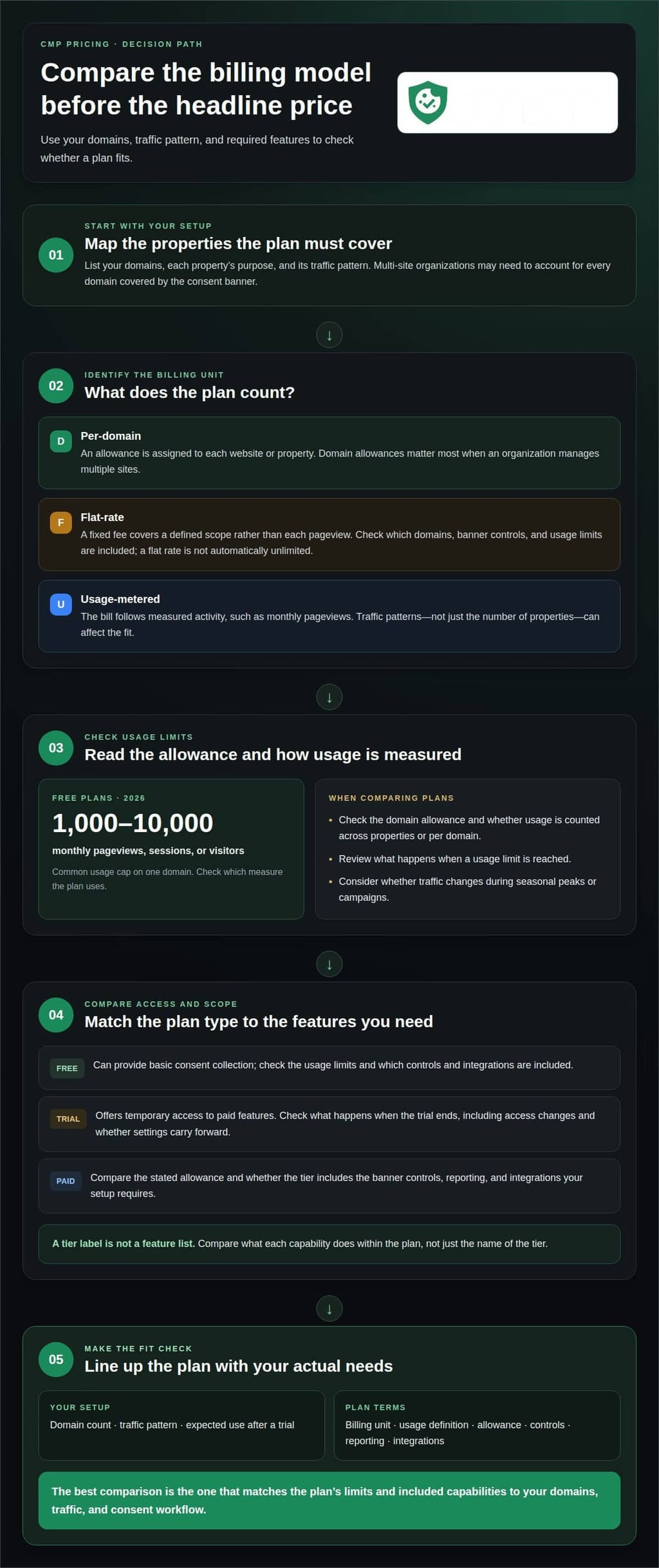
Consent management platform pricing models can start with a free plan, while paid costs depend on how usage is measured and which features a business needs. Some plans charge by traffic or domain; others bundle capabilities into tiers. The headline price alone does not show whether a plan fits.
It is reasonable to want a clear cost before choosing a platform. But the same plan may suit one site and fall short for a group of domains or a business that needs testing and analytics. This guide explains how billing models differ, what shapes the total, and how to compare options with your actual needs.
Key Takeaways
- Compare free and paid tiers by their usage limits and included capabilities, not by the headline plan label alone.
- Domain count, site traffic, and the way a platform measures usage can all shape the bill.
- Learn how Monthly Consent Actions relate to tracked users and why that billing metric may suit some sites better than pageviews.
- Use your traffic pattern and operating setup to narrow down which pricing model fits your needs.
- See how managed cloud hosting and self-hosted infrastructure offer different ways to run a consent platform.
Free plans, free trials, and paid tiers
CMP tiers differ in usage limits, available controls, and what happens after a trial. Free plans can provide an entry point, while paid plans may suit larger sites or needs that exceed a free tier.
What features are included in each CMP pricing tier? Features vary, so compare banner controls, integrations, reporting, and usage limits. A tier name alone does not tell you what is included.
Free Tier Feature Limits
Free tiers can cover basic consent collection, but usage limits often define their practical reach. In 2026, free CMP plans commonly cap usage at 1,000 to 10,000 monthly pageviews, sessions, or visitors on one domain. That makes the domain limit and measurement method essential comparison points. A site with several domains may face a different fit than a single-site project.
Paid Tier Features
Paid tiers typically differ through higher usage allowances or broader feature access, rather than simply removing a free label. Compare whether a plan includes the controls, reporting, and integrations your setup needs. For example, a business using an analytics workflow may value reporting differently from a publisher focused on advertising consent. Check how each feature works within the tier.
A free trial differs from a permanent free plan. A trial gives temporary access to paid features; a permanent plan continues under its stated limits. Before choosing a trial, find out what happens when it ends: whether access changes, settings carry forward, or paid access is required. These terms shape the transition, not just the initial experience.
Use the comparison below to distinguish access type from limits and feature scope. Plan labels vary, so compare the terms themselves.
| Plan option | Access | Usage criterion | Feature comparison |
|---|---|---|---|
| Permanent free plan | Continues under plan terms | May have a monthly cap | Check which controls and integrations are included |
| Free trial | Temporary access | Review trial conditions | Compare trial access with ongoing paid access |
| Entry paid tier | Paid access | Check the stated allowance | Match included functions to your site’s needs |
| Higher paid tier | Paid access | Check broader usage terms | Assess added controls, reporting, or integrations |
For a practical comparison, a consent platform pricing page can help you review plan terms and feature details together.
Choose a plan that fits your domain count, monthly traffic, integration needs, and expected use after any trial. For compliance with applicable regulations, prioritize the features your consent workflow requires, not the longest feature list.
CMP pricing by domain, website size, and traffic
A CMP bill can depend on the number of domains, website size, or traffic. Compare the billing unit first: a domain-based plan treats properties differently from one measured by pageviews.
Per-Domain Pricing
Per-domain pricing assigns an allowance to each website or property. For example, a retailer with separate storefronts may need to account for every domain covered by its consent banner. This differs from usage-metered pricing, where traffic drives the charge, and flat-rate pricing, where a fixed fee covers a defined scope. Domain allowances matter most for multi-site organizations.
Flat-Rate Pricing
A flat-rate plan charges for a defined scope rather than billing for each pageview. For example, a company with steady traffic across several properties may prefer predictable billing, provided the plan covers those domains. Check what the fixed rate includes: domain access, banner controls, and any usage ceiling. A flat rate is not automatically unlimited.
Usage-Metered Pricing
Usage-metered pricing ties the bill to measured activity, such as monthly pageviews. A publisher with seasonal traffic may see usage rise during a busy campaign, while a smaller site may stay within a lower allowance. Compare how the platform counts visits and what happens at the limit. Unlike per-domain pricing, a pageview-based model is driven by traffic, not the number of properties.
Domain and traffic measures can overlap. A business may operate a product site, a support site, and regional storefronts, each with distinct visitor patterns. A plan that counts pageviews across all properties may suit that setup differently from one that assigns allowances to each domain. Record the domains covered and their traffic patterns before comparing plans.
Website size also affects a plan’s practical value. A media site with frequent content updates can generate more pageviews than a small brochure site, even if both have a similar number of domains. An online service, for example, may have steady traffic across several properties serving different audiences. The billing unit determines which differences affect the cost.
For a useful comparison, map each property to its purpose, traffic pattern, and required banner. Then match that map against the provider’s domain allowance and usage definition. The price depends on your domain count, traffic, and selected plan scope; the exact figure is given in a quote for your case. You can review the consent platform pricing details alongside those factors.
How much does a consent management platform cost?
CMP costs vary with plan scope, privacy program needs, and whether infrastructure is standard or custom. Compare entry-level, mid-tier, and enterprise plans by their included capabilities, not price labels alone.
U.S. state privacy laws can shape a CMP’s required workflows and integrations. Delaware, New Jersey, Tennessee, Minnesota, and Maryland state privacy laws took effect during 2025, so applicable obligations can influence configuration and ongoing oversight.
Entry-Level and Mid-Tier Plans
Entry-level and mid-tier plans suit organizations with defined websites and consent needs. Enterprise plans may offer broader scope, more customization, or advanced controls. A company managing one brand may need a different setup from a corporate group coordinating preferences across multiple properties. Match the plan to the workflows your privacy program uses.
For a useful comparison, list the regions where your business operates, the properties covered, and the consent choices visitors can make. Then map those needs to the CMP’s configuration, integrations, and reporting. U.S. privacy laws do not create one identical checklist for every business. Applicable requirements depend on where and how the business operates and what data practices it uses.
Enterprise Starting Prices
Enterprise plans address broader programs, where dedicated workflows, analytics, or custom infrastructure may matter. They can be shaped around a company’s operating model and privacy preferences across business units. Because the scope varies, a single starting figure is a poor basis for comparison. Evaluate the infrastructure and services included alongside the monthly billing terms.
Infrastructure choices also affect the cost discussion. A business may prefer managed hosting or need consent operations within its own environment. Each approach affects implementation scope, maintenance responsibilities, and integration planning. Compare the operational work required, not just feature names. For example, a global organization coordinating regional teams may value centralized reporting differently from a company operating in one market.
Enterprise quotes can reflect the number of properties, applicable jurisdictions, required integrations, analytics needs, and infrastructure choices. A corporate plan should make these components visible, including any dedicated support or customization in scope. Review how the plan handles preference updates and changes to the organization’s privacy program. The quoted figure depends on the scope, integrations, and infrastructure requirements.
To compare proposals, separate recurring platform access from custom implementation and infrastructure work. Then check whether the configuration supports your applicable obligations, such as handling visitor preferences consistently across the properties in scope. A lower-tier option may fit a focused program; enterprise pricing makes more sense when broader coordination and custom requirements justify it.
What are Monthly Consent Actions, and why bill on them?
Monthly Consent Actions measure consent-related activity during a billing period. Unlike pageviews, this metric focuses on recorded choices and preference changes.
Cookie scan limits, consent records, and user volumes affect pricing by changing the platform’s workload and usage allowance. A site with more tracked visitors or frequent preference updates may need a different allowance than a site with steady, lower activity.
Monthly Consent-Action Allowances
An included monthly consent-action allowance sets the amount of counted activity covered by a subscription. It differs from a pageview cap because a visitor can browse several pages without making several consent choices. Check how the plan counts first-time choices, later preference changes, and stored records. These definitions determine whether the allowance reflects actual consent activity.
Traffic estimates help forecast usage, but raw visits are not the whole picture. For example, visitors may return with an existing choice, while a site with fewer visits may see more preference changes. Monthly tracked users provide another measure, though platforms may define tracking differently. Compare the counting method with your analytics and consent workflow.
Cookie scanning is a separate usage factor from consent actions. A scan checks a website for cookies and related technologies, while a consent record stores a visitor’s choice. A frequently changing site may need more scans than a stable one. When comparing plans, distinguish scan allowances, tracked-user limits, and action allowances rather than treating them as one metric.
Monthly and Annual Billing
Monthly billing follows a shorter renewal cycle, which can suit changing traffic or an implementation still being assessed. Annual billing commits the subscription for longer. Compare renewal terms, allowance resets, and what happens if usage changes. A monthly plan’s allowance usually aligns with its billing period; annual billing does not automatically mean one annual pool.
Essential and Professional labels describe vendor-specific tiers, not universal feature standards. Compare their consent actions, scanning limits, user volumes, and reporting before deciding. For example, a Professional tier may suit expected activity if its stated allowance covers it, while an Essential tier may fit a smaller workflow. Check how each tier handles peaks and overages.
Google Consent Mode can also matter when reviewing integrations and implementation needs. Treat it separately from action counting: integration requirements shape the plan comparison, while consent-action allowances describe usage. For a sound estimate, map monthly traffic, tracked users, scan frequency, and expected preference changes. Then compare those estimates with each tier’s definitions and billing cycle.
Consent management platform pricing information and availability
A useful price comparison needs more than a monthly figure. Check what each plan includes, how it is delivered, and which conditions affect access. For example, a platform may offer a published tier for standard needs and a tailored option for advanced requirements. Separate included features from optional scope to compare them fairly.
Start with the pricing page or plan details. Record whether the platform clearly describes its limits, supported domains, integrations, and billing terms. Then compare them with your setup. A single-language site with one consent banner has different needs from a group managing several sites and language versions. The right plan depends on your requirements, not its label.
Availability also means operational fit. Determine whether the CMP is managed or can run on your own infrastructure. That choice affects who manages the environment and how the consent script fits into your website. For example, a team with established hosting processes may value a self-hosted option, while another may prefer managed hosting.
Consider what the CMP must collect and connect. A site using Google Consent Mode needs to account for that integration during implementation. A publisher may also want analytics to understand how visitors interact with its banner. Compare these needs with each plan’s included capabilities rather than assuming every tier offers the same integrations or reporting.
Language support can shape availability for international sites. A consent banner needs to present choices clearly to its visitors. Map each website’s language requirements to the platform’s banner settings. Then check whether one configuration can support different properties or whether each site needs separate settings. This reveals practical gaps that a headline tier may hide.
Use this short comparison process before choosing a plan:
- List the websites, domains, and language versions in scope.
- Identify required integrations, such as Google Consent Mode.
- Separate standard banner needs from advanced analytics or testing requirements.
- Compare included limits, hosting arrangements, and billing terms.
- Note any requirement that calls for custom configuration.
This approach makes pricing information more useful: it connects plan terms to real implementation needs. A low headline figure may omit a feature your setup depends on, while a broader tier may include capabilities you won’t use. For a practical next step, review the available pricing options against your sites, integrations, and deployment requirements.
Conzent: Managed Cloud Consent Platform
Conzent offers a Managed Cloud Consent Platform for teams that want consent management without hosting the infrastructure themselves. Organizations that prefer to run the platform on their own systems can choose Self-Hosted Open Consent Infrastructure, which is free to self-host.
Consent A/B Testing helps compare banner approaches, while Revenue Impact Analytics shows how consent rates relate to ad revenue. These tools help teams manage consent and assess banner performance within one platform.
Explore Conzent’s Managed Cloud Consent Platform or free Self-Hosted Open Consent Infrastructure to find the setup that fits your needs.
Make your next CMP decision easier
Choose a consent platform that can keep pace with your website, not just its current setup. As your sites, integrations, or privacy workflows change, the right plan should still make those requirements manageable. The best consent management platform pricing models are ones you can assess against your priorities, including how you host the platform and what you need to measure.
Before deciding, define what a successful consent workflow looks like for your team. That gives you a practical basis for comparing scope and planning for future changes. Conzent offers a Managed Cloud Consent Platform and Self-Hosted Open Consent Infrastructure, with Consent A/B Testing for teams evaluating banner approaches.
Review pricing options for your consent setup and take the next step with a clearer view of what matters. A thoughtful choice can make consent management more transparent and easier to adapt.
Frequently Asked Questions
How much should your team budget for a CMP?
Budget for the people and processes around the platform, not just software access. Include time to approve banner language, map consent categories, and coordinate changes with marketing and analytics teams. For example, a campaign launch may require reviewing new tags before publication. Assign an internal owner so your budget reflects the ongoing work of maintaining a reliable consent setup.
Which CMP should you choose?
Choose a CMP that supports the standards and workflows your organization depends on. Check whether it records consent in a format your advertising or analytics systems can use, and whether it supports the framework required for your operations. Conzent supports IAB TCF v2.4, including v2.3. A practical selection test is to trace one visitor choice from the banner through the systems that rely on it.
What pricing models do consent management platforms use?
Common consent management platform pricing models include subscriptions, per-site plans, and usage-based arrangements. Some platforms also offer self-hosted access or sponsorship-supported pricing. Read the renewal, cancellation, and account-change terms, since these determine how a plan behaves over time. For instance, a team running a short-term campaign should understand its renewal obligations before choosing a longer commitment.
How much do consent management platforms cost per month or year?
There is no single amount that applies to every organization. The total depends on the platform’s scope and the arrangement selected, so forecast from current needs and likely changes. Separate recurring access from internal implementation effort, including testing and policy review. For Conzent’s managed service, sponsorships lower pricing; self-hosting is free. Use the relevant plan terms to estimate ongoing spend.
How do CMP prices vary by website traffic, page views, or number of domains?
Usage measurements matter when a plan uses them to set its allowance, but the count alone does not show operational complexity. For example, one high-traffic site may have a straightforward tag setup, while a smaller group of sites may use many marketing tools. Inventory the scripts and consent categories each property uses. This helps estimate configuration and maintenance work, not just platform usage.
Which consent management platforms offer free plans, and what are their limits?
Free plans are available from many CMP providers, but their value depends on what remains usable without upgrading. Check whether the plan lets your team configure the banner, record choices, and maintain the setup after a trial. Conzent’s self-hosted platform is free, with unlimited sites and pageviews. A team choosing self-hosting should also account for the internal work of operating its own infrastructure.
How do enterprise CMP pricing and custom quotes work?
A custom quote turns an organization’s requirements into a defined scope. Prepare a list of business units, consent workflows, systems that receive signals, and approval owners. Then ask for a clear distinction between platform access and any tailored work. This helps procurement compare proposals consistently and gives privacy, marketing, and engineering teams a shared record of what the deployment must support.
Are consent management platform prices different for small businesses and large enterprises?
Pricing can vary because organizations differ in procurement, governance, and deployment complexity. A small team may need a clear owner to approve banner changes, while a large enterprise may require coordinated sign-off across privacy, marketing, and regional teams. Consent management platform pricing models should match those operating needs. Compare how each option fits your approval process and future changes.