
Cookie Banner Accessibility Standards: The 2026 Compliance Guide
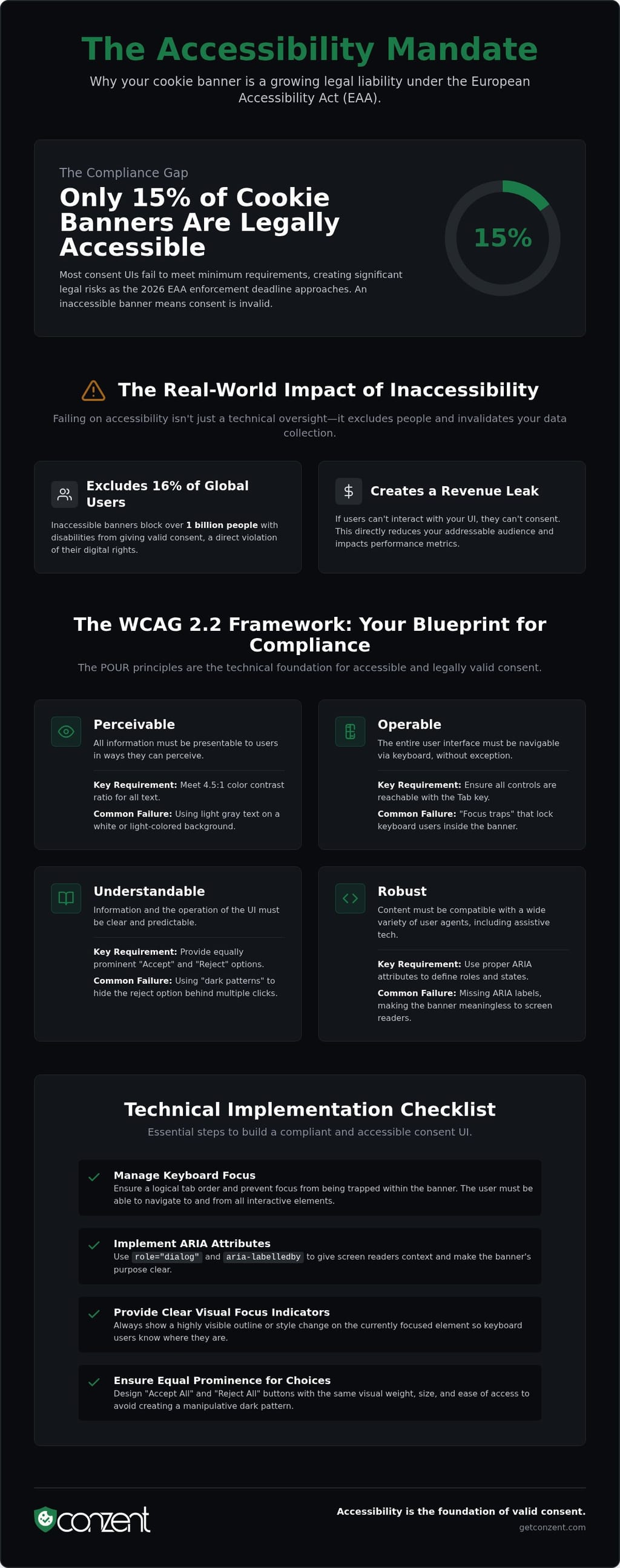
Only 15% of cookie banners currently meet the minimum accessibility requirements mandated by law. Most digital teams still view accessibility as a moral "nice to have," yet they often ignore the direct impact of accessibility on consent rates. If a user cannot navigate your banner using a screen reader or keyboard, they cannot give valid, informed consent. In 2026, this is no longer just a technical oversight; it's a significant legal liability under the European Accessibility Act (EAA).
You're likely feeling the weight of these shifting standards. Between the fear of EAA lawsuits and technical confusion over ARIA labels, the stakes have never been higher for your digital infrastructure. We believe that compliance shouldn't be a black box or a luxury reserved for the biggest players. It's a fundamental standard for a fair, transparent, and open web.
This guide provides the roadmap you need to master the technical and legal requirements for accessible cookie banners. You'll gain a clear WCAG 2.2 compliance checklist and learn how to protect your revenue from legal risks. We'll show you how to secure your data collection while respecting every user's digital rights and maintaining your performance metrics.
Key Takeaways
- Accessibility is the new legal baseline for valid consent. In 2026, an inaccessible banner isn't just a UX failure; it's a legal liability under the EAA.
- Apply the POUR principles to your consent flow. We'll help you eliminate focus traps and ensure your UI is fully perceivable by all users.
- Understand the impact of accessibility on consent rates. When your banner works for everyone, you protect your revenue and respect digital rights.
- Master the technical implementation of ARIA attributes. Learn how to manage focus and use aria-labelledby to create a compliant, keyboard-accessible experience.
- Scale your compliance with the right infrastructure. We'll compare managed and self-hosted solutions to help you maintain total control over your consent data.
Beyond GDPR: Why Accessibility is the New Legal Baseline for Consent
The legal landscape has shifted. Consent is no longer just a privacy issue; it's an accessibility mandate. Under the 2026 regulatory framework, foundational laws like the ePrivacy Directive and the GDPR are now interpreted through the lens of the European Accessibility Act (EAA). If a user cannot access your consent UI, they cannot be informed. Without information, consent is invalid. This isn't a minor UX flaw. It's a foundational legal failure that makes your data processing illegal from the start. You're not just losing data; you're inviting litigation.
We're seeing a rapid move from optional UX enhancements to mandatory digital infrastructure. Data Protection Authorities (DPAs) are no longer just looking for "Accept" buttons. They're auditing for keyboard accessibility, color contrast, and ARIA labels. Inaccessible banners block approximately 16% of the global population. That is over one billion people. When you exclude this many users, the impact of accessibility on consent rates becomes a massive revenue leak. You're effectively telling 16% of your audience that their digital rights don't matter. This exclusion is exactly what regulators are now targeting with increased scrutiny on "accessibility dark patterns."
Defining Informed Consent for All Users
Transparency requires more than just plain language. It requires technical legibility. Screen reader users must be able to perceive the purpose of every cookie through properly labeled elements. Keyboard-only users must be able to navigate the consent flow without getting stuck in focus traps. Failing this creates a high risk of "consent bypass" lawsuits, where users are forced into a choice they didn't actually make. We view accessibility as an ethical standard for digital rights. It ensures every user has the same agency over their personal data, regardless of their resources. You can learn more about how this fits into current standards on our GDPR compliance page.
The Business Case for Universal Design
Inclusive design is a competitive advantage, not a burden. As populations age, the need for clear, high-contrast interfaces grows. Sites that prioritize universal design see lower bounce rates among older demographics and users with temporary impairments. This isn't about premium luxury features. It's about principled, egalitarian UI choices that build long-term brand trust. Aligning your consent infrastructure with broader Environmental, Social, and Governance (ESG) goals demonstrates that your business is a responsible actor. You aren't just following rules; you're setting a standard for technical efficiency and human dignity. Accessibility is the floor, not the ceiling.
The WCAG 2.2 Framework: Applying POUR Principles to Cookie Banners
WCAG 2.2 is the definitive benchmark for 2026. It's the technical yardstick for the European Accessibility Act. The POUR model, Perceivable, Operable, Understandable, and Robust, serves as the technical foundation for digital inclusion. If your banner fails these tests, you're effectively blocking a segment of your audience. This neglect directly hits the impact of accessibility on consent rates, as users who can't interact with your UI simply bounce. Compliance is not a luxury. It's a prerequisite for valid data collection.
Perceivable and Operable Standards
Perceivability requires that all users can sense the information presented. This is not a suggestion. You must meet the 4.5:1 contrast ratio for all banner text. Light gray text on a white background is a legal liability. It's a barrier for users with low vision. Operability requires that the entire consent flow is usable by keyboard. Focus traps are the most common failure. A user should never be stuck in a loop. You must use the "region" role with an accessible name like "Cookie Consent" to allow landmarks to guide assistive technology. Clear visual indicators must identify the current element so keyboard users know exactly where they are in the flow.
Understandable and Robust Standards
Understandability prevents confusion. Your navigation patterns must be predictable. "Reject All" must have the same visual weight and ease of access as "Accept All." Dark patterns that hide the "Reject" option behind three layers of menus are now attracting heavy regulatory fines. Robustness ensures your banner remains functional as assistive tech evolves. Correct language attributes are essential. If your banner is in English but the code doesn't specify the language attribute, screen readers may use incorrect pronunciation. This breaks the "informed" part of informed consent. Error prevention is equally vital. Users shouldn't be able to accidentally bypass the banner without making a choice.
These aren't just technical checkboxes. They are ethical commitments. A robust, accessible banner builds trust with your most vulnerable users. It proves you value transparency over manipulation. When you remove technical barriers, you clear the path for valid, informed consent across your entire user base. If you're looking for a solution that balances these requirements with high-performance analytics, you can review our managed and self-hosted plans. Choosing the right infrastructure today prevents a total rebuild when the next audit arrives.
The European Accessibility Act (EAA) and 2026 Enforcement Realities
The grace period is over. As of August 2026, the European Accessibility Act is no longer a looming deadline; it is an active enforcement reality. While the initial implementation date passed in June 2025, the current landscape is defined by rigorous audits and market surveillance. This legislation harmonizes accessibility standards across all 27 EU member states, removing the patchwork of regional rules that previously frustrated global operations. If you provide digital services in the EU, you are likely liable. This includes e-commerce, banking, and any service deemed essential to digital participation.
The penalties for non-compliance are severe. Regulators have the power to issue heavy fines, but the greater risk is being barred from the EU market entirely. A non-compliant cookie banner can lead to a formal order to withdraw your service until the infrastructure meets EN 301 549 standards. The impact of accessibility on consent rates is now a critical metric for both legal teams and marketing departments. If your banner excludes users with disabilities, you are failing the legal requirement for universal access. This failure invalidates your consent strings and exposes your entire data pipeline to regulatory action.
EAA vs. GDPR: The Double Compliance Burden
The EAA doesn't replace existing privacy laws. It reinforces them. To meet GDPR requirements, consent must be freely given and informed. If a user cannot perceive the "Reject" button due to poor contrast or navigate the settings via keyboard, that consent is neither free nor informed. In 2026 audits, DPAs are collaborating with accessibility regulators to identify these gaps. Waiting for a user complaint is a failing strategy. Global organizations must treat accessibility as foundational infrastructure rather than a UI layer. You don't just need a banner; you need a compliant gateway that respects every user's digital rights.
Preparing for a Compliance Audit
Audit preparation requires a shift from passive hosting to active documentation. Internal audits often miss the subtle focus traps or ARIA mismatches that external regulators prioritize. You must be able to prove your infrastructure is accessible by design. This is where source-available infrastructure becomes a strategic asset. It provides the transparency needed for deep technical audits, allowing your team to verify every line of code against WCAG 2.2. Documentation should include:
- VPAT (Voluntary Product Accessibility Template) reports for your CMP.
- Evidence of regular testing with assistive technologies.
- Clear logs showing that consent flows are operable for all users.
Transparency is the best defense against regulatory scrutiny. By choosing open standards and verifiable infrastructure, you invite collaboration rather than suspicion. Compliance in 2026 is about proving your commitment to an egalitarian web through concrete technical evidence.
Implementation Guide: Accessible Consent UI Standards
Focus management is where most consent implementations fail. If your cookie banner isn't the first item in the tab order, it doesn't exist for a keyboard user. The technical execution of your UI has a measurable impact of accessibility on consent rates, as broken focus cycles lead to immediate site abandonment. You must ensure that when the banner triggers, the user's focus moves logically through the options. This isn't about forcing a choice. It's about providing the path to make one.
Performance optimization is often cited as a reason to skip accessibility features, but this is a false choice. Modern, accessible scripts are lightweight. They don't have to bloat your Core Web Vitals or trigger Cumulative Layout Shift (CLS). By using source-available infrastructure, you can audit the script's execution to ensure it delivers a compliant UI without delaying the Largest Contentful Paint (LCP). Accessibility and speed are both pillars of a high-performing digital experience in 2026.
Focus Management and ARIA Labels
Avoid the "modal trap" unless you are using a blocking banner that requires a choice before site entry. If the banner is intrusive, set the aria-modal="true" attribute to inform assistive technology that the rest of the page is temporarily inert. Use aria-labelledby to link the banner's heading to the container and aria-describedby for the explanatory text. This ensures screen readers provide the full context immediately. When a user updates their preferences, ensure the dynamic content change is announced via an ARIA live region. To identify focus traps, navigate your site using only the Tab and Shift+Tab keys to ensure the cursor never disappears or gets stuck inside the consent banner.
Integrating with Modern Standards
Maintaining compliance across multiple frameworks requires a unified technical approach. Your accessible UI must work seamlessly within Google Consent Mode v2 workflows to ensure signals are passed correctly to your marketing stack. Similarly, achieving IAB TCF 2.3 compliance shouldn't come at the cost of keyboard operability. The TCF's complex purpose lists must be rendered in a way that remains navigable and perceivable for all users. Testing should combine automated scans with manual audits to catch the nuance that software often misses.
Building an accessible consent flow is an investment in your site's longevity and legal safety. It removes the friction that leads to high bounce rates and ensures your data collection remains robust. If you're ready to deploy infrastructure that prioritizes both compliance and performance, explore our managed and self-hosted solutions. We provide the tools to make universal design a standard part of your technical stack.
Scaling Accessible Compliance with Conzent’s Managed Infrastructure
Compliance is a moving target. In 2026, maintaining a compliant banner requires constant technical vigilance as WCAG and EAA standards evolve. You shouldn't have to choose between legal safety and engineering velocity. We provide the infrastructure that makes digital rights a default setting, not a development backlog item. Whether you require the speed of a managed cloud or the total control of a self-hosted environment, our platform ensures your consent flow remains a bridge, not a barrier.
Data drives decisions. Understanding the impact of accessibility on consent rates is vital for protecting your bottom line. We bridge the gap between ethical design and commercial reality through revenue impact analytics. You can see exactly how accessible UI choices correlate with user trust and data quality. This isn't about guessing. It's about using verifiable evidence to prove that inclusion is a growth lever for your business.
Managed Cloud for Speed and Reliability
Our Managed Cloud Consent Platform is built for teams that prioritize deployment speed without sacrificing quality. It delivers automatic updates to meet the latest regulatory shifts, ensuring your site never falls behind the EAA enforcement curve. We offer egalitarian pricing that scales with your organization, making high-level compliance attainable for small businesses and global enterprises alike. With seamless integrations for WordPress, Shopify, and major CMS platforms, you can deploy a fully accessible banner in minutes rather than weeks.
Self-Hosting for Total Control
DevOps teams often prefer self-hosting the CMP to maintain absolute data sovereignty. Our source-available Open Consent Infrastructure (OCI) allows you to keep consent data within your own perimeter while ensuring universal access. This approach eliminates the "black box" problem of traditional vendors. By self-hosting, you have total accessibility control over the code, allowing for deep customization that meets your specific UI requirements. You aren't just buying a tool; you're contributing to a mission-driven movement for transparent privacy infrastructure.
Optimization requires experimentation. Using Conzent’s A/B testing, you can refine your accessible designs to find the perfect balance between usability and performance. You can test different contrast levels, button placements, and focus orders to see which configurations yield the best results. This allows you to maximize the impact of accessibility on consent rates by removing the friction points that cause users to drop off. We believe that a fair web is a functional web, and our infrastructure is designed to prove it every day.
Securing Your Digital Future through Universal Access
In 2026, accessibility is the technical prerequisite for valid legal consent. We have moved past the era of "good enough" UI. Your infrastructure must now meet strict WCAG 2.2 standards to survive an EAA audit. If your banner excludes users through focus traps or poor contrast, your consent strings are legally void. The impact of accessibility on consent rates is a direct reflection of your brand's commitment to transparency. When you build for everyone, you build trust with everyone.
Universal design is a standard we can all achieve. You don't need to hide behind technical complexity. By choosing infrastructure that is IAB TCF v2.3 certified and Google Consent Mode v2 ready, you protect your revenue and your users. Our source-available infrastructure ensures you have the transparency required for the modern web. It is time to stop viewing compliance as a burden and start seeing it as a commitment to digital rights.
You can deploy a compliant, accessible cookie banner with Conzent today. Let's build a more inclusive internet together.
Frequently Asked Questions
Are cookie banners required to be accessible under the European Accessibility Act?
Yes. The European Accessibility Act (EAA) explicitly covers digital services that facilitate e-commerce and electronic communications. Cookie banners are the gateway to these services. If your banner isn't accessible, your entire service is non-compliant. This isn't a suggestion for large corporations; it's a mandatory standard for all businesses operating in the EU. You must meet the EN 301 549 standards to avoid market exclusion and potential fines.
What is the minimum WCAG version required for cookie banner compliance in 2026?
WCAG 2.2 Level AA is the current stable standard for 2026 compliance. While older regulations referenced WCAG 2.1, the updated EN 301 549 standard now incorporates the latest W3C recommendations. This version adds nine new success criteria, including better focus appearance and target sizes. It's not enough to meet the bare minimum from five years ago. You need a modern infrastructure that supports these specific technical requirements to remain legally safe.
How do I test if my cookie banner is keyboard accessible?
You can perform a manual audit using only your keyboard. Navigate through your site using the Tab key to ensure the focus moves logically into the cookie banner. You should see a clear visual indicator around the active button. If your cursor disappears or gets stuck in a loop, you've found a focus trap. Testing with a screen reader like NVDA or VoiceOver is also vital to verify that all labels are announced correctly.
Can an inaccessible cookie banner lead to GDPR fines?
Yes. GDPR requires consent to be informed, specific, and freely given. If a user with a visual impairment can't read your banner or a motor-impaired user can't click "Reject," their consent isn't valid. DPAs are increasingly viewing accessibility failures as a breach of transparency. An inaccessible banner results in invalid consent strings, which can lead to the same high-tier fines as any other GDPR violation.
What are the most common accessibility errors in cookie consent managers?
Focus traps and poor color contrast are the most frequent offenders in modern CMPs. Many "compliant" banners fail to use ARIA landmarks, making them invisible to screen readers. These technical hurdles negatively influence the impact of accessibility on consent rates by forcing users to abandon the site. When you remove these barriers, you don't just achieve compliance; you create a smoother path for every user to provide valid, informed consent.
Does Google Consent Mode v2 require an accessible banner?
Google Consent Mode v2 is a signaling mechanism, but it relies on a legally valid consent choice. If your banner is inaccessible, the consent you collect is legally void under GDPR and the EAA. This means the signals you pass to Google's advertising and analytics platforms are built on a faulty foundation. To maintain your marketing data's integrity, your banner must be accessible to every user who visits your site.
How does an accessible cookie banner affect my website’s SEO and Core Web Vitals?
Accessibility and SEO share the same goal: clear, well-structured content. Google's algorithms reward sites that provide a high-quality user experience, which includes accessibility. Efficiently coded accessible banners also help you maintain healthy Core Web Vitals. By avoiding heavy, "black-box" scripts that cause Cumulative Layout Shift (CLS), you ensure that your consent interface doesn't slow down your Largest Contentful Paint (LCP) or frustrate your visitors.
Can I self-host an accessible cookie consent platform?
Yes. You can self-host using our source-available Open Consent Infrastructure (OCI). This gives your technical team total control over the UI and the underlying code. Self-hosting is often the preferred choice for organizations that need to maintain strict data sovereignty while ensuring universal access. It allows you to audit every line of code for accessibility compliance rather than relying on a third-party cloud provider's opaque updates.