Cookie Consent for Developers: Building Scalable Privacy Infrastructure in 2026
Why are we still letting bloated third-party scripts hijack Core Web Vitals just to satisfy a legal requirement? For too long, cookie consent for developers has meant choosing between compliance and performance. You've likely spent hours debugging Google Consent Mode v2 errors or staring at opaque pricing models that punish your traffic growth. It's frustrating to lose control over data residency and script execution just to keep the regulators at bay. Privacy shouldn't be a bolt-on that breaks your build.
We agree that privacy is a technical infrastructure challenge, not just a UI banner problem. You deserve a system that respects your users' rights without sacrificing your site's lighthouse score. This guide shows you how to implement a high-performance, developer-first consent strategy that satisfies GDPR, IAB TCF v2.3, and Google Consent Mode v2. We'll move past the superficial pop-ups to explore building a scalable privacy architecture that puts you back in control of your data, your residency, and your code.
Key Takeaways
- Treat privacy as a foundational backend state management requirement rather than just a frontend UI overlay.
- Maintain compliance with current technical standards like IAB TCF v2.3 and Google Consent Mode v2 to keep your tracking data valid.
- Evaluate the security and performance trade-offs between self-hosting your consent infrastructure and using a managed cloud service.
- Implement a high-performance strategy for cookie consent for developers that prioritizes Core Web Vitals and script sandboxing.
- Use revenue impact analytics and A/B testing to optimize opt-in rates without relying on unethical dark patterns.
Beyond the Banner: Why Developers Need Privacy Infrastructure
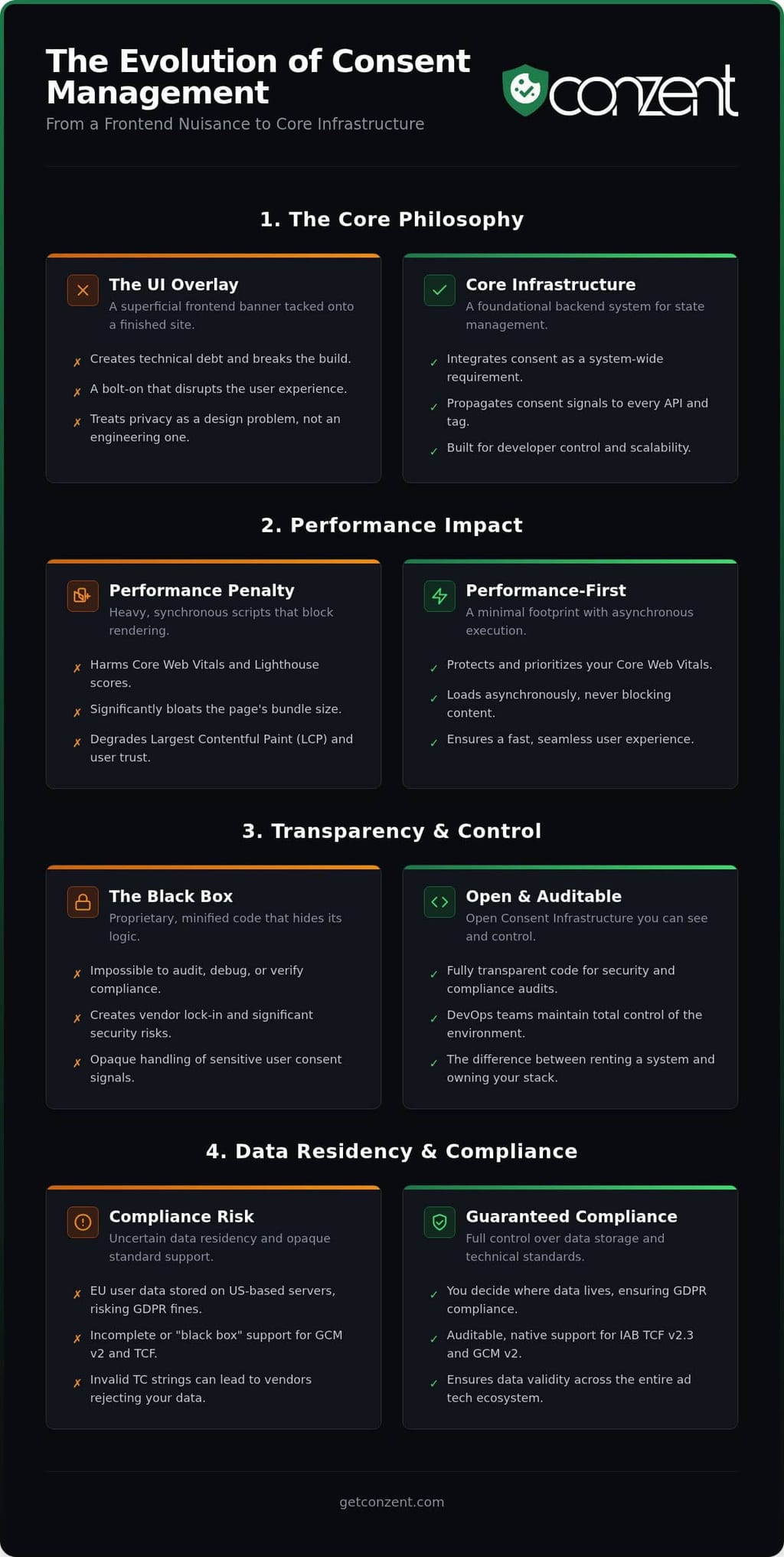
Privacy is a system requirement, not a design choice. In 2026, treating a consent notice as a simple frontend overlay is a recipe for technical debt. Developers are now responsible for managing the lifecycle of an HTTP cookie across multiple domains and services. This isn't just about showing a button; it's about backend state management. You must ensure the consent signal propagates correctly to every third-party tag, API, and server-side process in your stack. If the signal breaks, your data is useless.
Performance is the hidden cost of compliance. Many legacy solutions rely on heavy, synchronous scripts that bloat your bundle size and tank your Largest Contentful Paint (LCP). If your CMP script takes hundreds of milliseconds to execute before your main content loads, you've already lost your audience. Effective cookie consent for developers means finding tools that offer a minimal footprint and asynchronous execution. It's about protecting the user experience while meeting legal mandates. Code transparency is no longer optional; it's a security necessity.
The Technical Debt of Proprietary CMPs
Most proprietary platforms function as black boxes. You inject a script and it handles the rest. This sounds convenient until you need to debug a "consent not found" error or audit where user data is actually stored. Many vendors hide their logic behind minified code. This makes it impossible to verify how they handle sensitive signals. This creates vendor lock-in and significant security risks. If you can't see the code, you can't trust the compliance. Data residency is another major pain point. If your users are in the EU but their consent signals live on a US-based server, you might be violating the very laws you're trying to follow.
Defining Modern Consent Infrastructure
The industry is shifting from simple banners to robust Open Consent Infrastructure (OCI). Modern infrastructure consists of three core layers: signal collection, state persistence, and downstream API propagation. A Managed Cloud Consent Platform provides these as a service, while self-hosted consent infrastructure gives DevOps teams total control over their environment. Developers are choosing OCI because it offers the transparency needed for rigorous security audits. It's the difference between renting a closed system and owning your privacy stack. One is a temporary fix; the other is a scalable foundation.
Technical Standards: Navigating IAB TCF v2.3 and Google Consent Mode v2
Standards are the guardrails of digital rights. For cookie consent for developers, these standards have evolved from loose recommendations into strict technical protocols. In 2026, compliance isn't a checkbox; it's a handshake between your site and the global ad tech ecosystem. The IAB TCF v2.3 framework is now mandatory for anyone operating in the EEA. It requires a "Disclosed Vendors" segment in every TC string. Any string created after the February 28, 2026 deadline without this segment is considered invalid. If your string is invalid, your vendors won't process data. It's that simple.
Google Consent Mode (GCM) v2 adds another layer of complexity. It requires specific parameters like ad_user_data and ad_personalization to be passed based on user choice. You must map your CMP categories to these signals accurately. Failure to do so doesn't just risk a fine; it breaks your attribution modeling and stops you from capturing data for new EEA users. Many proprietary CMPs treat this as a black box. A transparent approach allows you to see exactly how these signals are fired in the dataLayer. You can explore infrastructure options that make these technical integrations visible and auditable.
Implementing IAB TCF v2.3 APIs
The core of TCF compliance is the __tcfapi function. This is the standardized interface that ad tech vendors use to query user consent. You need to ensure your CMP correctly encodes the TC string, which contains the granular choices of the user. For a deep dive into the technical specs, refer to the IAB TCF v2.2 Implementation Guidelines, which remain the foundation for current v2.3 logic. Using IAB TCF certified CMPs ensures that your signals are recognized by the thousands of vendors in the Global Vendor List (GVL).
Mastering Google Consent Mode v2
When implementing Google Consent Mode v2, you must choose between Basic and Advanced implementation. Basic mode prevents tags from loading until consent is granted. Advanced mode allows tags to load and send "pings" without cookies when consent is denied. This helps recover lost data through conversion modeling. The key is the sequence: you must set a "default" state in the dataLayer before any tags load, followed by an "update" command once the user interacts with your banner. Debug this using the browser console or Tag Assistant to ensure no pings are sent prematurely. This prevents "Consent Mode" errors from tanking your ad revenue attribution.
Finally, respect the Global Privacy Control (GPC) header. This browser-level signal allows users to opt out of data sharing across the web. Your infrastructure should detect this header and automatically set the consent state to "denied" for marketing and tracking. This is now a requirement under several updated US state laws effective in 2026. Automating this response builds trust and keeps your legal team happy.
Deployment Architecture: Self-Hosted vs. Managed Cloud CMP
Architecture defines your privacy boundaries. When building cookie consent for developers, you face a fundamental fork in the road: self-hosting your infrastructure or using a managed cloud service. This isn't just a pricing decision. It's a question of data residency, security, and long term maintenance. Self-hosting offers total control over your users' consent signals. Managed cloud offers speed and automated regulatory updates. Both paths require a clear understanding of the total cost of ownership (TCO).
Security starts with script isolation. Every third party script on your site is a potential vector for data leakage. You must sandbox your CMP scripts and implement strict Content Security Policy (CSP) headers. A robust architecture for cookie consent for developers ensures that consent events, which can reach millions of 'grant' and 'revoke' signals per month, are logged without impacting site performance. You need a system that scales horizontally. Many teams now use a hybrid approach. They develop and test on open source infrastructure but deploy on a managed cloud to ensure high availability and global CDN delivery.
Self-Hosting: Total Control for DevOps
Deploying Conzent OCI on your own infrastructure gives you absolute sovereignty. You own the database schemas for your consent audit logs. You control exactly where the data lives, which is critical for meeting strict residency requirements. However, the burden of maintenance is real. You are responsible for manual regulatory updates as laws shift. While the software is free to download, the real cost is the internal engineering time required to keep the system compliant and secure.
Managed Cloud: Scaling Without the Overhead
Managed hosting functions as Infrastructure-as-a-Service for privacy. It removes the maintenance debt. You get automatic updates for standards like Google Consent Mode v2 and IAB TCF v2.3. This path simplifies GDPR compliance by providing integrated analytics and revenue impact monitoring. It's built for scale. You don't have to worry about database performance or global latency. You pay for the service so your developers can focus on building your core product instead of managing privacy logs.
Implementation Workflow: Integrating Consent into Your Stack
Theory ends where the console begins. To build a robust system for cookie consent for developers, you need a methodical integration workflow. This isn't a "set and forget" script. It's a precise sequence of operations that ensures your tags only fire when they have the legal right to do so. Your first task is defining your taxonomy. Map every script on your site to one of four categories: Essential, Functional, Analytics, or Marketing. If a script doesn't fit your data strategy, it shouldn't be in your codebase.
Performance is your second priority. When you implement the CMP script, you face a trade-off between async and defer. An async script downloads in the background but executes immediately upon completion, which can disrupt the main thread. A defer attribute ensures the script executes only after the HTML is parsed, preserving your Largest Contentful Paint (LCP). Once the script is live, hook into the CMP's JavaScript API. Use event listeners to trigger conditional tag loading based on the user's latest consent state. Finally, validate your work. Use automated compliance scans to ensure no "rogue" cookies are slipping through your filters.
Consent in Modern Web Frameworks (React, Vue, Next.js)
Single Page Applications (SPAs) require more than a static script. You must handle consent state shifts during client-side navigation without refreshing the page. In frameworks like React or Vue, use Context or Provide/Inject to make the consent signal globally accessible to your component tree. Server-Side Rendering (SSR) in Next.js introduces the risk of layout shifts or "flickers" if the banner loads after the initial paint. Solve this by checking the consent cookie on the server and passing the initial state as a prop. This ensures the UI is consistent from the first frame.
Optimizing for Core Web Vitals
A heavy CMP is an SEO liability. Every kilobyte of JavaScript you add to the head of your document delays your site's interactivity. Choose a lightweight, source-available infrastructure that prioritizes execution speed. Load your CMP before Google Tag Manager (GTM) to establish the consent state, but ensure it doesn't block critical CSS or your hero image. You can use requestIdleCallback to defer the initialization of non-critical privacy UI components until the browser's main thread is free. This keeps your Total Blocking Time (TBT) low while maintaining full compliance.
Ready to build a faster, more transparent privacy stack? You can compare our managed and self-hosted plans to find the right fit for your team's workflow.
Optimizing the Privacy UX: A/B Testing and Revenue Impact
Developers often view consent as a hurdle to clear. This is a mistake. In 2026, the technical implementation of privacy is a primary driver of conversion rate optimization (CRO). If your banner is intrusive, your bounce rate climbs. If it's too subtle, you lose critical tracking data. Finding the "Goldilocks" zone requires data, not guesswork. By applying A/B testing to your consent UI, you can determine which layouts and copy variations maximize opt-in rates without compromising the user experience.
Monitoring "Consent Bounce Rate" is vital. This metric tracks users who leave the site immediately after seeing a consent banner without interacting with your content. It's a direct indicator of UX friction. Your goal as a developer is to bridge the gap between strict legal requirements and high-performance design. This means optimizing the execution order we discussed in the previous section while testing different visual triggers. Effective cookie consent for developers turns a technical requirement into a tool for user retention.
Measuring Revenue Impact
Compliance should be measurable. By integrating your CMP data with revenue analytics, you can see the direct correlation between consent signals and your bottom line. You need to calculate the delta between a "Hard Reject" and a "Soft Ignore". A user who explicitly rejects all cookies has a different value than one who simply ignores the banner. Visualizing this ROI allows you to justify the engineering time spent on cookie consent for developers to stakeholders who only care about the numbers. It turns a legal necessity into a strategic asset.
The Future of Consent: Privacy-First Growth
The industry is moving past "Compliance as a Hurdle". We are entering an era where "Privacy is a Competitive Edge". Users are increasingly tech-savvy. They notice when a site respects their choices and when it uses dark patterns. Using source-available infrastructure builds long-term trust through transparency. It shows you have nothing to hide in your code. This approach fosters a community-focused digital environment. Privacy isn't a premium luxury; it's a necessary standard for a healthy web. It's time to stop hiding behind complexity and start leading with openness.
Ready to build a scalable, ethical privacy stack? Explore Conzent's transparent pricing and mission to get started today.
Build for Trust and Performance
Privacy isn't a legal box to check. It's a core component of your technical stack. You've seen how moving from bloated banners to scalable infrastructure protects your site's performance and your users' rights. By mastering the integration of IAB TCF v2.3 and Google Consent Mode v2, you ensure your data remains valid and your revenue stays protected. These standards are the handshake of the modern web; they shouldn't be treated as an afterthought.
Implementing cookie consent for developers means choosing tools that offer code transparency instead of black-box scripts. You shouldn't have to sacrifice Core Web Vitals to satisfy a regulator. Whether you need the absolute control of self-hosting or the speed of a managed service, our infrastructure is built to handle millions of events without breaking your build. We provide source-available transparency and dedicated Copenhagen-based support to help you navigate every technical requirement in 2026.
View Pricing for Managed Cloud Consent and start building a more ethical, high-performance web today. You have the tools to turn compliance from a technical hurdle into a lasting competitive advantage. Build with confidence and respect your users' choices from the very first line of code.
Frequently Asked Questions
What is the difference between Google Consent Mode v2 Basic and Advanced?
Basic mode stops all tag execution until the user clicks accept. No data is sent to Google servers if consent is denied. Advanced mode allows tags to load and send cookieless "pings" when consent is withheld, which enables Google to use conversion modeling to fill data gaps. Choosing between them depends on your appetite for data modeling versus a strict "no consent, no load" policy.
How do I implement cookie consent in a React or Next.js application?
You should manage consent state through a global provider like React Context or a dedicated state management library. To prevent layout shifts in Next.js, check for the consent cookie in your middleware or server components before the initial render. This avoids the "flicker" where a banner appears only after the client-side hydration is complete, ensuring a smoother user experience.
Can I self-host my cookie consent manager for free?
Yes, you can self-host our Open Consent Infrastructure for free. While the software itself has no licensing fee, you'll need to account for the internal engineering time required to maintain the servers and ensure your implementation stays updated with shifting regulations. It's a direct trade-off between zero subscription costs and the responsibility of managing your own privacy infrastructure.
Does a cookie consent script affect my Google Core Web Vitals scores?
Every script you add to the head of your document has a performance cost. A heavy or synchronous cookie consent for developers script can tank your Largest Contentful Paint (LCP) and Total Blocking Time (TBT). Choosing a lightweight, asynchronous CMP is the only way to satisfy legal requirements without hurting your SEO rankings or site speed.
What is an IAB TCF 2.3 certified CMP and do I need one?
The IAB Transparency and Consent Framework (TCF) v2.3 is a technical standard for communicating user choices to ad tech vendors. You need a certified CMP if you run programmatic advertising in the EEA. Without a valid TC string, vendors will refuse to process your data, which effectively stops your ability to monetize traffic through most major ad networks.
How do I debug Google Consent Mode v2 errors in the browser?
Use Google Tag Assistant to verify if the ad_user_data and ad_personalization signals are firing correctly. You should also inspect the dataLayer in your browser console to ensure the "default" command precedes the "update" command. Debugging these sequences is the fastest way to fix attribution gaps and ensure your marketing tags respect user choices.
What happens if a user ignores the cookie banner instead of clicking 'Accept' or 'Reject'?
Under GDPR and similar regulations, an ignored banner must be treated as a "no". You cannot drop non-essential cookies or track user behavior until you receive explicit, affirmative consent. This makes cookie consent for developers a design challenge as much as a technical one; you need a layout that encourages interaction without resorting to illegal dark patterns.
Is Conzent's code truly open-source or just source-available?
Our code is source-available. This means you can audit the entire codebase, verify our security claims, and self-host the infrastructure on your own servers for total control. It provides the transparency of open-source while allowing us to maintain a principled business model that supports the long-term development of the platform as a public good.
Frequently Asked Questions
What is the difference between Google Consent Mode v2 Basic and Advanced?
Basic mode stops all tag execution until the user clicks accept. No data is sent to Google servers if consent is denied. Advanced mode allows tags to load and send cookieless "pings" when consent is withheld, which enables Google to use conversion modeling to fill data gaps. Choosing between them depends on your appetite for data modeling versus a strict "no consent, no load" policy.
How do I implement cookie consent in a React or Next.js application?
You should manage consent state through a global provider like React Context or a dedicated state management library. To prevent layout shifts in Next.js, check for the consent cookie in your middleware or server components before the initial render. This avoids the "flicker" where a banner appears only after the client-side hydration is complete, ensuring a smoother user experience.
Can I self-host my cookie consent manager for free?
Yes, you can self-host our Open Consent Infrastructure for free. While the software itself has no licensing fee, you'll need to account for the internal engineering time required to maintain the servers and ensure your implementation stays updated with shifting regulations. It's a direct trade-off between zero subscription costs and the responsibility of managing your own privacy infrastructure.
Does a cookie consent script affect my Google Core Web Vitals scores?
Every script you add to the head of your document has a performance cost. A heavy or synchronous cookie consent for developers script can tank your Largest Contentful Paint (LCP) and Total Blocking Time (TBT). Choosing a lightweight, asynchronous CMP is the only way to satisfy legal requirements without hurting your SEO rankings or site speed.
What is an IAB TCF 2.3 certified CMP and do I need one?
The IAB Transparency and Consent Framework (TCF) v2.3 is a technical standard for communicating user choices to ad tech vendors. You need a certified CMP if you run programmatic advertising in the EEA. Without a valid TC string, vendors will refuse to process your data, which effectively stops your ability to monetize traffic through most major ad networks.
How do I debug Google Consent Mode v2 errors in the browser?
Use Google Tag Assistant to verify if the ad_user_data and ad_personalization signals are firing correctly. You should also inspect the dataLayer in your browser console to ensure the "default" command precedes the "update" command. Debugging these sequences is the fastest way to fix attribution gaps and ensure your marketing tags respect user choices.
What happens if a user ignores the cookie banner instead of clicking 'Accept' or 'Reject'?
Under GDPR and similar regulations, an ignored banner must be treated as a "no". You cannot drop non-essential cookies or track user behavior until you receive explicit, affirmative consent. This makes cookie consent for developers a design challenge as much as a technical one; you need a layout that encourages interaction without resorting to illegal dark patterns.
Is Conzent's code truly open-source or just source-available?
Our code is source-available. This means you can audit the entire codebase, verify our security claims, and self-host the infrastructure on your own servers for total control. It provides the transparency of open-source while allowing us to maintain a principled business model that supports the long-term development of the platform as a public good.