
Cookie consent for subscription services: choices and compliance

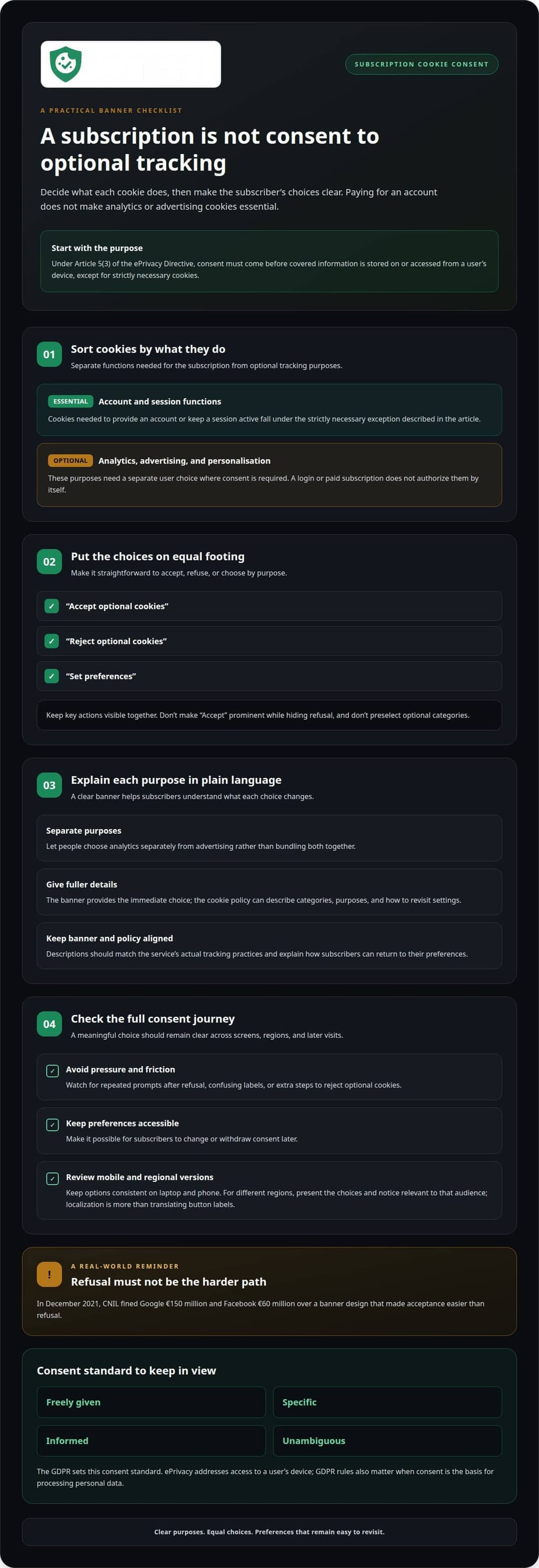
A paid subscription doesn’t make tracking cookies essential. Cookie consent for subscription services still depends on what each cookie does: under Article 5(3) of the EU ePrivacy Directive, consent is required before covered information is stored on or accessed from a user’s device, except for strictly necessary cookies.
That distinction matters when a service uses cookies for analytics, advertising, or personalisation alongside tools needed to provide an account or keep a session active. The GDPR defines valid consent as freely given, specific, informed, and unambiguous. Taking out a subscription does not replace these conditions.
Clear choices help subscribers understand what they agree to and how to change their minds. This article explains how cookie consent works for subscription businesses, which choices to present, and how GDPR and ePrivacy requirements shape consent and withdrawal. It also clarifies the difference between essential and optional cookies, so you can build a consent experience that respects user choice and accurately explains how the service works.
Key Takeaways
- Separate cookies needed to provide the subscription from analytics and advertising cookies that require a user choice.
- Make accepting and rejecting optional cookies equally clear, and explain each purpose in plain language.
- Support relevant privacy signals and consent frameworks to manage preferences across different regulatory contexts.
- Offer choices by purpose and make it easy for subscribers to change or withdraw consent later.
- Build consent flows around the GDPR and ePrivacy rules that apply to your users, not just your business location.
What is cookie consent?
Cookie consent for subscription services records a person’s informed choice about cookies and similar technologies. The key question is whether each cookie supports a requested account function or serves an optional purpose.
Analytics and Advertising Cookie Consent
Consent for analytics and advertising cookies means getting permission before using non-essential cookies for measurement or promotion. Paying for an account does not automatically make these cookies necessary to deliver the subscription.
Under Article 5(3) of the ePrivacy Directive, consent must come before covered information is stored on or accessed from a user’s device. The exception covers cookies that are strictly necessary. An analytics cookie measuring visits or an advertising cookie targeting promotions does not become essential merely because someone subscribes.
When a service processes personal data, the GDPR’s consent standard also matters: consent must be freely given, specific, informed, and unambiguous. Separate analytics and advertising purposes so subscribers can choose between them rather than accepting both together.
Consent Across Jurisdictions
Different laws can shape cookie choices according to a service’s users and activities. This matters to international subscription businesses, because one banner may need to support distinct privacy rights.
In the UK, regulation 6 of PECR sets out cookie consent rules. Brazil’s LGPD and South Africa’s POPIA are also relevant. Privacy rules can require businesses to explain data collection and give users choices about their personal information.
The CCPA can apply to businesses that buy or sell personal information of at least 100,000 consumers or households, according to the California Privacy Protection Agency. Map users and data practices before implementing a global consent flow, since requirements depend on the relevant jurisdiction and activity.
GDPR and ePrivacy Requirements
The GDPR and ePrivacy Directive govern different aspects of cookie consent. They apply together because ePrivacy addresses access to a user’s device, while GDPR rules apply when consent is the basis for processing personal data.
Article 5(3) of the ePrivacy Directive, Directive 2002/58/EC, requires prior informed consent before covered information is stored on or accessed from terminal equipment, except for strictly necessary cookies. The GDPR defines consent in Article 4(11) and sets consent requirements in Article 7.
When managing cookie consent for subscription services, distinguish account functions from optional tracking. A login does not itself authorize analytics or advertising cookies. Respect the subscriber’s choice before activating those optional technologies.
Cookie Banner Disclosures
A cookie banner explains what technologies do and presents a meaningful choice. A vague prompt does not make clear what subscribers are authorizing.
Describe purposes in plain language, distinguish essential cookies from optional categories, and provide fuller details before users decide. For an opt-in banner used globally, make rejecting optional advertising or third-party cookies as easy as accepting them.
In December 2021, CNIL fined Google €150 million and Facebook €60 million over a banner design that made acceptance easier than refusal. Treat the banner as a decision point: show clear options, record the selection, and make preferences accessible again.
Consent banner customization and user preferences
A well-designed banner gives subscribers clear control over cookie preferences. Its layout, language, and choices should reflect the service and the regions it serves.
Designing Refusal Options
Clear refusal options let people decline optional cookies without navigating confusing screens. Making refusal difficult can undermine a meaningful choice.
Keep key actions visible together, such as “Accept optional cookies,” “Reject optional cookies,” and “Set preferences.” Don’t make “Accept” bright and prominent while hiding refusal in a text link. Don’t preselect optional categories. Clear design lets subscribers decide without pressure.
Customization should clarify choices, not steer people toward tracking. Use concise labels for each purpose and explain what each choice changes. For example, distinguish analytics used to understand service use from advertising cookies used to personalise promotions. Separate controls in a preference panel ensure that accepting one purpose doesn’t silently enable another.
Dark patterns can show up in small design decisions, such as repeated prompts after refusal, confusing button labels, or an extra step to reject. Review the whole journey, including mobile screens and account pages. Subscribers should find the same preference options whether they first see the banner on a laptop or a phone.
Geotargeting can display a localized banner based on a visitor’s region. For an international subscription platform, localization involves more than translating “Accept” and “Reject.” Present the choices and notice relevant to each audience. Keep the language consistent with the service’s privacy policy, and don’t present a regional rule as universal.
Cookie Policies and Banners
A cookie banner provides the immediate choice interface; a cookie policy gives fuller details about cookies and their purposes. Both matter because a short prompt cannot explain every tracking practice.
Use the banner to summarize choices and connect its preference controls to clear explanations. The policy can identify cookie categories and purposes, and explain how subscribers can revisit settings. Keep the two aligned: if the service adds an analytics tool, update its description and the relevant preference category.
Localization also requires a review process. When a subscription service adds a language or enters a new market, update the banner text and relevant policy content together. Check that translated labels still distinguish optional advertising from essential account functions. Clear wording helps subscribers understand their choices before selecting an option.
Testing design variants can reveal whether people understand the options, but the test should measure clarity, not pressure. Compare layouts, labels, and preference-panel flows while preserving genuine choices. If you’re assessing how consent tools fit your setup, review the available platform options.
Global Privacy Control and IAB Transparency and Consent Framework support
Subscription services may need to handle browser privacy signals, advertising preferences, and different state privacy laws. A consent management platform can help translate these choices into consistent technical signals, but a signal and a user’s broader privacy information serve different purposes.
Global Privacy Control (GPC) is a browser signal that communicates a user’s opt-out preference. A service can detect the signal and apply it to relevant data practices, rather than treating it as another banner button. Its practical effect depends on the applicable laws and activity. A GPC signal does not explain every cookie purpose, replace a privacy notice, or record an explicit choice for unrelated processing.
For example, a subscriber may send a GPC signal while using an account that also has analytics cookies. The service needs a defined process for interpreting the signal, applying it to relevant sale or sharing practices, and keeping other choices separate. This distinguishes a broad opt-out preference from granular controls for analytics or advertising.
The IAB Transparency and Consent Framework (TCF) provides a standardized way to communicate consent and preferences across participating advertising technology providers. That technical coordination can help subscription services using programmatic advertising pass applicable choices through the ad supply chain. It does not decide what consent the service needs; the service’s purposes and applicable laws still shape the banner and configuration. An implementation should map each purpose to the related choice and signal. IAB TCF support is relevant when a service needs to communicate those preferences within the framework.
A cookie policy and a privacy policy have related but different purposes. The cookie policy focuses on cookies and similar technologies, their purposes, and how users manage preferences. The privacy policy explains broader data practices, such as what personal information the service processes and why. A banner offers a concise decision point; neither policy replaces it. Keep descriptions consistent across all three, including when an analytics tool or advertising partner changes.
US state privacy laws also make business scope important. The California CCPA can apply to businesses that buy or sell personal information of at least 100,000 consumers or households, according to the California Privacy Protection Agency. The Utah UCPA combines a revenue threshold with a specified data-processing or data-sale threshold. Virginia’s VCDPA includes a threshold of 100,000 Virginia residents during a calendar year. Minnesota’s MCDPA has thresholds based on consumer data processing and revenue from data sales.
These differences matter to subscription platforms serving customers across state lines. Map relevant users, data practices, and signals, then configure the consent experience to reflect each applicable obligation. A single banner can provide a consistent interface, but its technical behavior must account for different opt-out rights and advertising workflows.
Granular consent choices and withdrawal mechanisms
Granular controls let subscribers choose among separate cookie purposes instead of accepting every optional technology at once. Clear records and accessible withdrawal controls make those choices usable over time.
Granular Consent Choices
Granular consent means a subscriber can accept one optional purpose, such as analytics, without accepting another, such as advertising. Bundled choices can obscure what a person actually agreed to.
Present categories separately and describe their effects in plain language. A subscriber might allow analytics while rejecting advertising cookies, while essential cookies remain separate because they support a requested service function. Keep each selected state visible in the preference panel, so users can review their choices without repeating the original banner flow.
Choice design should match the technologies the service actually uses. If an analytics tool changes, update its category and explanation rather than leaving outdated information in place. A consent record can capture the preference, relevant purpose, and when the selection was made. This creates a useful history for handling questions and reviewing whether the service followed the user’s choice.
Records can also reveal mismatches between consent and behavior. For example, an audit can compare a stored refusal of advertising cookies with whether those cookies were later activated on the device. Review the banner, preference panel, and cookie behavior together: a record alone cannot show whether a technology respected the choice.
Consent Withdrawal Mechanisms
A withdrawal mechanism lets a subscriber change or remove an earlier consent choice. Consent is not permanent permission; users must be able to revise it.
GDPR Article 7(3) requires organisations to provide a way to withdraw consent at any time, as easily as consent was given. Keep a persistent preference link in an account or site interface, rather than requiring users to find the original banner again. When someone withdraws advertising consent, the preference should update across the relevant consent record and technologies.
Withdrawal should have a clear effect. The service should stop relying on withdrawn consent for the relevant purpose and prevent related optional cookies from being set or read. It should not disable essential cookies needed for a requested account function. Make the updated state easy to review, including on another visit or device where the service recognizes the same consent profile.
Retention also needs a defined policy. CNIL recommends retaining cookie consent choices for a maximum of 13 months. Set a review process for records, and distinguish current preferences from older entries. During an audit, trace a choice from the banner through the stored record to the behavior of each relevant cookie. That chain shows whether the user’s decision was captured and applied.
Cookie consent rules under the GDPR and ePrivacy Directive
EU subscription websites must obtain consent before setting non-exempt tracking cookies, regardless of where the business is located. UK services follow regulation 6 of PECR, alongside applicable data protection rules.
EU and UK Subscription Website Requirements
These requirements govern when a subscription service may store information on or access a user’s device. A paid account does not remove the need for consent to optional tracking.
In the EU, Article 5(3) of the ePrivacy Directive requires prior informed consent for covered cookies, except those strictly necessary for the requested service. The GDPR also requires consent to be freely given, specific, informed, and unambiguous when consent is the basis for processing personal data. A login or payment does not itself authorize analytics or advertising cookies.
The Court of Justice of the European Union ruled in Planet49 that pre-ticked checkboxes do not constitute valid consent in Case C-673/17, decided in October 2019. Under UK regulation 6 of PECR, the same practical distinction matters: identify essential cookies, then prevent non-essential cookies from activating before the user consents.
These rules can apply even when a service operates outside Europe but serves EU users. A California-based subscription website, for example, cannot rely on its location alone to avoid EU cookie requirements for those visitors.
Penalties and Compliance Risks
Failing to respect cookie rules or user choices can bring penalties and other compliance risks. The consequences go beyond financial exposure: tracking after refusal can prompt complaints, investigations, and a loss of subscriber trust.
For certain GDPR infringements, the maximum fine is €20 million or 4% of global annual turnover. Since 5 February 2026, the maximum UK cookie-rule fine is £17.5 million or 4% of worldwide turnover. These are maximums, not automatic penalties for every error.
Operational failures can create evidence of non-compliance. For example, a banner may offer a refusal choice while advertising cookies still load on the first page. A service also risks non-compliance if it changes analytics tools but fails to update its cookie notice or consent settings. Regularly test banner choices against actual device behavior, including after subscribers change their preferences.
EU authorities generally do not accept cookie walls that require visitors to accept tracking before accessing a service. For subscription businesses, paid access does not automatically make consent freely given. Review each cookie’s purpose, when it activates, and how refusal affects access. A compliant process connects the notice, the user’s selection, and the site’s technical behavior.
For help implementing consent controls across these requirements, explore consent platform options.
Conzent
Conzent helps subscription services give users clear consent choices. Its Managed Cloud Consent Platform runs in the cloud, while its Self-Hosted Open Consent Infrastructure runs on a service’s own systems. Consent A/B Testing lets teams compare banner options, and Revenue Impact Analytics shows how consent choices affect performance. This is useful when a service needs to manage preferences across its subscription experience and understand how consent choices affect performance. Conzent helps services make choices clear, respect subscriber preferences, and measure results while protecting privacy.
To discuss how Conzent can help with your consent setup, contact Conzent.
Build consent into your next product decision
Your next step is to make consent part of product operations, not a banner you launch once. A new subscription tier, analytics integration, or advertising partner can change how your service uses data. Treat each change as a prompt to review its purpose, the choices subscribers see, and whether the experience still reflects those choices.
This approach makes cookie consent for subscription services an ongoing design practice. Assign ownership for reviewing changes, keep consent settings aligned with the tools in use, and include preference flows in product testing. Clear processes help teams respond deliberately as the service evolves instead of leaving outdated choices in place.
Choose an approach that fits your infrastructure and how your team manages consent. Explore consent options with Conzent as you plan your next update. Before each release, check that consent settings match the data uses and choices subscribers see.
Frequently Asked Questions
How Does the GDPR Apply to Cookies?
The GDPR applies when cookies or related technologies process personal data. A cookie identifier, IP address, or device fingerprint can identify or relate to a person, even without their name. For a subscription service, consider what data an analytics cookie collects and whether it links activity across sessions. The GDPR works alongside cookie-specific rules, so assess both the data processing and the technology’s access to a user’s device.
What happens if I don't accept cookies?
If you reject optional cookies, those technologies should not be used for their optional purposes. Essential cookies may still operate to support functions you request, such as keeping you signed in or maintaining a checkout session. You might lose optional features such as personalized advertising or analytics-based recommendations. A subscription service should clearly explain any functional effects and avoid making access depend on accepting tracking where that would undermine freely given consent.
Which law sets the cookie rules?
The applicable law depends on where your subscribers are and what your service does. In the European Union, the ePrivacy Directive sets rules for storing information on or accessing information from devices, while the GDPR governs personal-data processing. In the United Kingdom, regulation 6 of PECR sets out cookie rules. A service serving subscribers across these markets should account for each relevant regime rather than treating one privacy notice as a universal rule.
What cookie consent laws apply to subscription services in the United States?
The United States has state privacy laws rather than one general federal cookie-consent rule in the facts covered here. California’s CCPA and CPRA are relevant to collection, sale, sharing, and sensitive personal information. Other state laws, including the Texas TDPSA, Utah UCPA, Virginia VCDPA, and Minnesota MCDPA, have different scope and applicability tests. Subscription services should assess their data practices and customer reach against the laws relevant to their operations.
Do subscription services need consent before using analytics and advertising cookies?
For users covered by EU cookie rules, a subscription service must obtain consent before setting non-exempt tracking cookies. Analytics and advertising cookies are not automatically essential just because the user pays for access. For example, a cookie measuring marketing campaign performance serves a different purpose from one that maintains a logged-in session. Classify each technology by its actual function, then ensure the consent choice matches that purpose.
How do state privacy laws such as CCPA/CPRA affect cookie consent for subscriptions?
CCPA/CPRA obligations can affect how subscription services disclose collection and honor choices about selling or sharing personal information. Advertising cookies may be relevant when they enable sharing for cross-context behavioral advertising. California law also requires prior consent before selling or sharing personal information belonging to known children under 16. Review the data flow behind each advertising tool, not just the cookie’s label, and connect applicable opt-out choices to that flow.
How should a subscription service configure a cookie consent banner and preference center?
Use the banner for a clear initial decision, then let the preference center explain and control separate purposes. For example, offer distinct settings for analytics and advertising rather than bundling them as “all cookies.” Keep the interface readable on mobile, use labels that describe actual functions, and ensure saved choices affect the corresponding technologies. If the service changes a tool or purpose, update both the settings and the explanation subscribers see.
How can subscribers withdraw or change cookie consent after signing up?
Provide a persistent privacy or cookie settings link in the account area, footer, or another easy-to-find location. Subscribers who change their minds should be able to reopen preferences, switch off a category, and save the updated choice without contacting support. Apply the change to the relevant technologies and retain an accurate record of the new selection. Keep this control available after account creation, not just during signup.