
Cookie Consent Without Monthly Fees: What to Check in 2026

A zero-dollar subscription isn’t the same as a zero-maintenance consent setup. If recurring software fees are climbing as your site grows, cookie consent without monthly fees can be a practical alternative. But the free option still needs to meet your technical and privacy needs.
The key is understanding what “free” includes. Self-hosting can remove software subscription charges, while leaving deployment and ongoing operation to your team. A free cloud trial can make it easier to evaluate a hosted service, but it isn’t the same as ongoing free cloud access. Managed plans trade a recurring charge for hosted operations. The right choice depends on how much control your team wants and what it can maintain.
This guide compares these models using practical criteria, including site limits, integrations, maintenance, and support for current standards. Conzent offers free, open-source self-hosting with unlimited sites and pageviews, alongside managed cloud plans with pricing that can decrease as sponsorship revenue grows. Its audited IAB CMP supports IAB TCF v2.4, including v2.3 and v2.2. Use the comparisons below to choose a setup that fits your site without overlooking the work behind consent.
Key Takeaways
- Separate software licensing from the costs of hosting, setup, maintenance, and staff time.
- Compare self-hosted software, hosted trials, and one-time payment options by how each handles ongoing work.
- Check whether a CMP supports the consent, logging, scanning, blocking, integration, and export features your site needs.
- To assess cookie consent without monthly fees, map your sites, technical requirements, hosting needs, and integrations before choosing a model.
- Estimate the staff time your team can commit to setup and maintenance, then weigh that effort against the convenience of managed cloud service.
Cookie consent without monthly fees: what does it really mean?
Cookie consent without monthly fees means using a consent tool without a recurring software subscription. It describes how the software is priced, not whether every part of running it is free. Hosting, setup, configuration, maintenance, and staff time can still require resources. The useful comparison is not simply “free versus paid.” It’s what your team pays for, what it manages, and what your consent setup needs to do.
What counts as cookie consent without a monthly subscription?
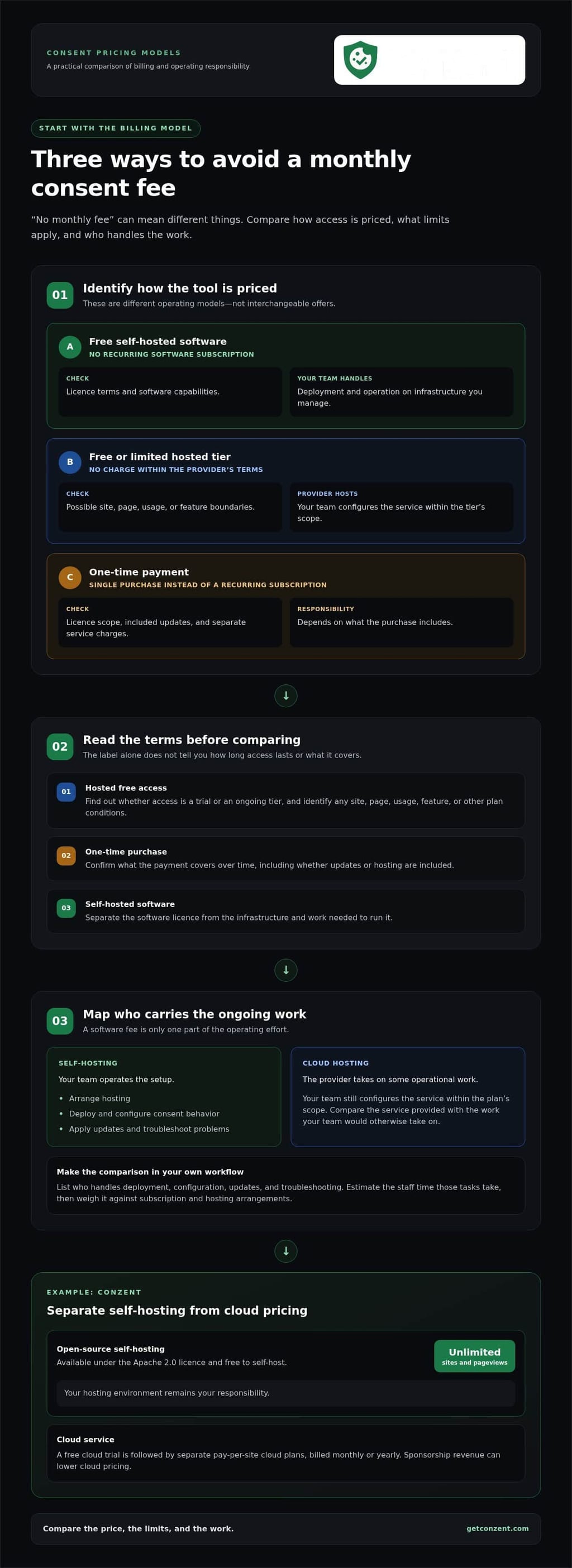
There are three common arrangements. With free self-hosted software, you run the software on infrastructure you manage. A free cloud trial lets you evaluate a hosted service, but doesn’t necessarily mean ongoing access is free. A paid cloud plan charges on a recurring basis for hosted service. These are different operating models, even if each can put a consent banner on a site.
Free cloud plans also differ in their terms and limits. Some may restrict features, sites, or usage; others may set different conditions. Read the specific plan terms and compare them with your requirements rather than assuming “free” means the same thing everywhere.
Where can costs and effort still appear?
Self-hosting removes the software subscription when the licence is free, but someone still needs to operate the setup. Depending on your infrastructure and workflow, that may include arranging hosting, deploying the software, configuring consent behavior, applying updates, and troubleshooting problems. Some teams can handle these tasks with existing skills and systems. Others may need to allocate staff time or budget for infrastructure. Paid support isn’t automatically required.
Cloud hosting shifts some operational work to the provider. A paid cloud plan can make recurring costs easier to anticipate, while the amount may depend on the plan’s pricing structure. Compare the service you receive with the work your team would otherwise take on.
Recurring fees attract scrutiny as a website adds properties, traffic, team members, or consent requirements. A plan that fits a small site today may not be the right operational or pricing fit later. That doesn’t make subscriptions inherently bad, or self-hosting automatically cheaper overall. Assess each model against your likely workload and capacity, not just its starting price.
Before choosing, list who will handle deployment, configuration, updates, and troubleshooting. Estimate the time those tasks take in your own workflow, then compare that effort with each option’s subscription and hosting arrangements. For a closer look at self-hosting, Conzent’s self-hosting approach explains how open consent infrastructure can run without a monthly software fee. Choose a setup your team can operate reliably, with costs and responsibilities clear from the start.
Three cookie consent pricing models that can avoid monthly fees
Cookie consent without monthly fees can refer to different pricing arrangements. The main distinction is whether the software is free to run on your infrastructure, offered through a hosted trial or tier, or sold for a one-time payment. Compare the billing basis, access terms, and included services before treating two “no-monthly-fee” options as equivalent.
Pricing model | Pricing structure | Limits to examine | Operating responsibility
Free self-hosted software | No recurring software subscription | Licence terms and software capabilities | Your team controls how it is deployed and operated.
Free or limited hosted tier | No charge while access remains within the provider’s terms | Possible site, page, usage, or feature boundaries | The provider hosts the service; your team configures it within the tier’s scope.
One-time payment | Single purchase instead of a recurring subscription | Licence scope, included updates, and any separate service charges | Responsibilities depend on what the purchase includes.
These labels describe billing, not identical offers. A one-time purchase can have a defined licence scope or separate charges for services. A free hosted tier can be available only while an account stays within its terms. Review the plan details rather than assuming “free” or “lifetime” means unlimited access to every feature.
Self-hosted software: no subscription, more operational ownership
With self-hosted software, the licence and infrastructure are separate parts of the decision. Conzent’s open-source platform is available under the Apache 2.0 licence and is free to self-host, with unlimited sites and pageviews. Your hosting environment remains your responsibility. Teams comparing deployment approaches can use self-hosted consent deployment as a reference for how this model works.
A cloud trial is different from ongoing free cloud access. Conzent offers a free cloud trial, followed by separate pay-per-site cloud plans billed monthly or yearly. Sponsorship revenue can lower cloud pricing. These terms make the cloud option a different pricing model from free self-hosting.
Hosted tiers and one-time payment options: read the terms closely
For any free hosted plan, identify the point at which access changes: a site count, page allowance, feature boundary, or other plan condition. For a one-time payment, check what the payment covers over time, including whether updates or hosting are part of the offer. Those details determine whether a plan remains suitable as your requirements change.
Compare the terms that matter to your sites, then review Conzent’s cloud pricing options alongside the free self-hosted route.
Does a no-monthly-fee CMP still cover the consent features you need?
A low price tells you how a tool is billed. It doesn’t tell you whether the tool covers your site’s consent workflow. Before choosing cookie consent without monthly fees, check what the CMP does from a visitor’s first page view through to the records and signals your team needs afterward. A banner alone may not cover every operational requirement.
Use this checklist to compare the functions you need. Look at what the tool does, how it connects to your site, and how your team can verify its behavior. Conzent’s consent platform combines a customizable banner with scanning, logging, blocking, integrations, policy generators, and revenue impact analytics.
Check consent signals, records, and integrations
Consent collection captures a visitor’s choice. Logging helps your team review what choice was recorded and when; it can support internal review, but it doesn’t guarantee a legal outcome. Integrations matter too. Ad-supported publishers may need IAB TCF support, while sites using Google services may need Google Consent Mode v2. Check that the CMP supports the relevant standard and that the integration works with your site’s actual setup. The IAB Transparency and Consent Framework is relevant when your advertising workflow depends on standardized consent signals.
- Consent collection: Can visitors make the choices your site needs to offer, and can they revisit or change those choices?
- Records and export: Does the CMP keep consent logs, and can your team access or export records for its own review?
- Scanning and blocking: Can it identify relevant cookies or trackers, and does it prevent them from running until the required choice is made?
- Integrations: Does it connect with your content platform, analytics, advertising tools, and required consent standards, including Google Consent Mode v2 or IAB TCF?
- Maintenance: Can your team keep configurations and integrations working as your site changes?
For teams that rely on IAB signals, confirm the exact framework version rather than relying on a general claim of “TCF support.” Conzent is audited as IAB CMP #446 and supports IAB TCF v2.4, including v2.3 and v2.2. Compare that capability with your publishing and integration needs, then test the signals in your own setup.
Check visitor experience and site performance
The consent interface affects how visitors understand and use their choices. Compare banner layouts, language coverage, and how clearly the options are presented. Then look at performance and behavior during page loading. Consent choices should take effect as intended, rather than after connected scripts have already run.
Conzent provides 9 banner layouts, dark and light themes, and support for 86 languages. Its script load time is sub-50 ms. Use these specifications as comparison points, then test the CMP on your own pages. Check the banner on common screen sizes, switch its language, and observe whether relevant scripts behave according to the selected consent state.
How to compare the real effort behind cookie consent without monthly fees
A fair comparison starts with one shared set of requirements. Don’t compare a self-hosted setup covering every site and integration you need with a cloud plan that covers only some of them. Map your workload first, then compare the operating effort and billing for each option against that same scope.
Map your sites, traffic model, and required functions
Write down what the CMP must support before comparing plans. Include each website and CMS, the regions and languages you serve, and the consent features or integrations your team relies on. Then note how each option defines its pricing basis and any usage boundaries. That gives you an apples-to-apples comparison, not a headline-price contest.
- List the sites. Record the number of websites and the CMS or platform each uses. Note any differences in how consent needs to work across them.
- Describe your audience and setup. Include relevant regions and languages, plus the consent functions and integrations your team needs.
- Record each plan’s pricing measure. Check whether billing is based on sites, traffic, pages, or another published measure. Note any caps that could affect your current or planned use.
- Assign the operational work. For each model, identify who handles deployment, configuration, updates, backups, and incident response. If responsibilities are shared, name the team that owns each task.
- Estimate staff time. Use your own workflow. Consider the initial setup and the recurring work your team expects to do, rather than relying on generic industry averages.
Account for setup, maintenance, and growth
Compare self-hosting and managed cloud using the same sites, requirements, and expected growth. With self-hosting, include the infrastructure and staff effort your team will take on. With managed service, account for the work Conzent handles and the plan’s billing basis. Compare the hosted service with the tasks your team would otherwise own.
Test the comparison against a realistic change, such as adding a site, adopting another integration, or increasing traffic. Conzent uses pay-per-site cloud pricing, and sponsorship revenue can lower that pricing. One Conzent customer reports that their bill did not change when their traffic roughly doubled. That is an individual customer report, not a forecast for every site. Use your own expected scope and the current plan terms.
Now compare the recurring plan with self-hosting side by side. Include subscription charges, hosting arrangements, staff time, and the work each model assigns to your team. This shows what “no monthly fee” means for your operation, rather than treating the subscription line as the whole picture.
Once you have that comparison, review Conzent’s current pricing options against your sites and operating needs.
How Conzent offers cookie consent without monthly fees for self-hosting
Choosing between Conzent’s self-hosted and cloud options comes down to how your team wants to run consent. Self-hosting is the direct route for teams seeking cookie consent without monthly Conzent software fees. It is free regardless of site count and includes unlimited sites and pageviews. Managed cloud is a separate pay-per-site service for teams that prefer Conzent to host the platform. The choice is about operational ownership as well as billing.
What Conzent includes in its open consent platform
Conzent’s consent platform includes a cookie banner, automatic cookie scanning, consent logging, policy generators, integrations, and revenue impact analytics. It also supports A/B testing, Google Consent Mode v2, and IAB TCF v2.4. All features are included in every plan, so the operating model doesn’t mean choosing between a reduced and a full feature set.
Self-hosting fits teams that want to run the platform in their own environment and have the technical capacity to manage that setup. Conzent’s native integrations include WordPress, Wix, Joomla, Drupal, TYPO3, and Umbraco. You can also add the platform to a site with one script tag. Review the deployment approach in the self-hosting guide, then assign an owner for configuration and routine platform operations.
Choose self-hosted or managed cloud based on your team
Managed cloud suits teams that would rather use a hosted service than operate the platform themselves. Its plans use pay-per-site pricing, with monthly or yearly billing options. Yearly billing gives an approximately 20% discount, and sponsorship revenue can lower cloud pricing. Compare these terms with your preferred billing cycle and the number of sites you plan to manage.
To make the decision practical, ask your team:
- Who will own the platform? Choose self-hosting if your team is ready to manage deployment and ongoing operation. Choose cloud if you prefer a managed service.
- What work can your team absorb? Consider technical capacity, existing hosting processes, and how routine changes will be handled.
- Which billing structure fits? Compare the pay-per-site cloud plan and billing cycle with your preference to operate the platform on your own infrastructure.
Neither route is automatically right for every organization. A team with infrastructure expertise may value control; a lean team may prefer to leave hosting to a managed service. Choose the option that gives your consent setup a clear owner and a sustainable operating plan.
Compare the options against your team’s needs, then compare Conzent plans and choose your consent setup.
Make consent a setup your team can sustain
The best cookie consent without monthly fees is a setup your team can keep working as the website changes. Give someone clear ownership of configuration and routine checks. Keep a simple record of how consent connects to your site’s tools, so future changes don’t leave the setup dependent on guesswork.
Set a review point whenever you add a website, change platforms, or introduce a new integration. Use it to confirm the setup still fits your needs and that the operating workload remains manageable. A clear owner and review habit matter as much as the original pricing choice.
Choose the route that matches how your team works, then take the next step: compare Conzent plans and choose your consent setup. A thoughtful choice gives your team a clearer path as its sites and needs evolve.
Frequently Asked Questions
Is cookie consent without monthly fees suitable for a business website?
Yes, cookie consent without monthly fees can work for a business website if the platform supports its actual setup and the team can keep it running. A small brochure site and a shop using several marketing tools may have different needs. Map the cookies and scripts on your pages, identify the consent choices visitors need, and test the setup before using it on your live site.
Can a free cookie consent platform support Google Consent Mode v2?
It can, but a free price or open-source licence doesn’t guarantee that capability. Conzent includes Google Consent Mode v2, with basic and advanced signaling for Google Ads, Analytics, and Tag Manager. For any CMP, review its integration guidance and test it with your actual tag configuration. Verify that consent signals change when a visitor makes or updates a choice, and that tags respond as intended. A staging site gives you a safer place to find configuration errors.
What happens if a cookie consent banner fails to load?
It depends on the platform’s failure behavior. Conzent’s Auto-Block Until Consent keeps scripts, cookies, and trackers blocked if the banner fails to load, rather than treating the missing interface as permission. Test this path in a controlled environment by making the banner unavailable and checking whether the relevant scripts remain blocked. Include the test in deployment checks so a future site change doesn’t quietly alter the result.
Can one cookie consent platform cover multiple websites without monthly fees?
Sometimes, but the answer depends on the software licence and how each site is configured. Conzent’s self-hosted platform is free with unlimited sites and pageviews. A shared platform can simplify administration, but sites may use different scripts, domains, or consent settings. Make an inventory of each site and test its configuration separately. Consider whether each site needs its own banner settings, records, or integrations.
Do I need to maintain a self-hosted cookie consent platform?
Yes. Plan for more than installing it once. Assign an owner to review updates, check that integrations still work after site changes, and keep a tested recovery process for the platform and its configuration. A simple change log can help the team trace problems back to a deployment or settings update. The exact routine should reflect your hosting environment and how your websites are maintained.
Does open-source cookie consent software provide IAB TCF v2.4 support?
Not automatically. Open-source describes how software is licensed, not which technical standards it implements. Conzent is audited as IAB CMP #446 and supports IAB TCF v2.4, including v2.3 and v2.2. If your advertising setup depends on those signals, test them with the vendors and tools you use. A general claim of “IAB support” isn’t enough to establish version-specific compatibility.
Will a cookie consent script slow down my website?
Any additional script can affect page loading, but the impact depends on its implementation and the rest of the page. Conzent’s script load time is sub-50 ms. Test key pages before and after adding the CMP, and compare load behavior and the visitor experience. Check mobile as well as desktop, since scripts and page elements can behave differently across devices. Re-test after banner or tag changes, not only during the initial installation.