
Cookiebot vs Self-Hosted Cookie Consent: Reclaiming Compliance Ownership in 2026

Renting your compliance is a liability, not a strategy. For years, the industry has accepted that privacy meant installing a black-box script and paying a monthly tax on every page view. This model is broken. When evaluating Cookiebot vs self-hosted infrastructure, the choice reveals your underlying priorities. One path forces you to trade site performance for legal safety. The other treats privacy as a fundamental technical standard. You shouldn't have to hand over your users' consent data to a third party just to stay legal.
You want predictable costs and absolute control over where your data lives. You need your site to stay fast, hitting those Core Web Vitals without a heavy third-party script dragging you down. This isn't just about a budget. It's about deciding whether you want to own your digital rights or lease them from a distant vendor. Consent is infrastructure; it is not a luxury add-on. True compliance requires owning the data flow, not just renting a banner.
This guide compares these two paths with technical clarity. We'll look at the reality of Google Consent Mode v2 and IAB TCF v2.3. You'll discover how to move from a pay-per-page headache to a streamlined setup that puts you back in charge of your website’s privacy stack.
Key Takeaways
- SaaS models often hide how they process data and punish your growth with scaling fees based on page counts.
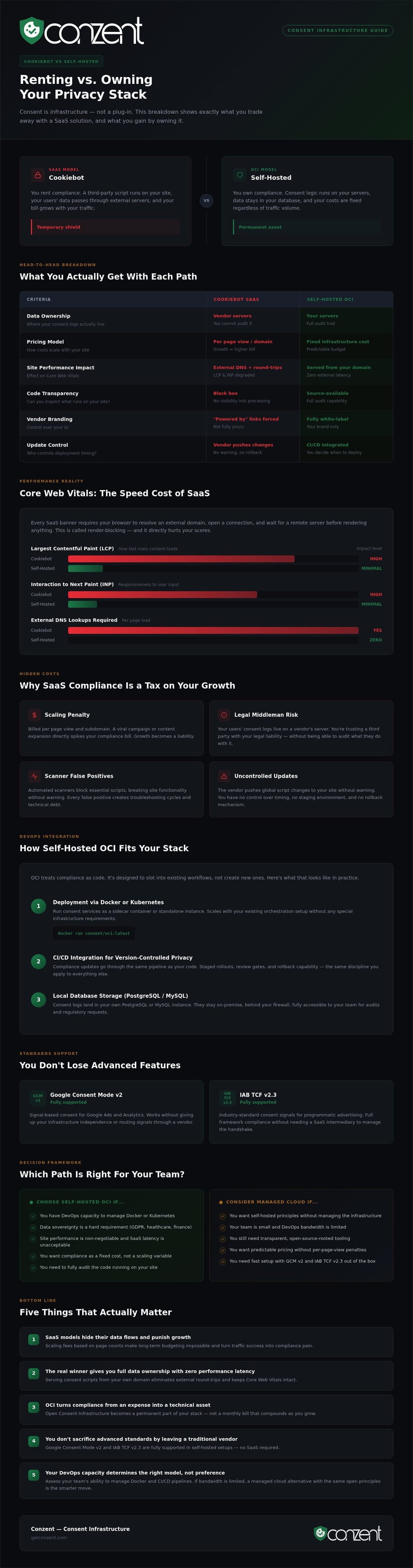
- In the debate of Cookiebot vs self-hosted, the real winner is the one that gives you full data ownership and zero performance latency.
- Open Consent Infrastructure (OCI) turns compliance from a recurring expense into a permanent part of your technical stack.
- You don't have to sacrifice advanced features like Google Consent Mode v2 or IAB TCF v2.3 when moving away from a traditional vendor.
- Learn how to assess your DevOps capacity to decide if a source-available, self-hosted model or a managed cloud alternative fits your team.
The SaaS Convenience Trap: Why Cookiebot Is Not Always the Answer
SaaS platforms like Cookiebot market themselves as the "easy" button for digital privacy. You copy a line of code, and the platform promises to handle the rest. But this convenience is a calculated trade-off. It creates a "black box" where you have zero visibility into how data is processed or where it's stored. When you weigh Cookiebot vs self-hosted options, you're choosing between a rented script and a permanent asset. If you can't audit the code running on your site, you don't truly own your compliance. You're simply renting a temporary shield.
Sending your users' consent logs to a third-party server introduces a secondary risk. You're effectively trusting a middleman with your legal liability. The primary differentiator here is control. Self-hosting ensures that your data stays on your infrastructure. It removes the middleman and keeps your legal records under your own lock and key. This is the only way to achieve true data sovereignty in a landscape of increasing regulatory scrutiny.
Pricing volatility is another hidden burden of the SaaS model. Most vendors bill based on page counts or subdomains. This model effectively punishes site growth. If a marketing campaign goes viral or you expand your content library, your compliance bill spikes. It's a tax on your success that makes long-term budgeting impossible for growing enterprises.
The hidden costs of automated scanning
Automated scanners are often sold as a "set and forget" safety net. In practice, they're often blunt instruments that trigger false positives. These scanners frequently block essential scripts, breaking site functionality without warning. This creates a cycle of constant troubleshooting and technical debt. Contrast this with owned infrastructure, where you define the rules based on your specific technical needs. You move away from unpredictable monthly invoices and toward a stable, manageable technical stack that respects your resources.
Third-party dependencies and site speed
Performance isn't just a luxury; it's a core component of user experience and SEO. SaaS solutions require external DNS lookups and connections to remote servers before the banner can even render. This latency directly degrades your Core Web Vitals, specifically impacting Largest Contentful Paint (LCP) and Interaction to Next Paint (INP). By serving the consent script from your own domain, you eliminate these external round-trips entirely. This ensures that privacy doesn't come at the cost of speed.
Render-blocking is a technical state where the browser stops displaying page content until a specific script is fully downloaded and executed.
Understanding Self-Hosted Consent Infrastructure
Self-hosting isn't just a technical preference. It's a declaration of independence. Open Consent Infrastructure (OCI) moves the logic of privacy from an external SaaS dashboard to your own servers. We're seeing a fundamental shift from simple "Cookie Banners" to robust "Consent Management Systems." A banner is just a cosmetic layer. A system is a piece of infrastructure that handles logic, storage, and auditing. It's the difference between renting a security guard and building your own vault.
When comparing Cookiebot vs self-hosted setups, the primary benefit is security. Your consent logs stay behind your firewall. They live in your database, not a vendor's. This solves the transparency problem by giving you total visibility into the data flow. You also gain absolute control over the user experience. There's no vendor-enforced branding or "Powered by" links to clutter your interface. Your site remains your own, visually and technically.
How self-hosting works for modern DevOps teams
Modern teams don't want to manage scripts manually. OCI is designed to fit into existing workflows rather than creating new ones. It treats compliance as code, allowing for a more disciplined approach to privacy.
- Deployment: Use Docker or Kubernetes to run consent services as a sidecar or standalone instance.
- CI/CD: Integrate compliance updates directly into your deployment pipelines for version-controlled privacy.
- Storage: Leverage your own PostgreSQL or MySQL database to keep consent logs local and accessible.
This allows you to control the update cycle. You're no longer at the mercy of a SaaS vendor's global script changes. You decide when and how to deploy updates across your infrastructure.
Privacy by design: Zero third-party data leaks
Third-party CMPs often become targets for "Consent Scraping." This happens when external scripts harvest user preferences from a common SaaS endpoint. By self-hosting, you close this door. You meet the strictest requirements of GDPR and the ePrivacy Directive by ensuring no data ever leaves your perimeter. This isn't a premium feature; it's the necessary standard for any data-sovereign enterprise.
For those who need deep technical details on implementation, you can view the OCI technical specs. This transparency is what makes OCI a reliable choice for developers and privacy officers alike. If you're ready to move beyond the SaaS trap, you can explore our managed and self-hosted options to find the right fit for your infrastructure.
Cookiebot vs Self-Hosted OCI: A Direct Comparison
Comparing Cookiebot vs self-hosted infrastructure isn't just about comparing features. It's about comparing philosophies. Many assume that choosing a self-hosted model means sacrificing the advanced tools found in a mature SaaS. That isn't true. Modern Open Consent Infrastructure (OCI) offers full feature parity. You get the same granular control, the same categorization, and the same reporting capabilities. You aren't losing functionality. You're simply gaining the freedom to decide how that functionality is deployed.
Maintenance is the standard objection to self-hosting. SaaS vendors promise a "set and forget" experience. In reality, this often means you're locked out of the engine room when things go wrong. A managed self-hosted approach provides a middle ground. You get the stability of professional updates without the lack of transparency. You can test updates in a staging environment before they go live on your production site. This prevents the "broken site" syndrome often caused by silent SaaS script changes.
Scalability behaves differently when you own the stack. SaaS models typically charge more as your traffic grows. If you process millions of consent events, your costs climb. With a self-hosted setup, your costs stay flat. You pay for the infrastructure, not the volume of users. This makes it the only viable choice for high-traffic sites that need to protect their margins while weighing the pros and cons of Cookiebot vs self-hosted models.
Infrastructure vs. Subscription: The Pricing Shift
Paying for a subscription is a recurring drain on your budget. Paying for infrastructure is an investment in your technical equity. When you own your consent stack, the long-term ROI is clear. You eliminate the "per-page" tax and gain a predictable cost structure. This shift in thinking allows you to scale your content without fear of a larger bill. In some cases, community sponsorships can even lower the cost of maintaining your compliance tools. It's about building a sustainable ecosystem rather than feeding a vendor's bottom line.
Compliance agility in 2026
The regulatory landscape is moving fast. You need a system that can adapt to Google Consent Mode v2 without a complete overhaul. For ad-supported publishers, support for IAB TCF 2.3 is a non-negotiable requirement for revenue stability. Infrastructure-level compliance is more resilient to browser changes because it doesn't rely on fragile third-party cookies for its own operation. You're building on a foundation that anticipates change rather than reacting to it. This agility ensures your site stays compliant and your revenue stays protected as the web evolves.
Decision Framework: When to Ditch the Cloud for Your Own Servers
Choosing between Cookiebot vs self-hosted infrastructure shouldn't be a guessing game. It's a technical and strategic assessment of your organization's resources. If you have an active DevOps team comfortable with containerization, self-hosting is a logical step. It moves compliance from an external expense to a managed part of your internal stack. However, if your team is already stretched thin, the maintenance overhead might outweigh the benefits of total control. You must weigh the human cost against the technical freedom.
Complexity also dictates your path. A simple blog might thrive on a basic SaaS script. But if you manage a complex environment with dozens of server-side cookies and intricate script dependencies, a "black box" scanner will eventually fail you. The decision between Cookiebot vs self-hosted systems often comes down to your tolerance for third-party dependencies. Data sovereignty is the final decider. For industries like FinTech or government services, the risk of third-party data leaks is unacceptable. Keeping consent logs behind your own firewall isn't just a preference; it's a security requirement.
The "Who" and "When" of self-hosting
Not every business needs to manage its own servers. Companies that handle sensitive user data or operate at massive scale should prioritize self-hosting to ensure absolute data ownership. This includes SaaS providers, financial institutions, and public sector organizations. If you lack the server resources but still want the benefits of open infrastructure, a managed cloud solution offers a balanced middle ground. Before making the switch, use A/B testing to determine which consent workflows resonate best with your specific audience.
Measuring the technical impact
You can't manage what you don't measure. Start by running a Lighthouse test on your current setup to see exactly how much latency your CMP adds to your site. High-traffic sites often see a measurable drop in Largest Contentful Paint (LCP) just by moving the consent script to their own domain. You should also analyze the revenue impact of your current opt-in rates. If your SaaS banner is driving users away, you're losing more than just a subscription fee.
Transitioning away from a vendor like Cookiebot doesn't mean you have to abandon your history. You can migrate your historical consent logs into your new infrastructure to maintain a continuous audit trail. This ensures you remain compliant during the shift without any gaps in your records. If you're ready to evaluate your options, you can compare our managed and self-hosted plans to see which fits your internal capacity.
Conzent: The Managed Cloud Alternative with Self-Hosted Roots
Conzent exists to resolve the tension inherent in the Cookiebot vs self-hosted debate. We don't believe you should have to choose between technical freedom and operational simplicity. Our Managed Cloud platform provides the same robust Open Consent Infrastructure (OCI) found in our self-hosted version. It's the "no-maintenance" edition of a transparent system. You get the reliability of a professional cloud without the mystery of a closed-source script. We offer clarity, not complexity.
Source-available code is our ethical standard. It's the only way to prove what happens to your users' data. A black box requires blind trust; an open system invites scrutiny. Our mission is to lower the barrier to entry for high-level compliance. Through community sponsorship, we scale down costs for everyone. We're a Danish company focused on European privacy standards, and we've built our tools to meet the most rigorous demands of 2026. You can even start for free by deploying your own Self-Hosted OCI instance today.
Bridging the gap between control and convenience
The Conzent Managed Cloud is designed for teams that value their time as much as their data sovereignty. It removes the burden of server maintenance and manual updates. We provide seamless integrations for platforms like WordPress and Drupal, ensuring your stack remains cohesive. Our platform is built to handle the technical heavy lifting of Google Consent Mode v2 and IAB TCF v2.3 by default. You don't have to be a DevOps expert to run a world-class consent system.
If you're currently locked into a restrictive SaaS contract, our experts provide support for complex migrations. We help you move your records without losing a single consent log. This ensures a smooth transition from a "rented" model to one where you own your compliance destiny. We don't just sell software; we provide the foundation for a more efficient and respectful digital presence.
The ethical choice for 2026
Trust is a currency. In 2026, users are more aware of their digital rights than ever before. Using a transparent CMP builds that trust by showing exactly how you respect those rights. We're not just a vendor; we're advocates for a faster, more open web. The future of privacy isn't found in expensive, opaque subscriptions. It's found in shared standards and efficient infrastructure. Take control of your compliance journey and view Conzent pricing and plans to see how we can support your growth.
Own Your Compliance Stack in 2026
Compliance is not a subscription you can simply set and forget. It's a core technical standard. By moving away from the "black box" SaaS model, you eliminate unpredictable billing and third-party data risks. You regain control over your site's performance and your users' privacy. When weighing Cookiebot vs self-hosted options, remember that true data sovereignty requires owning the logic that governs your consent flow. You shouldn't have to lease your legal safety from a distant vendor.
Conzent provides the middle ground you need. Our platform offers source-available transparency backed by Danish privacy expertise. We ensure you stay ahead of the curve with certified support for Google Consent Mode v2 and IAB TCF v2.3. You don't have to sacrifice ease of use for technical independence. It's time to stop renting your compliance and start investing in a system that respects your resources and your audience. Transparency isn't a luxury; it's the new baseline for digital trust.
Take control of your compliance with Conzent Managed Cloud or Self-Host for free today.
Building a faster, more transparent web starts with the choices you make for your own site. You're ready to lead the way.
Frequently Asked Questions
Is self-hosting a cookie consent manager legal under GDPR?
Yes, self-hosting is entirely legal and often preferred for high-security environments. GDPR requires you to protect user data and maintain clear records of consent. By keeping these logs on your own servers, you eliminate the risk of third-party data leaks. You aren't outsourcing your legal responsibility to a vendor; you're taking direct ownership of your compliance obligations and ensuring data stays within your perimeter.
Can a self-hosted CMP support Google Consent Mode v2?
Absolutely. Conzent's infrastructure provides full support for Google Consent Mode v2. It allows you to communicate user consent states directly to Google's tags without relying on external SaaS middle-men. This ensures your marketing data remains accurate while respecting the latest industry requirements. You get the same advanced features as a cloud provider but with the speed and reliability of local hosting.
How much technical knowledge is required to self-host Conzent?
You need a foundational understanding of DevOps and server management. If your team is comfortable with Docker, Kubernetes, or basic Linux administration, they can deploy our Open Consent Infrastructure easily. We've designed the process to be straightforward for developers. For those who want the power of OCI without the server management, our Managed Cloud provides a seamless, no-maintenance alternative that fits any workflow.
What are the main disadvantages of using Cookiebot?
Cookiebot forces you into a "black box" model with unpredictable costs. Their pricing scales based on your page count, which effectively taxes your site's growth and content scaling. Technically, the platform relies on third-party script execution that can significantly slow down your site. When comparing Cookiebot vs self-hosted solutions, the SaaS model often trades performance and cost-efficiency for a false sense of convenience.
How does self-hosting affect website performance and Core Web Vitals?
Self-hosting significantly improves your site's performance metrics. By serving the consent script from your own domain, you remove the need for external DNS lookups and third-party TLS handshakes. This reduces render-blocking latency and helps you achieve better Largest Contentful Paint (LCP) scores. Your compliance tools should help your site succeed and stay fast, not drag down its technical health with unnecessary external dependencies.
Can I migrate my existing Cookiebot settings to a self-hosted platform?
Yes, you can transition your configurations without losing your historical data. You can export your categorized cookies and consent logs to maintain a continuous audit trail. This makes the switch from Cookiebot vs self-hosted infrastructure a smooth process for any organization. You don't have to start from scratch to reclaim ownership of your data, your performance stack, and your long-term compliance strategy.
Does Conzent offer a free version for small websites?
Yes, our Self-Hosted Open Consent Infrastructure is source-available and free to deploy on your own servers. We believe that privacy is a fundamental right, not a premium luxury. This allows small businesses and independent developers to access enterprise-grade compliance tools without a monthly subscription. We lower the barrier to entry so that everyone can build a more transparent and ethical web regardless of their resources.
What happens if a new privacy law is introduced while I am self-hosting?
You simply update your instance to the latest version of our core software. We continuously monitor global regulations and release updates to ensure our infrastructure remains compliant with standards like IAB TCF v2.3. You maintain the agility to test and deploy these updates on your own schedule. This ensures your site stays protected against new legal requirements without waiting for a SaaS vendor's global rollout.