
E-commerce Consent Rate Optimization: The 2026 Guide to Recovering Revenue

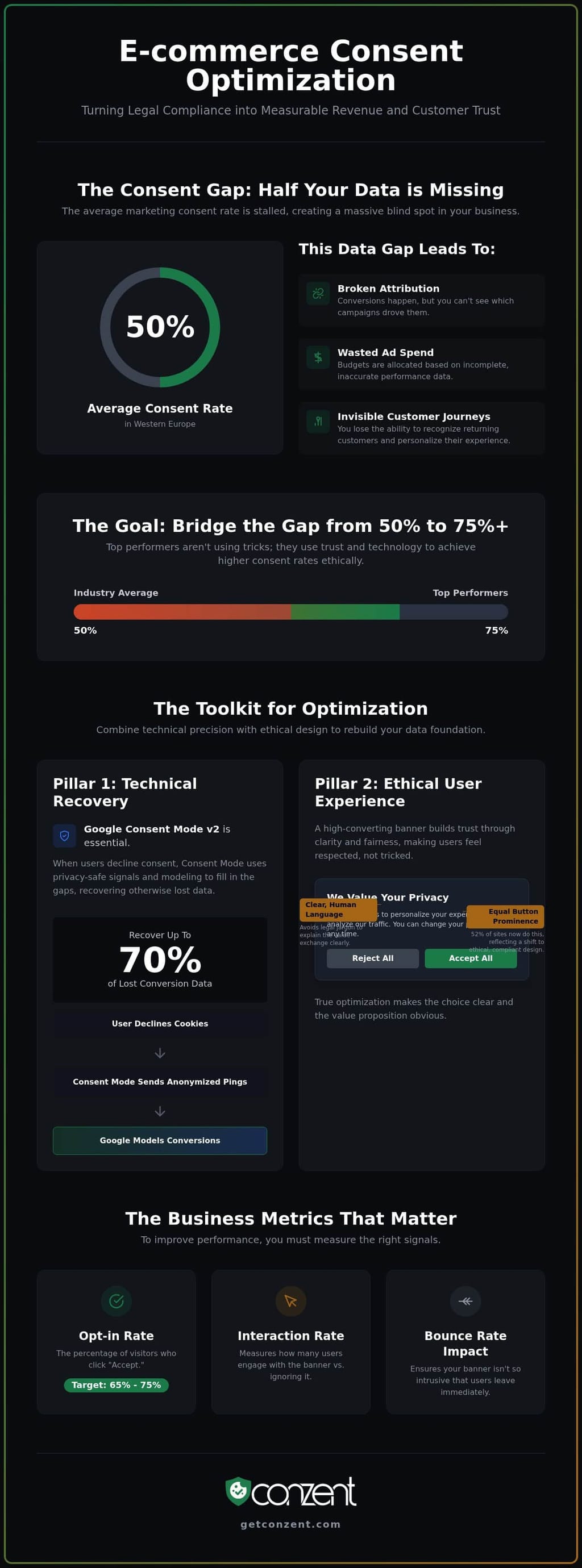
The average marketing consent rate in Western Europe has stalled at 50%, which means half of your customer journey is effectively invisible. For most retailers, this data gap leads to broken attribution and wasted ad spend. It's a systemic failure, not a minor technical glitch. Implementing a principled strategy for e-commerce consent rate optimization is the only way to recover this lost revenue without resorting to illegal dark patterns. You deserve accurate data, and your customers deserve digital dignity. These two goals are not mutually exclusive.
We understand the pressure of navigating Google Consent Mode v2 and the 2026 removal of Google Signals. It's a complex landscape that often feels designed to gatekeep success. This guide promises to demystify those requirements. You'll learn how to maximize legal compliance while capturing the 75% consent rates seen by the industry's top performers. We'll move from philosophical foundations to practical evidence, covering technical precision and the ethical UX designs that build lasting trust. It's time to stop guessing and start measuring again.
Key Takeaways
- Learn why e-commerce consent rate optimization is the essential bridge between legal compliance and accurate revenue attribution.
- Discover how to use Google Consent Mode v2 to recover up to 70% of lost marketing data without compromising user privacy.
- Master the anatomy of a high-converting banner that uses human language and ethical design to drive consent rates above 70%.
- Understand the strategic differences between managed cloud and self-hosted infrastructure for long-term data sovereignty and performance.
Table of Contents
What is E-commerce Consent Rate Optimization (CRO)?
Traditional conversion rate optimization focuses on moving a visitor toward a purchase. What is E-commerce Consent Rate Optimization (CRO)? It is the strategic process of ensuring that your visitors feel confident enough to share their data. This is the difference between a transparent digital handshake and a hidden tracking script. In the specific context of retail, this means maximizing the percentage of users who provide valid, informed consent so your marketing stack can actually function. Effective e-commerce consent rate optimization ensures that your revenue data remains whole without compromising user rights.
E-commerce is different because your revenue depends on data continuity. Without consent, your remarketing lists stay empty. Your cart recovery emails never fire. Your attribution models break. This creates the "Consent Gap", which is the invisible void between your total site traffic and the trackable traffic in your analytics dashboard. For many retailers, this gap swallows up to 50% of their measurement data. Optimization is the bridge across that gap. It's built on trust, not manipulation.
The Legal Boundaries of Optimization
Compliance is the floor, not the ceiling. Under GDPR standards, consent must be freely given, specific, and unambiguous. This means your "Accept All" button cannot be more prominent than your "Reject All" button. Regulators are increasingly aggressive about "dark patterns" that trick users into clicking. By 2025, the share of websites with equally visible buttons rose to 52%, reflecting a necessary shift toward ethical transparency. Using deceptive design doesn't just risk heavy fines; it erodes the brand equity you've worked hard to build. True optimization makes the choice clear and the value proposition obvious.
The Business Metrics That Matter
To improve your performance, you must measure the right signals. We focus on three primary indicators:
- Opt-in rate: The hard percentage of visitors who click "Accept". In 2026, the e-commerce industry average sits between 65% and 75%.
- Interaction rate: This measures how many users actually engage with your banner. A high "ignore" rate often indicates a banner that is too small or poorly placed.
- Bounce rate impact: If your banner is too intrusive, users will leave before they even see your products.
Measuring the Unseen: Revenue Impact and Data Attribution
Consent is not just a legal hurdle. It's a financial lever. When a user rejects tracking, your Return on Ad Spend (ROAS) effectively vanishes from your dashboard. You're still spending the money, but the result is invisible. This creates "dark traffic", where conversions happen but aren't attributed to the campaigns that drove them. Strategic e-commerce consent rate optimization is the only way to shine a light on these blind spots and stop the bleed of unmeasured revenue.
The death of third-party cookies makes first-party data your most valuable asset. If you can't set a first-party cookie because a user declined consent, you lose the ability to recognize that customer across sessions. This isn't just about measurement; it's about survival in a privacy-first economy. Using Revenue Impact Analytics allows you to stop guessing and start quantifying exactly how much each opt-out costs your business. You can see the real-time correlation between consent design and your bottom line without compromising on ethics.
Calculating the Cost of a Declined Consent
The "Value per Consented User" represents the average revenue difference between a visitor who accepts tracking and one who remains anonymous. When a high-intent shopper abandons their cart and refuses cookies, they're gone forever. You can't trigger a remarketing ad or a personalized recovery email. This data loss ripples through your entire growth engine, breaking your Lifetime Value (LTV) prediction models. Without accurate attribution, you'll likely underinvest in profitable channels and overspend on low-performing ones.
Privacy-First Growth Strategies
Growth doesn't require data hoarding. It requires data excellence. Transparent consent is the foundation of long-term customer loyalty. When you explain why you need data, users are more likely to trust you. This is why understanding The Anatomy of a High-Converting Consent Banner is critical for balancing user rights with site performance. We're seeing a massive shift toward zero-party data, where customers voluntarily share preferences because they value the experience you provide. If you're ready to align your tech stack with these ethical standards, you can explore our infrastructure plans to find a solution that scales with your traffic. Integrated e-commerce consent rate optimization turns privacy from a liability into a competitive advantage.
The Anatomy of a High-Converting Consent Banner
High-performance e-commerce consent rate optimization isn't about hiding your privacy controls. It's about presenting them with clarity. A banner that blocks the checkout flow is a conversion killer. A banner that is too small is a data killer. You need a visual hierarchy that respects the user's focus while providing a clear path to consent. This is a technical standard, not a design luxury. By 2026, the industry average for e-commerce consent reached 65-75%, but achieving the top end of that range requires more than a default template.
Trust signals are your most effective tools. Integrate your privacy policy link directly into the first layer of your cookie banner. Use your brand’s security badges if they fit naturally. Most importantly, use Consent A/B Testing to validate your assumptions. What works for a luxury fashion brand might fail for a high-volume electronics store. Data should drive your design decisions, not intuition.
Design Patterns That Drive Acceptance
Mobile users often prefer center-modals because they are harder to ignore but easier to interact with using one hand. In contrast, footer banners provide a less intrusive experience for desktop browsing. We recommend a "Layered Approach". Give users simple, high-level buttons for "Accept" and "Reject", but offer a deep-dive button for those who want granular control. This fulfills the GDPR requirement for specific consent without overwhelming the casual shopper. Your color palette should align with your brand, but the buttons must remain equally visible to stay compliant. Deceptive colors are a liability, not a strategy.
Messaging and Language Optimization
Stop using legalese. It creates suspicion. Instead, use human language to explain the "Why". Tell your customers that data helps you remember their cart or provide localized shipping rates. Small changes in micro-copy can lead to significant shifts in opt-in rates. For example, changing "Cookies" to "Personalized Experience" can soften the technical barrier. Multi-language support is also non-negotiable. Research shows that matching the banner language to the visitor's browser settings can increase consent rates by 15% to 25%. A global store needs a banner that speaks the customer's language, both literally and figuratively. This level of technical precision is what separates high-growth retailers from the rest.
Technical Pillars: Google Consent Mode v2 and Site Performance
Performance is the silent partner of compliance. Google Consent Mode v2 is not just a regulatory hurdle. It is a sophisticated data recovery mechanism. For e-commerce stores, this technology can recover up to 70% of ad click-to-conversion journeys that would otherwise be lost when users decline cookies. It achieves this through behavioral modeling. It fills the gaps in your attribution without identifying individual users. This is technical precision serving ethical marketing. Integrating with Google Consent Mode v2 ensures your growth engine remains fueled by accurate data.
The choice between "Basic" and "Advanced" implementation defines your data depth. Basic mode blocks tags entirely until a user clicks accept. Advanced mode is different. It sends anonymous pings to Google even when consent is denied, allowing for more robust modeling. High-performance e-commerce consent rate optimization requires you to understand these nuances. You shouldn't settle for a "black box" solution that hides these technical details from you.
Implementing Google Consent Mode v2
Success requires a methodical setup to avoid data gaps. Follow these three essential steps:
- Map your tags: Assign every tag to specific consent types like analytics_storage or ad_storage.
- Signal state early: Ensure your CMP communicates the consent state before any marketing tags attempt to fire.
- Verify the flow: Use Google Tag Assistant to confirm that pings are firing correctly under different consent scenarios.
Lightweight Scripts and Performance
A heavy CMP script is a tax on your conversion rate. If your consent banner causes a spike in Total Blocking Time (TBT), your mobile shoppers will abandon their carts before they even see your products. Site speed is a Core Web Vital and a primary SEO signal. Most legacy platforms prioritize their own tracking over your site performance. We don't. Using source-available, lightweight scripts is essential for maintaining a fast, accessible storefront in 2026. Whether you choose server-side or client-side management, your infrastructure must be built for speed. If you are ready to modernize your technical stack, you can view our transparent pricing to find a solution that prioritizes your site's performance.
Choosing the Right Consent Infrastructure for Scale
Scale requires more than just a banner. It requires infrastructure that doesn't buckle under load. For high-growth stores, e-commerce consent rate optimization is a technical foundation. You have two distinct paths: Managed Cloud or Self-Hosted infrastructure. Managed Cloud offers the convenience of automatic updates and seamless scaling during high-traffic events like Black Friday. Self-hosting is different. It provides total data sovereignty. You keep your consent data within your own perimeter. This eliminates dependency on third-party vendors who might hide their code behind a "black box." We believe compliance is a public good. That's why we champion the Open Consent Infrastructure (OCI) mission.
Choosing a model depends on your internal resources and risk appetite. Enterprise teams often look for a balance between control and ease of use. Evaluating the Conzent Pricing model helps you align your budget with your long-term data strategy. Whether you're a mid-market retailer or a global brand, your infrastructure should empower your marketing, not limit it. Direct control over your consent stack is the only way to guarantee 100% uptime for your tracking signals.
Managed Cloud vs. Self-Hosted CMP
Security is a primary concern for modern retailers. Self-hosting allows you to manage consent logs on your own servers, ensuring that sensitive user interactions never leave your control. This is a sharp contrast to typical SaaS models where your data lives on someone else's cloud. Operational costs vary between these paths. SaaS fees provide predictability and reduce technical overhead. Self-hosting requires infrastructure maintenance but offers zero dependency on external service availability. Flexibility is the final factor. A self-hosted Open Consent Infrastructure allows for deep customization of e-commerce workflows that standard platforms simply cannot match.
Final Implementation Checklist
Before you finalize your strategy, verify these core components to protect your revenue and reputation:
- IAB TCF 2.3 Certification: This is non-negotiable for ad-supported revenue streams and complex publisher relationships.
- Mobile Responsiveness: Test your banner across every device type to ensure it doesn't break the mobile shopping experience or block the checkout button.
- Quarterly Compliance Audit: Schedule a regular Compliance Audit to stay ahead of shifting global regulations and technical requirements.
Future-Proofing Your Data Strategy
Privacy is no longer a compliance hurdle to clear. It's a standard of digital dignity that separates market leaders from those left behind. By mastering e-commerce consent rate optimization, you reclaim the visibility needed to scale your brand while respecting your customers' rights. We've shown how technical precision through Google Consent Mode v2 and ethical banner design can recover lost attribution data. Now, the choice of infrastructure rests with you. The "Consent Gap" is a solvable problem, not an inevitable tax on your growth.
You can bridge the measurement gap today with a platform that is IAB TCF 2.3 Certified and Google Consent Mode v2 Ready. Our commitment to source-available transparency ensures you never have to trust a "black box" with your most sensitive user data. Whether you require managed convenience or the absolute sovereignty of self-hosted code, we provide the tools for ethical growth. View Conzent Pricing and Infrastructure Options to find your path forward. You don't have to choose between legal safety and marketing success. You can have both.
Frequently Asked Questions
How does consent rate optimization affect my Google Ads revenue?
E-commerce consent rate optimization directly protects your Google Ads revenue by preserving the signals required for automated bidding and remarketing. When a user in the European Economic Area (EEA) denies consent, Google Ads loses the ability to track their journey. By using Google Consent Mode v2, you can recover approximately 70% of these lost conversion signals through behavioral modeling. This prevents your ROAS from artificially dropping due to missing data.
Is it legal to A/B test different cookie banner designs under GDPR?
Testing is legal and encouraged as long as every variant maintains strict compliance with GDPR standards. You cannot test a compliant design against one that uses deceptive dark patterns to artificially inflate rates. Instead, focus your A/B testing on ethical variables like button placement, micro-copy, and color palettes that match your brand identity. The goal is to improve clarity and trust, not to trick the user into a specific choice.
What is the average consent acceptance rate for e-commerce sites in 2026?
The average consent acceptance rate for the e-commerce industry in 2026 currently sits between 65% and 75%. This is significantly higher than the general EU average of 46% for marketing cookies. Retailers often see better results because customers understand that data sharing facilitates features like cart recovery and personalized discounts. These rates vary by region, with Southern and Eastern Europe typically reporting higher acceptance than Northern Europe.
How do I implement Google Consent Mode v2 without technical errors?
Successful implementation requires you to map your marketing tags to specific consent types like ad_storage and analytics_storage. You must ensure your consent management platform signals the user's choice before any tags attempt to fire. Use Google Tag Assistant to verify that anonymous pings are sent when consent is denied. This technical precision prevents data gaps and ensures you are meeting Google's mandatory requirements for all traffic within the EEA.
Will a cookie banner slow down my mobile site speed?
A poorly optimized cookie banner will absolutely slow down your mobile site and hurt your Core Web Vitals. Many legacy platforms use heavy scripts that increase Total Blocking Time (TBT). This drives away impatient shoppers before they even see your products. To avoid this, use source-available, lightweight scripts that prioritize performance. Fast load times are a prerequisite for both SEO rankings and a high-performing checkout flow in a competitive market.
What are dark patterns in consent management and how do I avoid them?
Dark patterns are manipulative design choices that trick users into giving consent, such as making the "Reject All" button smaller or harder to find. You avoid them by ensuring that the "Accept" and "Reject" options are equally visible and accessible. Regulators are increasingly aggressive about these tactics. By 2025, the number of websites using equally visible buttons rose to 52%, reflecting a shift toward ethical transparency and long-term brand trust.
Can I self-host my consent management platform to improve privacy?
You can absolutely self-host your consent management infrastructure to ensure maximum data sovereignty. This approach removes your dependency on third-party SaaS vendors and keeps all consent logs within your own secure perimeter. It is a principled choice for businesses that view privacy as a public good rather than a commercial luxury. Self-hosting provides the transparency and control needed to audit every line of code that interacts with your customers' data.
How do I measure the revenue impact of users who reject cookies?
You measure revenue impact by comparing the average order value and conversion rates of consented users against the modeled data of those who opt out. Revenue Impact Analytics provides a clear view of the "Consent Gap" in your dashboard. It quantifies the specific dollar value lost to missing attribution. This data allows you to make informed decisions about your marketing spend instead of guessing based on incomplete or fragmented analytics.