
E-commerce Cookie Consent Optimization: Maximizing Revenue in 2026

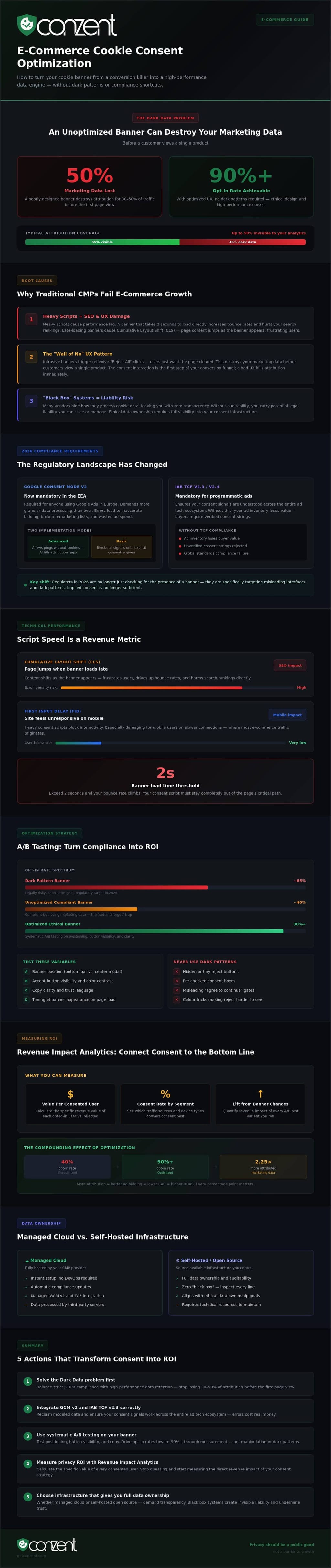
Did you know that an unoptimized cookie banner can wipe out 50% of your marketing data before a customer even views a single product? For most online retailers, compliance feels like a tax on growth. It's a source of high bounce rates and broken GA4 attribution. E-commerce cookie consent optimization is not a legal chore. It is a competitive advantage. We believe that privacy should be a public good, not a barrier to entry. You don't have to choose between respecting digital rights and hitting your revenue targets.
We understand the frustration of losing half your traffic to intrusive pop-ups or complex Google Consent Mode v2 errors. It feels like the system is rigged against transparency. This article will show you how to transform your consent layer from a conversion killer into a high-performance data engine. You'll learn to balance strict GDPR moral clarity with the technical efficiency required for 2026. We are moving beyond basic banners to a world of ethical data ownership and source-available infrastructure.
You can achieve opt-in rates of 90% or higher without resorting to deceptive dark patterns. We will explore the shift to IAB TCF v2.4 standards, the power of Revenue Impact Analytics, and how A/B testing can turn compliance into ROI. It is time to stop guessing and start measuring. Let's build a faster, more transparent foundation for your store's future growth.
Key Takeaways
- Stop losing marketing attribution to the "Dark Data" problem by balancing strict GDPR compliance with high-performance data retention.
- Master e-commerce cookie consent optimization by integrating Google Consent Mode v2 and IAB TCF v2.3 to reclaim lost modeled data.
- Use systematic A/B testing on banner positioning and button visibility to drive opt-in rates toward 90% without using deceptive dark patterns.
- Measure the ROI of your privacy strategy using Revenue Impact Analytics to calculate the specific value of every consented user.
- Choose between managed cloud or self-hosted open infrastructure to maintain technical efficiency and full ownership of your customer data.
The Hidden Cost of Compliance-Only Cookie Banners
Compliance is not a finish line. It is a baseline. Most retailers treat their cookie banner as a legal nuisance to be ignored after installation. This passive approach creates a massive leak in your revenue bucket. We call this the "Dark Data" problem. When your banner is poorly designed, you lose attribution for 30% to 50% of your traffic. You are effectively spending marketing dollars blindly. It is the opposite of effective e-commerce cookie consent optimization.
You cannot optimize what you cannot see. E-commerce cookie consent optimization is the practice of balancing legal requirements with high-performance data retention. It is the difference between a "leaky" setup and a lucrative one. Think of consent as the very first step in your conversion funnel. If a user rejects all tracking because your interface is confusing, your marketing data dies before the first page view. Active optimization transforms this interaction from a roadblock into a high-performance data engine.
Why Traditional CMPs Fail E-commerce Growth
Many legacy platforms prioritize "setting and forgetting" over actual performance. Heavy scripts cause significant performance lag, which directly hurts your SEO and user experience. If your banner takes two seconds to load, your bounce rate will climb. Beyond speed, poor UX design often creates a "Wall of No". This happens when a banner is so intrusive that users reflexively click "Reject" just to clear their screen. Finally, many vendors use "Black Box" systems. They hide how they process an HTTP cookie or manage data, leaving you with zero transparency and potential liability.
The 2026 Regulatory Landscape for Retailers
The rules of the game have changed. In 2026, regulators are no longer just checking for the presence of a banner. They are targeting misleading interfaces and "dark patterns". Google Consent Mode v2 is now mandatory for anyone using Google Ads in the European Economic Area. This requires a more granular approach to data processing than ever before. You must move from implied consent to explicit, clear choices. Our Danish-engineered approach provides the moral clarity needed to navigate these shifts. A managed cloud consent platform should provide the tools to be both ethical and profitable. It is about proving that privacy and growth are not mutually exclusive.
Technical Infrastructure: Speed, GCM v2, and IAB TCF
Your technical stack determines your data quality. Script execution speed isn't just a developer metric. It's a revenue metric. If your consent banner delays the rest of the page, you've already lost the customer. High-performance e-commerce cookie consent optimization starts with a script that stays out of the way. Late-loading banners create friction that customers won't tolerate in 2026.
Optimizing for Core Web Vitals
Late-loading banners cause Cumulative Layout Shift (CLS). This happens when the page content jumps as the banner appears, frustrating users and hurting your search rankings. It creates a jarring experience that drives up bounce rates. You should prioritize lightweight cookie consent scripts to protect your First Input Delay (FID). This ensures your site feels responsive, especially for mobile users on slower connections.
Implementing Google Consent Mode v2 Correctly
GCM v2 is a critical tool for reclaiming "modeled" data. When a user denies consent, Google uses AI to fill the gaps in your attribution. You can choose between Advanced and Basic implementation. Advanced allows pings without cookies, while Basic blocks all signals until consent is given. It is vital to fix Google Consent Mode errors immediately. Mistakes here lead to inaccurate bidding, broken remarketing lists, and wasted ad spend.
For retailers relying on programmatic advertising, IAB TCF 2.3 certification is mandatory. It ensures your consent signals are understood by the entire ad tech ecosystem. This framework aligns with the principles found in the European Commission's cookie policy, which emphasizes transparency and user control. Without this integration, your ad inventory becomes less valuable to buyers who require verified consent strings to comply with global standards.
We believe in moral clarity and technical openness. Our Danish-engineered infrastructure is source-available. Closed-source CMPs act as "black boxes" that hide how they handle your data. Source-available infrastructure provides the security and control that scaling brands need. You can see exactly how the code works. This transparency builds trust with your users and protects your brand from hidden vulnerabilities. If you are ready to move beyond generic solutions, you can explore our flexible pricing options to find the right fit for your traffic volume.
A/B Testing: Finding the Optimal Privacy UX
Assuming a single banner design works for every store is a mistake. Your audience in Berlin interacts with privacy notices differently than your audience in New York. Effective e-commerce cookie consent optimization requires a data-driven approach to user experience rather than a "set and forget" mentality. We believe that transparency should be tested, not guessed. You must find the balance where your banner respects the user while maintaining your data engine.
You need to test specific variables like banner position, button colors, and the visibility of the "Reject" button. Using cookie consent A/B testing allows you to find the exact "sweet spot" for your unique traffic. This process is about ethical nudging. It is the practice of guiding a user toward a choice that benefits your business without stripping away their agency. It is not about trickery. It is about clarity and hierarchy.
Design Patterns that Drive Opt-in Rates
Center-modals often outperform bottom-bars on mobile devices because they demand an active choice before the user can browse. However, they can also increase bounce rates if the design feels too aggressive. Your "Brand Voice" matters here. A privacy notice doesn't have to be clinical or cold. It can be an extension of your brand’s commitment to its community. You can guide users toward "Accept All" by making it the primary visual focus. Just ensure the "Reject" option remains clear and accessible. This aligns with the ICO's guidance on cookies, which emphasizes that refusing should be as easy as accepting.
Running a Scientific Consent Test
Stop guessing and start measuring. Every test must begin with a clear baseline of your current opt-in percentage. Isolate your variables. If you change the button color and the banner position at the same time, you won't know which element caused the shift. You also need enough traffic for statistical significance. A test with a handful of visitors is not a test. It is a coincidence. High-performance e-commerce cookie consent optimization relies on evidence, not intuition. We provide the infrastructure to run these tests directly within your CMP, ensuring that your privacy strategy is always backed by real-world performance data.
Revenue Impact Analytics: Connecting Consent to the Bottom Line
Most consent management platforms provide logs to prove you aren't breaking the law. That is a low bar. We believe compliance should be a window into your business health, not just a shield against fines. Revenue Impact Analytics is the missing piece of the CMP puzzle. It allows you to calculate the "Cost Per Consent." If you know a consented user is worth significantly more to your store than a rejected one, you can finally see the true cost of an unoptimized banner. This data turns e-commerce cookie consent optimization from a technical chore into a high-stakes financial strategy.
Visualizing the correlation between banner design and cart abandonment is essential for growth. We have seen how a single intrusive modal can trigger a wave of exits before a user even sees a product. You aren't just losing data. You are losing customers. Using analytics to justify your privacy infrastructure investment makes sense to stakeholders. It moves the conversation from how much a tool costs to how much revenue it actually saves for the brand.
Metrics that Matter for E-commerce Managers
You must track the "Bounce-on-Banner" rate. This measures the friction created in the first three seconds of a visit. If this rate is high, your banner is a conversion killer. You should also analyze your opt-in rate by channel. If your social media traffic has a lower opt-in rate than your organic search traffic, your attribution is failing exactly where you spend the most. Revenue leakage is the estimated value of missing GA4 conversions. When you identify where you lose the most data, you can target your optimization efforts where they will have the greatest impact on your bottom line. This level of granular insight is especially valuable when paired with an enterprise-scale commerce platform like Ommni, allowing retailers to align their privacy strategy with overall operational performance.
Data ends arguments. Marketing teams often want minimal banners to protect the user experience. Legal teams want maximum disclosure to protect the brand from regulatory scrutiny. Hard data moves everyone past gut feelings. When you present clear consent metrics to the DPO and the CMO, you create a shared language of performance. Our Danish-engineered approach provides the moral clarity needed to make these decisions. It makes complex requirements feel attainable for everyone in the organization. If you are ready to stop guessing and start measuring the ROI of your privacy strategy, you can explore our managed cloud consent options.
Future-Proofing Your Compliance: The Conzent Advantage
Your choice of infrastructure dictates your brand's integrity. We don't view privacy as a premium feature. It is a fundamental right. E-commerce cookie consent optimization shouldn't be a struggle for resources. It should be a streamlined part of your growth engine. Our Danish-engineered platform provides the moral clarity needed to meet strict EU standards. We aren't just another vendor. We are community advocates for technical efficiency and digital rights. Moving from a simple "banner" to a robust growth infrastructure is the next step for any scaling retailer.
The mission of the Open Consent Infrastructure (OCI) is to treat compliance as a public good. Most platforms are closed-source black boxes. They hide their logic and your data. We offer a transparent alternative. Whether you choose our managed cloud consent or a self-hosted model, you maintain ownership of your information. This transparency builds trust with your customers. It also ensures that your business remains resilient as global regulations evolve toward explicit, granular consent.
Managed Cloud vs. Self-Hosted Infrastructure
Control or convenience? You don't have to sacrifice one for the other. Choose self-hosted cookie consent if you require maximum data sovereignty. This is the ideal path for enterprise brands with strict internal security protocols. For those who want to reduce DevOps overhead, our Managed Cloud version ensures 99.9% uptime. It integrates seamlessly with Shopify, WordPress, and custom headless builds. You get the same Danish-engineered precision without the server management. It is about making high-level compliance attainable for all users regardless of their technical resources.
The Path to 95% Opt-in Rates
Optimization is a continuous loop, not a one-time event. Follow our roadmap: Audit your current leaks. Implement a lightweight, high-performance script. Test your design variables using A/B frameworks. Analyze the revenue impact of every change. This systematic approach is how you reach 90% or even 95% opt-in rates ethically. We provide the tools to prove that privacy-first growth is possible. It is time to stop treating e-commerce cookie consent optimization as a legal burden. Treat it as the foundation of a more honest relationship with your customers. You can view Conzent pricing and features to see which infrastructure fits your scale.
Securing Your Store’s Growth and Integrity
Privacy is no longer a legal hurdle to clear. It is the foundation of a modern customer relationship. You've seen how technical speed, proper GCM v2 integration, and systematic A/B testing reclaim lost attribution data. By shifting from passive compliance to active e-commerce cookie consent optimization, you stop guessing and start growing. Transparency is your most valuable asset in 2026. It's the difference between a leaky funnel and a high-performance data engine.
We provide the infrastructure for brands that value data ownership and technical excellence. Our platform is IAB TCF v2.3 Certified and Google Consent Mode v2 Ready. With source-available transparency and Danish-engineered moral clarity, you protect your users without sacrificing your bottom line. It's time to build a consent layer that works for your business and your community. You don't have to choose between ethics and revenue.
Optimize Your E-commerce Revenue with Conzent
You have the roadmap. Now it's time to execute. Let's build a more transparent and profitable digital future together.
Frequently Asked Questions
How does cookie consent optimization affect my e-commerce conversion rate?
Optimization directly impacts your conversion rate by reducing "bounce-on-banner" friction. When a banner is intrusive or slow, users leave before seeing a single product. A fast, well-designed banner ensures that the first interaction is seamless. By using e-commerce cookie consent optimization, you protect the user experience while maintaining the data flow needed to refine your sales funnel. It turns a legal barrier into a performance asset.
Can I A/B test my cookie banner without violating GDPR?
You can ethically A/B test banners if you avoid deceptive "dark patterns" that trick users into consenting. GDPR requires that rejecting cookies is as easy as accepting them. Testing allows you to find the most transparent and effective way to present choices. You should focus on variables like banner position or wording that clarify the value of data sharing rather than hiding the "Reject" button. This ensures your optimization remains principled and legal.
What is the difference between basic and advanced Google Consent Mode v2?
Basic mode blocks all data transmission until a user grants consent. This is the most conservative approach but results in total data loss for non-consenting users. Advanced mode sends cookieless "pings" when consent is denied. Google uses these signals to model conversions in GA4 and Ads. Choosing the right mode depends on your brand's risk appetite and your need for accurate attribution in a privacy-first environment. It is about balancing safety with data utility.
How do I measure the revenue impact of rejected cookies?
You can measure this through specialized Revenue Impact Analytics that correlate consent states with transaction data. By identifying the average order value of consented users versus the modeled data from rejected users, you calculate the "Cost Per Consent." This reveals the true financial leak in your marketing attribution. It moves the conversation from simple compliance logs to a deep understanding of how privacy choices affect your store's bottom line and growth.
Is a self-hosted cookie consent manager better for site speed?
Self-hosting can improve site speed by reducing external requests and giving you full control over script execution. When you host the Open Consent Infrastructure on your own servers, you eliminate the latency associated with third-party cloud calls. This is beneficial for high-traffic stores where every millisecond affects Core Web Vitals. However, our managed cloud service also prioritizes technical efficiency with lightweight scripts designed for 99.9% uptime and minimal overhead for your development team.
What are the best UX design patterns for cookie banners in 2026?
The best patterns in 2026 focus on clarity and accessibility. Center-modals often work best for mobile users by forcing a clear choice, while bottom-bars are less intrusive for desktop browsing. You should use high-contrast buttons for "Accept All" but ensure the "Reject" option has a clear visual hierarchy. Avoid hiding choices behind multiple clicks. Transparent communication about why you collect data builds trust and often leads to higher organic opt-in rates for your brand.
How does IAB TCF 2.3 help my programmatic advertising revenue?
IAB TCF v2.3 provides a standardized way to communicate consent signals to the programmatic advertising ecosystem. Many high-quality ad buyers now require this certification to bid on your inventory. Without it, you may see a drop in fill rates or CPMs because advertisers cannot verify legal consent for data processing. Integration ensures your ad revenue stays stable by proving to the entire supply chain that you respect user choices and follow global technical standards.
Why should I choose a Danish CMP like Conzent over US-based alternatives?
Choosing a Danish CMP provides moral clarity and a stricter adherence to EU data protection standards. US-based alternatives often struggle with legal uncertainties regarding data transfers and global privacy rulings. Being based in Copenhagen means our infrastructure is designed with GDPR as a native requirement rather than an afterthought. We offer a principled, source-available approach that prioritizes data sovereignty and transparency for brands that value ethical responsibility and technical efficiency over corporate black-box solutions.