
EPrivacy Regulation vs GDPR: Navigating the 2026 Privacy Landscape

Most businesses are still bracing for an ePrivacy Regulation that the European Commission formally withdrew on February 5, 2025. It's a common mistake; however, the reality is that the 2002 ePrivacy Directive still governs your cookies while the GDPR handles your data processing. Understanding the interplay of ePrivacy regulation vs GDPR isn't just a legal hurdle. It's a technical requirement for anyone operating in 2026. Privacy is not a premium feature. It's a foundational standard.
You likely feel the weight of compliance fatigue as rules overlap and the threat of GDPR fines reaching 4% of global turnover remains a constant pressure. We agree that the complexity of "lex specialis" shouldn't be your burden to carry alone. This article provides a clear strategy to implement a unified compliance framework. We'll explore how to deploy Google Consent Mode v2 and IAB TCF 2.3 through a transparent infrastructure that reduces legal risk and respects your users' confidentiality.
Key Takeaways
- Understand the "lex specialis" relationship. GDPR serves as the general framework for personal data while ePrivacy provides the specific rules for electronic communications.
- Master the distinction between ePrivacy regulation vs GDPR. One protects an individual's identity while the other ensures the absolute confidentiality of the communication itself.
- Align your tracking with 2026 standards. Valid consent must be freely given and unambiguous to avoid the high penalties associated with dark patterns and pre-ticked boxes.
- Eliminate compliance fatigue by centralizing your strategy. Moving to an Open Consent Infrastructure (OCI) ensures data sovereignty and handles technical requirements like Google Consent Mode v2.
- Mitigate legal risk by recognizing that enforcement levels have converged. Misinterpreting these overlapping rules can lead to fines of up to 4% of global annual turnover.
Table of Contents
The Lex Specialis Relationship: Why You Need Both Laws
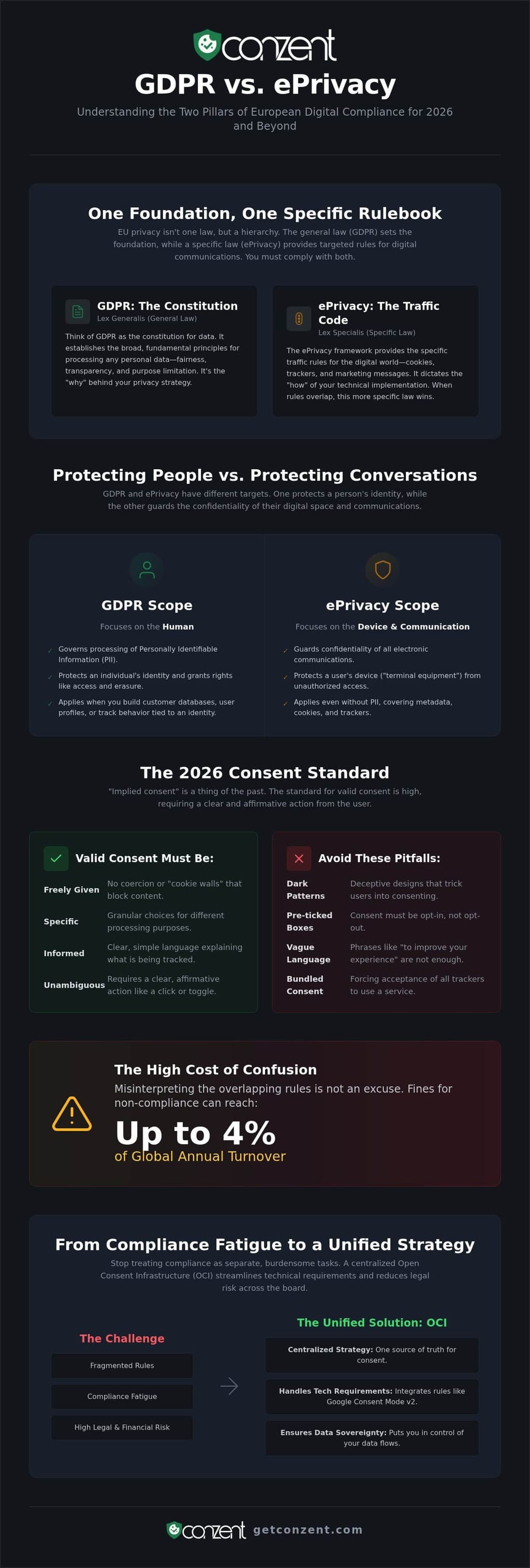
GDPR is your foundation. It's the Lex Generalis, the general law that governs every piece of personal data you touch. But the digital world needs more than generalities. It needs specific rules for the wires and waves that carry our messages. This is where the ePrivacy framework steps in. It's the Lex Specialis, a specialized set of rules for electronic communications. Understanding the relationship of ePrivacy regulation vs GDPR is the only way to build a compliant stack in 2026. You cannot pick one. You must master both.
The legal principle is simple. Specific rules override general ones. If the GDPR says you need a legal basis for data processing, but the ePrivacy rules dictate a specific method for cookie consent, the specialized rule wins. It's a hierarchy designed to ensure that the unique risks of digital tracking aren't lost in broad legal definitions. Compliance isn't about checking boxes; it's about respecting the boundaries of your users.
The Constitution vs. The Traffic Code
Think of the GDPR as a constitution. It sets broad principles like fairness, transparency, and purpose limitation. It's the "why" behind your privacy policy. The ePrivacy rules are the traffic code. They dictate the "how" of your technical implementation. They tell you when to signal a light, when to stop tracking, and how to manage the confidentiality of a user's terminal equipment. Ignoring the traffic code while following the constitution still leads to a crash. Total compliance requires aligning your high-level data processing with your granular technical execution. Following one but ignoring the other is a recipe for total compliance failure.
Regulation vs. Directive: The 2026 Shift
For years, the 2002 ePrivacy Directive created a fragmented landscape. Every EU country had its own version of the rules. That era is over. While the standalone ePrivacy Regulation proposal was withdrawn in 2025 to make way for better alignment, the 2026 reality is the "Digital Omnibus" package and the full application of the AI Act. This shift streamlines the rules across the Single Market. It moves us away from national interpretations and toward a unified standard.
For global SaaS companies, this is a relief. It replaces 27 different headaches with a single, clear rulebook for electronic privacy. The shift is about consistency. Under the old Directive, a cookie banner in France looked different than one in Germany. This fragmentation was a nightmare for developers. The 2026 environment treats privacy as a unified technical standard. By integrating these standards into your GDPR compliance infrastructure, you ensure your technology is as principled as your legal team. It makes compliance feel like a public good rather than a corporate burden.
Personal Data vs. Confidentiality: Comparing the Scopes
Privacy laws don't just exist to protect names and email addresses. They exist to protect boundaries. In the technical debate of ePrivacy regulation vs GDPR, the scope of protection is much broader than simple identity. GDPR protects the human. ePrivacy protects the conversation itself. This distinction is vital because ePrivacy applies even when no personal data is involved. It treats a user's laptop, smartphone, or smart device as private property. No one should be allowed to access that property without explicit permission.
As we move through 2026, this boundary is becoming more important. The rise of machine-to-machine (M2M) communication and the Internet of Things (IoT) means that data is constantly moving between devices. Much of this data is metadata. It might not tell you a person's name, but it reveals the timing, location, and duration of a communication. Under the current landscape, this metadata is just as sensitive as a social security number. It requires an infrastructure built on transparency and ethical responsibility.
GDPR: The Human-Centric Protection
GDPR is built around individual rights. It focuses on how organizations process Personally Identifiable Information (PII). This includes the right to access, erase, and move your data between services. It's a framework designed to ensure fairness and transparency whenever a human identity is involved. If you're building a database of customers or tracking user behavior to create a profile, you're operating within the GDPR's jurisdiction. You can explore how to manage these requirements in our GDPR Compliance Guide.
ePrivacy: The Device and Network Protection
ePrivacy is different. It's about the "Right to be Left Alone" in a digital environment. It protects the integrity of terminal equipment. Your laptop is your terminal equipment. Your phone is your terminal equipment. ePrivacy ensures that no entity can drop a file or read a bit of information from your device without a valid reason. This is why even non-PII tracking requires consent. If a script reads a device's screen resolution or battery level for fingerprinting, it has crossed a boundary.
The official EDPB opinion on ePrivacy and GDPR makes it clear that these specific rules take precedence. In 2026, this means your consent strategy must account for the device's confidentiality, not just the user's data. Whether it's an IoT sensor or a browser cookie, the rules of the road are the same. Managing these overlapping scopes shouldn't be a burden for your developers. You can implement a unified strategy that respects both laws by choosing a plan from our transparent pricing options.
Cookies, Trackers, and the 2026 Consent Standard
The term "Cookie Law" is a misnomer that simplifies a complex reality. It's actually the ePrivacy framework in action. While the GDPR governs the data you collect, the ePrivacy rules govern the act of accessing the user's device to place that tracker. In 2026, the standard for this access is higher than ever. Consent is no longer a checkbox on a hidden page. It's a fundamental gatekeeper. If your infrastructure doesn't treat consent as a primary data signal, you aren't just risking a fine. You're failing your users.
The technical interplay of ePrivacy regulation vs GDPR has effectively killed the use of "Legitimate Interest" for non-essential tracking. Regulators have made it clear: if a tracker isn't strictly necessary for the service the user requested, you need a clear "Yes." This consent must be freely given, specific, informed, and unambiguous. There is no middle ground. Implied consent is a relic of the past. Your cookie banner must be a tool for transparency, not a hurdle of dark patterns.
The Hierarchy of Tracking Consent
Understanding what requires consent is the first step toward a clean stack. Strictly necessary trackers are exempt from ePrivacy consent requirements. These include tools for security, load balancing, or remembering what's in a shopping cart. They make the digital world function. Everything else falls into the opt-in category. Analytics, personalization, and marketing trackers require an explicit signal before they fire. This is where the IAB TCF 2.3 framework is essential. It provides a standardized language that ensures every vendor in the programmatic chain respects the user's initial choice. It's about creating a chain of trust from the browser to the ad server.
Implementing Google Consent Mode v2
Google Consent Mode v2 is the bridge between legal requirements and data utility. It allows your website tags to adjust their behavior dynamically based on the user's ePrivacy choice. When a user denies consent, tags don't just stop. They pivot. They send anonymous, non-identifying pings that allow for basic measurement without violating confidentiality. This technical nuance is how businesses balance ad revenue with strict EU enforcement. It's not about bypasses; it's about respectful modeling. For a deeper dive into the technical setup, refer to our Google Consent Mode v2 Implementation Guide. Proper implementation ensures that your data collection remains principled and your performance remains predictable.
Enforcement and Penalties: The Cost of Confusion
Confusion is expensive. In 2026, the financial stakes of mismanaging the relationship between ePrivacy regulation vs GDPR have reached a fever pitch. GDPR fines are well-known: up to €20 million or 4% of global annual turnover. What many leaders miss is that the 2026 privacy landscape has aligned ePrivacy penalties with these exact levels. Misinterpreting a "lex specialis" rule is no longer a minor oversight. It's a high-stakes gamble with your company's balance sheet. Compliance is a foundational standard, not a premium luxury.
You face a unique "Double Jeopardy" risk. A single tracking error can trigger two separate investigations. One authority might fine you for illegal data processing under GDPR. Another might penalize you for violating communication confidentiality under ePrivacy rules. One action. Two laws. Two fines. National Data Protection Authorities (DPAs) are increasingly collaborative. They share audit findings to ensure no breach goes unnoticed. This coordinated enforcement makes your technical infrastructure your first line of defense.
Recent Enforcement Trends in 2026
DPAs have shifted their focus. They aren't just looking for missing banners. They're hunting for "Dark Patterns." If your "Reject All" button is hidden or requires three extra clicks, you're a target. We're also seeing a crackdown on "Consent or Pay" models. Regulators argue that privacy shouldn't be a luxury for those who can afford it. Transparency is your only defense. A clear, honest interface isn't just a legal shield. It's a statement of your values. It shows you treat users as peers rather than targets.
The Impact of Non-Compliance on Brand Trust
Fines are just the beginning. The real damage comes from data deletion orders. Imagine being forced to wipe years of marketing data because the initial consent was flawed. It's a total loss of investment. However, a transparent Consent Management Platform (CMP) does more than prevent audits. It builds user loyalty. When users see you respect their boundaries, they're more likely to engage. You can measure this effect directly by analyzing the Revenue Impact of Cookie Consent. Trust is a performance metric.
Protecting your brand shouldn't be a complex puzzle. Our infrastructure handles the interplay of these laws automatically, so you can focus on growth. Secure your compliance and your reputation by choosing one of our transparent pricing plans today.
A Unified Strategy for ePrivacy and GDPR Compliance
Stop patching holes in your digital boat. Managing the ePrivacy regulation vs GDPR interplay with a handful of disconnected plugins creates technical debt and legal exposure. A fragmented setup isn't just inefficient. It's dangerous. Centralizing your consent signals into a single source of truth is the only way to ensure every tag, tracker, and script respects the user's choice across every legal framework. Compliance is a foundational standard. It should be built into your architecture, not bolted on as an afterthought.
Your strategy must automate the complex handshakes required by IAB TCF 2.3 and Google Consent Mode v2. These aren't just technical features. They are the language of 2026 digital rights. By unifying these signals, you turn a legal burden into a streamlined technical advantage. This approach respects your developers' time and your users' autonomy. It's about moving from reactive fixes to a principled, proactive infrastructure.
Managed Cloud vs. Self-Hosted CMP
Choosing the right deployment model depends on your resource profile and security needs. A Managed Cloud platform offers speed and agility. It handles the constant updates of the 2026 privacy landscape automatically. For high-security industries, a zero-trust architecture is the only ethical choice. You can maintain absolute data sovereignty by choosing to self-host your Open Consent Infrastructure (OCI). This ensures that your consent data never leaves your own environment. It's about ownership, not just compliance.
The 3-Step Compliance Audit
A methodical approach is the best defense against audits. Follow these steps to align your stack with current requirements:
- Map your flows: Identify every personal data processing activity (GDPR) and every point where you access terminal equipment (ePrivacy).
- Deploy certified infrastructure: Use a CMP that handles both frameworks and provides native support for GCM v2 and TCF 2.3 signals.
- Monitor and optimize: Use revenue impact analytics to ensure your privacy settings aren't destroying your conversion rates.
Future-Proofing Your Privacy Stack
The era of the "black box" vendor is over. Source-available infrastructure is the new standard for privacy tools. It invites scrutiny and ensures transparency. As the industry moves toward a post-cookie world, server-side consent will become the primary method for maintaining confidentiality. Prepare your stack today for the requirements of tomorrow. You can scale your privacy without the black box with Conzent and build a future rooted in digital rights and technical efficiency.
Secure Your Digital Infrastructure for 2026
The landscape of ePrivacy regulation vs GDPR is no longer a theoretical debate. It's a technical reality. You've seen how the "lex specialis" principle dictates your cookie strategy and why "dark patterns" are now a primary target for enforcement. Compliance isn't a premium luxury you add later. It's the foundation of a trustworthy digital presence. Your infrastructure should reflect your commitment to digital rights.
Successful navigation requires moving beyond fragmented plugins. You need a unified infrastructure that is IAB TCF 2.3 Certified and Google Consent Mode v2 Ready. This isn't just about avoiding fines; it's about treating your users as peers whose confidentiality is worth protecting. Our source-available Open Consent Infrastructure gives you the transparency and control needed to thrive in this new environment.
Start your 2026 compliance journey with Conzent's Managed Cloud.
You don't have to carry the burden of shifting regulations alone. By choosing a principled approach to privacy, you protect both your revenue and your users' rights. Build a stack that respects boundaries and earns loyalty.
Frequently Asked Questions
Does the ePrivacy Regulation replace the GDPR?
No, the ePrivacy Regulation doesn't replace the GDPR. It acts as a specialized layer for electronic communications. While the GDPR sets the broad standard for personal data processing, the ePrivacy rules provide specific requirements for cookies, metadata, and email marketing. You must comply with both to avoid legal risk in the 2026 landscape. It's a relationship where the specific rule overrides the general one.
Do I need a cookie banner if I don't use tracking cookies for marketing?
Yes, you usually need a banner if you use any non-essential cookies. Even if you don't use marketing trackers, most analytics or personalization cookies require explicit consent. Only strictly necessary cookies, like those for security, load balancing, or shopping carts, are exempt from the consent requirement. If a tracker isn't vital for the service the user requested, you need a clear opt-in signal.
Can I use 'Legitimate Interest' for analytics under the ePrivacy Regulation?
You cannot use "Legitimate Interest" to bypass the consent requirement for cookies or device access. The ePrivacy rules are clear: accessing a user's terminal equipment requires consent unless it's strictly necessary. This is a key technical distinction in the debate of ePrivacy regulation vs GDPR. ePrivacy consent standards are higher because they protect the integrity of the device itself, regardless of the data type.
What is the main difference between a Directive and a Regulation?
The main difference is how the law applies across the EU. A Directive is a goal that each member state must achieve through its own national laws, which often leads to fragmented rules. A Regulation has direct effect. It provides a single, unified rulebook that applies to all EU countries simultaneously. This shift simplifies compliance for businesses operating across the Single Market by removing national variations.
How does Google Consent Mode v2 help with ePrivacy compliance?
Google Consent Mode v2 helps by dynamically adjusting tag behavior based on the user's consent signal. If a user denies consent, the system sends anonymous pings instead of identifying trackers. This allows you to respect the confidentiality of terminal equipment while still gathering basic performance metrics. It bridges the gap between strict legal requirements and the need for actionable business data.
Are the fines for ePrivacy the same as GDPR in 2026?
Yes, the 2026 privacy landscape has aligned ePrivacy fines with GDPR levels. Violations can lead to penalties of up to €20 million or 4% of your global annual turnover. Enforcement isn't just about identity anymore; it's about the technical integrity of communications. National authorities now treat both laws with the same financial weight, making technical compliance a foundational business standard.
What happens if my website is hosted outside the EU but serves EU citizens?
Location doesn't grant immunity from these laws. If your website targets or serves users within the European Union, you must follow both GDPR and ePrivacy rules regardless of where your servers sit. This extra-territorial reach ensures that EU citizens enjoy the same level of protection and confidentiality no matter where the service provider is based. Compliance is about the user's location, not the company's.
Is IAB TCF 2.3 mandatory for all websites?
IAB TCF 2.3 isn't a legal requirement for every website, but it's a technical necessity for those using programmatic advertising. It provides a standardized language for vendors to communicate consent signals. Without it, many ad-tech partners and platforms may restrict your ability to serve personalized ads. It's the industry standard for ensuring that every player in the advertising chain respects the user's choice.