
Full control over consent data under GDPR

Consent is not a master switch for every use of personal data. Full control over consent data means understanding what a person agreed to, how that choice affects processing, and what happens when they withdraw it.
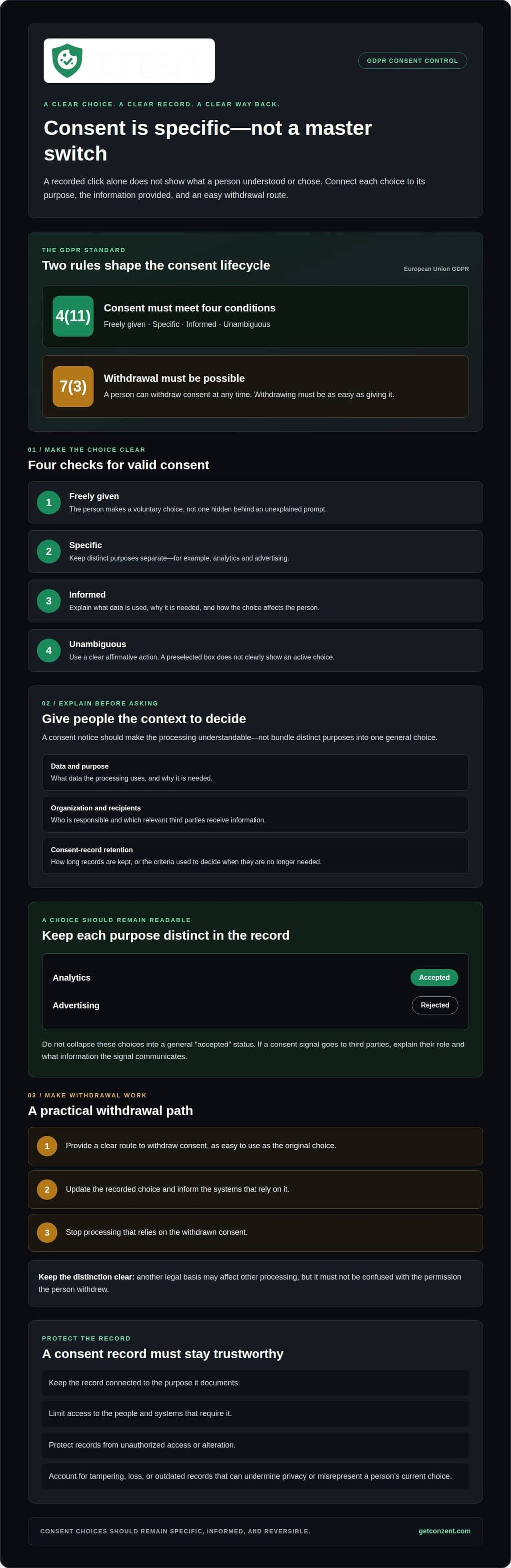
The GDPR sets a clear standard: consent must be freely given, specific, informed, and unambiguous, as the European Union defines it in Article 4(11). It must also be possible to withdraw consent, and withdrawal must be as easy as giving it under Article 7(3). But consent is only one part of data control. Shared data raises further questions about privacy, responsibility, and who can decide how information is used.
This article explains how GDPR consent and withdrawal rules work, which baseline rights matter, and why data sovereignty extends beyond a consent banner. It also shows how control over personal data differs from control over shared data, where the limits arise, and how consent tools help websites manage choices in practice.
Key Takeaways
- Assess whether consent is clear, specific, and freely chosen, rather than treating a single click as permission for every use.
- Consider how data type, organizational size, and sharing arrangements shape practical control over shared information.
- Make consent withdrawal straightforward, and distinguish consent-based processing from processing that relies on another legal basis.
- Separate baseline rights, such as data ownership, from the controls and safeguards used to protect data when it is shared.
- Use data sovereignty to consider who can shape how shared data is provided, protected, and governed.
GDPR consent requirements and withdrawal
Consent gives a person a choice about specific processing, not blanket control over every use of their data. A sound approach links each choice to clear information, an affirmative action, and an easy way to withdraw consent.
Information Provided Before Consent
Before asking for consent, explain what data the processing uses, why it is needed, and how the choice affects the person. This context helps people assess the request rather than click through an unexplained prompt. Identify the organization responsible, describe relevant recipients, and explain how long consent records are kept or what determines their retention. Use direct language and separate distinct purposes, such as analytics and advertising.
Consent Validity Requirements
Valid consent must reflect a person’s informed, specific, and voluntary choice, shown through a clear affirmative action. According to the European Union, the GDPR requires consent to be freely given, specific, informed, and unambiguous under Article 4(11). A preselected box does not clearly show an active choice. A bundled request can also obscure which purpose a person accepts. These distinctions matter because a recorded click alone does not establish what the person understood or chose.
Sharing, Retention, and Third-Party Disclosures
A consent data policy should explain what consent information is shared, which third parties receive it, why sharing occurs, and how retention is determined. It should also describe safeguards in plain language. Stored records can expose a person’s choices if accessed without authorization. Tampering, loss, or outdated records can also undermine privacy and misrepresent a person’s current choice.
Keep the record connected to its purpose. For example, a person who accepts analytics but rejects advertising should not see those choices collapsed into one general “accepted” status. When third parties receive consent signals, explain their role and what information the signal communicates. A GDPR consent framework can help teams keep notices and processing choices aligned.
Retention should have a stated rationale, not an arbitrary promise. Set out the retention period or the criteria for deciding when records are no longer needed. Limit access to the people and systems that require it, and protect records from unauthorized access or alteration. These steps reduce exposure while preserving the information needed to interpret a recorded choice.
Consent must also remain reversible. Under Article 7(3), a person can withdraw consent at any time, and withdrawing must be as easy as giving it. A clear withdrawal route should update the recorded choice and inform the systems that rely on it. Processing based on consent should then stop; a separate legal basis may affect other processing, but it must not be confused with the withdrawn permission.
Contextual conditions affecting data sovereignty
Data sovereignty depends on how information is collected, used, and shared. Data type, organizational size, and the business’s data-sharing arrangements all affect how difficult it is to put control into practice. The same policy can work differently for a small publisher sharing basic site preferences and a large organization coordinating personal data across several teams.
Start with the data itself. A record of a person’s consent choice differs from a dataset combining identity details, preferences, and activity. Each additional data type raises questions about who needs access, which uses the person’s choice covers, and how information moves between systems. For example, a consent signal sent to an analytics partner needs a clear purpose and recipient. A record kept only to manage internal preferences has a different sharing context.
Organizational size changes the coordination challenge. In a small team, the same people may set policy and manage the systems that apply it. In a larger organization, privacy, marketing, analytics, and technical teams may each control part of the process. If those groups interpret a consent choice differently, the person’s preference can lose force as information moves through the organization. Assigning responsibility for each data flow makes gaps easier to spot.
The sharing arrangement matters too. A direct exchange between two organizations has different control points from a chain involving multiple recipients. Map who provides the data, who receives it, and which party manages each use. Then identify where the originating choice must remain visible. This is especially useful when a recipient combines shared data with information from another source, because the original context can otherwise become harder to preserve.
Local rules can also shape the available choices. Under Turkey’s Personal Data Protection Law, access to a service cannot be conditioned on explicit consent when the processing is not essential to providing that service. A service that requires an account to function may involve necessary processing, while optional promotional use is a separate purpose. Keeping those purposes distinct helps avoid treating access as agreement to unrelated uses.
These conditions do not create one universal model of control. They show why sovereignty must account for the data, the organizations involved, and the actual sharing relationship. A practical assessment traces each flow from collection to recipient, identifies who makes decisions at each stage, and records how the person’s choices remain effective across those boundaries. That map gives teams a concrete basis for discussing access, responsibility, and safeguards.
If these operating needs affect how you plan consent management, explore the consent platform pricing options as a next step.
Withdrawal of consent
A withdrawal changes what an organization may do under consent; it does not erase the history of the choice. Under GDPR Article 7(3), withdrawal must be possible at any time and as easy as giving consent. The practical test is whether a person can find and use the withdrawal route without unnecessary obstacles. For example, if consent was given through a website setting, a clear account or privacy control can make reversal accessible.
After withdrawal, stop the processing that relied on that consent. This takes more than changing a preference on one screen. The organization must carry the updated choice through the systems and purposes that use it. If a person withdraws permission for advertising, that change should reach the relevant advertising processes. It should not automatically alter a separate analytics choice. Keeping purposes distinct makes the effect of withdrawal clear and precise.
Withdrawal does not, by itself, answer every question about continued processing. Under Turkey’s Personal Data Protection Law, a data subject may withdraw explicit consent at any time, after which the controller must stop the related processing activities. Processing based on another legal basis may continue after explicit consent is withdrawn. The key distinction is the basis for each activity: consent-based processing must stop, while a separate basis is assessed on its own terms.
A reliable process connects the person’s request to the relevant purposes and processing systems. First, identify which consent choice changed. Next, update the record and communicate the change to systems that use the choice. Then distinguish any activity based on a separate legal basis. For example, withdrawing consent for promotional messages should not be treated as permission to continue those messages just because the person still has an account.
Keep evidence of the change without confusing that record with permission to continue the withdrawn activity. A timestamped status can show which choice applies, while access controls limit who can alter it. The record should also make the relevant purpose clear. Otherwise, a team may see an old approval and miss a later withdrawal, especially when separate systems handle a website, email campaign, or analytics service.
When a withdrawal affects information already shared with another organization, the sender needs a process for carrying the changed choice into that relationship. The response depends on what was shared and which basis supports each use. For example, a recipient using data only under the withdrawn consent must stop that related processing; a distinct legal basis may support another activity. Clear records of recipients, purposes, and status help teams act consistently instead of treating withdrawal as a vague, global command.
Baseline rights and data ownership
Data ownership is a useful starting point, but it doesn’t settle every question about personal data. In a data-sharing relationship, one person may be the subject of information, while an organization provides or uses it. Treating ownership as a baseline right means asking who can access, protect, and influence data processing, rather than assuming one party controls every decision.
In the United States, applicable federal and state privacy laws, including state consumer privacy laws, can shape control over consent data. Which rules apply depends on the person’s state, the organization, the information, and its use. A national policy should therefore account for relevant jurisdictions and sectors instead of treating every consent record alike.
A data sovereignty framework separates protection, participation, and provision. Protection establishes the foundation for sharing, including baseline rights such as data ownership. Provision covers the mechanisms used to preserve those rights, including control, security, and compliance. Participation concerns how people or organizations can influence the terms of provision. These facets help clarify responsibilities when a company shares information with a service partner.
For example, a person may provide information to a platform, which then shares selected data with a business partner. The person’s relationship to the data doesn’t automatically determine who can change the partner’s use or enforce safeguards. A useful ownership analysis traces the data source, purpose, recipient, and decision-maker. It then identifies which party can correct records, restrict access, or respond when handling changes.
Users can review consent choices through available account or privacy settings, or submit an access or correction request through the organization’s privacy channel. They should identify the relevant account and the choices or records they want reviewed. The organization’s process should link the request to the appropriate consent records, show their purposes, and provide a way to update an inaccurate or outdated choice.
For an organization, baseline rights become practical through defined responsibilities. Assign an owner to each data flow, document who can view or change consent records, and specify how a correction reaches connected systems. For instance, if a person updates an analytics preference, the change should appear wherever that preference is used. A clear responsibility map makes it easier to spot gaps between the recorded choice and actual processing.
Ownership also shouldn’t be confused with unrestricted access. A party that holds a copy of data doesn’t automatically have authority to use it for every purpose. Protection mechanisms can limit access, while participation arrangements clarify who has a say in sharing decisions. Together, these boundaries help people understand what they can influence and help organizations assign accountability without treating shared data as ownerless.
Data sovereignty and control over shared data
Consent records show a person’s choices, but data sovereignty asks who can shape shared data and its use. That distinction matters whenever information moves between organizations.
Control Over Shared Data
In the data economy, data sovereignty means a provider can control data it shares. It does not mean shared information has only one stakeholder or decision-maker. A framework built from 31 expert interviews identifies protection, participation, and provision as distinct facets. For personal data, privacy is a protection concern; participation concerns who can influence sharing terms, while provision covers mechanisms that preserve control.
Consider a business sharing customer information with a service partner. The originating organization may set conditions, while the data subject has interests in privacy and use. Ownership questions can arise between providers and subjects, alongside compliance and enforcement challenges. A workable arrangement identifies which party can authorize each use, who applies safeguards, and how agreed limits remain visible after transfer.
Control should follow the data across the relationship. A recipient that combines shared information with its own records can make the original context harder to see. Document the provider, recipient, purpose, and responsibilities for each flow. Then define how restrictions, security measures, and compliance checks apply during and after sharing. This turns sovereignty from a broad principle into decisions teams can assign and review.
Implementing User-Controlled Consent
Organizations can implement user-controlled consent by mapping each purpose to the data, recipients, and decisions it governs. This matters because a preference recorded in one interface has little force if connected systems cannot interpret it. Start with distinct purposes, then preserve the person’s choice as information moves between teams or organizations.
- Map each flow. Identify the data provider, recipient, purpose, and systems involved.
- Assign responsibility. Name who manages access, safeguards, and changes at each stage.
- Record the choice. Keep consent status linked to its purpose and sharing conditions.
- Carry controls forward. Communicate applicable limits to recipients and connected processes.
- Review the arrangement. Reassess roles when recipients, purposes, or data flows change.
This sequence makes responsibility visible rather than assuming control transfers automatically with a data file. For example, if a recipient’s role changes, the organization can revisit the purpose and applicable conditions before continuing the same sharing arrangement. Reviews should consider data type, organizational roles, and business context, since each can affect how sovereignty works in practice.
Clear ownership of these tasks supports protection, participation, and provision together. Explore consent platform options for managing consent choices as part of your data-sharing approach.
Conzent
Conzent helps website teams manage consent choices and connect them to their data practices. Its Managed Cloud Consent Platform and Self-Hosted Open Consent Infrastructure suit different operating needs, while Consent A/B Testing and Revenue Impact Analytics help teams assess how consent experiences perform.
Turn to Conzent when you need practical tools to present choices and manage consent data, rather than legal representation or decisions about your organization’s legal basis. The right setup depends on how your team operates and where it wants to run its consent infrastructure.
Contact Conzent to discuss your consent management needs.
Turn consent choices into lasting practice
Make your next step operational. Decide who owns consent records, how teams apply changes, and how shared-data arrangements stay aligned as business needs evolve. A clear operating model turns full control over consent data from a policy goal into a responsibility teams can maintain.
Start with a practical question: where could a person’s choice become unclear as it moves between systems or teams? Use the answer to set priorities, assign ownership, and identify the consent-management tools that fit your approach. The aim isn’t complexity for its own sake. It’s a process people can understand and teams can follow.
Conzent can help you consider consent management options suited to your operating model. Explore consent platform options to compare available plans.
Frequently Asked Questions
What does full control over consent data mean?
It means people can understand and manage the choices recorded about their consent, while organizations can apply those choices to the relevant processing. For example, a person might allow analytics on one site but decline advertising. Control depends on keeping those preferences distinct and making them usable wherever the related activity occurs. It does not mean one consent choice automatically governs every organization or purpose involving someone’s data.
How can users withdraw or revoke consent, and how quickly does it take effect?
Users can withdraw consent through the organization’s privacy settings or another withdrawal channel it provides. The GDPR says withdrawal must be possible at any time and as easy as giving consent. After a request, the organization should identify the affected purpose and update the systems that rely on that consent. Separate processing based on another legal basis may be treated differently, so withdrawal does not automatically end every use of related data.
What rights do consumers have to delete, correct, or export consent data?
Those rights depend on the applicable privacy laws and what the record contains. A consent record may document a preference without being the personal data used for another purpose. For example, correcting an outdated preference differs from requesting deletion of an account. Consumers can submit a specific request to the responsible organization, identifying the record or choice involved, and the organization can assess it under applicable law.
How do businesses record and prove valid consent?
Businesses should keep records linking a person’s affirmative action to the notice and purpose presented at the time. A useful record can identify the choice, the relevant purpose, and when the action occurred. For example, a record showing acceptance of analytics should not be used to claim permission for advertising. Keeping consent choices separate makes it easier to explain what a person agreed to and distinguish later changes.
What tools let users manage consent across websites and apps?
Consent management platforms can present preference controls and communicate a user’s choices to connected services. For example, a website can use a consent banner that lets people select purposes instead of accepting or rejecting every use together. Organizations managing multiple digital properties need consistent records and settings across them. Conzent offers a Managed Cloud Consent Platform and Self-Hosted Open Consent Infrastructure for managing website consent choices.
What laws govern consent data control in the United States, including state privacy laws?
The FCC’s rules implementing the TCPA allow specific consent-revocation requests and designate exclusive methods for consumers to revoke consent.