
GDPR Banner Examples: 10 High-Converting Designs for 2026

Your cookie banner is no longer just a legal requirement; it's the most important conversion lever on your website. In 2026, a poorly designed interface doesn't just invite regulatory scrutiny. It actively kills your marketing data. You've likely felt the frustration of watching bounce rates spike the moment a clunky, intrusive overlay appears. It's a common struggle to find GDPR banner examples that satisfy IAB TCF 2.3 and Google Consent Mode v2 without alienating 30% of your traffic. We agree that you shouldn't have to choose between ethical data practices and your bottom line.
This guide promises to bridge that gap by showing you how to maintain a 70%+ opt-in rate while remaining fully compliant with the latest EU AI Act and GDPR standards. We'll analyze ten high-converting designs that prove transparency is a competitive advantage. You'll get a clear look at the technical frameworks required for GCM v2 and a scalable infrastructure that keeps your site fast. From source-available architectures to revenue impact analytics, we are breaking down the exact elements that turn a privacy hurdle into a trust-building asset.
Key Takeaways
- Understand why your consent banner is a critical revenue metric that dictates the accuracy of your marketing attribution.
- Master the multi-layer anatomy required for IAB TCF 2.3 and Google Consent Mode v2 compliance.
- Compare ten high-performing GDPR banner examples ranging from minimalist SaaS footers to high-visibility e-commerce modals.
- Apply A/B testing frameworks to optimize button visibility and user flow without resorting to deceptive dark patterns.
- Determine if managed cloud or self-hosted open consent infrastructure is the right technical fit for your scaling needs.
Table of Contents
Why GDPR Banner Design is a Revenue Metric in 2026
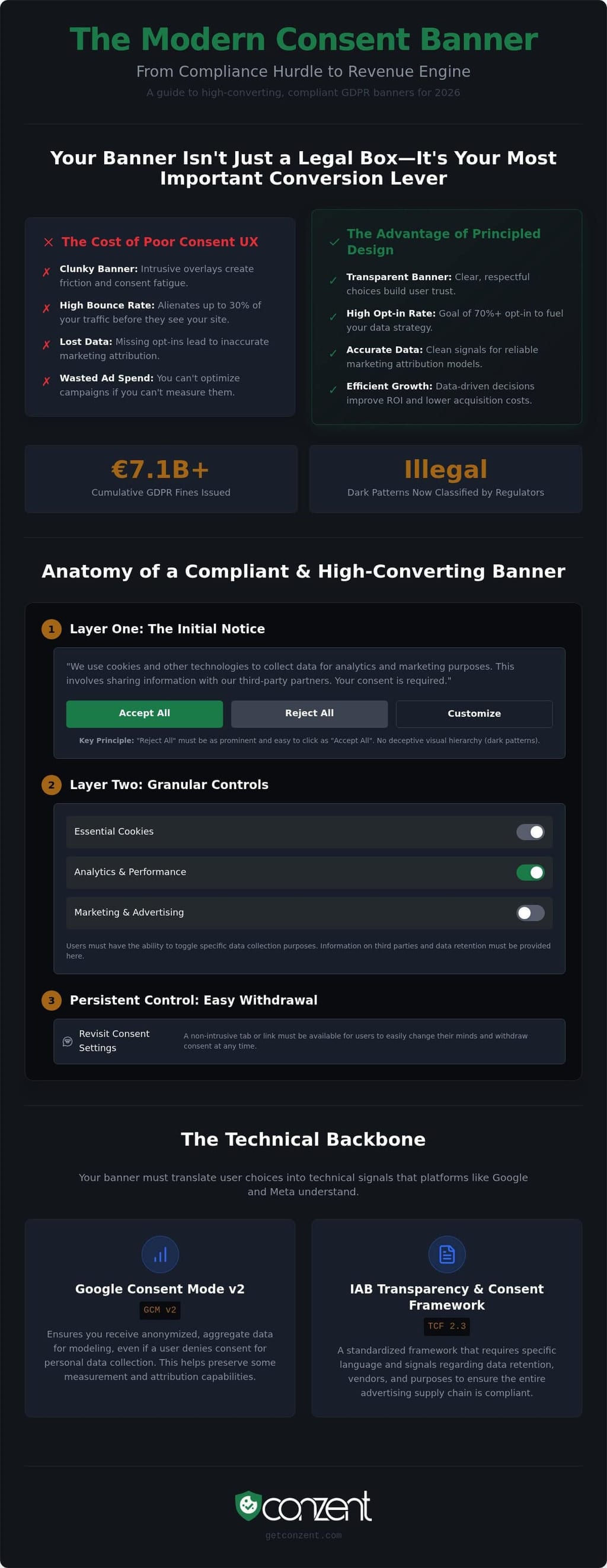
Consent is no longer a passive checkbox. It's the gateway to your first-party data strategy. In a world where third-party cookies are obsolete, your banner is the primary intake valve for marketing data. If users don't opt in, your attribution models fail. You lose visibility into which campaigns drive revenue and which waste budget. This creates a direct link between banner design and your bottom line. High-performing GDPR banner examples show that consent is a technical signal, not just a legal hurdle. It's the difference between a data-driven growth engine and flying blind.
The Cost of Poor Consent UX
A clunky banner does more than look bad. It signals a lack of respect for user privacy. High bounce rates at the banner layer often stem from consent fatigue. Users are tired of complex, opaque overlays that disrupt their journey. When a design feels intrusive or deceptive, they leave. This isn't just a UX failure; it's a financial one. Cumulative GDPR fines have surpassed €7.1 billion, and regulators are now targeting the very designs that frustrate users. The "Consent Gap" represents the dark space in your analytics where uncaptured user behavior leads to inflated customer acquisition costs and wasted ad spend.
Trust as a Competitive Advantage
Regulators in 2026 are aggressive. They've already classified dark patterns as illegal design. Your banner must make rejecting cookies as easy as accepting them. While this might seem like a threat to your opt-in rates, the opposite is often true. Transparency builds digital trust. Principled design reduces legal risk and stabilizes data flows. By analyzing successful GDPR banner examples, we see that clear choice architecture improves long-term retention. It's about moving from coercion to collaboration.
Maintaining high-level GDPR compliance is now a primary brand differentiator. It shows you value your customers' rights and digital autonomy. The General Data Protection Regulation (GDPR) established a standard that goes beyond simple legal boxes. It's about ethical responsibility. When you use design patterns that prioritize clarity, you aren't just avoiding fines. You're positioning your brand as a trustworthy partner in an era of increasing data skepticism. Trust is the new currency. If you don't earn it at the banner layer, you won't earn it anywhere else.
Anatomy of a Compliant GDPR Banner: Must-Have Elements
Compliance is built on transparency. A banner that hides information is a liability. To build an effective interface, you must understand the two-layer approach. Layer one is the immediate notice. It must state which third parties are involved and the specific purposes of data collection before any tracking begins. Layer two provides the granular controls. This is where users toggle specific permissions. High-quality GDPR banner examples demonstrate that clarity does not have to be overwhelming. It is about presenting choices in a way that respects the user's time and intelligence.
Regulators are clear on one point: the "Reject All" button must be as prominent as "Accept All". If your "Accept" button is a bright blue and your "Reject" button is a faint grey link, you are using a dark pattern. This leads to significant legal risk. Additionally, consent must be as easy to withdraw as it was to give. A small, non-intrusive "Revisit" tab allows users to change their minds without cluttering the UI. For a deeper dive into these requirements, the ICO's Guide to the GDPR offers comprehensive frameworks for organizational compliance.
Technical Standards: IAB TCF 2.3 and GCM v2
Your banner is a communication hub. It must translate user choices into technical signals that platforms like Google and Meta understand. Modern GDPR banner examples prioritize seamless integration with Google Consent Mode v2. This ensures that even if a user denies consent, you can still receive anonymized, aggregate data for modeling. Under IAB TCF 2.3, publishers must provide specific language regarding data retention and legitimate interests. Conzent handles these complex signals with zero latency, ensuring your site speed remains optimal while your compliance remains bulletproof.
Visual Hierarchy and Accessibility
Accessibility is a core component of digital rights. Your consent interface must meet WCAG standards to be inclusive. This means using high contrast ratios and legible font sizes. On mobile, avoid the "full-screen trap" where a banner blocks the entire viewport and prevents navigation. A well-designed mobile banner stays compact but accessible. An unambiguous opt-in requires a clear affirmative action that leaves no doubt about the user's intent to permit data processing. If you are looking to implement these standards without the technical headache, explore our flexible platform options to find a plan that fits your scale.
10 GDPR Banner Examples: From Minimalist to Full-Screen
Effective design balances legal rigidity with user experience. These GDPR banner examples illustrate how different industries solve the same problem: capturing consent without destroying the user journey. Consent is not a barrier; it is a handshake. Choosing the right layout depends on your traffic profile and business model. Whether you need a subtle footer or a high-visibility modal, the goal remains the same. You must provide a clear, affirmative choice that satisfies both the user and the regulator.
- The Minimalist Footer: Best for SaaS platforms with high-intent users. It stays at the bottom of the viewport, allowing the product to remain the focus while compliance runs in the background.
- The Centered Modal: High visibility for e-commerce sites. It demands a choice before the user interacts with the catalog, often resulting in higher opt-in rates for marketing trackers.
- The IAB TCF Publisher Wall: Essential for media companies. It prioritizes vendor transparency to protect ad revenue through strict IAB TCF v2.3 Integration.
- The Side-Bar Tooltip: A non-intrusive design for portfolios. It respects the visual hierarchy of creative sites without blocking central content.
- The Multi-Language Hybrid: Dynamic banners for global traffic. These detect user location to serve the correct legal language and regional requirements automatically.
Industry-Specific Design Patterns
E-commerce brands often integrate trust badges directly into the consent layer. This builds confidence before the user even sees a product. B2B SaaS platforms focus on data security. They use "Zero-Trust" messaging to reassure enterprise buyers about infrastructure integrity. Publishers have a more complex task. They must maximize the real estate for extensive vendor lists to maintain compliance under TCF 2.3 standards. Each industry requires a tailored approach to balance revenue with rights.
Examples of Non-Compliant Dark Patterns
Design is not just what you see; it's what you're allowed to do. Many sites still hide the "Reject" button or use pre-ticked boxes. These are clear violations that lead to heavy fines in 2026. The European Data Protection Board has repeatedly ruled against these tactics. Pre-ticked boxes are not valid consent. Implied consent is a myth that fails modern legal tests. If a user must dig through a sub-menu to say no, your design is non-compliant. True compliance requires a "Reject All" option that is just as prominent as the "Accept" button. Using principled banner design ensures you stay on the right side of the law while maintaining data flows.
Beyond Compliance: How to A/B Test Your Consent Banner
Guessing your banner design is a multi-thousand dollar mistake. It is a significant financial risk. Most businesses treat consent as a static hurdle, but the highest-performing GDPR banner examples are the result of rigorous experimentation. When you fail to test, you leave your marketing attribution to chance. You might be losing a large portion of your data simply because a button color lacks contrast or your copy feels clinical. Optimization is about finding the balance between visibility and coercion. It is about proving that ethical design also drives performance.
Testing button colors is a common starting point. A high-contrast "Accept" button might drive more clicks, but if it is too aggressive, it can lead to accidental consent that skews your data quality. Copywriting also plays a massive role. Does "We value your privacy" actually perform better than "Manage cookies"? Data often suggests that specific, functional language builds more trust than vague platitudes. By measuring the revenue impact of consent loss, you can quantify exactly how much money is at stake when users walk away from your banner.
Setting Up a Consent A/B Test
You need a North Star metric. Is it your opt-in rate or your bounce rate? Often, a high opt-in rate at the cost of a high bounce rate is a net loss for the business. Use Conzent A/B testing to deploy multiple versions of your interface simultaneously. This allows you to identify the optimal layout for specific segments. Testing across different geographic regions is also critical. A design that works in Berlin might fail in Los Angeles due to different cultural expectations and regional regulatory frameworks.
Analyzing the Data
Look for Revenue Leakage. This occurs when technical errors in the consent string prevent tags from firing even after a user says yes. It is a silent killer of ROI. When users say no, Google Consent Mode v2 modeling fills the gaps in your analytics by providing aggregate, anonymized insights. This ensures you aren't flying blind. A/B testing validates your privacy UX strategy by replacing assumptions with verifiable performance data. Stop leaving your data strategy to chance. Explore our pricing options to start optimizing your consent flow today.
Choosing Your Infrastructure: Managed Cloud vs. Self-Hosted Banners
Infrastructure is the silent engine of your consent strategy. Most GDPR banner examples focus on visual design, but the underlying architecture determines your site’s performance and data sovereignty. You shouldn't have to sacrifice speed for compliance. Choosing the right setup depends on your team’s resources and security requirements. It is a choice between the seamless updates of the cloud and the total control of a self-hosted environment. Both paths lead to compliance, but they serve different operational goals.
When to Choose Managed Cloud
Managed Cloud is the benchmark for businesses that prioritize agility. It offers zero-maintenance compliance. This is critical as we move through 2026 and face shifting regulatory interpretations. The platform handles the heavy lifting. It updates your scripts automatically to meet new standards without requiring a single line of code from your team. This path is ideal for organizations scaling across thousands of subdomains. It prevents infrastructure lag and ensures a consistent user experience globally. If your priority is a hands-off, enterprise-grade solution, explore our Managed Cloud pricing to find a plan that supports your growth.
The Power of Self-Hosting
Choosing to host your own infrastructure is the principled choice for technical teams. It removes the "third-party black box" from your privacy stack. When you use our Open Consent Infrastructure (OCI), you keep your data within your own perimeter. You don't rely on a distant vendor to manage your consent logs. This level of sovereignty is essential for security-conscious organizations and those in highly regulated industries. You can integrate consent directly into your CI/CD pipeline, treating compliance as a core part of your deployment process. It is about transparency and technical efficiency.
Performance remains a critical revenue metric. Heavy, poorly optimized scripts destroy your Core Web Vitals and frustrate your users. A slow-loading banner is a bounce-rate catalyst. We engineered our infrastructure to be lightweight and purposeful. Conzent supports both managed and self-hosted paths because we believe in an open consent mission. We provide the tools; you choose the deployment. This ensures that your GDPR banner examples aren't just compliant on paper, but high-performing in practice.
Future-Proofing Your Consent Strategy
Your cookie banner is the most visible expression of your brand's ethical standards. It's not just a legal shield; it's a technical gateway for your marketing data. By analyzing these GDPR banner examples, you've seen that high opt-in rates and strict compliance coexist through principled design and rigorous A/B testing. Whether you choose the flexibility of the cloud or the sovereignty of self-hosting, your infrastructure must support the latest industry standards like IAB TCF 2.3 and Google Consent Mode v2.
Efficiency doesn't have to be complex or inaccessible. We provide the tools to help you navigate this landscape with confidence. Our platform is IAB TCF 2.3 certified and fully Google Consent Mode v2 ready, offering both managed cloud and open source infrastructure options to fit your specific technical stack. You can stop guessing and start measuring the real impact of your privacy strategy today.
View Conzent Managed Cloud Pricing and Features to secure your site’s data future. Building a transparent digital ecosystem starts with a single, respectful handshake. You have the framework; now it's time to implement it.
Frequently Asked Questions
What is the most effective GDPR banner placement for mobile users?
The most effective placement for mobile is a bottom-docked banner that does not block the entire viewport. This design ensures users can still see your content while having a clear, accessible path to opt in or out. It avoids the "full-screen trap" which regulators often view as coercive. A compact footer respects the mobile user experience while meeting essential accessibility standards.
Can I still use Google Analytics if a user rejects my GDPR banner?
You can still receive data via Google Consent Mode v2 even if a user rejects cookies. This advanced implementation sends cookieless pings to Google for basic measurement and conversion modeling. It prevents a total data blackout while respecting the user's choice to opt out of persistent tracking. This technical signal ensures your analytics remain functional without violating privacy rights.
Does the GDPR require a "Reject All" button on the first layer?
Yes, the GDPR requires a "Reject All" button on the first layer of your banner. Regulators like the EDPB have ruled that rejecting cookies must be as easy as accepting them. If your design hides the reject option in a second layer or uses smaller text, it is considered an illegal dark pattern. High-quality GDPR banner examples always feature equal prominence for both actions.
How does Google Consent Mode v2 change the way banners are designed?
Google Consent Mode v2 requires your banner to capture specific signals for ad_user_data and ad_personalization. This changes the technical backend and the language used in your interface. Your banner must now communicate these granular permissions directly to Google’s tags. It moves consent from a simple binary switch to a more complex set of data processing instructions.
What are the penalties for using dark patterns in cookie banners in 2026?
Penalties for dark patterns remain severe. Under the GDPR, violations can lead to fines of up to €20 million or 4% of global annual turnover. The EU AI Act, enforced as of August 2026, introduces even higher penalties of up to €35 million or 7% of global turnover for serious violations. Regulators now systematically check websites for manipulative cookie banner designs to enforce these standards.
Is it better to self-host my consent manager or use a cloud service?
Self-hosting is better for organizations that demand total data sovereignty and want to remove third-party black boxes from their stack. Cloud services are superior for businesses that need a zero-maintenance solution with automatic updates for changing laws. We offer both paths to ensure you can choose the infrastructure that matches your technical resources and security requirements.
How do I measure the impact of my cookie banner on my ad revenue?
You measure the impact by using Revenue Impact Analytics to compare the conversion value of consented versus non-consented traffic. This identifies exactly how much revenue is lost due to consent gaps. By analyzing these numbers, you can justify A/B testing different GDPR banner examples to find the design that maximizes both legal compliance and your marketing attribution accuracy.
What specific language should a GDPR-compliant banner use?
Compliant banners must use clear, non-legalistic language that explains exactly what data is collected and for what purpose. You must list specific intentions, such as "personalized advertising" or "site analytics," and identify the third parties involved. Avoid vague phrases like "to improve your experience." Transparency is about providing the user with enough information to make an informed, affirmative choice.