
GDPR Consent Data Storage: Rules for Records and Rights

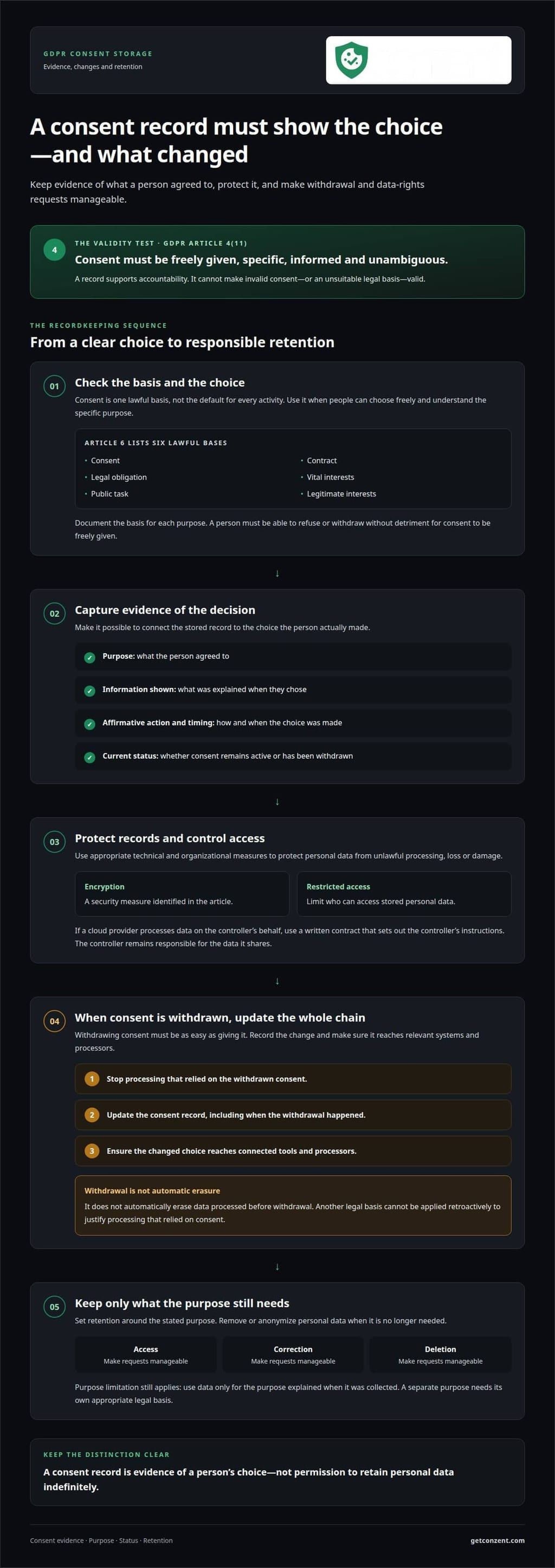
Consent is not a box to tick and forget. GDPR-compliant storage must preserve evidence of what a person agreed to and keep personal data only as long as it’s needed for the stated purpose. Under Article 4(11) of the GDPR, the European Union defines valid consent as freely given, specific, informed and unambiguous.
It’s reasonable to expect a clear rule for what to store. In practice, keep records that can demonstrate consent, protect them appropriately, and make withdrawals and data-rights requests manageable. Storage supports accountability, but it cannot make invalid consent valid.
Learn when personal data may be processed, what makes consent valid, and what consent records should show. This section also covers retention and security, the effects of withdrawal, and how access, correction, and deletion rights apply.
Key Takeaways
- Identify a lawful basis for each processing purpose; consent is only one option.
- Keep records that show what people agreed to, when they agreed, and how they can withdraw.
- Use clear, specific consent requests that give people a genuine choice.
- Make access, correction, deletion, and withdrawal requests part of your data-handling process.
- Set retention and security practices around the purpose of the data, then remove or anonymize it when it’s no longer needed.
When is data processing allowed?
Personal data may be processed only when the controller has a lawful basis and follows the GDPR’s data protection principles. Article 6 lists six legal bases: consent, contract, legal obligation, vital interests, public task, and legitimate interests. The right basis depends on the purpose. A business delivering an order may rely on a contract for information needed to fulfil it, but not automatically for unrelated advertising.
Consent is one legal basis, not the default for every activity. It is appropriate when people can choose freely and understand the specific purpose. If processing is necessary to meet a legal obligation, consent may be the wrong basis. Controllers should document the basis for each purpose and explain it to people. GDPR-compliant data storage for consent records supports accountability, but keeping a record cannot make an unsuitable legal basis lawful.
The GDPR applies to organizations outside the EU when they process the personal data of people in the EU or offer goods or services to them. Organizations processing data across borders must consider where the data goes, who can access it, and which transfer measure applies. When personal data is transferred outside the EU, an applicable transfer measure must preserve GDPR protection. Hosting location matters, but it is not the only factor: access by a processor in another country can also raise transfer questions.
Cloud storage does not change a controller’s responsibilities. If a cloud provider processes personal data on the controller’s behalf, it must follow the controller’s instructions under a written contract. The controller remains responsible for the data it shares. A sound arrangement identifies the stored data, the processing purpose, permitted access, and how the provider protects it. Technical and organizational measures, such as encryption and restricted access, help protect personal data from unlawful processing, loss, or damage.
Security also affects breach response. According to the European Union, organizations must notify data subjects about a data breach within 72 hours, subject to a possible waiver when safeguards such as encryption render the data useless to an attacker. According to the European Union, the maximum fine described for violations is €20 million or 4% of global revenue, whichever is higher. The GDPR compliance requirements therefore connect lawful processing with accountable storage and protection. A consent record is evidence of a choice, not permission to retain personal data indefinitely.
What are the GDPR consent requirements?
Consent must relate to a stated purpose, and people must be able to withdraw it. Records should document that choice and what happens when it changes.
Withdrawal ends processing that relies on the relevant consent. The controller must stop that processing, update the consent record, and ensure the withdrawal reaches relevant systems and processors. For example, withdrawing permission for analytics should prevent further analytics processing based on that consent. It does not automatically erase data processed before withdrawal, but another legal basis cannot be applied retroactively to justify processing that relied on consent.
Withdrawing consent must be as easy as giving it. A clear, accessible option is more appropriate than a hidden process that takes extra effort. The record should capture the withdrawal and when it happened, so the controller can distinguish current permissions from past choices. This matters when websites share consent signals across tools: a changed choice must not remain active in a connected system.
Purpose Limitation After Withdrawal
Purpose limitation means using personal data only for the purpose explained when it was collected. After withdrawal, the controller must stop processing for that purpose if it depended on consent. A separate purpose needs its own appropriate legal basis; it cannot be quietly substituted to keep the same consent-based activity running. This distinction keeps records accurate and prevents permission for one use from becoming permission for another.
Consent Storage Rules Across Privacy Regimes
Consent recordkeeping requirements differ across legal regimes, so a record designed for GDPR purposes may not meet every other law’s requirements. GDPR records should connect a person’s choice to its purpose and withdrawal status. ePrivacy rules and US privacy laws may have different scopes and consent triggers, with US requirements varying by applicable law. Organizations serving people across regions should map each applicable rule to the data and processing it covers.
Weak records create more than an administrative problem. If a controller cannot demonstrate consent, it may struggle to show that consent-based processing was lawful, and regulators may take enforcement action, including fines. The GDPR maximum fine is described above. Records should preserve the relevant choice, purpose, and changes without retaining unnecessary personal data.
For organisations reviewing implementation options, compare consent platform options against the consent records and withdrawal workflows they need to support.
Article 7 of the GDPR defines the basic requirements for effective legal consent: it must relate to specified purposes sufficiently explained to the data subject.
Requirements for valid consent
According to the European Union, Article 4(11) of the GDPR defines consent as a freely given, specific, informed and unambiguous indication of a data subject’s wishes. A record must help show that each element was present when the person chose.
A GDPR consent record should identify the purpose, the information presented, the person’s affirmative action, and when the choice was made. It should also show the current consent status, including any withdrawal. These details help a controller connect the stored record to the choice it documents.
“Freely given” means the person has a genuine choice. Recital 42 says consent is not freely given if someone cannot refuse or withdraw without detriment. A service should not demand permission for processing that it doesn’t need to provide that service. For example, access to an account shouldn’t depend on agreeing to unrelated marketing.
“Specific” means consent relates to a defined purpose, not an open-ended range of future uses. Explain each purpose separately, such as personalizing content and sending promotional emails. A person may agree to one and refuse the other. Combining unrelated purposes makes the choice less clear and weakens the record’s value.
“Informed” means the request explains what personal data the organization collects and how it will use it. GDPR information should use clear, plain language and distinguish the consent request from other matters. If a request is buried in general terms, it may be difficult to show what the person understood. The record should preserve enough context to connect the action to the information shown.
“Unambiguous” requires a clear affirmative action. Recital 32 says silence, pre-ticked boxes, and inactivity don’t constitute consent. A person selecting an empty checkbox is different from a form that has already selected it. The system should record the action rather than infer agreement from browsing, continued use, or failure to opt out.
For special categories of personal data, Article 9 of the GDPR governs processing. Consent records should make clear which purpose and information the person agreed to, rather than treating a general permission as covering every category. Where processing relies on consent, a record that links the person’s action with the relevant request gives the controller a clearer account of the choice.
Organizations planning their consent-management setup can review consent platform options alongside the recordkeeping needs described here.
Data access, correction, and deletion rights
A data subject can ask what personal data an organization holds and request changes or deletion. A clear process links each request to the relevant records and processing activities.
Individual Data Rights
Individual data rights let a person access, correct, or request deletion of personal data. They matter because consent records may contain outdated details or reflect a choice that has changed. Under Article 16 of the GDPR, people can correct inaccurate or incomplete personal data. For example, a correction request should update the relevant record, not leave conflicting versions in active use.
Organizations must respond to requests to exercise data rights within 1 month of receiving them. The response period for complex or multiple requests may be extended by 2 months, if the person is informed of the extension. A reliable process records when a request arrived, what data it concerns, and the response given. That creates a traceable path from the data subject’s request to the action taken.
Deletion requests need careful handling. The organization should identify the personal data linked to the request, then determine what action applies to the relevant processing. For example, removing a consent record from an active system may not address copies in connected records. A documented process helps coordinate deletion or other action across the systems involved.
Controls for Data Access
Access controls limit personal data access to authorized personnel. They matter because a consent record can reveal a person’s choices and related information. Permissions should match each role’s responsibilities, and organizations should review them regularly. For example, staff who manage consent records may need different access from staff who analyze aggregated performance.
Clear information helps people understand the processing behind a request or consent choice. Article 12 of the GDPR requires information about processing to be concise, transparent, intelligible, easily accessible, and written in clear, plain language. A data subject should be able to distinguish a consent request from other information and understand what data the organization collects and why.
For each request, the organization should record when it arrived, which systems were searched, the decision, and the response. Restricting access to that request record helps protect the data subject while preserving accountability. A consistent workflow also reduces the chance that one team corrects a record while another continues using inaccurate information.
GDPR data storage principles
GDPR storage is not simply keeping a consent log. It means limiting personal data to its purpose, protecting it, and removing it when it is no longer needed.
Core Data Storage Principles
The storage limitation principle means keeping identifiable personal data only as long as necessary for its specified purpose. A valid consent record does not justify retaining every related identifier indefinitely. A retention policy should connect each processing activity to the data held, its purpose, storage location, retention period, and what happens when it is no longer needed.
Security matters throughout the retention period. The GDPR requires appropriate technical and organizational measures to protect personal data from unlawful processing, accidental loss, destruction, or damage. Encryption and pseudonymisation are recommended safeguards, but neither removes the need to decide which people and systems require access. For example, limiting record access to staff responsible for consent administration reduces unnecessary exposure.
Rules for Storing Consent Records
Consent records should preserve evidence of a person’s affirmative choice and enough context to connect it to the stated purpose. A timestamp, consent status, and version of the information presented can help explain what the record represents. The record should distinguish a freely given choice from a refusal or later withdrawal, rather than treating every state as active permission.
Keep records proportionate. A consent log needs information that supports accountability, not unrelated personal details. If an identifier links the record to a person, coded or pseudonymised data remains personal data. Automated deletion or anonymization can help apply retention decisions consistently; the European Data Protection Board says controllers should embed systematic procedures for these actions in processing activities.
Consent Record Retention
There is no single retention duration that suits every consent record. Keep personal data only while it remains necessary for the specified purpose, and explain the storage period in privacy information. The purpose, data involved, and applicable recordkeeping needs determine how long a record remains useful.
When that purpose ends, the retention policy should specify whether the organization deletes or anonymizes the record. Anonymization means no key-code exists to re-identify the person; pseudonymization alone does not meet that standard. This distinction matters when consent evidence is separated from a direct identifier but remains linkable through another system.
For organizations assessing tools that support consent-record workflows, review consent platform options against their storage and retention requirements.
Conzent
Conzent helps websites manage consent through its Managed Cloud Consent Platform or Self-Hosted Open Consent Infrastructure. Customizable consent banners support clear choices, while Consent A/B Testing and Revenue Impact Analytics help teams assess how consent experiences perform. These tools support consent management, but they do not replace decisions about lawful basis, retention, or data rights.
Consider Conzent when you need consent infrastructure suited to your hosting approach and a way to coordinate consent experiences across your website. Choose a setup that helps you manage consent records and update banners while keeping privacy choices clear and manageable.
Contact Conzent to discuss your consent workflow.
Build consent into your operating model
Consent management works best when considered alongside the systems that collect data, apply preferences, and support future changes. Treat GDPR-compliant data storage for consent as an ongoing operational responsibility, not a one-time setup. As your website and processing activities change, keep the consent experience and its records aligned.
Map how consent choices move through your current setup. Note where preferences are captured, which systems use them, and how your team updates them. This can help you decide whether managed or self-hosted infrastructure fits your needs, without confusing a technical platform with legal advice.
Conzent offers consent infrastructure for teams working through those implementation decisions. Contact Conzent about your consent setup to discuss which approach fits your requirements. A system that records preferences and sends updates to the right tools helps your team apply people’s choices.
Frequently Asked Questions
What Is GDPR Compliance?
GDPR compliance means handling personal data according to the General Data Protection Regulation. In practice, an organization maps what it collects, why it uses each item, and which systems receive it. For example, a signup form might collect an email address for account access, while a separate marketing purpose needs its own assessment. Clear records of these decisions help teams explain their data practices.
What is considered "personal data"?
Personal data is information that identifies a person or can be linked to them. Names and email addresses are direct examples; an IP address or account identifier may also identify someone in context. Pseudonymized data remains personal data, even if the organization holding it does not have the key-code. For example, replacing a name with a customer number does not make a record anonymous if it can still be linked back to the person.
How do professional providers secure and encrypt consent data under GDPR?
Providers use technical and organizational safeguards suited to the data and its risks. These can include encryption, pseudonymisation, restricted staff access, and regular permission reviews. Consider what each control protects: encrypting administrative secrets does not necessarily mean every consent record is encrypted. Conzent does not track visitors; its confirmed controls include two-factor authentication for dashboard access and encrypted secrets.
Where can GDPR-regulated consent data be stored and processed?
Consent data can be stored in the EU or outside it, provided an applicable transfer measure is used for transfers beyond the EU. EEA-based controllers and processors remain bound by the GDPR when they store or process data elsewhere. Conzent’s data is EU-hosted, and visitor consent data stays with the customer. Its self-hosted option lets customers run the core on their own infrastructure.
What data protection principles apply to consent storage, including minimization and purpose limitation?
Collect only the personal data needed for a defined purpose, and do not reuse it for unrelated activities. For example, a record used to document a cookie choice should not become a source for a separate marketing list. Limit access to stored records, protect them from loss or unauthorized use, and set a retention rule. When the purpose ends, delete the data or anonymize it if appropriate.
How can a consent management provider prove consent and track consent withdrawal under GDPR?
A consent system should create a record linking a person’s choice to the relevant purpose and information presented. It should distinguish permission, refusal, and withdrawal, then make the updated status available to systems that rely on that choice. For example, withdrawal should not leave an older permission active in a connected advertising or analytics tool. A clear event history helps explain how the status changed.
What are the GDPR requirements for consent management platforms and processors?
A platform’s role depends on how it handles personal data. When a provider processes data for a controller, it must follow the controller’s instructions under a written contract. The controller remains responsible for processing decisions, including purposes and legal basis. A consent platform can support recordkeeping and preference handling, but using one does not establish that every website activity complies with the GDPR.
How do GDPR consent storage requirements compare with ePrivacy rules and US privacy laws?
GDPR records should link a person’s choice to its purpose and withdrawal status. ePrivacy rules and US privacy laws may have different scopes and consent triggers, and US requirements vary by applicable law.