
GDPR Cookie Consent Requirements 2026: The Comprehensive Compliance Checklist

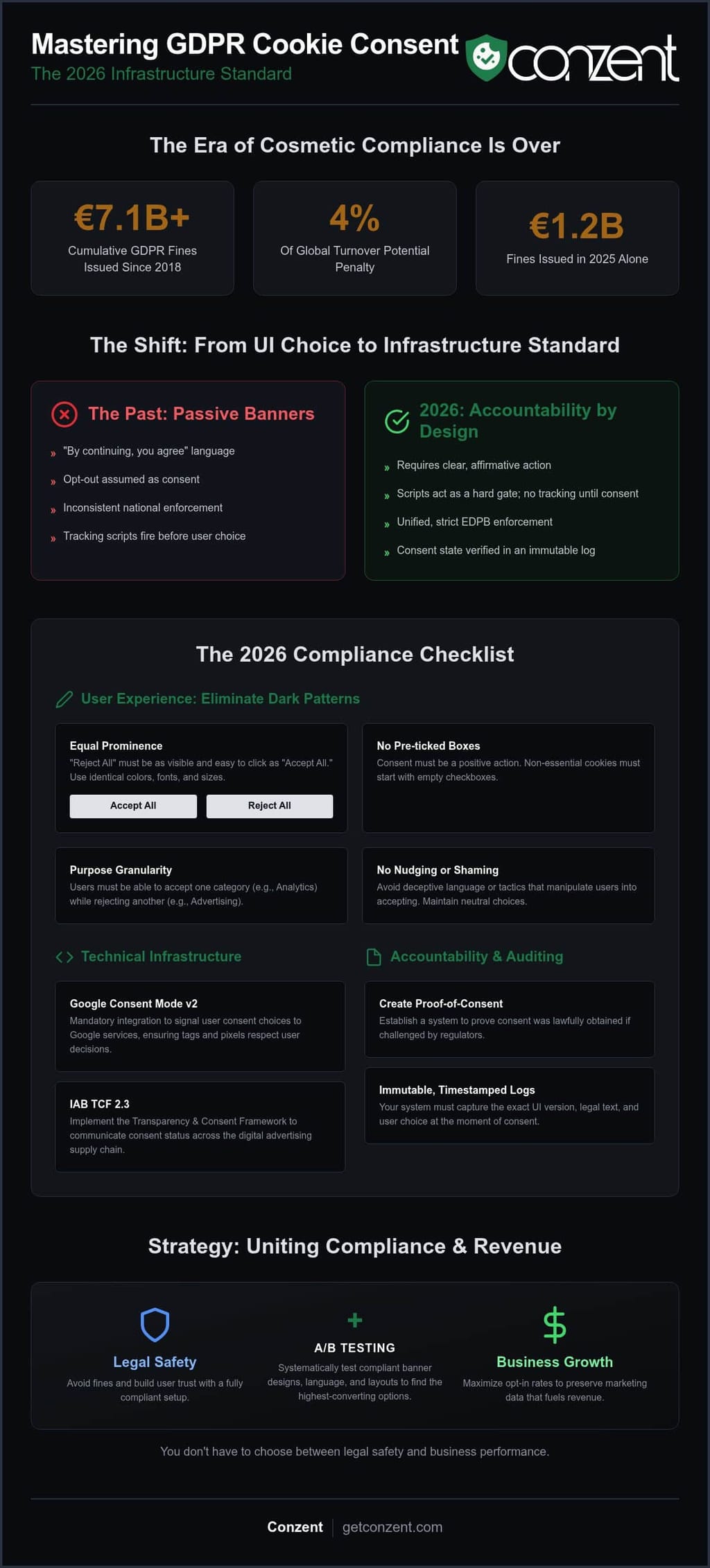
Over €7.1 billion in cumulative fines prove that regulators have moved past polite warnings. Compliance is no longer a front-end UI choice. It's a mission-critical infrastructure standard. You're likely struggling to balance the strict GDPR cookie consent requirements 2026 with the technical complexity of Google Consent Mode v2. It's a difficult tightrope. On one side, you face penalties of up to 4% of global turnover. On the other, you risk losing the marketing data that fuels your revenue.
We believe privacy shouldn't be a luxury or a barrier to growth. You shouldn't have to choose between legal safety and business performance. This guide provides a clear, actionable roadmap to master the 2026 landscape. We offer a technical and legal checklist designed to protect your users and your bottom line. We'll examine IAB TCF 2.3 enforcement, technical proof-of-consent strategies, and how to maintain ad revenue without compromising on ethics.
Key Takeaways
- Shift from visual banners to "Accountability by Design" to satisfy the unified enforcement standards of the EDPB.
- Remove dark patterns by giving "Accept" and "Reject" options equal weight and eliminating all pre-ticked boxes.
- Meet the technical GDPR cookie consent requirements 2026 through mandatory integrations like Google Consent Mode v2 and IAB TCF 2.3.
- Create an auditable proof-of-consent system using immutable, timestamped logs that capture the specific UI shown at the moment of choice.
- Balance legal safety with business growth by utilizing A/B testing to find the highest-converting compliant banner designs.
Table of Contents
The 2026 GDPR Landscape: Why Banners Alone Are Not Enough
The era of cosmetic compliance is over. In 2026, transparency is a technical requirement, not a design choice. The days of treating a cookie banner as a simple UI overlay have passed. Regulators now demand "Accountability by Design." This means your compliance must be integrated into your data infrastructure. The General Data Protection Regulation (GDPR) has evolved from a set of legal principles into a rigorous technical specification that leaves no room for ambiguity.
The European Data Protection Board (EDPB) now acts as a central enforcement engine. They've eliminated the old inconsistencies between national authorities. If your website is accessible in the EU, you're held to a single, uncompromising standard. Cumulative fines have already surpassed €7.1 billion since 2018. In 2025 alone, authorities issued approximately €1.2 billion in penalties. The financial risk is massive, but the loss of brand trust is often more permanent. Users expect digital rights to be respected, not bypassed through clever wording.
Contrast this with the 2018-era "opt-out" approach. Back then, many businesses assumed that a lack of an objection equaled consent. Today, that assumption is a legal trap. The GDPR cookie consent requirements 2026 focus on technical verification. It's no longer enough to show a banner. You must prove that your tracking pixels remained dormant until the user made a choice. If your marketing tags fire before a click, you're non-compliant. Even the UK has tightened its grip; the Data (Use and Access) Act 2025 increased PECR fines to £17.5 million or 4% of global turnover, matching GDPR levels.
From Passive Banners to Active Consent Signals
Passive consent is a relic of the past. Phrases like "by continuing to browse, you agree to cookies" are now evidence of a violation. Consent must be a clear, affirmative action. It has to be specific and informed. For developers and site owners, the 2026 standard is the "Active Signal." This means your consent management system must act as a hard gate. No tracking scripts should initialize, load, or execute until a positive consent state is verified and recorded in an immutable log. It's a binary state: either you have the signal, or you don't track.
The Interplay of ePrivacy and GDPR in 2026
Privacy laws work in tandem. While the proposed ePrivacy Regulation was formally withdrawn in February 2025, the existing ePrivacy Directive and GDPR still govern your data flow. You must clearly separate "strictly necessary" cookies from "marketing" or "analytics" cookies. Necessary cookies keep a shopping cart functional or maintain a user session; they don't require consent. Everything else does. You can find a deeper breakdown of these legal categories on our GDPR compliance page. Staying legal means ensuring your technical stack can distinguish between these categories in real-time.
2026 User Experience Checklist: Eliminating Dark Patterns
User experience in 2026 is no longer just about aesthetics. It's about ethics. Regulators are actively targeting "dark patterns" that trick users into surrendering their data. If your design relies on psychological manipulation, you aren't compliant with the GDPR cookie consent requirements 2026. Transparency is not a luxury; it is a standard. Manipulation is not marketing; it is a liability. Your interface must provide a neutral choice that respects user autonomy.
Use this checklist to audit your current interface for compliance:
- Equal Prominence: Your "Reject All" button must be as easy to see and click as your "Accept All" button. This means identical colors, fonts, and sizes.
- No Pre-ticked Boxes: Consent must be given through a clear, positive action. Empty checkboxes are the only legal starting point for non-essential cookies.
- Purpose Granularity: Don't bundle consents. Users must have the ability to accept analytics but reject advertising trackers in the same view.
- No Nudging: Avoid deceptive language or "confirm-shaming" tactics. Phrases like "I prefer a worse experience" on a rejection button are now direct triggers for enforcement.
Designing for Moral Clarity and Transparency
Transparency isn't a wall of legal text. It's a clear conversation. Descriptions should explain what a cookie does in plain language. Instead of "cross-site identifier tracking," try "shows you ads based on your interests." A multi-layered notice provides a high-level summary immediately with a deep dive available for those who want it. You can see these principles in action through our cookie banner features, which prioritize user understanding over complex jargon.
The "Withdrawal" Requirement: A 2026 Priority
Consent is not a permanent contract. It's a temporary permission. Under 2026 standards, withdrawing consent must be as easy as giving it. This requires a persistent technical solution, such as a floating icon or a fixed footer link that remains accessible on every page. The FTC guidance on privacy and security emphasizes that deceptive withdrawal paths are just as harmful as deceptive collection methods. When a user clicks "withdraw," your system must trigger an immediate block on those specific scripts without delay. Legally, the withdrawal path must be a one-click process that doesn't require navigating through multiple sub-menus or re-verifying an identity.
If you're looking for a platform that handles these technical nuances automatically, you can explore our flexible pricing options to find the right fit for your scale.
Technical Infrastructure Checklist: GCM v2 and TCF 2.3
Stop viewing consent as a cosmetic layer. In 2026, it is a data-routing standard. If your technical stack fails to communicate consent states accurately, your marketing performance will collapse. Many organizations fall into The Privacy Compliance Gap because they treat banners as isolated UI elements rather than core infrastructure. Meeting the GDPR cookie consent requirements 2026 requires a deep integration between your Consent Management Platform (CMP) and your advertising tags.
The industry is moving toward server-side consent management. Client-side blocking is often fragile and easily bypassed by sophisticated scripts. Server-side control offers a principled approach; it ensures that data never leaves your environment unless a valid consent signal exists. This shift provides the transparency that regulators now demand while protecting your site speed and security.
Implementing Google Consent Mode v2 Correctly
Google Consent Mode v2 is no longer a suggestion. As of June 15, 2026, it is the exclusive mechanism for controlling data flow between your site and Google services. You must correctly map four key signals: ad_storage, analytics_storage, ad_user_data, and ad_personalization. Failure to send these parameters results in a total loss of conversion modeling and audience building in Google Ads.
You have two choices for implementation. A "Basic" setup blocks tags entirely until a user clicks accept. This is the safest legal path but results in data gaps. An "Advanced" setup sends cookieless pings to Google before consent, allowing for AI-driven modeling. Your choice depends on your legal risk appetite. Avoid common errors like firing tags before the default_consent state is set. For a step-by-step technical breakdown, consult our Google Consent Mode v2 implementation guide.
IAB TCF 2.3: The Publisher’s Standard
If you monetize through programmatic advertising, IAB TCF 2.3 is your mandatory standard. Enforcement began on February 28, 2026, making all previous TCF 2.2 strings invalid. The primary change in version 2.3 is the "Disclosed Vendors" segment. You must now provide explicit transparency about every vendor in your stack. It is not enough to link to a generic list; you must technically verify that only consented vendors receive the TC string.
Managing the Global Vendor List (GVL) is now a dynamic task. You must regularly audit your CMP to ensure no unauthorized vendors are sneaking into your data flow. This level of technical hygiene is what separates compliant leaders from those waiting for a fine. You can find more details on maintaining these standards in our IAB TCF compliance details section.
The Accountability Checklist: Auditable Proof of Consent
A cookie banner without an audit trail is just a digital facade. In 2026, the burden of proof lies entirely with you. Regulators don't just ask if you collected consent; they demand to see the receipt. Meeting the GDPR cookie consent requirements 2026 means maintaining a technical record that is both immutable and verifiable. If you cannot prove exactly what a user agreed to, your consent is legally non-existent. Transparency is not a static statement; it is a documented history.
Follow these four steps to build a defensible accountability framework:
- Step 1: Implement Immutable Logs. Every consent action must generate a timestamped entry. This log should be read-only to prevent tampering or retrospective editing.
- Step 2: Record the UI Version. Save a snapshot of the exact banner layout, wording, and button colors shown at the moment of consent. This prevents accusations of using deceptive "dark patterns" that were later modified.
- Step 3: Synchronize Cross-Device Consent. If a user rejects tracking on mobile, that choice must persist on desktop. This synchronization must happen securely without triggering new tracking scripts during the handshake.
- Step 4: Audit Script Behavior. Regularly verify that your third-party tags actually stay silent when a "reject" signal is sent. Automated testing is the only way to catch "cookie creep" before a regulator does.
Building a Tamper-Proof Audit Trail
Transparency requires control. This is why many organizations are moving toward self-hosted consent infrastructure. When you host your own CMP, you own the audit trail. You don't rely on a third-party vendor's black-box logging. A robust log entry should include an anonymized identifier, the precise timestamp, the specific consent categories selected, and the unique ID of the UI version displayed. This level of detail transforms compliance from a vague promise into a technical fact.
Automating Compliance Audits
Compliance is a continuous process, not a one-time setup. Scripts change. Vendors update their tags. You need automated scanners to detect unauthorized trackers the moment they appear. This "continuous monitoring" of tracking scripts is a core requirement for 2026 accountability. When a user submits a Data Subject Access Request (DSAR), you must be able to produce their specific consent history instantly. Manual searching is no longer viable at scale. Automation ensures that your legal safety net is always active, protecting both your users and your business.
Ready to secure your data infrastructure? View our managed and self-hosted pricing to start building your auditable proof of consent today.
Strategic Checklist: Compliance Meets Revenue Growth
Compliance is not a tax on your growth. It is an investment in your brand's integrity. In the context of GDPR cookie consent requirements 2026, the businesses that thrive won't be the ones trying to hide their trackers. They will be the ones that turn privacy into a competitive edge. You can maintain high-performance marketing while staying strictly legal. It requires moving from a mindset of evasion to one of optimization. Trust is your new currency. Privacy is your new standard.
Most site owners fear that honest banners will kill their data. Evidence suggests otherwise. Clear, respectful interfaces build the trust necessary for long-term retention. By using Consent A/B Testing, you can find the exact balance of layout and copy that resonates with your specific audience. You aren't guessing. You are using real-world performance metrics to protect your data flow. You can optimize for opt-ins without compromising on moral clarity.
Optimizing Opt-In Rates Without Coercion
Testing is the antidote to coercion. You can experiment with the timing of your banner or the specific language used to describe your vendors. A banner that appears after five seconds of engagement often sees higher opt-in rates than one that interrupts the initial landing. We provide Revenue Impact Analytics to help you visualize exactly how these changes affect your bottom line. This transparency allows you to justify compliance costs. You can show a direct correlation between user trust and conversion value. It is not a barrier; it is a bridge to better data.
The Future of Privacy-First Growth
The digital landscape is shifting toward zero-party data and direct first-party relationships. As third-party cookies continue to degrade, your ability to collect consented, high-quality data becomes your most valuable asset. Leveraging open-source infrastructure, like our Self-Hosted Open Consent Infrastructure, allows you to lower overhead while maintaining total control over your compliance stack. It's a move toward technical efficiency and ethical responsibility. Self-hosting is the ultimate transparency play for 2026.
Our Managed Cloud Consent Platform simplifies this entire 2026 roadmap. It handles the technical heavy lifting of GCM v2 and TCF 2.3 so you can focus on building your business. Explore Conzent Pricing to start your 2026 compliance journey and secure your revenue for the years ahead.
Future-Proof Your Data Infrastructure
Compliance in 2026 is no longer a front-end choice. It is a technical mandate. Mastering the GDPR cookie consent requirements 2026 means integrating transparency into every layer of your digital stack. You've seen that banners alone are insufficient. You need auditable logs, active consent signals, and a total rejection of dark patterns. These aren't just legal hurdles. They are the building blocks of a sustainable first-party data strategy. Trust is your most valuable asset. Don't leave it to chance. It's the difference between a resilient brand and a liability.
You can secure your business today. Our platform is IAB TCF 2.3 certified and fully Google Consent Mode v2 integrated. We provide source-available transparency that puts you in control of your own data destiny. It's time to move from reactive fixes to a principled infrastructure that respects user autonomy. Get a 2026-Ready Managed Cloud Consent Platform and protect your revenue without compromising your values. Your users deserve moral clarity. Your business deserves a roadmap that works.
Frequently Asked Questions
What are the main GDPR cookie consent changes for 2026?
The primary shift involves moving from visual banners to technical proof. Regulators now demand that tracking remains dormant until a positive signal is received. This requires a deeper integration between your banner and your tag manager. You must treat compliance as a data infrastructure requirement rather than a design task. It's about technical accountability, not just appearance.
Is Google Consent Mode v2 mandatory for GDPR compliance in 2026?
Google Consent Mode v2 became the exclusive mechanism for controlling data flow on June 15, 2026. Without it, you lose conversion modeling and audience building features in Google Ads. It is a technical necessity to meet GDPR cookie consent requirements 2026 while maintaining marketing performance. Failure to implement this signal correctly results in data gaps that AI cannot bridge.
How do I prove consent to a GDPR regulator if audited?
You must produce an immutable, timestamped log of every consent action. This record should include the specific UI version the user saw to prove you didn't use dark patterns. Anonymized identifiers link the user's choice to the technical execution. If you can't produce this "receipt" during an audit, your consent is legally invalid and your data is at risk.
Can I still use "Accept All" buttons on my cookie banner in 2026?
You can use an "Accept All" button if the "Reject All" button is identical in size, color, and font. Regulators now fine companies for "nudging" users toward acceptance through visual hierarchy. The choice must be neutral. If your rejection path requires more clicks than your acceptance path, your banner is non-compliant and violates the principle of egalitarian design.
What is the penalty for non-compliant cookie banners in 2026?
Penalties reach up to €20 million or 4% of total global turnover, whichever is higher. The UK has also aligned its PECR fines with these levels. Beyond the financial hit, authorities now focus on immediate enforcement rather than simple warnings. Non-compliance also risks total data deletion orders that can erase years of marketing insights and audience data instantly.
Does 2026 GDPR allow for bundled consent for marketing and analytics?
Bundled consent is strictly prohibited. You cannot force a user to accept marketing cookies just to gain access to site analytics. Each purpose needs its own opt-in. This granularity ensures that users have total control over how their data is used. Your technical stack must be able to fire scripts selectively based on these specific choices to stay legal.
How often should I audit my website for compliant cookie behavior?
Continuous monitoring is the new standard. Manual quarterly checks are no longer sufficient to meet GDPR cookie consent requirements 2026. Automated scanners should audit your script behavior daily to detect unauthorized trackers or "cookie creep." This ensures that your technical execution always matches your legal promises and respects the user's latest choices without delay.
What is the difference between IAB TCF 2.3 and older versions?
IAB TCF 2.3 introduced the mandatory "Disclosed Vendors" segment. You must provide explicit transparency for every vendor in your stack. TC strings from version 2.2 became invalid on February 1, 2026. This version focuses on technical verification to ensure that only consented vendors receive data signals. It is a more rigorous standard designed for the modern programmatic ad industry.