Google Consent Mode v2 Implementation: The 2026 Technical Guide
What if the data gap in your Google Ads isn't a technical failure, but a failure of infrastructure? You're likely watching conversion numbers dwindle while the threat of GDPR penalties, reaching up to 4% of global turnover, looms over your operations. It's a false choice between legal compliance and marketing performance. We believe privacy is a necessary standard, not a barrier to growth. Mastering your google consent mode v2 implementation is the only way to stop guessing and start measuring with confidence again.
This guide provides the technical roadmap to recover more than 70% of ad-click-to-conversion journeys lost to user declines. We'll demystify the critical 2026 shifts, including the June update that established the ad_storage parameter as the single point of control for advertising data. You'll learn how to configure the mandatory ad_user_data and ad_personalization fields for both Basic and Advanced modes. We'll move from philosophical foundations to practical evidence; showing you how to verify your status in Tag Assistant and restore conversion modeling in GA4. It's time to build a tracking setup that is as ethical as it is efficient.
Key Takeaways
- Understand why the Digital Markets Act transformed GCM v2 from a choice into a technical requirement for any brand operating in the EEA or UK.
- Compare the data recovery potential of Advanced Mode against the privacy-first simplicity of Basic Mode to find the right balance for your site.
- Execute a precise google consent mode v2 implementation by setting default consent states that align with current legal standards.
- Leverage machine learning in GA4 to bridge the attribution gap and recover up to 70% of conversion data lost when users decline cookies.
- Explore how self-hosted, open-source infrastructure provides the transparency and speed that traditional, bloated consent platforms lack.
Understanding Google Consent Mode v2 in the 2026 Privacy Landscape
Google Consent Mode v2 isn't a suggestion. It is a technical necessity. At its core, GCM v2 is a signal-based framework that tells Google's tags exactly how to behave based on a user's choice. In 2026, this system serves as the primary bridge between strict privacy regulations and the data insights you need to stay profitable. It's not about tracking users; it's about respecting their boundaries while maintaining a functional digital economy. We view this as an egalitarian standard that makes digital rights accessible to every business, regardless of their size.
The regulatory pressure behind this shift comes from the Digital Markets Act (DMA). Under this law, Google is designated as a gatekeeper. This means they must prove that user consent was explicitly granted before processing data for advertising. If your google consent mode v2 implementation is missing or broken, your Google Ads account will simply stop building audiences. You can't run remarketing campaigns. You can't personalize ads. Without these signals, Google's machine learning models have nothing to work with, leaving your marketing strategy blind and your ad spend inefficient.
The Four Key Consent Signals
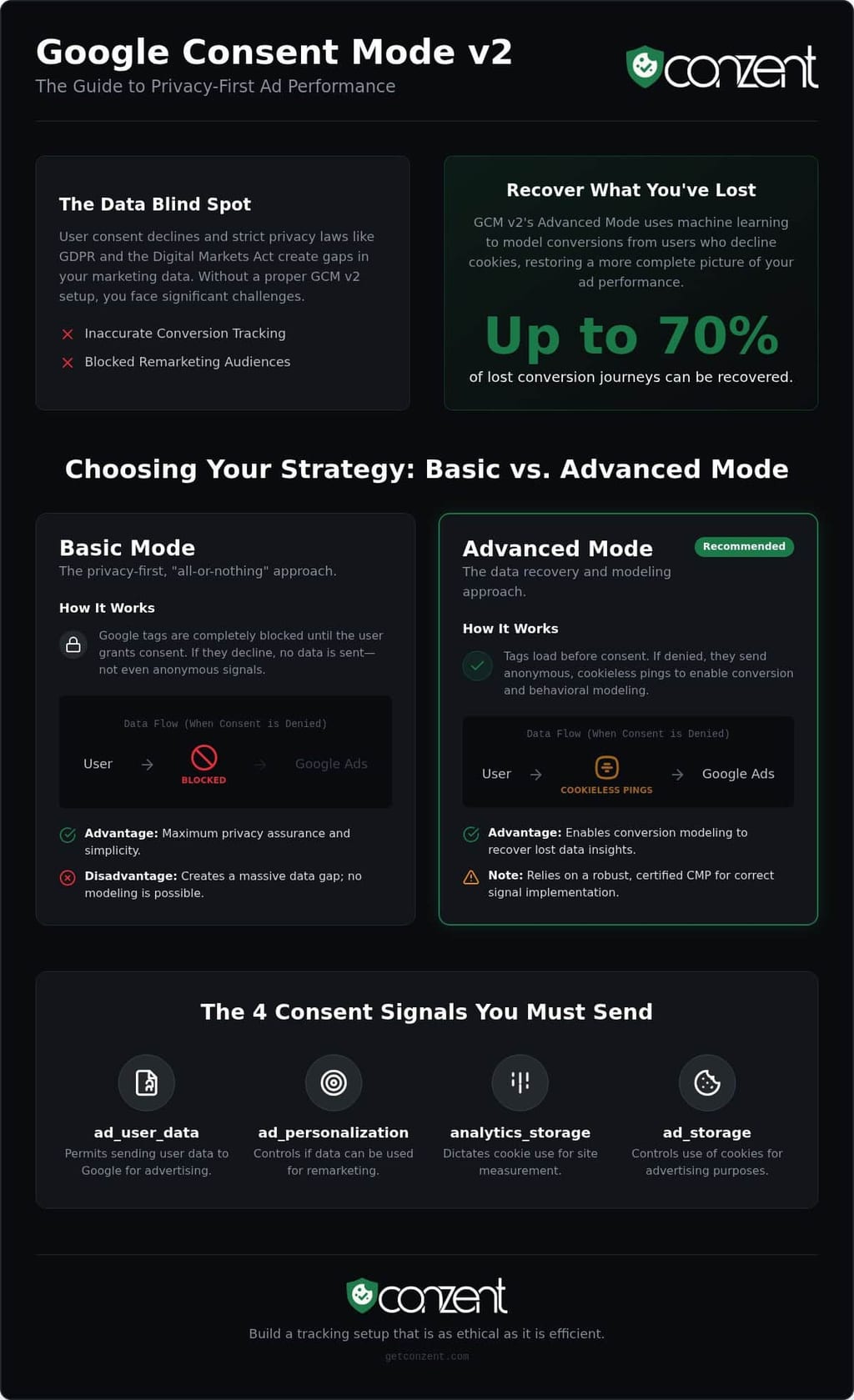
The original version of Consent Mode focused primarily on cookies. Version 2 expands this to cover how data is used within the Google ecosystem. Understanding these four signals is vital for any technical setup:
- ad_storage: Controls the use of cookies for advertising purposes.
- analytics_storage: Dictates whether cookies can be used for site measurement and performance tracking.
- ad_user_data: A newer parameter that determines if user data can be sent to Google for advertising services.
- ad_personalization: Specifically controls whether data can be used for remarketing and targeted ad experiences.
Why 2026 Demands a Certified CMP
The days of "rolling your own" consent banner are effectively over for most businesses. Google now requires publishers and advertisers in the EEA and UK to use a Google-certified Consent Management Platform (CMP). This isn't just about showing a banner. It's about ensuring the underlying infrastructure correctly communicates with the Google tag. A proper google consent mode v2 implementation requires a partner that stays current with evolving standards like IAB TCF v2.3.
Choosing a certified platform turns compliance from a legal chore into a technical advantage. By integrating with an infrastructure that prioritizes transparency, you ensure that your data flow remains uninterrupted. You can find more about maintaining these standards on Conzent’s GDPR compliance page. In 2026, privacy is the baseline for performance. It's a standard we must all meet to keep the web open and honest.
Advanced vs. Basic Implementation: Choosing Your Strategy
Choosing between Basic and Advanced mode isn't just a technical toggle. It's a strategic decision that defines your relationship with user data. In a google consent mode v2 implementation, the path you take determines whether you operate with full visibility or half-blind. We believe every business deserves clarity on these trade-offs. It's not about choosing a "better" mode; it's about choosing the one that aligns with your specific risk tolerance and performance goals. Executing a google consent mode v2 implementation requires a balance between data density and strict interpretation of ePrivacy.
Basic mode is the "consent-or-nothing" approach. Google tags are entirely blocked until the user interacts with your banner and provides explicit permission. If they don't click "Accept," no data is sent. Period. This provides absolute peace of mind for privacy officers, but it leaves a massive hole in your analytics. You lose all visibility into the behavior of users who opt out, making it impossible to calculate true ROI or optimize your ad spend accurately.
Advanced mode offers a more nuanced alternative. It allows tags to load before the user makes a choice, but it restricts their behavior based on Google's official Consent Mode documentation. Instead of setting cookies, the tags send anonymous "cookieless pings" to Google. These pings contain no personal identifiers. They simply signal that an event happened. Google then uses machine learning to model the missing conversions, allowing you to recover data without compromising individual privacy.
When to Use Basic Implementation
Basic implementation is the standard for industries where the cost of a single compliance error is catastrophic. Healthcare providers, financial institutions, and legal services often prefer this "hard block" approach. It's a clean break. There is zero risk of unauthorized data transmission because the tags don't exist until consent is granted. However, be prepared for the consequences. You won't benefit from Google's behavioral modeling. Your conversion data will be significantly lower than reality, often by 30% or more depending on your opt-in rates.
The Case for Advanced Implementation
For e-commerce and SaaS brands, Advanced mode is the necessary standard for growth. It fuels the machine learning models that Google Ads relies on to find your best customers. By providing these cookieless pings, you give the algorithm enough context to understand attribution without identifying the user. This keeps your ROAS stable while respecting ePrivacy requirements. If you're ready to see how this impacts your bottom line, you can explore our infrastructure options to find a fit for your team. You can also dive deeper into the nuances on our GCM v2 compliance page to ensure your strategy is airtight.
Step-by-Step Google Consent Mode v2 Implementation Guide
Implementation isn't just about writing code. It's about following a legal standard defined by the European Commission on the Digital Markets Act. To begin, you must deploy a Google-certified Consent Management Platform (CMP). We built Conzent to handle this natively, ensuring your google consent mode v2 implementation is both compliant and performant. The process follows a logical sequence from default settings to final verification.
The roadmap to a successful setup involves four critical stages:
- Define the default state: Set your consent parameters to "denied" by default for users in regulated regions before any interaction occurs.
- Update based on choice: Ensure the CMP triggers an update command immediately after the user interacts with the banner.
- Map required signals: Link your banner's "Accept" or "Reject" actions to Google's four mandatory keys: ad_storage, analytics_storage, ad_user_data, and ad_personalization.
- Verify in Tag Assistant: Use the "Consent" tab in Google Tag Assistant to confirm that the "On-page Default" and "Current State" match the user's actual choice.
Implementation via Google Tag Manager (GTM)
GTM is the most efficient route for most teams. You must use the "Consent Initialisation" trigger for your default settings. This is a specific trigger type designed to fire before any other tags. It prevents "race conditions" where an analytics tag might fire before the consent state is known. Within your GTM container, enable "Consent Overview" to manage tag-specific settings. Avoid using manual dataLayer.push events for consent signals. Native GTM integration is cleaner, faster, and less prone to error.
Manual gtag.js Implementation for Developers
If you aren't using a tag manager, script ordering is your biggest hurdle. The consent command must appear in your code before the Google tag (gtag.js) library loads. A standard implementation uses the gtag("consent", "default", {"ad_storage": "denied", "analytics_storage": "denied", "ad_user_data": "denied", "ad_personalization": "denied"}); object to lock down tracking until permission is granted. This ensures that even if scripts load asynchronously, the privacy-first default is already established. For more details on the underlying infrastructure, check our GCM v2 technical page.
Bridging the Data Gap: Revenue Modeling and Behavioral Signals
In 2026, digital marketing isn't about watching individuals. It's about training models. A successful google consent mode v2 implementation acts as the primary data source for Google's machine learning engines. Without it, you aren't just losing names; you're losing the patterns that drive profit. Google reports that for advertisers using Advanced Consent Mode, conversion modeling recovers more than 70% of ad-click-to-conversion journeys lost when users decline consent. This isn't magic. It's a calculated bridge built on cookieless pings that preserve privacy while restoring your attribution.
The transition from observed data to modeled data is the most significant shift in modern analytics. Observed conversions are those where a user explicitly granted consent. Modeled conversions use the signals from non-consenting users to estimate their likely behavior based on the actions of those who did consent. By using these signals, you lower your Customer Acquisition Cost (CAC) because your bidding algorithms have a more complete picture of what actually works. You stop overpaying for traffic that doesn't convert and start investing in the paths that do. This allows you to scale your ad spend based on actual performance rather than incomplete snapshots.
Behavioral Modeling for GA4
GA4 uses GCM v2 pings to fill the blanks in your user journey. When a user denies consent, the tag sends a signal without a persistent identifier. Google’s AI then compares this anonymous signal to the behavior of consenting users. To activate this feature, your account needs approximately 700 ad clicks over a seven-day period per country and domain. This threshold ensures the model has enough evidence to be accurate. If you fall below this, your data remains fragmented, and your attribution reports will consistently under-report your success. You can find more about the technical requirements on our GCM v2 technical page.
Using Conzent Revenue Impact Analytics
Compliance shouldn't come at the cost of your bottom line. We believe in providing tools that show exactly how consent choices correlate with your checkout value. Our Revenue Impact Analytics let you identify where "consent fatigue" might be hurting your conversion rate. It's about transparency. You can see the real-time difference between observed and modeled data within your own infrastructure. This insight allows you to optimize your google consent mode v2 implementation for actual revenue, not just legal boxes. Stop treating privacy as a performance tax and start using it as a competitive advantage. View our platform options to see how we can help you bridge the gap and maintain a high-performance marketing stack.
Scaling Compliance with Conzent’s Managed Consent Platform
Compliance is a standard, not a luxury. We built Conzent on the principle that digital rights and technical efficiency should be accessible to every developer and business owner. While others hide behind proprietary black boxes, we offer a source-available, Open Consent Infrastructure (OCI). This transparency ensures that your google consent mode v2 implementation is fully auditable and under your control. It's about moving away from vendor lock-in and toward a web where privacy is built into the foundation.
Our platform handles the heavy lifting of signal mapping. You don't need to write manual code to bridge your banner choice with Google's requirements. Whether it's ad_user_data or ad_personalization, the integration is native. More importantly, we prioritize performance. Many legacy consent platforms are bloated. They tank your Core Web Vitals and frustrate your users. Conzent uses lightweight scripts designed for speed. We believe that protecting user privacy shouldn't come at the cost of your site's technical health.
Why Self-Hosting is the 2026 Gold Standard
Data sovereignty is the ultimate security. By choosing to self-host, you keep your consent logs on your own servers. This reduces third-party dependencies and eliminates a common point of failure. It's the preferred choice for DevOps teams who demand total control over their stack. You gain better security, faster load times, and absolute transparency. If you're ready to take ownership of your infrastructure, follow our Conzent Self-Host guide to get started. It's a mission-driven approach to data management.
Managed Cloud: Compliance on Autopilot
Not every team has the resources to manage their own infrastructure. Our Managed Cloud service provides the same principled approach with zero maintenance. We handle the automatic updates as Google evolves the GCM protocol. Your google consent mode v2 implementation stays current without you lifting a finger. It's scalable infrastructure for high-traffic enterprise websites that need to remain compliant without distraction. You can explore our options and find the right fit on the Conzent Pricing page. Whether you choose cloud or self-hosted, our goal is to make compliance a streamlined reality for everyone. We don't just provide a tool; we provide a path to an ethical digital future.
Mastering the Privacy-First Standard
The shift toward signal-based tracking is a permanent evolution in how the web operates. It isn't a hurdle. It's a necessary standard for a more honest digital economy. You've seen how behavioral modeling can restore more than 70% of your lost conversion data. You've also learned that the choice between Basic and Advanced modes defines your risk profile and your performance ceiling. Executing a precise google consent mode v2 implementation is the final step in reclaiming your marketing visibility without compromising user trust.
We believe technical efficiency should be accessible to everyone. Our IAB TCF v2.3 certified CMP is built for high-performance enterprise stacks that demand speed and data sovereignty. Whether you choose our managed cloud or our source-available infrastructure, you're choosing transparency over complexity. You don't have to sacrifice ad performance to maintain compliance. The tools are ready and the standards are clear. It's time to build a data strategy that respects the user and fuels your growth.
Deploy Google Consent Mode v2 with Conzent
Frequently Asked Questions
Is Google Consent Mode v2 mandatory for all websites in 2026?
Yes, Google Consent Mode v2 is mandatory for any website targeting users in the European Economic Area (EEA) or the UK. This requirement is a direct result of the Digital Markets Act (DMA). If you use Google Ads or Analytics to reach these audiences, you must pass these signals to maintain ad measurement and audience building. It's the industry standard for legal and technical compliance.
What happens to my Google Ads performance if I don't implement GCM v2?
Your Google Ads performance will degrade significantly without a proper setup. Google will stop collecting data for remarketing and ad personalization for EEA and UK users. This effectively shuts down your ability to build audiences or run retargeting campaigns. Your bidding algorithms will also lose the signals they need to optimize, leading to higher acquisition costs and lower conversion visibility.
How do I check if Google Consent Mode v2 is active and working?
You can verify your google consent mode v2 implementation using Google Tag Assistant. Open the "Consent" tab in the debug view to see the "On-page Default" and "Current State" for each signal. A working setup will show "granted" or "denied" based on your interactions with the banner. If these fields are empty or missing the new parameters, your implementation is incomplete and needs correction.
Does Google Consent Mode v2 replace the need for a cookie banner?
No, Google Consent Mode v2 does not replace your cookie banner. It is the technical bridge that carries the choices made on that banner to Google's tags. You still need a compliant Consent Management Platform (CMP) to collect the user's decision. Consent Mode then translates that decision into specific signals like ad_storage and ad_user_data so Google knows how to process the data.
What is the difference between ad_user_data and ad_personalization?
These two signals serve distinct purposes in the framework. The ad_user_data parameter controls whether user data is sent to Google for advertising services at all. In contrast, ad_personalization determines if that data can be used specifically for remarketing and targeted advertising. You need both parameters set correctly to maintain full advertising functionality and comply with Google's 2026 requirements.
Can I use Google Consent Mode v2 with a self-hosted CMP?
Yes, you can use a self-hosted CMP as long as it is Google-certified. We believe self-hosting is the gold standard for data sovereignty and performance. It allows you to maintain your google consent mode v2 implementation on your own infrastructure, reducing third-party dependencies. This approach ensures you own your consent logs while meeting the technical requirements for signal transmission.
How does GCM v2 affect GA4 data accuracy?
GCM v2 improves GA4 accuracy by enabling behavioral modeling. When users decline consent, GA4 uses anonymous pings to estimate their behavior based on the patterns of consenting users. This recovers a significant portion of the user journey that would otherwise be lost. Without these signals, your GA4 reports will show a massive undercount of traffic and conversions from non-consenting users.
Is Advanced Mode compliant with strict GDPR interpretations?
Advanced Mode is designed to be privacy-safe, but its compliance depends on your specific legal interpretation of the ePrivacy Directive. It sends cookieless pings before consent is granted to fuel modeling. While Google treats these as anonymous, some strict Data Protection Officers (DPOs) prefer Basic Mode, which blocks all pings until consent. You should choose the mode that matches your organization's specific risk tolerance.
Frequently Asked Questions
Is Google Consent Mode v2 mandatory for all websites in 2026?
Yes, Google Consent Mode v2 is mandatory for any website targeting users in the European Economic Area (EEA) or the UK. This requirement is a direct result of the Digital Markets Act (DMA). If you use Google Ads or Analytics to reach these audiences, you must pass these signals to maintain ad measurement and audience building. It's the industry standard for legal and technical compliance.
What happens to my Google Ads performance if I don't implement GCM v2?
Your Google Ads performance will degrade significantly without a proper setup. Google will stop collecting data for remarketing and ad personalization for EEA and UK users. This effectively shuts down your ability to build audiences or run retargeting campaigns. Your bidding algorithms will also lose the signals they need to optimize, leading to higher acquisition costs and lower conversion visibility.
How do I check if Google Consent Mode v2 is active and working?
You can verify your google consent mode v2 implementation using Google Tag Assistant. Open the "Consent" tab in the debug view to see the "On-page Default" and "Current State" for each signal. A working setup will show "granted" or "denied" based on your interactions with the banner. If these fields are empty or missing the new parameters, your implementation is incomplete and needs correction.
Does Google Consent Mode v2 replace the need for a cookie banner?
No, Google Consent Mode v2 does not replace your cookie banner. It is the technical bridge that carries the choices made on that banner to Google's tags. You still need a compliant Consent Management Platform (CMP) to collect the user's decision. Consent Mode then translates that decision into specific signals like ad_storage and ad_user_data so Google knows how to process the data.
What is the difference between ad_user_data and ad_personalization?
These two signals serve distinct purposes in the framework. The ad_user_data parameter controls whether user data is sent to Google for advertising services at all. In contrast, ad_personalization determines if that data can be used specifically for remarketing and targeted advertising. You need both parameters set correctly to maintain full advertising functionality and comply with Google's 2026 requirements.
Can I use Google Consent Mode v2 with a self-hosted CMP?
Yes, you can use a self-hosted CMP as long as it is Google-certified. We believe self-hosting is the gold standard for data sovereignty and performance. It allows you to maintain your google consent mode v2 implementation on your own infrastructure, reducing third-party dependencies. This approach ensures you own your consent logs while meeting the technical requirements for signal transmission.
How does GCM v2 affect GA4 data accuracy?
GCM v2 improves GA4 accuracy by enabling behavioral modeling. When users decline consent, GA4 uses anonymous pings to estimate their behavior based on the patterns of consenting users. This recovers a significant portion of the user journey that would otherwise be lost. Without these signals, your GA4 reports will show a massive undercount of traffic and conversions from non-consenting users.
Is Advanced Mode compliant with strict GDPR interpretations?
Advanced Mode is designed to be privacy-safe, but its compliance depends on your specific legal interpretation of the ePrivacy Directive. It sends cookieless pings before consent is granted to fuel modeling. While Google treats these as anonymous, some strict Data Protection Officers (DPOs) prefer Basic Mode, which blocks all pings until consent. You should choose the mode that matches your organization's specific risk tolerance.