
How to Balance User Privacy and Ad Revenue: A Practical Guide

What if the path to steadier ad revenue isn’t asking users to share more, but measuring what happens when they have a real choice? If you’re trying to work out how to balance user privacy and ad revenue, it’s understandable to worry that stronger controls will cut earnings. But a change in revenue alone doesn’t show whether consent caused it or whether other factors were at play.
Privacy and advertising performance aren’t automatic opposites. You can respect user choices and still make informed decisions about your ad setup. The key is to measure carefully and improve performance without making consent harder to understand or decline.
This guide lays out a practical process: clarify what each consent choice means for measurement, establish a reliable baseline, and test changes in a way that separates consent effects from other revenue shifts. You’ll also learn how to assess consent tools and implementation options, including consent A/B testing and revenue impact analytics, without treating higher opt-in rates as the only measure of success. The goal is clearer evidence, better decisions, and advertising that doesn’t depend on pressuring users.
Key Takeaways
- Learn how to balance user privacy and ad revenue by evaluating consent choices, ad delivery, and revenue as separate signals.
- Trace how a visitor’s consent choice affects advertising signals, and account for gaps in analytics or attribution.
- Compare privacy-conscious tactics, such as clearer banner language and contextual advertising, while keeping every choice understandable and accessible.
- Use a structured testing workflow to assess revenue, consent choices, user experience, and implementation errors without making consent harder to decline.
- Evaluate consent platforms by their controls, analytics, integrations, and operational fit, then weigh self-hosting against managed cloud hosting.
How to Balance User Privacy and Ad Revenue Without Treating Them as Opposites
Privacy and advertising can work together when the goal is to make permitted advertising more relevant and measurable, not to secure acceptance at any cost. For publishers, that means explaining choices clearly, providing usable controls, and making sound decisions with the signals available under those choices. Consent collection is one part of the picture. Ad strategy and measurement are another.
Consent quality is how clearly and freely people can choose; consent volume is simply how many people accept. A higher acceptance rate doesn’t prove that people understood the options, and it can’t guarantee a particular revenue result. Treating those measures as interchangeable risks optimizing for banner clicks instead of a trustworthy experience.
Advertising itself isn’t one approach. Targeted advertising can use behavioral information, while contextual advertising can use a page’s subject to inform ad placement. Each approach may rely on different inputs. Your strategy should account for what users have chosen and what your advertising and measurement tools can appropriately use.
What does balancing privacy and advertising revenue mean?
In practice, the balance is a process: explain choices plainly, respect them in your consent setup, and pursue sustainable revenue through advertising that fits the signals available. Clear consent controls support meaningful choice, but they don’t determine ad performance on their own.
Consent collection concerns how a person is informed, how their preference is recorded, and how it is applied. The broader advertising strategy concerns ad formats, delivery, and performance assessment. A well-designed consent process can support responsible measurement, but it can’t guarantee that a campaign will earn more.
Why can consent and revenue appear to conflict?
A visitor’s choice may affect which advertising or measurement signals are available. With fewer signals, some attribution or analytics may be less complete. That can make performance harder to interpret, but it doesn’t automatically mean the advertising generated less value. The measured result and the underlying result may differ.
Look for other explanations before linking a revenue change to consent. Compare like with like, and check whether the audience mix, seasonality, or campaign setup changed during the same period. For example, a revenue dip after a banner update could coincide with a shift in traffic sources or a new campaign. The timing raises a question to investigate; it doesn’t prove cause.
That’s the practical answer to how to balance user privacy and ad revenue: preserve honest choice, then evaluate advertising performance carefully. Don’t make acceptance the sole success metric. Ask whether the setup respects preferences and whether the available evidence supports your decisions.
How Consent Choices Affect Ad Delivery, Measurement, and Revenue Signals
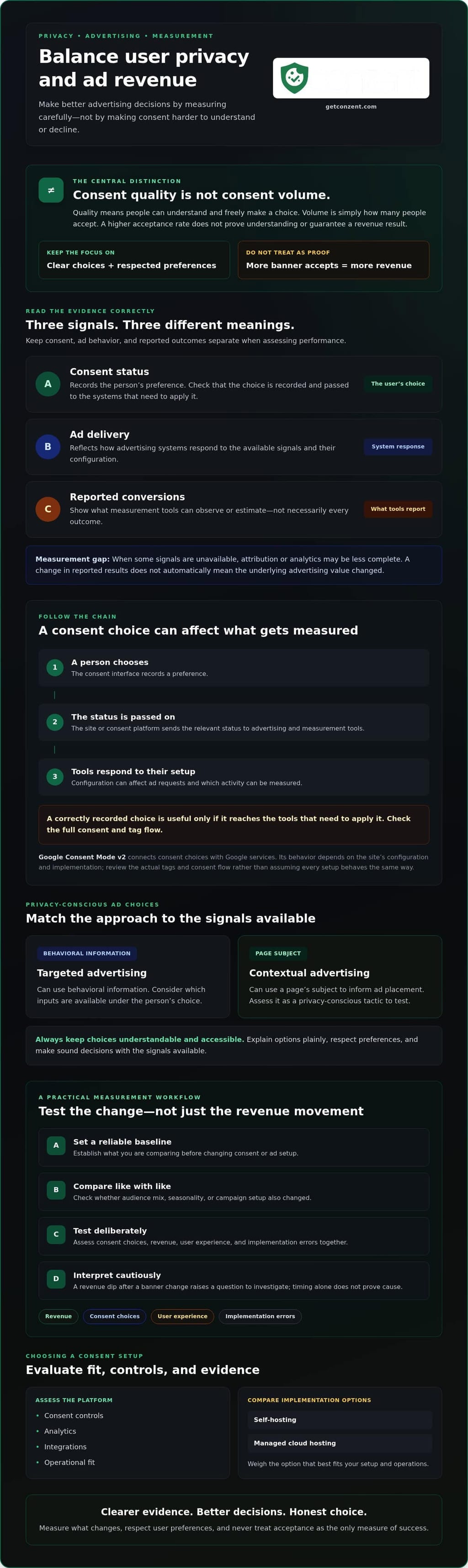
A visitor’s choice starts a chain of technical events. The consent interface records a preference, and the site or consent platform passes the relevant status to advertising and measurement technologies. Those systems respond according to their configuration, which may affect the ad requests made and the activity that can be measured. Check the full chain: a correctly recorded choice is useful only if it reaches the tools that need to apply it.
Keep three signals distinct: consent status records a person’s preference; ad delivery reflects how advertising systems respond; and reported conversions reflect what measurement tools can observe or estimate. A conversion report is not a direct count of every outcome, especially when some measurement signals aren’t available.
Which advertising and measurement signals can change?
Google Consent Mode v2 is an integration that connects consent choices with Google services. Its behavior depends on the site’s configuration and implementation, so don’t assume that enabling it produces the same measurement or ad behavior everywhere. Review the Google Consent Mode v2 implementation guide and check the current setup against your actual tags and consent flow.
Where a system provides aggregated or modeled reporting, treat it as distinct from measurement based on directly observed, consented signals. The available methods and outputs depend on the tools and configuration in use. Confirm what each report represents before comparing it with another source.
What can revenue analytics tell you, and what can’t they?
Revenue impact analytics can help you compare observed patterns across consent experiences. For example, compare revenue and reported conversions before and after a banner change, while checking whether the audience mix, seasonality, or campaign setup also shifted. Keep consent choices, ad delivery, and reported outcomes separate in your analysis. Each describes a different part of the picture.
A measured revenue change shows that two things changed together; it doesn’t prove that one caused the other. A dashboard can reveal a relationship worth investigating, but it can’t rule out other explanations by itself. Conzent’s revenue impact analytics help examine consent-related revenue effects, but don’t guarantee a particular outcome.
This distinction matters beyond any one platform. Harvard Business School’s analysis of the future of online advertising considers how privacy and advertising economics interact. The practical lesson is to treat measurement as evidence for decisions, not proof that a consent choice caused a revenue result. If you’re comparing implementation options, review the available consent platform options alongside your measurement needs.
Which Privacy-First Ad Revenue Tactics Are Worth Testing?
Useful tests improve advertising without making a person’s choice harder to understand or act on. Start with a specific question, then assess more than acceptance or revenue. A tactic that lifts one metric but frustrates visitors or obscures refusal isn’t a sound improvement.
Use this comparison to choose a test. Set the success measures and guardrails before you launch.
| Tactic | Question to test | Guardrail |
|---|---|---|
| Clearer banner language | Do visitors understand what each choice means? | Keep options accurate, concise, and easy to compare. |
| Accessible controls | Can visitors find and use each available choice? | Make acceptance and refusal equally clear and usable. |
| Contextual advertising | Can page subject matter support relevant ad placement? | Don’t present contextual targeting as a universal replacement for other approaches. |
| Consent-aware measurement | Can performance be assessed using signals available for each consent experience? | Interpret reports carefully, and don’t treat association as proof of cause. |
How can consent banner A/B testing stay fair?
Test clarity, layout, or wording, not whether visitors can be steered into accepting. For example, compare two plain-language explanations while keeping the choices similarly visible and straightforward to use. Define the question first, then review consent outcomes alongside revenue, usability, and complaint signals. Conzent’s consent A/B testing supports structured evaluation of banner variations. A test can inform decisions, but it can’t guarantee a revenue lift.
For advertising practices more broadly, consult the FTC guidelines on online advertising. Keep the test honest: a change should help people understand their options, not disguise them.
When can contextual advertising help?
Contextual advertising uses a page’s subject matter to inform ad placement rather than relying on an individual’s behavior profile. A cooking page, for instance, could be considered for ads relevant to cooking topics. This gives publishers another approach to test, especially when they want to reduce reliance on personal tracking signals. It isn’t a guaranteed revenue substitute. Compare results in your own context, and consider user experience as well as earnings.
That’s a practical way to approach how to balance user privacy and ad revenue: test tactics against clear questions, preserve meaningful choices in every variation, and judge the outcome using distinct signals. Revenue matters, but so do whether visitors can make an informed choice and whether the experience creates avoidable friction.
How to Measure and Improve Revenue Without Weakening User Choice
Reliable improvement starts with a comparison you can explain. Don’t change a banner, campaign, and ad setup at the same time, then credit any revenue movement to consent. Use a repeatable workflow and keep user choice intact throughout the test.
- 1. Establish a baseline. Record the consent experience, relevant configuration, traffic context, and revenue measures. Use consistent definitions and reporting windows, and note campaign changes or major site updates.
- 2. Change one variable. For example, adjust banner wording while leaving other settings unchanged. Keep each choice clear and equally accessible.
- 3. Measure distinct outcomes. Track consent choices, advertising revenue, user experience, and implementation errors separately.
- 4. Interpret the result. Compare equivalent periods and account for changes in traffic, campaign mix, or configuration before drawing conclusions.
- 5. Review and act. Keep, revise, or roll back the change based on the evidence and whether the consent experience still supports meaningful choice.
What should a useful baseline include?
Capture what visitors saw and which consent configuration was active, alongside the traffic context and revenue measures you plan to compare. Define each metric and reporting window in advance, then use those definitions consistently. Flag confounding events, such as a campaign shift or major site update. Without this record, a before-and-after comparison may look clear while hiding important differences.
How should you interpret a test result?
Describe what the test observed, not what it cannot establish. If revenue rose while a banner variation ran, check whether user experience worsened or implementation errors increased. Review changes in consent choices and any campaign or traffic shifts, too. Keep the variation only if the evidence supports it and its controls remain understandable; otherwise, revise or roll it back.
A useful next step is to review the revenue impact of cookie consent and decide which measures belong in your baseline. Revenue impact analytics can help examine consent-related effects, but don’t guarantee a particular result. This evidence-led process is central to how to balance user privacy and ad revenue: measure carefully, preserve clear choices, and avoid claiming more than the data shows.
To compare consent platform options for this measurement work, review Conzent’s platform options.
Choose a Consent Platform That Makes Privacy and Performance Measurable
A consent platform should do more than display a banner. It should help you present clear choices, apply them consistently across relevant tools, and assess performance without treating acceptance as the only measure of success. The right fit depends on your integrations, measurement needs, and technical capacity.
What should you check when comparing consent platforms?
Evaluate a platform against your actual setup, not a feature list alone. Check whether you can configure clear banner choices, whether those choices work as intended across your site, and whether the platform supports the advertising and measurement integrations you use. If relevant to your implementation, confirm support for IAB TCF v2.3 or Google Consent Mode v2, then verify the current technical details before relying on either integration. Also check whether it supports the CMS or e-commerce tools your site uses.
- Choice and configuration: Can you present understandable options and keep them consistent with your intended consent experience?
- Measurement and testing: Can you examine consent-related revenue patterns and evaluate banner variations without making unsupported assumptions about results?
- Operational fit: Does the hosting model match your team’s capacity to manage infrastructure, maintenance, and implementation?
Self-hosting and managed cloud are different operating choices, not a universal ranking. Self-hosting can suit teams that want to operate the source-available infrastructure themselves and have the capacity to do so. Conzent’s self-hosted option is available for free. Managed cloud hosting may fit teams that prefer a hosted service, with infrastructure maintenance, automatic updates, and cloud-based analytics dashboards included. Compare what your team needs to oversee in each model before deciding.
How can Conzent support a measurable approach?
Conzent offers customizable consent banners, consent A/B testing, and revenue impact analytics to help teams evaluate banner variations and examine consent-related revenue effects. It also supports IAB TCF v2.3 and Google Consent Mode v2 integrations. These capabilities can inform decisions; they don’t guarantee higher revenue or replace careful review of your implementation.
Conzent’s source-available consent platform is available as a managed cloud service or for self-hosting. As you compare options, consider how each model fits your internal resources, integration needs, and approach to measurement. That practical fit is central to how to balance user privacy and ad revenue without weakening meaningful user choice.
For an overview of configurations and costs, compare Conzent pricing and platform options.
Make Privacy-First Ad Decisions With Confidence
Balancing privacy and advertising isn’t about maximizing consent at any cost. It’s about preserving clear user choice, measuring the signals you can rely on, and improving your approach based on evidence. Keep revenue, consent outcomes, and user experience distinct so one metric doesn’t stand in for the whole picture.
Consent A/B testing and revenue impact analytics can support structured evaluation, while IAB TCF v2.3 and Google Consent Mode v2 integrations can help connect consent configurations with relevant technologies. These tools inform decisions; they don’t guarantee a revenue outcome.
Use the steps in this guide to assess your consent setup against your team’s needs. The FAQ below covers common questions about consent, advertising, and measurement.
Frequently Asked Questions
Can you earn ad revenue without tracking every visitor?
Yes. Advertising can use page context, such as a page’s topic, rather than an individual visitor’s browsing behavior. A publisher can also assess ad performance using the signals available without assuming every visit can be attributed to an ad. These approaches don’t guarantee a particular revenue result, but they give publishers ways to support advertising while respecting user choices. That’s one part of how to balance user privacy and ad revenue.
Does a lower consent rate always mean lower ad revenue?
No. A lower consent rate doesn’t automatically mean lower ad revenue. Consent can affect the signals available for ad delivery and measurement, but revenue also shifts with factors such as audience mix, seasonality, and campaign changes. Compare equivalent reporting periods and track consent rates separately from revenue. A change in one metric raises a question to investigate, but doesn’t prove the cause of a change in another.
How can I test a cookie banner without pressuring users?
Test whether people can understand and use their choices, not how to steer them toward acceptance. Compare wording or layout while keeping options clear, accessible, and straightforward to decline. Decide in advance how you’ll assess consent outcomes, usability, revenue, and complaints. If a variation makes refusal harder or hides meaningful information, it isn’t a fair improvement, even if its acceptance rate rises.
What should I measure when assessing consent’s effect on ad revenue?
Track consent choices, advertising revenue, ad delivery, reported conversions, user experience, and implementation errors as separate measures. Use consistent definitions and comparable reporting windows. Record relevant changes to campaigns, traffic sources, or consent configuration so you can assess other possible explanations for a revenue shift. Analytics can show patterns and relationships, but a dashboard alone can’t establish that a consent change caused the result.
Does Google Consent Mode v2 guarantee recovered ad revenue?
No. Google Consent Mode v2 doesn’t guarantee recovered revenue or a specific advertising outcome. It connects consent choices with relevant Google services, but results depend on the implementation, configuration, and available measurement signals. Check that consent status reaches the appropriate tools and review what your reports represent. Treat the integration as part of a measurement setup, not a substitute for testing or proof of revenue recovery.
How do I choose a consent management platform for privacy and revenue measurement?
Look for clear, configurable consent controls, the integrations your setup needs, and analytics that help you examine consent-related revenue patterns. Check whether the platform supports structured banner testing and whether its hosting model fits your team’s technical capacity. Conzent offers consent A/B testing, revenue impact analytics, IAB TCF v2.3 integration, and Google Consent Mode v2, with managed cloud and self-hosted options.
To assess Conzent’s managed cloud and self-hosted options for your needs, compare platform options.