
How to Get Buy-In for a Privacy Budget by Aligning Priorities

A privacy budget earns support when it advances priorities the organization already shares. Compliance matters, but stakeholders also need to understand how the proposed spending addresses real risks, supports essential work, and demonstrates progress.
If you’re deciding how to get buy-in for a privacy budget, start by bringing the right people into the conversation early. Include formal decision-makers and colleagues who influence how work gets done. Then connect each proposed investment to a shared priority, and explain what it will help the organization accomplish. This guide helps you make those choices clear and open to discussion.
This guide explains how to build stakeholder commitment, plan spending around organizational needs, and turn privacy goals into measurable milestones. You’ll also learn how to review progress together and adjust priorities as risks and business needs change. The aim isn’t to win approval for a fixed list of expenses. It’s to create a practical plan people understand, support, and can revisit.
Key Takeaways
- Bring formal decision-makers and informal influencers into the discussion, and connect privacy work to priorities they already share.
- Plan spending around the privacy and data security activities that address your organization’s needs, rather than relying only on worst-case estimates.
- Turn privacy goals into actionable milestones and measurable objectives so stakeholders can track progress and assess results.
- Reassess priorities together as risks, business needs, and progress change; use open discussion to resolve competing budget demands.
- Compare the resources required for privacy controls with the potential impact of risks, and make the assumptions behind each estimate clear.
1. Building stakeholder commitment and buy-in
Start by identifying who approves funding and who shapes day-to-day work. The finance lead may control budget approval, while a product manager or engineering lead understands delivery constraints. Both formal authority and informal influence can affect a privacy initiative. Map these roles before drafting a request, then determine what each person needs to support the work.
Build the case around shared priorities, not privacy terminology alone. A finance lead may want predictable spending and clear accountability. A product team may need consent processes that fit existing workflows. An executive may focus on trust and business continuity. Connect each proposed activity to the outcome that matters to that stakeholder, then explain how you’ll review progress.
Show the practical effect of each request. If a planned consent change adds steps to a product team’s release process, for example, explain what those steps involve and invite the team to identify friction. Requirements that make employees’ jobs harder may meet greater resistance. Treat that feedback as guidance for a workable plan, not as a reason to abandon the privacy goal.
Involve people before the final budget meeting. A brief conversation with engineering can reveal dependencies; a check-in with customer support can surface recurring user confusion. Surveys and check-ins can also identify challenges employees face with compliance changes. Summarize what you heard, explain the resulting adjustments, and acknowledge contributors who helped improve the proposal.
Make the request specific enough to discuss. Instead of asking for general support for “better privacy,” describe a defined activity, its purpose, the teams involved, and the evidence that will show it is complete. For example, separate a consent-flow review from staff training. Stakeholders can then discuss scope, timing, and ownership without losing sight of the objective.
Address concerns directly and keep the decision open to informed revision. If a department worries that training will interrupt operations, discuss formats suited to its work. Training can use interactive in-person sessions or online gamified approaches, depending on how the group learns best. Agree on a format, record the decision, and assign an owner to the next step.
End each discussion with a clear record of the supported priority, unresolved concerns, responsible person, and next decision point. That prevents informal agreement from fading after the meeting. It also gives budget discussions a shared reference, helping stakeholders focus on trade-offs and evidence rather than restarting the case each time.
2. Planning privacy and data security budgets
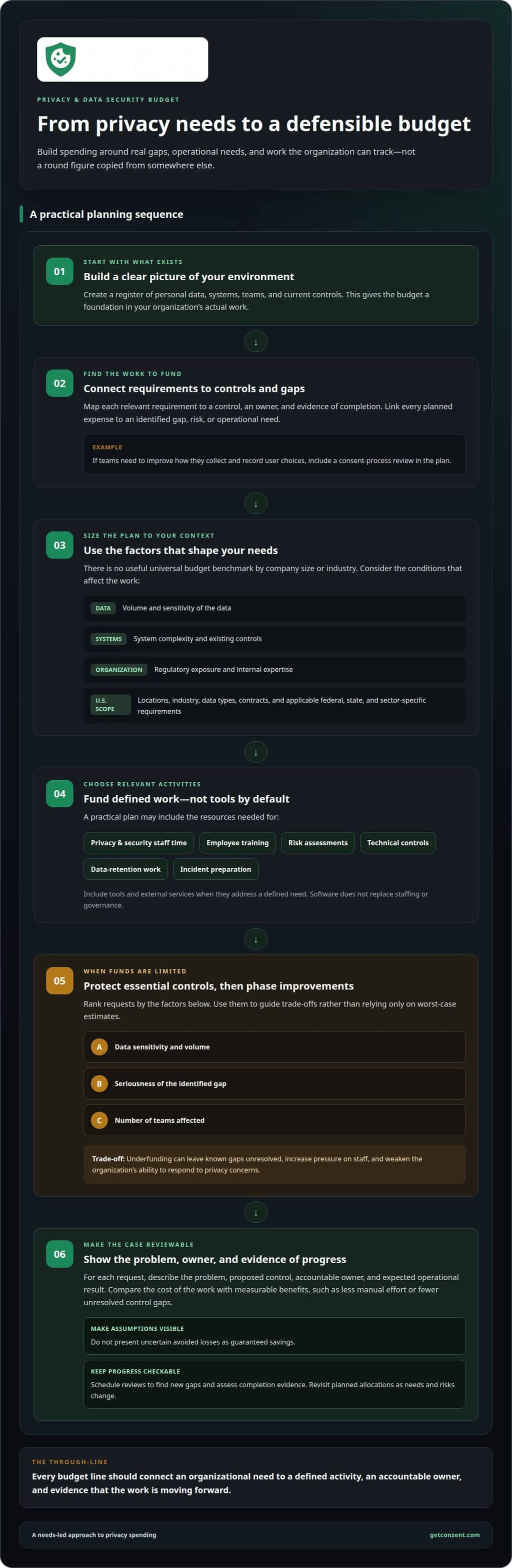
Build the budget around work the organization intends to do, not a round figure copied from another business. Start with a register of personal data, systems, teams, and current controls. Then connect each planned expense to a gap, risk, or operational need. For example, include a consent-process review when teams need to improve how they collect and record user choices.
To connect privacy spending with regulatory compliance, map each relevant requirement to a control, an owner, and evidence of completion. Fund the work needed to close identified gaps, then schedule reviews to find new ones. This makes compliance progress visible and supports timely remediation, but it cannot make fines impossible.
In the United States, budget needs depend on the organization’s locations, industry, data types, and contracts. Identify applicable federal, state, and sector-specific privacy and security requirements, then account for the systems, staff, and processes needed to meet them. A company handling sensitive information may need different controls from one handling limited customer data.
There is no useful universal budget benchmark by company size or industry. The amount depends on data volume and sensitivity, system complexity, existing controls, regulatory exposure, and internal expertise. Compare planned work with these factors instead of treating another company’s spending as your target.
Build the business case by describing the problem, proposed control, accountable owner, and expected operational result. Estimate return on investment by comparing the cost of the work with measurable benefits, such as less manual effort or fewer unresolved control gaps. Make assumptions visible, and don’t present uncertain avoided losses as guaranteed savings.
A practical budget can cover privacy and security staff time, employee training, risk assessments, technical controls, data-retention work, and incident preparation. Include tools and external services only when they address a defined need. If teams need to test consent choices, for example, include the testing work and a way to assess its effect.
When funds are limited, rank requests by data sensitivity and volume, the seriousness of the gap, and the number of teams affected. Protect essential controls first, then phase lower-priority improvements. Underfunding can leave known gaps unresolved, increase pressure on staff, and weaken the organization’s ability to respond to privacy concerns.
For a consent-platform budget line, reviewing the available pricing structure can help connect planned work with the organization’s operating model, without treating software as a substitute for staffing or governance.
Businesses preparing privacy and data security compliance budgets for 2026 should consider which activities to fund, then test proposed allocations against the organization’s actual needs. Privacy budgets can be overly cautious because they are based on worst-case estimates, so make assumptions explicit and distinguish planned work from contingency planning. Tracking spending habits for at least a month is recommended when setting a budget; this can help teams see which costs recur and which address a specific gap.
An example monthly budget allocates $600 to short- and long-term savings. That example is a reminder to assign money deliberately, not a target for a business. Apply the principle to privacy and security by connecting each allocation to a funded activity, revisiting estimates as work progresses, and adjusting priorities when needs or evidence change.
3. Actionable milestones and measurable objectives
A privacy goal becomes manageable when it has a deliverable, an owner, and evidence of completion. Replace “improve data handling” with a defined task, such as documenting where customer data enters a process. Name the responsible team and decide what record will prove the task is complete. This gives budget reviewers a clear link between spending and visible progress.
Separate milestones from outcomes. A milestone marks completed work, such as reviewing a data flow or updating a retention process. An outcome measures whether the change works, such as fewer records being kept without a clear business purpose. Tracking both shows whether teams completed the funded work and whether it addressed the intended issue.
Use a balanced scorecard to connect privacy objectives with organizational priorities. It can track operational work, risk reduction, and user experience together, rather than reducing success to a single compliance measure. For example, it might show completed process reviews alongside unresolved data-handling gaps and feedback about confusing consent choices. Tie every measure to a named owner and regular review.
Choose indicators teams can reproduce. “Better awareness” is difficult to assess; training completion records provide clearer evidence. “More transparent data use” needs a defined test, such as whether a process description identifies the data collected, its purpose, and the responsible team. A consistent method makes results comparable across departments and review periods.
Set milestones in sequence when one task depends on another. A data inventory may need to come before a retention review, because teams first need to know which records exist. A process owner can then document the decision while a privacy lead tracks open questions. For example, an entertainment company reviewing an audience sign-up flow can map the information collected before assessing whether each field serves its stated purpose.
Make the measures useful to the people doing the work. Track the number of processes reviewed only if teams also record findings and follow-up actions. A high completion count can hide unresolved issues. Pair activity measures with quality checks, such as whether each review identifies the data subject, purpose, access roles, and retention decision.
Review the scorecard with budget stakeholders at agreed decision points. Discuss missed milestones, changed dependencies, and evidence that a control needs adjustment. If a team cannot complete a task, record the blocker and its effect on the next milestone. This turns a delay into a budget decision, not an unexplained status update.
Use the measures to guide the next planning cycle. Retain objectives that show clear value, revise measures that provide little insight, and stop tracking indicators teams cannot act on. A concise scorecard gives leaders a shared view of progress while preserving enough detail for privacy and operational teams to make responsible decisions.
4. Compromising and reassessing the budget together
Use a shared review meeting to resolve competing requests, not defend fixed departmental totals. Ask each budget owner to explain the work, the risk it addresses, and what happens if it waits. A privacy lead might rank a data-retention review ahead of a reporting improvement. Base the decision on documented impact, dependencies, and available capacity.
Separate essential controls from improvements that can wait for a later phase. A team may need to fix unclear data access before funding a new reporting feature, for example. Record what stays funded, what shifts, and why. This makes the compromise visible rather than an unexplained cut, and helps everyone understand the trade-off.
When teams disagree, compare proposals using the same criteria. Consider data sensitivity, the number of processes affected, operational dependencies, and the evidence behind each request. If a government contract creates a specific operational requirement, document how it affects the proposed work. Don’t assume every department’s preferred project is equally urgent.
Set a review date and define events that could bring it forward. A major product change, newly identified data flow, or missed control milestone may change priorities. At the review, compare the current plan with actual progress. If a dependency delayed a task, decide together whether to shift resources or change its sequence.
Keep a decision log naming the proposal, decision, rationale, owner, and next review point. If security needs additional capacity while a product team requests a consent-flow update, for instance, record which work proceeds first and what evidence would reopen the decision. A concise record helps new team members understand the reasoning without reviving settled debates.
Use scenario planning to make compromises concrete. Outline what the organization can complete with current resources, what requires added capacity, and which tasks would remain open under each option. Don’t present the lowest-cost option as the only reasonable choice. Explain its consequences, such as slower remediation or a longer wait before teams can assess a process.
Reassessment should include people affected by the budget, not just approvers. Ask a process owner whether the funded change reduced friction and the privacy team whether it addressed the intended gap. If feedback shows that a control creates unnecessary work, refine its design while preserving its purpose. Record the revised action and owner.
Close each review with a shared summary of confirmed priorities, deferred work, changed assumptions, and the next checkpoint. This keeps the budget responsive without turning every meeting into a reset. Stakeholders can direct resources toward current needs while maintaining a clear record of why priorities changed.
5. How do you quantify the cost of privacy risks and data protection controls?
Start with a specific data process, such as a customer sign-up form, and describe what could go wrong. Identify the information involved, who can access it, and how the process could expose people to harm. This defines the risk being assessed instead of treating “privacy risk” as one vague category.
Estimate risk by considering how likely a harmful event is and how serious its effects could be. A useful model compares likelihood with impact, using the organization’s evidence and consistent rating criteria. For example, an exposed record containing sensitive details may deserve more attention than a process involving limited, low-sensitivity information.
Assess impacts on people and operations. Consider possible loss of trust, service disruption, investigation time, and the effort needed to notify affected groups or correct records. Keep legal exposure in view, but don’t treat a possible fine as the sole measure of harm or a guaranteed financial outcome.
Estimate the cost of controls based on the work needed to reduce risk. Include staff time for design and review, implementation effort, training, ongoing maintenance, and supporting tools or services. A technical control may require modest setup but regular monitoring. A process change may need less technology but more coordination across teams.
Compare the risk before and after the proposed control. Record which part of the risk it addresses and what may remain. For instance, limiting access to a customer database may reduce exposure from unnecessary internal access while leaving other risks, such as excessive collection, untouched. This makes the control’s value and limits clear to budget decision-makers.
Use evidence rather than false precision. Review incident records, access logs, process maps, support complaints, and audit findings where available. If evidence is incomplete, state the assessment’s assumptions and identify what information would improve it. Consistent criteria matter more than a precise-looking score teams cannot explain or reproduce.
Present the comparison in a short decision record covering the process, risk scenario, affected people, proposed control, required resources, expected effect, and remaining exposure. Include the control owner and a review point. This lets finance, security, and privacy teams challenge the same assumptions and distinguish urgent work from measures with limited impact.
Revisit the estimate when the process changes, new evidence appears, or a control fails to work as intended. A new data use can change the exposure; a tested safeguard can change the remaining risk. For a consent-platform line item, review the pricing structure as part of assessing fit alongside operational needs and expected value.
Conzent
Conzent helps teams connect consent-related spending with clear operational priorities. Its Managed Cloud Consent Platform and Self-Hosted Open Consent Infrastructure provide different ways to run consent systems, while Consent A/B Testing and Revenue Impact Analytics help teams assess performance and business impact. These tools can support budget discussions with practical evidence, but they don’t replace privacy governance or legal advice. Consider them when your plan includes improving consent management or understanding how consent choices affect revenue. Align the approach with your infrastructure, ownership model, and measurable objectives. Contact Conzent to discuss how its offerings may fit your privacy budget priorities.
Make the next budget decision together
A privacy budget works best as an ongoing decision, not a line item left untouched until annual planning. In the next planning cycle, ask whether the funded work still fits your organization’s priorities. If needs change, bring the relevant decision-makers together and agree what should shift. This keeps privacy investment connected to real operations.
Knowing how to get buy-in for a privacy budget means explaining why the investment matters to operations. Conzent’s pricing options can inform teams’ assessment of consent-management options as part of planning. A clear rationale gives your privacy program room to move forward.
Frequently Asked Questions
Which privacy budget metrics and KPIs should leaders track?
Track indicators that reveal exposure, control performance, and user impact. Leaders can monitor systems without named data owners, unresolved access exceptions, overdue deletion requests, and consent-related support complaints. Pair these with incident trends and audit findings, distinguishing measures teams control from external outcomes. Each KPI should have a clear definition, data source, owner, and trend so decision-makers interpret changes consistently.
How do you present a privacy budget proposal to executives and finance teams?
Present the decision required, the work it funds, and the business priority it supports. Separate ongoing operating needs from one-time implementation effort, and identify who owns renewals, maintenance, and internal labor after launch. Offer practical funding options with clear trade-offs, including what each enables and what remains unresolved. Finance can assess assumptions against existing plans, while executives judge whether the proposal supports organizational priorities.
What is a privacy budget in business or government?
A privacy budget is a plan for funding privacy and data security work that addresses an organization’s needs, including staff time, training, risk assessments, technical controls, data retention, and incident preparation.