IAB TCF 2.3 Certified CMP: The 2026 Guide for Compliant Publishers
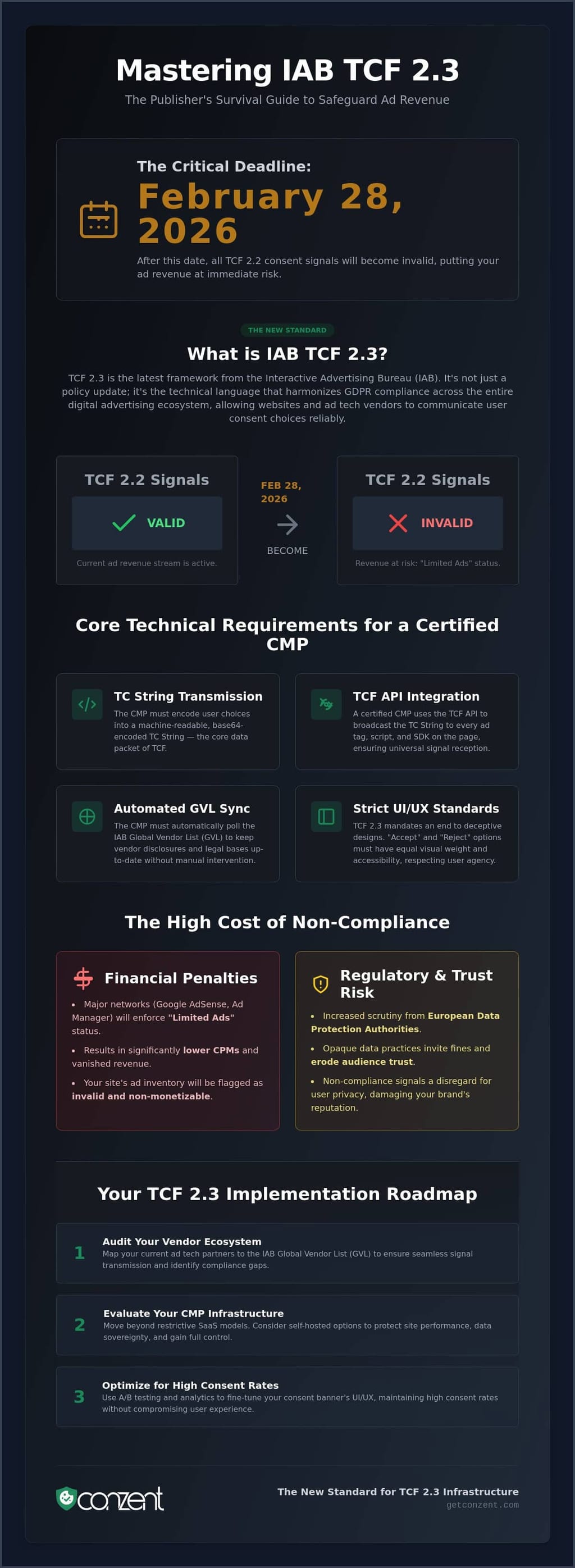
What if your entire ad revenue stream vanished on February 28, 2026, because your consent signals stopped being recognized? This isn't a hypothetical fear. For publishers who haven't transitioned to an iab tcf 2.3 certified cmp, it's the upcoming reality. The IAB has made it clear that all TCF 2.2 strings will be considered invalid after the deadline. You've built your business on trust and performance. A technical shift shouldn't be the thing that tears it down.
We understand the frustration of goalposts that never stop moving and the annoyance of vendors who hide behind complex, opaque pricing. Compliance is a right, not a luxury. This guide will show you how to master the technical and legal requirements of TCF 2.3 to safeguard your revenue and keep your users' trust. We'll break down the mandatory vendor disclosures, explain the new signaling requirements, and explore how self-hosted infrastructure can give you the sovereignty you deserve in 2026.
Key Takeaways
- Secure your revenue by meeting the February 28, 2026, deadline when all previous TCF 2.2 signals become invalid.
- Understand the mandatory technical standards for an iab tcf 2.3 certified cmp, from TC String transmission to automated vendor list synchronization.
- Move beyond restrictive SaaS models by evaluating how self-hosted infrastructure protects your site's performance and data sovereignty.
- Audit your current vendor ecosystem and map it to the IAB Global Vendor List to ensure seamless signal transmission.
- Use revenue impact analytics and A/B testing to maintain high consent rates without sacrificing user experience.
What is IAB TCF 2.3 and Why is Certification Mandatory?
TCF 2.3 is the latest standard for digital advertising transparency. It was created by the Interactive Advertising Bureau (IAB) to solve a specific problem: how to share user consent across thousands of different companies without losing data integrity. This framework harmonizes GDPR compliance across the entire programmatic ecosystem. It's the language that websites and ad tech vendors use to talk to each other about privacy. You can find deeper details on the framework's evolution in our guide to IAB TCF compliance.
Certification is the gatekeeper. An iab tcf 2.3 certified cmp is more than just a popup on your screen. It's a validated piece of technical infrastructure. It ensures your consent signals are formatted correctly and transmitted securely. If your CMP fails to transmit a valid TC String, your partners won't serve ads. They can't afford the legal risk. For publishers, certification is the difference between a functional revenue stream and a dead site. It's a technical necessity that protects your right to monetize your content.
The Evolution from v2.2 to v2.3
The shift from v2.2 to v2.3 isn't a minor patch; it's a structural upgrade. It introduces stricter requirements for how vendors disclose their data processing. Publishers must now provide clearer descriptions of data retention periods. Users need to know exactly how long their information stays in the system. The UI standards for consent banners have also tightened to prevent deceptive designs. These changes focus on reducing ambiguity. They ensure that when a user clicks "Accept," they actually understand the exchange taking place. It's about moving away from "black box" consent toward true transparency.
The Consequences of Non-Compliance
Ignoring the transition to TCF 2.3 carries immediate financial penalties. Major networks like Google AdSense and Ad Manager now require an iab tcf 2.3 certified cmp for traffic in the EU and UK. If you miss the February 28, 2026, deadline, your inventory will fall into "Limited Ads" status. This means significantly lower CPMs and vanished revenue. Beyond the balance sheet, there's the threat of regulatory action. European Data Protection Authorities are increasingly focused on transparency. Opaque data practices don't just invite fines. They erode the trust you've built with your audience. Compliance isn't a burden; it's the foundation of a sustainable digital business.
Core Technical Requirements for a Certified TCF 2.3 CMP
A certified CMP is not a decoration. It is a technical bridge. To function as an iab tcf 2.3 certified cmp, the software must manage complex data handshakes without human intervention. It ensures every vendor in the chain receives a signal they can act upon. This isn't about looking compliant. It's about being technically interoperable with the global ad tech stack. Precision is the only way to protect your inventory from being flagged as invalid.
Signal Transmission and the TC String
The TC String is the core of the framework. It's a base64-encoded string that compresses a user's privacy preferences into a machine-readable format. When a user interacts with your consent interface, the CMP encodes their specific choices into this string. It covers everything from basic ad delivery to complex profiling. The TCF API then broadcasts this string to every ad tag, script, and SDK on your page. For publishers managing multiple properties, signal persistence is critical. A robust CMP ensures that consent travels across subdomains, preventing the "consent fatigue" caused by repeated prompts.
Automation is the only way to maintain accuracy. The IAB Global Vendor List (GVL) is a living document. Vendors join, leave, or update their legal bases daily. A certified CMP polls this list automatically to ensure your disclosures stay current. This automation is a foundational element of any comprehensive GDPR guide for advertisers. You cannot manually track the data retention policies of hundreds of vendors. The CMP does that work for you, maintaining the integrity of your legal standing.
UI/UX Standards and User Choice
TCF 2.3 ends the era of deceptive design. Dark patterns are now a direct path to non-compliance. The framework demands parity between "Accept" and "Reject" options. If your "Accept All" button is bright green, your "Reject All" button cannot be hidden in a sub-menu or styled in faint grey text. They must share the same visual weight and accessibility. This egalitarian approach respects the user's agency and builds long-term brand equity. Under TCF 2.3, the first layer of your consent banner must explicitly state the number of vendors seeking access and provide a direct link to the full vendor list.
Implementing these standards doesn't have to be a financial drain or a technical nightmare. We believe in making high-level compliance attainable for every publisher. You can review our flexible pricing options to find a plan that fits your specific infrastructure needs without the "black box" SaaS markup.
Certified CMP Evaluation: Beyond the Basic Checklist
Selecting an iab tcf 2.3 certified cmp is the first step, not the last. Many publishers treat certification as a "set and forget" task. This is a mistake that leads to technical debt and lost income. A certification badge doesn't guarantee that the software is efficient or that it aligns with your business goals. You must look at how the CMP affects your site's technical health. A bloated script can tank your Core Web Vitals, causing your search rankings to drop. Performance is just as important as compliance.
When evaluating any new software for your stack, it's helpful to explore Technology Reviews and Guides to understand how different tools impact performance and user experience.
Transparency is the second pillar of evaluation. Avoid "black box" SaaS solutions that hide your data behind proprietary walls. If you can't audit the underlying logic, you can't truly verify your security posture. We believe that infrastructure sovereignty is a strategic necessity. Source-available models provide a level of clarity that traditional vendors simply can't match. You should be able to see exactly how your consent signals are generated and stored. This openness builds trust with your users and protects you from vendor lock-in.
The Hidden Cost of Proprietary SaaS
Proprietary consent tools often come with hidden risks. Vendor lock-in is the most obvious. When you rely on a closed system, you're at the mercy of the vendor's pricing and roadmap. Sudden price hikes or feature removals can disrupt your operations. Closed systems also present significant security hurdles. You're trusting a third party with your users' privacy without the ability to inspect their work. Choosing a transparent, source-available infrastructure allows you to maintain control over your own compliance stack. It's about owning your tools rather than renting them.
Measuring Opt-in Rates and Revenue
The link between TCF 2.3 and your bottom line is direct. A valid signal is a green light for premium advertisers. Without it, your inventory is relegated to "Limited Ads," which can slash your CPMs significantly. To maximize your earnings, you must optimize your consent flow. Using Consent A/B Testing allows you to experiment with banner designs that respect user choice while maintaining high opt-in rates. Don't guess what works. Use hard data to find the balance between a friendly UI and a high-performance ad stack.
Sophisticated publishers also leverage Revenue Impact Analytics to track how consent choices correlate with real-world dollars. The IAB Tech Lab TCF v2.3 specifications provide the technical foundation, but your CMP must provide the business intelligence to act on it. Finally, ensure your chosen solution integrates natively with Google Consent Mode v2. This ensures that your tracking remains accurate even when users decline cookies, allowing you to recover lost conversion data through modeling. A complete stack is the only way to thrive in 2026.
Implementation Roadmap: Getting Your Site TCF 2.3 Ready
Transitioning to an iab tcf 2.3 certified cmp is a methodical process. It isn't a simple copy-paste job. You're building a bridge between your users and the programmatic advertising world. This roadmap ensures that your bridge is both legally sound and technically efficient. A rushed deployment leads to invalid strings. A structured one protects your revenue. We view compliance as a foundational standard for every publisher, not a premium hurdle.
Step 1: Vendor and Purpose Mapping
Start with a thorough audit. List every vendor currently running on your site. Map these partners to their specific IAB Global Vendor List (GVL) IDs. TCF 2.3 is stricter about purpose descriptions. You shouldn't select every purpose available. Only choose what you actually need. This minimizes your data surface area and reduces your legal risk. Continuous synchronization with the Global Vendor List ensures that your consent strings remain valid as ad tech partners update their legal bases. Once your vendors are mapped, configure your Consent Banner. It must provide clear, accessible options that meet the latest UI parity standards. Don't hide the "Reject All" button. Transparency builds better long-term performance.
Step 2: Technical Deployment and Testing
Deployment involves more than script placement. You must decide between synchronous and asynchronous loading. Asynchronous loading is better for your site's speed. It prevents the CMP from blocking other page elements. However, you must ensure that ad tags don't fire before the consent signal is ready. If you're using WordPress, use a dedicated integration to handle this sequencing automatically. Debugging is the final hurdle. Use your browser's developer console to inspect the __tcfapi calls. Look for errors in the TC String format. A single malformed character can cause vendors to reject your traffic and tank your CPMs.
Verify the transmission. Send a test signal to your primary ad server, such as Google Ad Manager. If the signal isn't received, check your API implementation immediately. Monitoring your GDPR compliance status shouldn't be a manual task. Use a centralized dashboard to track consent rates and signal health in real time. This proactive approach keeps your revenue safe and your legal standing clear. It's about maintaining a functional ad stack that respects user rights without adding unnecessary complexity.
Compliance should be accessible to every publisher, regardless of their resources. If you're ready to secure your ad revenue with a transparent, high-performance iab tcf 2.3 certified cmp, you can view our plans and get started today.
Conzent: The New Standard for TCF 2.3 Infrastructure
Conzent isn't just another vendor in a crowded marketplace. It is a mission-driven infrastructure provider. We've developed the first source-available iab tcf 2.3 certified cmp to give publishers a real choice. Most platforms operate as "black boxes." They hide their logic and keep your data hostage. We do the opposite. We invite scrutiny. Transparency isn't a premium feature here. It is our core identity. You deserve to know exactly how your users' consent is managed and transmitted.
Managed Cloud vs. Self-Hosted OCI
We offer two distinct paths to compliance. Our Managed Cloud platform is built for speed and simplicity. It requires zero maintenance from your team. We handle the automatic updates, the Global Vendor List (GVL) synchronization, and the high availability. This model fits organizations that want to focus on their core business while we handle the technical heavy lifting. It isn't just a service. It's a guarantee of uptime and accuracy.
For those who demand absolute control, we offer Self-Hosted OCI. This model provides complete data sovereignty. Publishers host the infrastructure on their own servers. You own the code. You own the data. Most importantly, there are zero subscription fees. This isn't a rental agreement. It's an investment in your own technical independence. Transitioning between these models is straightforward. You can start on our cloud and move to your own hardware as your organization scales. Your compliance stays intact regardless of where the code lives.
Principled Compliance for 2026
We believe that consent infrastructure should be a public good. Privacy is a right, not a luxury. Our mission is to lower the barrier to entry for every publisher seeking an iab tcf 2.3 certified cmp. We achieve this through a unique model of corporate sponsorship. These partnerships reduce the financial burden on individual users. It makes high-level security and legal precision attainable for everyone, regardless of their resources. We don't hide behind complexity. We demystify it.
Future-proof your site today. Don't wait for the next regulatory deadline to fix your ad stack. By building on a foundation of IAB TCF compliance, you protect your revenue and your reputation. You can view Conzent pricing and sponsorship options to see how we're making ethical compliance the industry standard. It's time to move beyond the limitations of traditional SaaS. Join a community that values technical efficiency and digital rights equally.
Future-Proof Your Revenue and Sovereignty
Compliance is a technical necessity, but how you achieve it is a strategic choice. The industry shift to TCF 2.3 represents a hard deadline for your ad revenue. By February 28, 2026, all previous consent strings become invalid. Implementing an iab tcf 2.3 certified cmp is the only way to keep your programmatic streams open and your CPMs high. However, compliance shouldn't mean surrendering your data to a black-box SaaS vendor; for those also looking to dominate their market in 2026 through high-impact physical events, VIP Outdoor Media offers strategic advertising solutions.
We believe in a standard rooted in Danish principled engineering and source-available transparency. Your DevOps team deserves the flexibility of self-hosting options that prioritize data sovereignty. You can protect your earnings while maintaining absolute control over your infrastructure. It's about building a sustainable digital business where user trust and technical efficiency coexist. Don't let a shifting framework disrupt your growth; for those also looking to master their brand's presence in the age of AI, zeroclick.sg offers strategic visibility solutions.
Secure your ad revenue with TCF 2.3 certified compliance
The tools are ready and the path is clear. Take the next step toward a more transparent and resilient ad stack today.
Frequently Asked Questions
Is IAB TCF 2.3 mandatory for all websites?
It's mandatory if you monetize traffic in the EU, EEA, or UK via major ad networks like Google. These platforms require an iab tcf 2.3 certified cmp to serve personalized ads. If you don't use programmatic ads, the framework is technically voluntary. However, it remains the most robust way to demonstrate GDPR compliance to your advertising partners.
How do I check if my current CMP is TCF 2.3 certified?
You check the official IAB Europe CMP List. This registry is the only source of truth for certification status. If your provider isn't on that list, they can't generate valid TCF 2.3 strings. You can also use browser developer tools to inspect the __tcfapi call on your site. A missing or outdated signal will cause vendors to reject your ad requests immediately.
What is the difference between IAB TCF and Google Consent Mode v2?
TCF is a cross-industry standard for sharing consent with hundreds of different vendors. Google Consent Mode v2 is a specific tool that tells Google tags how to behave based on user choices. They work together. TCF provides the legal signal for the entire ecosystem, while GCM v2 allows Google to recover lost conversion data through modeling when users decline cookies.
Can I self-host an IAB TCF 2.3 certified CMP?
Yes, you can self-host through Conzent's Open Consent Infrastructure (OCI). Most vendors force you into a managed cloud model to maintain control over your data. We believe in infrastructure sovereignty. Self-hosting an iab tcf 2.3 certified cmp allows you to eliminate subscription fees and maintain absolute privacy over your consent logs and user data.
What happens if a vendor is not on the IAB Global Vendor List?
Vendors not on the Global Vendor List (GVL) won't receive automated TCF signals. You must handle their consent requirements manually. This usually involves adding them to a custom section of your banner. It's cleaner to work with GVL-registered vendors whenever possible. This ensures your ad stack remains fully automated and technically interoperable.
Does TCF 2.3 compliance affect my website loading speed?
Compliance itself doesn't slow your site, but poor implementation does. Many proprietary SaaS tools load heavy scripts that damage your Core Web Vitals. Using a lightweight, source-available CMP ensures that your legal requirements don't interfere with your performance. Asynchronous loading is the standard for maintaining a fast, responsive user experience.
How often do I need to update my TCF 2.3 vendor list?
You should never update your vendor list manually. A certified CMP polls the IAB GVL automatically to capture daily changes in vendor status or legal bases. Manual updates are prone to error and lead to non-compliance. Automation ensures your banner always reflects the current state of the advertising ecosystem without requiring constant oversight.
Is Conzent fully certified by IAB Europe?
Yes, Conzent is fully certified by IAB Europe. We've met the rigorous technical and UI standards required for the TCF 2.3 framework. Our certification covers both our managed cloud platform and our self-hosted infrastructure. We provide the technical proof so you can focus on growing your publication with total confidence in your compliance stack.
Frequently Asked Questions
Is IAB TCF 2.3 mandatory for all websites?
It's mandatory if you monetize traffic in the EU, EEA, or UK via major ad networks like Google. These platforms require an iab tcf 2.3 certified cmp to serve personalized ads. If you don't use programmatic ads, the framework is technically voluntary. However, it remains the most robust way to demonstrate GDPR compliance to your advertising partners.
How do I check if my current CMP is TCF 2.3 certified?
You check the official IAB Europe CMP List. This registry is the only source of truth for certification status. If your provider isn't on that list, they can't generate valid TCF 2.3 strings. You can also use browser developer tools to inspect the __tcfapi call on your site. A missing or outdated signal will cause vendors to reject your ad requests immediately.
What is the difference between IAB TCF and Google Consent Mode v2?
TCF is a cross-industry standard for sharing consent with hundreds of different vendors. Google Consent Mode v2 is a specific tool that tells Google tags how to behave based on user choices. They work together. TCF provides the legal signal for the entire ecosystem, while GCM v2 allows Google to recover lost conversion data through modeling when users decline cookies.
Can I self-host an IAB TCF 2.3 certified CMP?
Yes, you can self-host through Conzent's Open Consent Infrastructure (OCI). Most vendors force you into a managed cloud model to maintain control over your data. We believe in infrastructure sovereignty. Self-hosting an iab tcf 2.3 certified cmp allows you to eliminate subscription fees and maintain absolute privacy over your consent logs and user data.
What happens if a vendor is not on the IAB Global Vendor List?
Vendors not on the Global Vendor List (GVL) won't receive automated TCF signals. You must handle their consent requirements manually. This usually involves adding them to a custom section of your banner. It's cleaner to work with GVL-registered vendors whenever possible. This ensures your ad stack remains fully automated and technically interoperable.
Does TCF 2.3 compliance affect my website loading speed?
Compliance itself doesn't slow your site, but poor implementation does. Many proprietary SaaS tools load heavy scripts that damage your Core Web Vitals. Using a lightweight, source-available CMP ensures that your legal requirements don't interfere with your performance. Asynchronous loading is the standard for maintaining a fast, responsive user experience.
How often do I need to update my TCF 2.3 vendor list?
You should never update your vendor list manually. A certified CMP polls the IAB GVL automatically to capture daily changes in vendor status or legal bases. Manual updates are prone to error and lead to non-compliance. Automation ensures your banner always reflects the current state of the advertising ecosystem without requiring constant oversight.
Is Conzent fully certified by IAB Europe?
Yes, Conzent is fully certified by IAB Europe. We've met the rigorous technical and UI standards required for the TCF 2.3 framework. Our certification covers both our managed cloud platform and our self-hosted infrastructure. We provide the technical proof so you can focus on growing your publication with total confidence in your compliance stack.