
LGPD Brazil Cookie Policy: A Practical Guide for 2026

A cookie banner can offer a choice and still leave visitors unsure what happens next. A useful LGPD Brazil cookie policy connects each tracking tool to the data it handles, its purpose, the legal basis assessed for that processing, and the controls that put visitor choices into effect.
It’s understandable to feel uncertain. Some cookies support basic site functions; others may help measure visits, personalize content, or deliver advertising. A cookie’s name alone doesn’t show whether it involves personal data or which legal basis may apply. And a policy can’t make a banner accurate if the site continues tracking after a visitor declines.
This guide explains how to build a clear, Brazil-focused policy that describes your tracking practices and matches the choices your banner presents. You’ll learn how cookies can relate to personal data under the LGPD, what to document about purposes and legal bases, and how to make consent choices meaningful in practice. You’ll also find a repeatable way to record changes, update disclosures when tracking changes, and check whether your site behaves as described. The goal is a policy visitors can understand, backed by controls your team can test.
Key Takeaways
- Build an inventory of the cookies, pixels, local storage, and other tracking tools your site actually uses.
- Use your LGPD Brazil cookie policy to connect each technology with its provider, purpose, data, duration, and user controls.
- Document legal bases carefully, and describe recipients or data transfers only when they apply and you’ve verified the details.
- Follow a repeatable process: scan, classify, assess, configure, test, document, and review your setup.
- Choose consent technology that fits your workflow, but use it as an operational tool, not a replacement for legal analysis.
LGPD Brazil cookie policy: what the law means for website cookies
A cookie policy should answer practical questions: which tracking technologies does your site use, why are they active, and what choices can visitors make? It should explain your actual use of cookies and similar tools, rather than make a generic statement about valuing privacy.
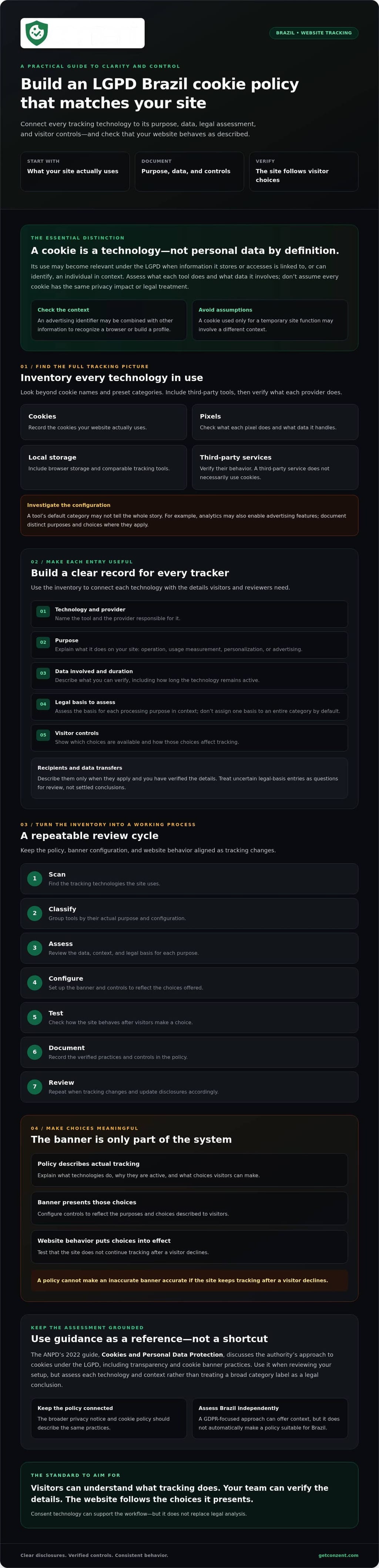
The General Personal Data Protection Law (LGPD) governs the processing of personal data in Brazil. Cookies are technologies, not personal data by definition. Their use can become relevant under the LGPD when information they store or access is linked to, or can identify, an individual in context. An advertising identifier, for example, may be combined with other information to recognize a browser or build a profile. A cookie used only for a temporary site function may involve a different context. Don’t assume every cookie has the same privacy impact or legal treatment.
The ANPD’s 2022 guide, Cookies and Personal Data Protection, explains the authority’s approach to cookies under the LGPD, including transparency and cookie banner practices. Use it as a reference when reviewing your setup, but don’t treat a broad category label as a legal conclusion. Check what each technology actually does and what data it involves.
How the LGPD relates to cookies and personal data
Start with the processing, not the cookie name. Check whether a cookie or comparable tool stores identifiers, reads information from a device, or passes data to a provider. Then assess whether that information relates to an identifiable person in your specific setup. Your policy should describe what you can verify, while your legal assessment should account for context and applicable LGPD rules.
Who should review a Brazil-focused cookie policy?
Website owners, publishers, ecommerce teams, and organizations that serve people in Brazil should check whether their tracking practices involve personal data covered by the LGPD. If your site operates across countries, review which requirements apply in each market. One policy or banner may not address every market’s rules. A GDPR-focused approach can offer useful context, but it doesn’t automatically make a policy suitable for Brazil. See Conzent’s overview of GDPR compliance as a separate framework, then assess the LGPD independently.
Keep the cookie policy connected to the broader privacy notice. The notice can explain personal data practices across the organization; the cookie policy can give visitors a clearer view of website tracking and related controls. Both should describe the same practices. A GDPR template or cookie banner alone can’t establish Brazil-specific suitability. The policy, banner choices, and website behavior need to tell a consistent story.
Which cookies and legal bases should a Brazil cookie policy explain?
Start with evidence, not preset categories. Inventory the cookies, pixels, local storage, and comparable technologies your website actually uses. Include tools loaded by third parties, but verify what each provider does. A third-party service doesn’t necessarily use cookies, and a cookie’s name alone won’t tell you its purpose.
For each item, record the provider, purpose, duration, data involved, and related user control. Then assess the legal basis for the processing in context. Consent may be appropriate for analytics or advertising, while another basis may fit a different purpose. Don’t assign one basis to every technology just because it appears in the same category.
Classify by actual purpose
Group trackers by what they do on your site: support site operation, measure usage, personalize content, or deliver advertising. Check the configuration rather than relying on a vendor’s default label. For example, an analytics tool may also enable advertising features. Document those functions separately if they involve different purposes or user choices.
Assess legal bases with care
Assess the appropriate legal basis for each processing purpose, then have the conclusions reviewed against current LGPD requirements and ANPD guidance. The ANPD’s cookie guidance is a useful starting point; this expert legal analysis on LGPD cookie rules offers additional context. Treat uncertain entries as questions for review, not settled conclusions.
Use a working table like this. The examples are prompts for investigation, not legal determinations:
| Technology | Purpose | Legal basis to assess | Policy disclosure |
|---|---|---|---|
| Session cookie | Site operation | Review the basis for the specific function | Provider, duration, data, and relevant control |
| Analytics pixel | Measure site use | Assess whether consent or another basis applies | Measurement purpose, provider, data, and choice |
| Advertising storage | Personalize or measure ads | Review the basis; flag uncertainty | Advertising role, provider, duration, and control |
Keep the inventory connected to the banner. If visitors can turn a category off, verify which technologies that choice affects and whether the policy describes them accurately. A consent platform can help present and manage choices, but it can’t determine the legal basis for you. If you’re assessing tools for this workflow, review consent platform options.
What to include in an LGPD Brazil cookie policy
A clear LGPD Brazil cookie policy gives visitors a practical account of website tracking. It should match the technologies your site uses today, not promise controls or privacy practices that exist only in a template.
A practical structure for cookie disclosures
Open with the policy’s scope and a plain-language explanation of the cookies and similar technologies used on the site. Then organize the details by purpose, such as site operation, analytics, personalization, or advertising. For each technology or group, include what you can verify:
- Technology and provider: Identify the cookie, pixel, or other tool, and name the provider when known.
- Purpose and data: Explain what the tool does and the types of information it handles, using clear language.
- Duration and legal basis: State the known retention period and the basis assessed for the relevant processing purpose. Flag information that still needs confirmation.
- Recipients or transfers: Describe these only when they apply and you have verified the relevant providers, destinations, and arrangements. Don’t copy broad claims from a template.
- User controls: Explain how visitors can review or change choices, but only describe controls that are actually available.
Make the policy useful when visitors make a choice. If your cookie banner lets users manage categories, describe those categories consistently in the policy. Don’t describe a preference setting that the live banner doesn’t offer.
Verify the details before publishing
Check disclosures against a current site scan and the live implementation. Cookie names, providers, purposes, durations, and categories can change when teams add or reconfigure analytics, advertising, or other third-party services. Confirm what each service does on your site. Don’t assume every provider sets a cookie or that a familiar tool behaves the same way across configurations.
Compare three things: the inventory, the policy, and the tags that load on the site. If the policy says a category is optional, verify that the banner choice and site behavior match that description. Resolve mismatches before publishing.
Use plain language and date the policy review. Set a recurring review process, and revisit the policy when tracking changes, a provider changes its service, or the banner is updated. A template can help with structure, but remove any statement you haven’t verified. Accuracy builds trust, as does correcting outdated information promptly.
How to implement and maintain a Brazil cookie policy
A policy only works when the website behaves as described. Treat implementation as a repeatable process, not a one-time publishing task. For an LGPD Brazil cookie policy, connect the inventory, legal review, banner settings, and live site so they stay aligned as tracking changes.
Follow a practical implementation workflow
- Scan: Identify cookies, pixels, local storage, scripts, and other tracking technologies active on the site.
- Classify: Record each tool’s purpose, provider, data involved, duration, and user-facing category where relevant.
- Assess: Review the legal basis for each processing purpose. Refer to current ANPD guidance and involve qualified counsel when legal interpretation is needed.
- Configure: Set up banner choices and policy links to reflect the decisions made during review.
- Test: Check what loads before a visitor makes a choice, after each available choice, and after preferences are changed. Compare observed behavior with the policy. Don’t assume one technical rule fits every site.
- Document: Record the inventory, review decisions, test results, and any changes to policy or banner settings.
- Schedule reviews: Set a recurring check, and review sooner when a vendor, analytics tool, advertising setup, or tracking purpose changes.
Connect policy language to banner behavior
Use clear labels that explain what each choice affects. If a banner offers category controls, make sure the policy describes those categories in terms visitors can understand. Link directly to relevant, current policy information, and avoid claims about what a choice does until testing confirms the site’s behavior. A customizable cookie banner can help present choices, but its configuration still needs to reflect the website’s actual tracking setup.
Keep the process accountable
Assign someone to review new scripts and providers before or as they are added to the site. That person should check whether each addition changes the tracking purpose, policy wording, or banner options. Keep a dated record of the review, findings, and follow-up work. This makes it easier to identify gaps when the live setup changes.
Recheck current ANPD guidance as part of the review process. A consent tool can support how you present and manage choices, but it can’t determine legal bases or replace legal advice. To assess consent platform options for managing this workflow, review Conzent’s platform options.
Choosing cookie consent technology for LGPD Brazil workflows
The right consent technology should fit the way your team maintains its cookie inventory, policy, and user choices. A platform can make consent operations easier to manage, but it can’t decide which legal basis applies to a processing purpose or replace qualified legal advice. For an LGPD Brazil cookie policy, assess whether your team can keep controls and disclosures aligned with the site’s actual tracking.
Compare options against practical needs:
- Banner controls: Can you present clear choices that match the categories and controls explained in your policy?
- Workflow fit: Can the people responsible for tracking changes review and update the setup?
- Integrations: Check support for the consent signals and services your website actually uses, and confirm the details in current product documentation.
- Hosting: Decide whether your team prefers a managed cloud platform or deployment on infrastructure it operates.
- Review capability: Consider whether the available tools help your team assess banner changes and their impact, without treating analytics as proof of legal compliance.
Managed cloud or self-hosted consent infrastructure?
With Conzent’s managed cloud option, hosting includes infrastructure maintenance, automatic updates, and cloud-based analytics dashboards. With self-hosting, customers deploy the source-available platform on their own infrastructure. The practical difference is who operates the hosting environment. Compare these approaches with your team’s infrastructure preferences and operational capacity. For a closer look at the managed cloud option, read the managed cloud consent platform guide.
How consent tools support policy operations
Conzent offers customizable cookie banners, consent A/B testing, and revenue impact analytics. These capabilities can support how a team presents choices and evaluates banner variations. They don’t determine the appropriate legal basis, establish that a policy is accurate, or guarantee compliance. Your organization still needs to assess its processing and verify that the live site behaves as its disclosures describe.
Before choosing a platform, define your required banner controls, integrations, hosting model, and review process. Then compare those needs with the available options. Compare Conzent plans once you know what your implementation requires.
Make your cookie practices clear and maintainable
A strong LGPD Brazil cookie policy is more than a disclosure page. It connects the tracking your site actually uses with its purposes, assessed legal bases, visitor choices, and the controls behind your banner. Keep the cookie inventory, policy, and live website aligned, then review them when providers or tracking configurations change.
Consent technology can help your team put those choices into practice, but it can’t determine legal bases or replace qualified legal advice. Conzent offers a source-available platform with managed cloud and self-hosted deployment options, plus customizable banners, consent A/B testing, and revenue impact analytics. Choose an approach that fits your operational needs, then check that your disclosures match what visitors experience.
When you’re ready to assess the platform against your consent workflow, compare Conzent plans.
Frequently Asked Questions
Does the LGPD require consent for every cookie?
No. Consent isn’t a safe blanket assumption for every cookie, and another legal basis shouldn’t be presumed either. First identify what each technology does, what personal data it involves, and the purpose of the processing. Then assess the appropriate legal basis under current LGPD requirements and ANPD guidance. If the legal analysis is unclear, ask qualified counsel to review it rather than relying on a generic cookie category or template.
What should an LGPD cookie policy include?
An LGPD cookie policy should explain the tracking technologies your site uses, their purposes, relevant providers, applicable legal bases, and the controls available to visitors. Describe how users can review or change their choices only if those controls exist. Before publishing or updating the policy, compare its details with a current cookie and tag inventory. This helps catch outdated provider names, missing tools, or descriptions that no longer match the live website.
Is a GDPR cookie policy enough for a website serving Brazil?
Not by itself. A GDPR policy may provide a useful structure, but it doesn’t automatically answer Brazil-specific legal or operational questions. Review its disclosures and consent design against current LGPD requirements and ANPD guidance. If your site serves multiple regions, identify which requirements apply in each market. Don’t present one jurisdiction’s template as universally sufficient, and verify that the policy accurately describes the tracking and choices available to visitors in Brazil.
Do I need a cookie banner for an LGPD Brazil cookie policy?
Whether and how to use a banner depends on your site’s processing and legal analysis. A banner communicates and manages choices, but installing one doesn’t resolve every policy or compliance question. Check that its labels and controls match the policy, then test whether the website’s tracking behavior reflects those choices. Verify your approach against current guidance. The useful test is consistency: what the banner says, what the policy explains, and what the site does.
How often should a Brazil cookie policy be reviewed?
Review the policy whenever your site adds or removes tracking tools, changes analytics or advertising providers, or uses personal data in a different way. Schedule regular checks as well, since disclosures can drift from the live site even without a planned policy update. Assign a clear owner to compare the policy with the current inventory and implementation. Recheck current legal guidance periodically, and don’t rely on an old scan or copied template.
Can a cookie consent platform make a website LGPD-compliant?
No platform can determine every appropriate legal basis or replace legal advice. Consent technology can support how your team presents choices and manages its workflow, but your organization remains responsible for accurate tracking information, legal analysis, clear disclosures, and a working implementation. Evaluate a platform against those needs, including banner controls and fit with your review process. Have qualified counsel assess legal conclusions when appropriate, and confirm that the live site matches its policy.