Maintaining Ad Revenue Without Third-Party Cookies: The 2026 Strategy
What if the biggest threat to your growth isn't a browser update, but the invisible gap between a user's click and your ability to prove it? Even with third-party cookies still lingering in Chrome, the reality of 2026 is a fragmented digital landscape where signal loss is the new default. You've likely seen it in your dashboards already. Attributions are dropping. The complexity of managing GDPR, TCF 2.3, and shifting US state laws feels like a full-time job. You're caught between the fear of non-compliance and the desperate need for maintaining ad revenue without third-party cookies to keep your business alive.
We agree that this tension feels like a zero-sum game, but it doesn't have to be. You deserve a strategy that treats privacy as a performance lever rather than a technical barrier. This guide will show you how to recover lost ad signals and protect your bottom line using advanced consent infrastructure and first-party data strategies. We'll explore how owning your data pipeline and optimizing for Google Consent Mode v2 can turn compliance into a competitive advantage. It's time to stop reacting to platform changes and start building your own durable revenue moat.
Key Takeaways
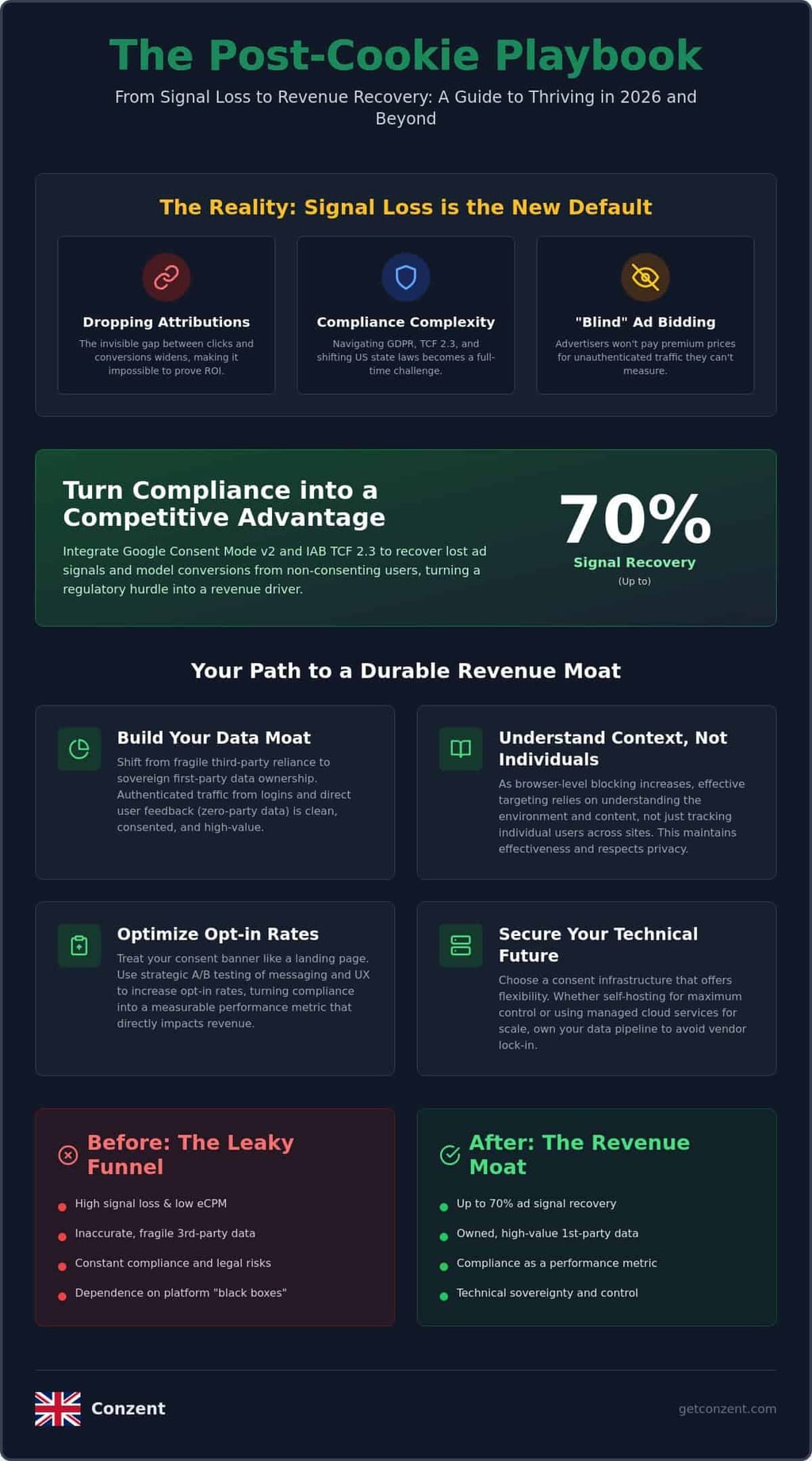
- Recover up to 70% of lost ad signals by integrating Google Consent Mode v2 and IAB TCF 2.3 into your technical stack.
- Shift from tracking individuals to understanding context, ensuring your targeting remains effective as browser-level blocking increases.
- Master the art of maintaining ad revenue without third-party cookies by prioritizing first-party data ownership over third-party reliance.
- Optimize your opt-in rates through strategic A/B testing of consent UX, turning compliance into a measurable performance metric.
- Secure your technical future by selecting a consent infrastructure that offers the flexibility of self-hosting or the scale of managed cloud services.
The Post-Cookie Reality: Why 2026 is the Year of Signal Loss
The industry spent years bracing for a "cookie apocalypse" that never arrived in the way we expected. Google didn't kill the cookie; they simply made it optional. However, optionality is effectively a death sentence for mass-market targeting. In 2026, third-party cookies still exist in Chrome, but they are legacy tools. They are no longer the reliable backbone of digital advertising. Signal loss occurs when browsers block cross-site tracking or when users exercise their right to stay anonymous. This leads to "blind" ad bidding where you're paying for impressions without knowing if they actually convert. The shift from deterministic tracking to probabilistic modelling is no longer a choice. It's mandatory for anyone serious about maintaining ad revenue without third-party cookies.
Transparency has become the new currency. Users are increasingly tech-savvy and privacy-conscious. They don't just want to know that you're tracking them; they want to know why. Brands that hide their tracking logic behind complex scripts are being punished with high opt-out rates. Conversely, brands that are inclusive and clear about their data practices are seeing higher engagement. Privacy is not a barrier to profit. It is the foundation of a sustainable technical infrastructure.
The Definition of Signal Loss in Digital Ads
Signal loss is not a vague concept. It is a measurable decline in your eCPM and fill rates. When you lose the ability to link a click to a conversion, your ad inventory loses value. Advertisers won't pay premium prices for unauthenticated traffic that they can't measure. In 2026, the divide between authenticated users (those who log in) and unauthenticated users is the primary driver of revenue variance. Privacy-first is not a marketing slogan. It's a technical requirement to ensure your ad server isn't bidding in the dark. If you can't prove the value of your traffic, you can't charge for it.
Regulatory Pressure: Beyond the GDPR
The legal landscape is more complex than it was in 2018. We're now dealing with the evolution of ePrivacy directives and a growing list of US state laws. As of January 2026, new comprehensive privacy laws in Kentucky, Rhode Island, and Indiana have changed the compliance map. These regulations demand a more granular approach to consent. You can't just ask for a blanket "Yes" anymore. You need to manage specific permissions for different ad-tech vendors. This is where IAB TCF 2.3 becomes critical. It standardizes how consent signals travel through the bidstream, ensuring that every player in the ad stack knows exactly what the user has permitted. Maintaining ad revenue without third-party cookies requires this level of precision to avoid both legal penalties and revenue leakage.
Building Your Moat: First-Party Data and Contextual Intelligence
Third-party data was always a borrowed asset. It was fragile, often inaccurate, and fundamentally detached from the user relationship. In 2026, the only durable strategy for maintaining ad revenue without third-party cookies is to build your own data moat. This isn't just about survival. It's about technical sovereignty. When you own the relationship, you own the revenue. The industry shift is clear. The CMA's investigation into Google's Privacy Sandbox highlighted the risks of platform-level control. Relying on a single vendor's black-box solution is a gamble your bottom line can't afford.
The foundation of this moat is a transparent value exchange. Users don't hate ads; they hate being stalked. When you offer high-quality content or utility in exchange for an email or a login, you create authenticated traffic. This is deterministic data. It's clean, consented, and high-value. You should also consider zero-party data. Ask your users directly about their preferences through polls or preference centers. This builds trust while providing the exact signals advertisers crave. If you want to see how your current setup impacts these signals, you might explore revenue impact analytics to identify where your data leaks are happening.
Leveraging Your Own Audience Data
First-party cookies are the gold standard. They are set by your domain and remain functional across most privacy-centric browsers. To maximize accuracy, move your data collection server-side. Client-side scripts are easily blocked by ad-blockers and browser tracking protections. Server-side collection ensures that your "Lookalike" audiences are built on actual user behavior, not fragmented snippets. It is about precision. It is about reliability. This infrastructure allows you to maintain high-value targeting without crossing ethical or regulatory lines.
The Resurgence of Contextual Advertising
Context is the new identity. For years, the industry obsessed over the "who." In 2026, we're returning to the "what." Contextual targeting places ads based on the content of the page rather than the history of the user. It is inherently privacy-compliant. Modern tools now use semantic and sentiment analysis to understand the nuance of your articles. An ad for a high-end camera performs better on a deep-dive photography tutorial than it does following a "camera-interested" user to a weather site. Contextual ads often yield higher engagement because they meet the user in the right mindset. They respect the user's current intent instead of haunting their past actions.
Recovering the Missing Revenue: Google Consent Mode v2 and IAB TCF 2.3
Technical gaps in your data don't have to stay empty. In the current landscape, Google Consent Mode (GCM) v2 is the definitive bridge between user privacy and data-driven marketing. It is not a workaround for tracking. It is a communication protocol that tells Google’s tags how to behave based on a user's consent status. When a user declines cookies, GCM v2 doesn't just stop. It sends "pings" devoid of personal identifiers. These pings allow for sophisticated conversion modelling, which is the only way of maintaining ad revenue without third-party cookies while respecting the user's choice. While Google's Privacy Sandbox initiative has seen significant shifts in its roadmap, GCM v2 remains the mandatory standard for anyone operating in the EEA or UK.
The danger of using "uncertified" Consent Management Platforms (CMPs) in 2026 is real. Major ad networks now require verified signals. If your CMP isn't certified, your ad tags might not fire at all, or worse, they might fire without the necessary legal protections. This results in immediate revenue leakage. Transparency is your shield. By using a certified framework, you ensure that every participant in the bidstream understands the user's preferences. It is about technical integrity. It is about protecting your bottom line from the friction of non-compliance.
How Google Consent Mode v2 Works
You have two implementation paths: Basic and Advanced. Basic mode blocks tags until consent is granted, leaving a total data void if the user opts out. Advanced mode is the engine of revenue recovery. It sends anonymous pings even when consent is denied. Google’s AI then uses these signals to recover up to 70% of lost ad signals by comparing the behavior of consenting users with the aggregate pings from those who opted out. Google Consent Mode v2 uses machine learning to analyze the behavior of consenting users and predict the conversion paths of non-consenting users, effectively filling the data void without individual tracking. This probabilistic modelling is the new baseline for performance marketing.
IAB TCF 2.3: The Publisher’s Safety Net
The IAB Transparency and Consent Framework (TCF) 2.3 is the industry's shared language. It ensures your consent signals are "legally readable" by every ad partner in your stack. Without it, you're manually managing hundreds of vendor relationships. TCF 2.3 specifically refines how "Legitimate Interest" and "Explicit Consent" are handled, reducing the risk of regulatory fines. It is a safety net that automates compliance across the entire bidstream. See how Conzent’s IAB TCF 2.3 certified CMP automates this process, ensuring your signals are always valid and your ad inventory remains eligible for premium bids. Maintaining ad revenue without third-party cookies is impossible without a standardized way to communicate consent to your partners.
Consent UX: Turning Compliance into a Conversion Engine
Compliance is often framed as a tax on user experience. This is a technical mistake. In 2026, your "Opt-in Rate" is your most critical ad-ops metric. It is the new fill rate. If users don't opt in, your probabilistic models have less data to work with. This leads to less accurate bidding and lower yields. Maintaining ad revenue without third-party cookies requires a shift in perspective. Your consent banner is the first interaction a user has with your brand's ethical standards. It should feel like a natural part of the site. It should not look like a suspicious pop-up from a third-party vendor.
Reducing bounce rates starts with making consent part of the brand experience. Transparency is not a barrier; it is a gateway. When users understand that their data fuels the free content they enjoy, they are more likely to participate. Inclusive design and clear language build a relationship of trust. This trust is the foundation of a durable revenue moat. You don't need to hide your tracking logic. You need to explain its value.
Optimising the Consent Journey
A/B testing is no longer just for landing pages. It's for consent infrastructure. You must test the prominence of "Accept All" versus "Manage Preferences" buttons. It is not about trickery. It is about reducing friction. Use Revenue Impact Analytics to see which banner designs actually pay off in your ad auctions. Some designs might look clean but drive users away. Others might be too aggressive and trigger regulatory scrutiny. The goal is a seamless journey where consent is an informed, quick choice that respects the reader's time.
Technical Performance and Core Web Vitals
Site speed is a ranking factor and a revenue driver. Heavy, bloated CMP scripts often delay the very ads they are supposed to authorize. If your script takes too long to execute, your ad auction starts late. This hurts your priority in the bidstream and lowers your overall yield. Lightweight, source-available scripts ensure your site remains fast and your Core Web Vitals stay green. Efficiency is a moral choice. It respects the user's device resources and your own server costs. Increased script latency creates a technical bottleneck that delays ad delivery and directly reduces your total daily earnings.
Ready to optimize your infrastructure for better performance? Start Consent A/B Testing today to find the banner that maximizes both trust and revenue.
Future-Proofing Your Ad Stack with Conzent’s Managed Infrastructure
Compliance is not a commodity you buy from a distant vendor. It is a core component of your technical stack. Relying on closed-source, third-party platforms creates a dependency that can break your business when their terms or pricing change. Future-proofing your strategy for maintaining ad revenue without third-party cookies requires technical sovereignty. You need to own the tools that manage your user relationships. We believe in an Open Consent Infrastructure. Our mission is to make compliance a public good rather than a premium gated service. It is about moral clarity. It is about technical efficiency.
Owning your infrastructure is the ultimate hedge against vendor lock-in. When you control the code, you control the data. This independence allows you to pivot as fast as the regulations do. It ensures that your revenue isn't tied to a single provider's roadmap. We provide the blueprint. You provide the vision. This partnership ensures that privacy remains a standard that is attainable for all users, regardless of their resources.
Managed Cloud: Compliance without the Overhead
Our Managed Cloud Consent Platform is designed for teams that prioritize speed. It handles the heavy lifting of tracking evolving global regulations like the GDPR, CCPA, and the latest 2026 US state laws. You get automatic updates across all your domains and CMS platforms. It scales with your traffic. We use corporate sponsorships to lower compliance costs, making high-level privacy tools accessible to everyone. It is not a luxury. It is a necessity for maintaining ad revenue without third-party cookies in a complex market.
Self-Hosting for Maximum Data Sovereignty
DevOps teams often prefer our self-hosted model for its security and transparency. It allows you to keep consent logs on your own servers, eliminating the risk of third-party data leakage. You aren't just following the law; you are securing your technical perimeter. Source-available infrastructure means you can audit every line of code. There are no black boxes here. You can see how your data flows and how your revenue is protected. Explore Conzent’s source-available consent platform to regain control over your data pipeline and your future.
Our Revenue Impact Analytics takes the guesswork out of this transition. It provides a direct view of how your consent infrastructure influences your bidding success. You can see the real-time correlation between opt-in rates and fill rates. This transparency allows you to optimize your stack for performance without compromising on your ethical responsibilities. It is time to stop guessing and start measuring.
Reclaiming Your Technical Sovereignty
The digital landscape of 2026 demands a shift from passive tracking to active data ownership. You've seen how signal recovery isn't just about compliance; it's about reclaiming the data lost to technical fragmentation. By prioritizing first-party moats and contextual intelligence, you move beyond the fragile legacy of the past. Your strategy for maintaining ad revenue without third-party cookies must be built on durable, transparent infrastructure that respects the user while protecting the publisher. It is not a choice between privacy and profit. It is a commitment to both.
Conzent provides the tools to turn this vision into reality. Our platform is IAB TCF 2.3 Certified and Google Consent Mode v2 Ready, ensuring your signals are valid and your auctions stay competitive. Whether you choose our managed cloud or our source-available self-hosted option, you gain maximum transparency and technical control. We don't believe in black boxes. We believe in open standards that empower every business owner to succeed. It's time to stop renting your compliance and start owning your future.
Start protecting your ad revenue with Conzent today. You have the capacity to build a sustainable, privacy-first business that thrives on trust and technical excellence. The tools are ready when you are.
Frequently Asked Questions
How does Google Consent Mode v2 actually recover lost ad revenue?
Google Consent Mode v2 recovers revenue by bridging the data gap created when users opt out of tracking. It sends anonymous, cookieless pings to Google’s servers. These signals allow machine learning models to predict conversion behavior based on the actions of consenting users. It's a technical solution that replaces lost deterministic data with high-accuracy probabilistic modeling. This ensures your campaigns continue to optimize even when individual identifiers are missing.
Can I still use Google Analytics 4 without third-party cookies?
You can absolutely use Google Analytics 4 without third-party cookies. GA4 is built to prioritize first-party data and works seamlessly with Consent Mode to fill gaps through behavioral modeling. It's not about losing data; it's about shifting how you collect it. By moving to a first-party foundation, you ensure your analytics remain resilient against browser-level blocking and evolving privacy standards.
What is the difference between IAB TCF 2.2 and the new 2.3 standard?
The transition to TCF 2.3 focuses on enhanced transparency and stricter vendor management. While 2.2 established the baseline, 2.3 improves how consent strings communicate specific user choices to the ad tech ecosystem. It addresses the granular requirements of new US state laws and updated ePrivacy directives. It is a necessary technical update to ensure your consent signals remain "legally readable" by premium ad networks in 2026.
Does a cookie banner always increase my website’s bounce rate?
A cookie banner only hurts your bounce rate if it's poorly integrated or technically heavy. Performance-focused banners that match your brand's aesthetic often have a negligible impact on user retention. The key is script latency. If your CMP script is lightweight and fires efficiently, it won't trigger the user frustration that leads to bounces. Transparency actually builds trust, which can improve long-term engagement.
Is it better to self-host a CMP or use a managed cloud service?
Choosing between self-hosting and managed cloud depends on your need for data sovereignty. Self-hosting your consent infrastructure eliminates third-party data leakage and gives your DevOps team full control over the source code. Managed cloud services are better for teams that need automatic regulatory updates without the maintenance overhead. Both paths are viable for maintaining ad revenue without third-party cookies, provided the underlying technology is certified and open.
What happens to my ad revenue if a user clicks "Reject All"?
If a user clicks "Reject All" and you lack a sophisticated consent bridge, your ad revenue for that session effectively disappears. You lose the ability to serve targeted ads or measure conversions. However, using Google Consent Mode v2 allows you to serve non-personalized ads and still receive basic pings. This keeps your inventory eligible for the auction and provides the aggregate data needed to maintain your bidding strategy.
How do I measure the "Revenue Impact" of my cookie consent settings?
Measuring the financial impact requires specialized Revenue Impact Analytics. You must correlate your consent opt-in states with real-time bid data from your ad server. This allows you to see exactly how different banner designs or consent configurations affect your eCPMs and total yield. It's about moving from legal guesswork to data-driven performance. You can't optimize what you don't measure.
Are contextual ads as profitable as behavioral ads in 2026?
Contextual ads are proving to be highly profitable in 2026 because they meet users in the right mindset. Unlike behavioral ads that follow users across the web, contextual targeting aligns with the content the user is currently consuming. This relevance often drives higher engagement and click-through rates. When combined with high-quality first-party data, contextual strategies provide a stable and ethical foundation for maintaining ad revenue without third-party cookies.
Frequently Asked Questions
The Definition of Signal Loss in Digital Ads
Signal loss is not a vague concept. It is a measurable decline in your eCPM and fill rates. When you lose the ability to link a click to a conversion, your ad inventory loses value. Advertisers won't pay premium prices for unauthenticated traffic that they can't measure. In 2026, the divide between authenticated users (those who log in) and unauthenticated users is the primary driver of revenue variance. Privacy-first is not a marketing slogan. It's a technical requirement to ensure your ad server isn't bidding in the dark. If you can't prove the value of your traffic, you can't charge for it.
Regulatory Pressure: Beyond the GDPR
The legal landscape is more complex than it was in 2018. We're now dealing with the evolution of ePrivacy directives and a growing list of US state laws. As of January 2026, new comprehensive privacy laws in Kentucky, Rhode Island, and Indiana have changed the compliance map. These regulations demand a more granular approach to consent. You can't just ask for a blanket "Yes" anymore. You need to manage specific permissions for different ad-tech vendors. This is where IAB TCF 2.3 becomes critical. It standardizes how consent signals travel through the bidstream, ensuring that every player in the ad stack knows exactly what the user has permitted. Maintaining ad revenue without third-party cookies requires this level of precision to avoid both legal penalties and revenue leakage. Third-party data was always a borrowed asset. It was fragile, often inaccurate, and fundamentally detached from the user relationship. In 2026, the only durable strategy for maintaining ad revenue without third-party cookies is to build your own data moat. This isn't just about survival. It's about technical sovereignty. When you own the relationship, you own the revenue. The industry shift is clear. The CMA's investigation into Google's Privacy Sandbox highlighted the risks of platform-level control. Relying on a single vendor's black-box solution is a gamble your bottom line can't afford. The foundation of this moat is a transparent value exchange. Users don't hate ads; they hate being stalked. When you offer high-quality content or utility in exchange for an email or a login, you create authenticated traffic. This is deterministic data. It's clean, consented, and high-value. You should also consider zero-party data. Ask your users directly about their preferences through polls or preference centers. This builds trust while providing the exact signals advertisers crave. If you want to see how your current setup impacts these signals, you might explore revenue impact analytics to identify where your data leaks are happening.
Leveraging Your Own Audience Data
First-party cookies are the gold standard. They are set by your domain and remain functional across most privacy-centric browsers. To maximize accuracy, move your data collection server-side. Client-side scripts are easily blocked by ad-blockers and browser tracking protections. Server-side collection ensures that your "Lookalike" audiences are built on actual user behavior, not fragmented snippets. It is about precision. It is about reliability. This infrastructure allows you to maintain high-value targeting without crossing ethical or regulatory lines.
The Resurgence of Contextual Advertising
Context is the new identity. For years, the industry obsessed over the "who." In 2026, we're returning to the "what." Contextual targeting places ads based on the content of the page rather than the history of the user. It is inherently privacy-compliant. Modern tools now use semantic and sentiment analysis to understand the nuance of your articles. An ad for a high-end camera performs better on a deep-dive photography tutorial than it does following a "camera-interested" user to a weather site. Contextual ads often yield higher engagement because they meet the user in the right mindset. They respect the user's current intent instead of haunting their past actions. Technical gaps in your data don't have to stay empty. In the current landscape, Google Consent Mode (GCM) v2 is the definitive bridge between user privacy and data-driven marketing. It is not a workaround for tracking. It is a communication protocol that tells Google’s tags how to behave based on a user's consent status. When a user declines cookies, GCM v2 doesn't just stop. It sends "pings" devoid of personal identifiers. These pings allow for sophisticated conversion modelling, which is the only way of maintaining ad revenue without third-party cookies while respecting the user's choice. While Google's Privacy Sandbox initiative has seen significant shifts in its roadmap, GCM v2 remains the mandatory standard for anyone operating in the EEA or UK. The danger of using "uncertified" Consent Management Platforms (CMPs) in 2026 is real. Major ad networks now require verified signals. If your CMP isn't certified, your ad tags might not fire at all, or worse, they might fire without the necessary legal protections. This results in immediate revenue leakage. Transparency is your shield. By using a certified framework, you ensure that every participant in the bidstream understands the user's preferences. It is about technical integrity. It is about protecting your bottom line from the friction of non-compliance.
How Google Consent Mode v2 Works
You have two implementation paths: Basic and Advanced. Basic mode blocks tags until consent is granted, leaving a total data void if the user opts out. Advanced mode is the engine of revenue recovery. It sends anonymous pings even when consent is denied. Google’s AI then uses these signals to recover up to 70% of lost ad signals by comparing the behavior of consenting users with the aggregate pings from those who opted out. Google Consent Mode v2 uses machine learning to analyze the behavior of consenting users and predict the conversion paths of non-consenting users, effectively filling the data void without individual tracking. This probabilistic modelling is the new baseline for performance marketing.
IAB TCF 2.3: The Publisher’s Safety Net
The IAB Transparency and Consent Framework (TCF) 2.3 is the industry's shared language. It ensures your consent signals are "legally readable" by every ad partner in your stack. Without it, you're manually managing hundreds of vendor relationships. TCF 2.3 specifically refines how "Legitimate Interest" and "Explicit Consent" are handled, reducing the risk of regulatory fines. It is a safety net that automates compliance across the entire bidstream. See how Conzent’s IAB TCF 2.3 certified CMP automates this process, ensuring your signals are always valid and your ad inventory remains eligible for premium bids. Maintaining ad revenue without third-party cookies is impossible without a standardized way to communicate consent to your partners. Compliance is often framed as a tax on user experience. This is a technical mistake. In 2026, your "Opt-in Rate" is your most critical ad-ops metric. It is the new fill rate. If users don't opt in, your probabilistic models have less data to work with. This leads to less accurate bidding and lower yields. Maintaining ad revenue without third-party cookies requires a shift in perspective. Your consent banner is the first interaction a user has with your brand's ethical standards. It should feel like a natural part of the site. It should not look like a suspicious pop-up from a third-party vendor. Reducing bounce rates starts with making consent part of the brand experience. Transparency is not a barrier; it is a gateway. When users understand that their data fuels the free content they enjoy, they are more likely to participate. Inclusive design and clear language build a relationship of trust. This trust is the foundation of a durable revenue moat. You don't need to hide your tracking logic. You need to explain its value.
Optimising the Consent Journey
A/B testing is no longer just for landing pages. It's for consent infrastructure. You must test the prominence of "Accept All" versus "Manage Preferences" buttons. It is not about trickery. It is about reducing friction. Use Revenue Impact Analytics to see which banner designs actually pay off in your ad auctions. Some designs might look clean but drive users away. Others might be too aggressive and trigger regulatory scrutiny. The goal is a seamless journey where consent is an informed, quick choice that respects the reader's time.
Technical Performance and Core Web Vitals
Site speed is a ranking factor and a revenue driver. Heavy, bloated CMP scripts often delay the very ads they are supposed to authorize. If your script takes too long to execute, your ad auction starts late. This hurts your priority in the bidstream and lowers your overall yield. Lightweight, source-available scripts ensure your site remains fast and your Core Web Vitals stay green. Efficiency is a moral choice. It respects the user's device resources and your own server costs. Increased script latency creates a technical bottleneck that delays ad delivery and directly reduces your total daily earnings. Ready to optimize your infrastructure for better performance? Start Consent A/B Testing today to find the banner that maximizes both trust and revenue. Compliance is not a commodity you buy from a distant vendor. It is a core component of your technical stack. Relying on closed-source, third-party platforms creates a dependency that can break your business when their terms or pricing change. Future-proofing your strategy for maintaining ad revenue without third-party cookies requires technical sovereignty. You need to own the tools that manage your user relationships. We believe in an Open Consent Infrastructure. Our mission is to make compliance a public good rather than a premium gated service. It is about moral clarity. It is about technical efficiency. Owning your infrastructure is the ultimate hedge against vendor lock-in. When you control the code, you control the data. This independence allows you to pivot as fast as the regulations do. It ensures that your revenue isn't tied to a single provider's roadmap. We provide the blueprint. You provide the vision. This partnership ensures that privacy remains a standard that is attainable for all users, regardless of their resources.
Managed Cloud: Compliance without the Overhead
Our Managed Cloud Consent Platform is designed for teams that prioritize speed. It handles the heavy lifting of tracking evolving global regulations like the GDPR, CCPA, and the latest 2026 US state laws. You get automatic updates across all your domains and CMS platforms. It scales with your traffic. We use corporate sponsorships to lower compliance costs, making high-level privacy tools accessible to everyone. It is not a luxury. It is a necessity for maintaining ad revenue without third-party cookies in a complex market.
Self-Hosting for Maximum Data Sovereignty
DevOps teams often prefer our self-hosted model for its security and transparency. It allows you to keep consent logs on your own servers, eliminating the risk of third-party data leakage. You aren't just following the law; you are securing your technical perimeter. Source-available infrastructure means you can audit every line of code. There are no black boxes here. You can see how your data flows and how your revenue is protected. Explore Conzent’s source-available consent platform to regain control over your data pipeline and your future. Our Revenue Impact Analytics takes the guesswork out of this transition. It provides a direct view of how your consent infrastructure influences your bidding success. You can see the real-time correlation between opt-in rates and fill rates. This transparency allows you to optimize your stack for performance without compromising on your ethical responsibilities. It is time to stop guessing and start measuring. The digital landscape of 2026 demands a shift from passive tracking to active data ownership. You've seen how signal recovery isn't just about compliance; it's about reclaiming the data lost to technical fragmentation. By prioritizing first-party moats and contextual intelligence, you move beyond the fragile legacy of the past. Your strategy for maintaining ad revenue without third-party cookies must be built on durable, transparent infrastructure that respects the user while protecting the publisher. It is not a choice between privacy and profit. It is a commitment to both. Conzent provides the tools to turn this vision into reality. Our platform is IAB TCF 2.3 Certified and Google Consent Mode v2 Ready, ensuring your signals are valid and your auctions stay competitive. Whether you choose our managed cloud or our source-available self-hosted option, you gain maximum transparency and technical control. We don't believe in black boxes. We believe in open standards that empower every business owner to succeed. It's time to stop renting your compliance and start owning your future. Start protecting your ad revenue with Conzent today. You have the capacity to build a sustainable, privacy-first business that thrives on trust and technical excellence. The tools are ready when you are.
How does Google Consent Mode v2 actually recover lost ad revenue?
Google Consent Mode v2 recovers revenue by bridging the data gap created when users opt out of tracking. It sends anonymous, cookieless pings to Google’s servers. These signals allow machine learning models to predict conversion behavior based on the actions of consenting users. It's a technical solution that replaces lost deterministic data with high-accuracy probabilistic modeling. This ensures your campaigns continue to optimize even when individual identifiers are missing.
Can I still use Google Analytics 4 without third-party cookies?
You can absolutely use Google Analytics 4 without third-party cookies. GA4 is built to prioritize first-party data and works seamlessly with Consent Mode to fill gaps through behavioral modeling. It's not about losing data; it's about shifting how you collect it. By moving to a first-party foundation, you ensure your analytics remain resilient against browser-level blocking and evolving privacy standards.
What is the difference between IAB TCF 2.2 and the new 2.3 standard?
The transition to TCF 2.3 focuses on enhanced transparency and stricter vendor management. While 2.2 established the baseline, 2.3 improves how consent strings communicate specific user choices to the ad tech ecosystem. It addresses the granular requirements of new US state laws and updated ePrivacy directives. It is a necessary technical update to ensure your consent signals remain "legally readable" by premium ad networks in 2026.
Does a cookie banner always increase my website’s bounce rate?
A cookie banner only hurts your bounce rate if it's poorly integrated or technically heavy. Performance-focused banners that match your brand's aesthetic often have a negligible impact on user retention. The key is script latency. If your CMP script is lightweight and fires efficiently, it won't trigger the user frustration that leads to bounces. Transparency actually builds trust, which can improve long-term engagement.
Is it better to self-host a CMP or use a managed cloud service?
Choosing between self-hosting and managed cloud depends on your need for data sovereignty. Self-hosting your consent infrastructure eliminates third-party data leakage and gives your DevOps team full control over the source code. Managed cloud services are better for teams that need automatic regulatory updates without the maintenance overhead. Both paths are viable for maintaining ad revenue without third-party cookies, provided the underlying technology is certified and open.
What happens to my ad revenue if a user clicks "Reject All"?
If a user clicks "Reject All" and you lack a sophisticated consent bridge, your ad revenue for that session effectively disappears. You lose the ability to serve targeted ads or measure conversions. However, using Google Consent Mode v2 allows you to serve non-personalized ads and still receive basic pings. This keeps your inventory eligible for the auction and provides the aggregate data needed to maintain your bidding strategy.
How do I measure the "Revenue Impact" of my cookie consent settings?
Measuring the financial impact requires specialized Revenue Impact Analytics. You must correlate your consent opt-in states with real-time bid data from your ad server. This allows you to see exactly how different banner designs or consent configurations affect your eCPMs and total yield. It's about moving from legal guesswork to data-driven performance. You can't optimize what you don't measure.
Are contextual ads as profitable as behavioral ads in 2026?
Contextual ads are proving to be highly profitable in 2026 because they meet users in the right mindset. Unlike behavioral ads that follow users across the web, contextual targeting aligns with the content the user is currently consuming. This relevance often drives higher engagement and click-through rates. When combined with high-quality first-party data, contextual strategies provide a stable and ethical foundation for maintaining ad revenue without third-party cookies.