Managed Cloud Consent Platform: Scaling Privacy Without the Black Box
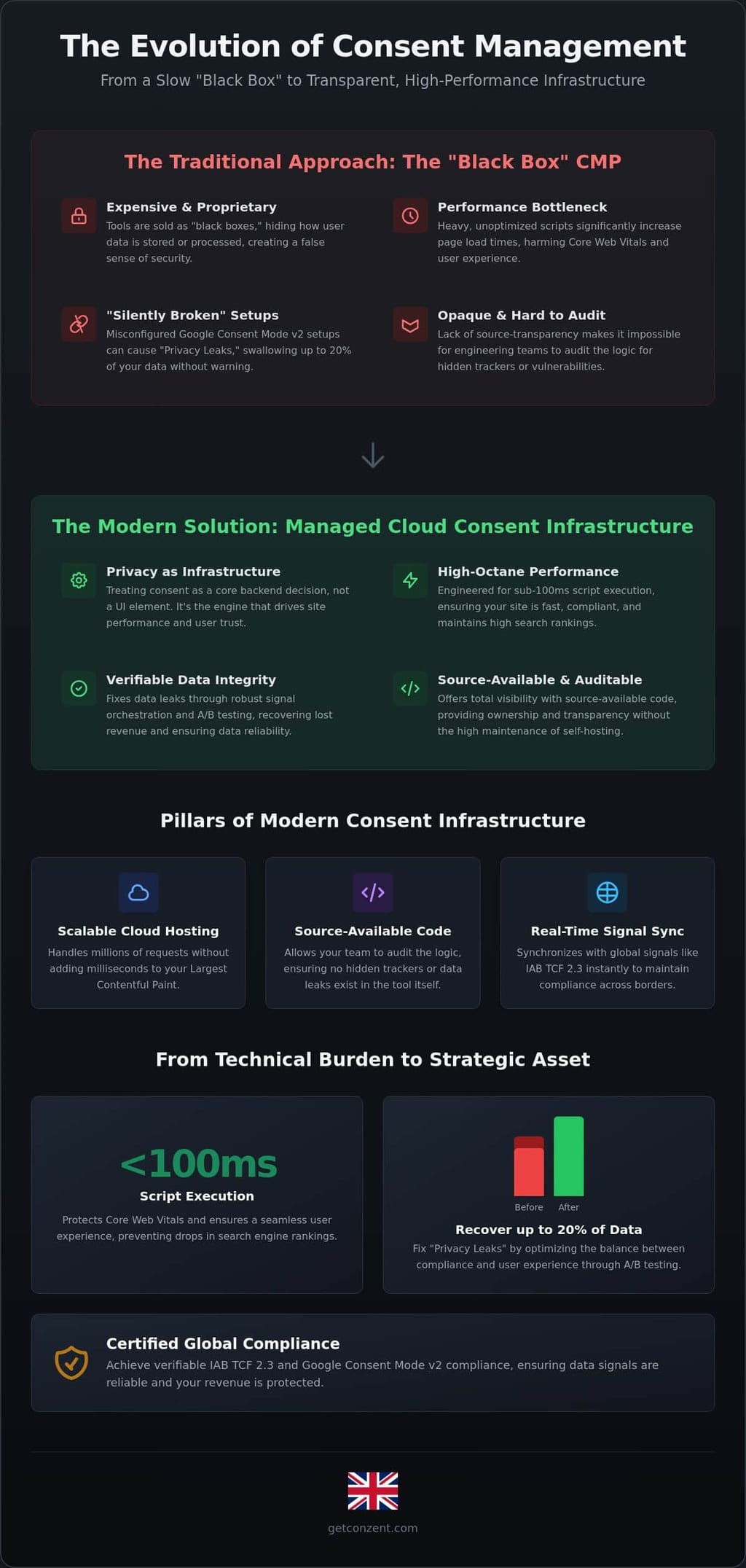
Why should a privacy requirement feel like a performance penalty? Most "black box" solutions force a choice between legal safety and site speed. They hide their logic, bloat your code, and leave you guessing about how data is actually stored. A managed cloud consent platform changes this dynamic by treating privacy as core infrastructure rather than an afterthought. It's the bridge between the radical transparency of open-source and the reliability of enterprise SaaS.
You've likely felt the frustration of watching heavy compliance scripts tank your PageSpeed scores. It's even worse when you're racing to meet the February 28, 2026, deadline for IAB TCF 2.3 or struggling to make Google Consent Mode v2 behave. This guide explores how managed infrastructure solves these technical hurdles. We'll show you how to achieve sub-second script execution, maintain perfect compliance, and finally get clear visibility into how privacy choices impact your revenue. We're moving past opaque vendors toward a standard of openness and speed.
Key Takeaways
- Rethink privacy as a core infrastructure choice. Understand how moving beyond simple UI elements prevents performance lag and builds real transparency.
- Meet the February 2026 deadline for IAB TCF 2.3 with confidence. We explain how to integrate the latest standards without breaking your programmatic advertising setup.
- Recover lost data by fixing the "privacy leak." Learn how A/B testing your consent banners can protect your revenue while maintaining strict compliance.
- Choose the right path for your digital rights strategy. Compare self-hosting for total sovereignty against a managed cloud consent platform that scales ethically without the maintenance overhead.
Defining the Managed Cloud Consent Platform in 2026
A managed cloud consent platform is not a cookie banner. It is the engine that powers it. For years, digital teams treated privacy as a cosmetic layer; they slapped a script on the header and hoped for the best. That era is over. In a landscape where cloud-based solutions now hold a 70% market share in the privacy sector, the distinction between a simple UI tool and true infrastructure has become a matter of technical survival.
Foundationally, Consent Management is the process of giving users control over their data while ensuring businesses stay compliant with shifting laws. Most traditional SaaS providers operate as "black boxes." They ask for your trust but deny you visibility. You cannot audit their logic, you cannot inspect their database schemas, and you certainly cannot modify how they handle your users' most sensitive signals. This proprietary wall is failing modern development teams who require transparency to meet strict security standards.
A managed cloud consent platform offers a principled alternative. It provides the backend infrastructure required for global compliance without the proprietary secrecy. It is the bridge where enterprise-grade performance meets the egalitarian spirit of open standards. You get the convenience of a managed service, but you retain the right to see how the machine works. It is about sovereignty, not just a checkbox.
The Core Components of Modern Consent Infrastructure
Modern privacy needs more than a static script. It requires scalable cloud hosting capable of handling high-traffic environments without latency. It demands source-available codebases so your security team can perform real-time auditing. Finally, it must include real-time synchronization with global privacy signals. If a user changes their mind in Berlin, your stack in New York must know instantly. This isn't a feature; it's a requirement for ethical scaling.
Why Compliance Must Be Managed, Not Just Installed
Installing a plugin is easy. Managing a global compliance posture is hard. The "Compliance Tax" on engineering resources is real; developers spend hundreds of hours chasing new GDPR requirements or ePrivacy updates instead of building products. A managed cloud consent platform automates this orchestration. It shifts the burden of maintenance from your team to a specialized infrastructure. By moving toward Self-Hosted Open Consent Infrastructure or its managed counterparts, you ensure your stack stays current with every regulatory shift automatically. This is how you turn a legal obligation into a technical advantage.
Technical Standards: IAB TCF 2.3 and Google Consent Mode v2
Compliance is a moving target. In 2026, meeting standards like IAB TCF 2.3 or Google Consent Mode v2 isn't a "set and forget" task. It's a continuous technical operation. A managed cloud consent platform ensures that these protocols are baked into your stack, not just duct-taped to the front end. It transforms regulatory requirements into a predictable part of your infrastructure.
Performance is the first casualty of poor privacy tech. Most Consent Management Platforms (CMPs) add hundreds of milliseconds to your Largest Contentful Paint (LCP). We reject that tradeoff. By utilizing managed cloud infrastructure, you can achieve sub-100ms script execution. This keeps your Core Web Vitals healthy while maintaining alignment with FTC Privacy & Security Guidance on transparent data practices. Speed and ethics are not mutually exclusive.
Implementing Google Consent Mode v2 at Scale
Choosing between Basic and Advanced implementation is a strategic pivot. Basic mode blocks tags until consent is granted. Advanced mode sends "pings" to recover modeled data without using cookies. In 2026, Google Consent Mode v2 acts as the primary control for all ad data collection, using AI to model conversions where direct signals are missing due to user opt-outs. From June 15, 2026, this system becomes the sole control for ad data collection as Google Signals is retired. Handling this transition at scale requires a backend that doesn't buckle under the weight of real-time signal processing.
IAB TCF 2.3: The Standard for Global Publishers
The deadline for IAB TCF 2.3 is February 28, 2026. This isn't a suggestion; it's a requirement for anyone running programmatic ads in the EEA. The new standard mandates the "DisclosedVendors" segment in the TC String to provide users with absolute clarity on who sees their data. Certification is mandatory. Google now limits data collection from sites without a certified CMP.
Managing these vendor lists manually is a recipe for error. A managed cloud consent platform automates the generation of the Transparency and Consent String (TC String). It synchronizes your vendor list with the IAB Global Vendor List (GVL) in real-time. This automation reduces the risk of non-compliance while ensuring your ad revenue remains stable. If you are looking to balance these technical requirements with a sustainable budget, you can view our transparent pricing options to find a fit for your traffic levels. It's about building a foundation that is both legally sound and technically superior.
Compliance vs. Revenue: Solving the Privacy Leak
Privacy is not a zero-sum game. Many businesses treat compliance as a necessary evil that inevitably drains revenue. They accept a "Privacy Leak" where poor UX choices lead to a 20% loss in actionable data. This happens when banners are intrusive, confusing, or technically slow. A managed cloud consent platform provides the tools to stop this leak. It turns the consent banner into an optimized touchpoint rather than a barrier. You shouldn't have to choose between respecting a user and hitting your growth targets.
The goal is ethical scaling. This means moving away from "dark patterns" that trick users into consenting. Instead, focus on clarity and speed. When a banner loads instantly and explains value clearly, trust increases. Increased trust leads to higher opt-in rates. By using a managed cloud consent platform, you gain the backend power to process these interactions without the lag that typically drives users to hit "Reject All" just to clear their screen.
Consent A/B Testing: Beyond the "Accept All" Button
Optimization requires evidence. You shouldn't guess where a banner works best; you should test it. We provide Consent A/B Testing to help you find the precise balance between user rights and business needs. You can experiment with banner placement, color schemes, and the micro-copy used in the call-to-action. Managed cloud infrastructure is essential here because high-frequency testing generates massive amounts of event data. Our platform handles this load seamlessly, ensuring that your experiments don't compromise site performance or Core Web Vitals.
Revenue Impact Analytics for Stakeholders
Compliance conversations often stay trapped in legal departments, but the consequences live on the balance sheet. You need to quantify the cost of a "Reject All" click in real currency. Our Revenue Impact Analytics bridge this gap by attributing revenue fluctuations directly to specific privacy signals. You can visualize consent rates across different geographic regions to see exactly where regulations like GDPR or CCPA are impacting your funnel. This level of visibility allows you to monitor the performance of Google Consent Mode v2 and see how much data is being recovered through modeling. By making this data visible, you move from speculation to a principled, data-driven strategy.
Managed Cloud vs. Self-Hosted: The Strategic Choice
Choosing where your consent data lives is a strategic decision, not just a technical one. Self-Hosted Open Consent Infrastructure offers the ultimate form of data sovereignty. You own the server, the database, and every line of code. However, this level of control comes with a high maintenance cost. Your developers must manage updates, patch security vulnerabilities, and ensure the system scales during traffic surges. For many, the sovereignty of self-hosting becomes a burden that distracts from core product development.
A managed cloud consent platform provides a principled middle ground. It offers the transparency of open standards with the operational ease of enterprise SaaS. You don't lose sight of the source code, but you do lose the headache of server management. The strategic choice usually comes down to dev hours versus subscription fees. If your team spends more than five hours a month maintaining a privacy stack, you're likely overpaying in hidden labor costs. We believe infrastructure should be a utility, not a full-time job.
Transitioning from a self-hosted setup to a managed environment is a sign of operational maturity. It happens when your traffic hits a threshold where manual scaling is no longer viable or when the complexity of global regulations requires dedicated infrastructure. You can compare our service tiers to see how managed efficiency stacks up against your current internal costs. It's about choosing where your team's energy is best spent.
The DevOps Argument for Managed Infrastructure
Traffic is never static. During high-stakes events like Black Friday or major product launches, your consent infrastructure must handle massive spikes without adding latency to the user experience. Managed cloud platforms provide immediate protection through centralized security patches, whereas unpatched self-hosted instances remain vulnerable to emerging exploits. You get zero-maintenance updates for API and SDK changes. This ensures your managed cloud consent platform stays compliant with the latest browser requirements without a single manual commit from your team.
Data Sovereignty and Compliance Location
Location dictates jurisdiction. For businesses focused on GDPR, the physical location of the data center is a legal priority. We prioritize Danish-based hosting to ensure your data remains within one of the world's most privacy-conscious jurisdictions. This isn't just about avoiding US-based surveillance; it's about providing an immutable audit trail. A managed environment simplifies this by generating comprehensive logs and compliance reports automatically. You get the benefits of a global cloud with the legal protection of local sovereignty.
Conzent: The Managed Cloud Solution for Ethical Scaling
Conzent exists because privacy shouldn't be a premium luxury. We provide the managed cloud consent platform that bridges the gap between total developer control and enterprise-grade reliability. Many proprietary vendors lock you into a black box. They hide their logic and hold your data hostage. We take the opposite approach. Our infrastructure is built on open standards; it's designed to be audited, understood, and trusted. This isn't just a product. It's a new standard for digital rights.
Our mission is simple. We make high-level compliance accessible to every website, regardless of their engineering budget. We've built an API-first environment that is lightning fast. It doesn't just meet the sub-100ms execution target we discussed earlier; it sets a new standard for how privacy scripts should behave. We believe that infrastructure should be a public good. This is about making the web better for everyone, one domain at a time.
We offer a unique pricing model that reflects our egalitarian values. In the traditional SaaS world, costs only go up. At Conzent, we utilize a corporate sponsorship model where infrastructure costs drop as our community grows. When more businesses join the platform, the collective efficiency increases. We pass those savings directly to you. It's a sustainable way to scale ethical privacy without the typical corporate overhead. You get the best tech at a price that respects your resources.
Why Conzent is the Ethical Choice
Transparency is our default setting. By providing source-available code, we invite scrutiny rather than hiding from it. We don't engage in data brokerage. We don't use "dark patterns" to trick users into clicking accept. Your users deserve an honest choice, and your business deserves a partner that values digital rights as much as you do. This is honest consent, delivered through a managed cloud consent platform that you can actually trust. It is a principled choice for a transparent future.
Getting Started with Conzent Managed Cloud
Moving away from a legacy proprietary CMP is easier than you think. We've designed our migration path to be seamless, with native support for platforms like WordPress, Joomla, and Drupal. Whether you are running a single domain or a global network, our infrastructure scales with you. You can find detailed setup guides in our help center to get your first banner live in minutes. We provide the tools; you provide the vision.
Ready to scale your privacy? Try Conzent Managed Cloud today.
Future-Proof Your Privacy Infrastructure
Privacy is not a static checkbox; it's a dynamic technical standard. You now understand how the right managed cloud consent platform eliminates the "black box" of proprietary vendors while maintaining sub-100ms performance. By choosing infrastructure that prioritizes transparency and source-available code, you move beyond mere compliance toward true digital sovereignty. You don't have to sacrifice site speed or data visibility to respect your users' rights.
The deadlines for 2026 are approaching fast. Whether you're optimizing for Google Consent Mode v2 or integrating the latest IAB TCF 2.3 requirements, your foundation must be resilient. Our platform is IAB TCF 2.3 Certified, Google Consent Mode v2 Ready, and Danish-engineered for GDPR precision. It's time to stop treating privacy as a burden and start treating it as a standard of excellence. We're here to help you scale ethically and effectively.
Start your journey to transparent compliance with Conzent Managed Cloud. It's time to build a web that respects everyone.
Frequently Asked Questions
What is the difference between a managed cloud CMP and a traditional SaaS CMP?
Managed cloud CMPs provide infrastructure transparency and data sovereignty, whereas traditional SaaS CMPs are proprietary "black boxes." You get the reliability of a managed service without losing the ability to audit the source code or control where data is stored. It is the bridge between the freedom of open-source and the convenience of enterprise hosting.
Does a managed cloud consent platform impact my website performance?
A managed cloud consent platform is engineered to minimize performance lag through optimized, sub-100ms script execution. Unlike heavy proprietary scripts that bloat your site and hurt Core Web Vitals, this infrastructure prioritizes speed. We treat privacy as a core performance metric rather than a secondary script that slows down your user experience.
Is Conzent compliant with IAB TCF 2.3 and Google Consent Mode v2?
Yes, we provide certified integration for both IAB TCF v2.3 and Google Consent Mode v2. Our system is built to handle the February 28, 2026, deadline for TCF 2.3 and the retirement of Google Signals. We ensure your ad data signals remain accurate, legally sound, and fully automated across your entire domain network.
Can I switch from managed cloud to self-hosted later?
You can transition between our managed cloud and self-hosted open consent infrastructure at any time. Because the underlying code is source-available and standardized, you aren't locked into a specific vendor model. This flexibility allows you to start with managed convenience and move to total internal control as your technical resources grow.
How does A/B testing for consent banners work in the cloud?
We use real-time analytics to test different banner designs, placements, and micro-copy across your live traffic. The cloud backend processes these high-frequency events to show you which versions yield the highest opt-in rates. This allows you to recover lost data by finding the optimal balance between user trust and conversion performance.
Does Conzent offer a free version for small websites?
We don't offer a freemium plan, but we provide a 7-day free trial for our paid tiers. This allows us to maintain high-quality infrastructure and ethical standards for every user. Our pricing is based on domains and pageviews, ensuring that even small sites get access to the same enterprise-grade privacy tools as large corporations.
What regions are supported for data storage in the managed cloud?
We prioritize data sovereignty by offering storage in specific jurisdictions, including Danish-based hosting for strict GDPR compliance. Choosing a managed cloud consent platform with local hosting ensures your data stays within the correct legal boundaries. This eliminates the risks associated with storing sensitive consent signals in jurisdictions with less protective privacy laws.
How does corporate sponsorship affect my subscription price?
Corporate sponsorship allows us to lower subscription costs for the entire community as the platform grows. It is an egalitarian model where collective efficiency creates savings that we pass directly to you. This approach makes high-level compliance accessible to everyone, ensuring that principled privacy is a standard requirement rather than a premium luxury.
Frequently Asked Questions
The Core Components of Modern Consent Infrastructure
Modern privacy needs more than a static script. It requires scalable cloud hosting capable of handling high-traffic environments without latency. It demands source-available codebases so your security team can perform real-time auditing. Finally, it must include real-time synchronization with global privacy signals. If a user changes their mind in Berlin, your stack in New York must know instantly. This isn't a feature; it's a requirement for ethical scaling.
Why Compliance Must Be Managed, Not Just Installed
Installing a plugin is easy. Managing a global compliance posture is hard. The "Compliance Tax" on engineering resources is real; developers spend hundreds of hours chasing new GDPR requirements or ePrivacy updates instead of building products. A managed cloud consent platform automates this orchestration. It shifts the burden of maintenance from your team to a specialized infrastructure. By moving toward Self-Hosted Open Consent Infrastructure or its managed counterparts, you ensure your stack stays current with every regulatory shift automatically. This is how you turn a legal obligation into a technical advantage. Compliance is a moving target. In 2026, meeting standards like IAB TCF 2.3 or Google Consent Mode v2 isn't a "set and forget" task. It's a continuous technical operation. A managed cloud consent platform ensures that these protocols are baked into your stack, not just duct-taped to the front end. It transforms regulatory requirements into a predictable part of your infrastructure. Performance is the first casualty of poor privacy tech. Most Consent Management Platforms (CMPs) add hundreds of milliseconds to your Largest Contentful Paint (LCP). We reject that tradeoff. By utilizing managed cloud infrastructure, you can achieve sub-100ms script execution. This keeps your Core Web Vitals healthy while maintaining alignment with FTC Privacy & Security Guidance on transparent data practices. Speed and ethics are not mutually exclusive.
Implementing Google Consent Mode v2 at Scale
Choosing between Basic and Advanced implementation is a strategic pivot. Basic mode blocks tags until consent is granted. Advanced mode sends "pings" to recover modeled data without using cookies. In 2026, Google Consent Mode v2 acts as the primary control for all ad data collection, using AI to model conversions where direct signals are missing due to user opt-outs. From June 15, 2026, this system becomes the sole control for ad data collection as Google Signals is retired. Handling this transition at scale requires a backend that doesn't buckle under the weight of real-time signal processing.
IAB TCF 2.3: The Standard for Global Publishers
The deadline for IAB TCF 2.3 is February 28, 2026. This isn't a suggestion; it's a requirement for anyone running programmatic ads in the EEA. The new standard mandates the "DisclosedVendors" segment in the TC String to provide users with absolute clarity on who sees their data. Certification is mandatory. Google now limits data collection from sites without a certified CMP. Managing these vendor lists manually is a recipe for error. A managed cloud consent platform automates the generation of the Transparency and Consent String (TC String). It synchronizes your vendor list with the IAB Global Vendor List (GVL) in real-time. This automation reduces the risk of non-compliance while ensuring your ad revenue remains stable. If you are looking to balance these technical requirements with a sustainable budget, you can view our transparent pricing options to find a fit for your traffic levels. It's about building a foundation that is both legally sound and technically superior. Privacy is not a zero-sum game. Many businesses treat compliance as a necessary evil that inevitably drains revenue. They accept a "Privacy Leak" where poor UX choices lead to a 20% loss in actionable data. This happens when banners are intrusive, confusing, or technically slow. A managed cloud consent platform provides the tools to stop this leak. It turns the consent banner into an optimized touchpoint rather than a barrier. You shouldn't have to choose between respecting a user and hitting your growth targets. The goal is ethical scaling. This means moving away from "dark patterns" that trick users into consenting. Instead, focus on clarity and speed. When a banner loads instantly and explains value clearly, trust increases. Increased trust leads to higher opt-in rates. By using a managed cloud consent platform, you gain the backend power to process these interactions without the lag that typically drives users to hit "Reject All" just to clear their screen.
Consent A/B Testing: Beyond the "Accept All" Button
Optimization requires evidence. You shouldn't guess where a banner works best; you should test it. We provide Consent A/B Testing to help you find the precise balance between user rights and business needs. You can experiment with banner placement, color schemes, and the micro-copy used in the call-to-action. Managed cloud infrastructure is essential here because high-frequency testing generates massive amounts of event data. Our platform handles this load seamlessly, ensuring that your experiments don't compromise site performance or Core Web Vitals.
Revenue Impact Analytics for Stakeholders
Compliance conversations often stay trapped in legal departments, but the consequences live on the balance sheet. You need to quantify the cost of a "Reject All" click in real currency. Our Revenue Impact Analytics bridge this gap by attributing revenue fluctuations directly to specific privacy signals. You can visualize consent rates across different geographic regions to see exactly where regulations like GDPR or CCPA are impacting your funnel. This level of visibility allows you to monitor the performance of Google Consent Mode v2 and see how much data is being recovered through modeling. By making this data visible, you move from speculation to a principled, data-driven strategy. Choosing where your consent data lives is a strategic decision, not just a technical one. Self-Hosted Open Consent Infrastructure offers the ultimate form of data sovereignty. You own the server, the database, and every line of code. However, this level of control comes with a high maintenance cost. Your developers must manage updates, patch security vulnerabilities, and ensure the system scales during traffic surges. For many, the sovereignty of self-hosting becomes a burden that distracts from core product development. A managed cloud consent platform provides a principled middle ground. It offers the transparency of open standards with the operational ease of enterprise SaaS. You don't lose sight of the source code, but you do lose the headache of server management. The strategic choice usually comes down to dev hours versus subscription fees. If your team spends more than five hours a month maintaining a privacy stack, you're likely overpaying in hidden labor costs. We believe infrastructure should be a utility, not a full-time job. Transitioning from a self-hosted setup to a managed environment is a sign of operational maturity. It happens when your traffic hits a threshold where manual scaling is no longer viable or when the complexity of global regulations requires dedicated infrastructure. You can compare our service tiers to see how managed efficiency stacks up against your current internal costs. It's about choosing where your team's energy is best spent.
The DevOps Argument for Managed Infrastructure
Traffic is never static. During high-stakes events like Black Friday or major product launches, your consent infrastructure must handle massive spikes without adding latency to the user experience. Managed cloud platforms provide immediate protection through centralized security patches, whereas unpatched self-hosted instances remain vulnerable to emerging exploits. You get zero-maintenance updates for API and SDK changes. This ensures your managed cloud consent platform stays compliant with the latest browser requirements without a single manual commit from your team.
Data Sovereignty and Compliance Location
Location dictates jurisdiction. For businesses focused on GDPR, the physical location of the data center is a legal priority. We prioritize Danish-based hosting to ensure your data remains within one of the world's most privacy-conscious jurisdictions. This isn't just about avoiding US-based surveillance; it's about providing an immutable audit trail. A managed environment simplifies this by generating comprehensive logs and compliance reports automatically. You get the benefits of a global cloud with the legal protection of local sovereignty. Conzent exists because privacy shouldn't be a premium luxury. We provide the managed cloud consent platform that bridges the gap between total developer control and enterprise-grade reliability. Many proprietary vendors lock you into a black box. They hide their logic and hold your data hostage. We take the opposite approach. Our infrastructure is built on open standards; it's designed to be audited, understood, and trusted. This isn't just a product. It's a new standard for digital rights. Our mission is simple. We make high-level compliance accessible to every website, regardless of their engineering budget. We've built an API-first environment that is lightning fast. It doesn't just meet the sub-100ms execution target we discussed earlier; it sets a new standard for how privacy scripts should behave. We believe that infrastructure should be a public good. This is about making the web better for everyone, one domain at a time. We offer a unique pricing model that reflects our egalitarian values. In the traditional SaaS world, costs only go up. At Conzent, we utilize a corporate sponsorship model where infrastructure costs drop as our community grows. When more businesses join the platform, the collective efficiency increases. We pass those savings directly to you. It's a sustainable way to scale ethical privacy without the typical corporate overhead. You get the best tech at a price that respects your resources.
Why Conzent is the Ethical Choice
Transparency is our default setting. By providing source-available code, we invite scrutiny rather than hiding from it. We don't engage in data brokerage. We don't use "dark patterns" to trick users into clicking accept. Your users deserve an honest choice, and your business deserves a partner that values digital rights as much as you do. This is honest consent, delivered through a managed cloud consent platform that you can actually trust. It is a principled choice for a transparent future.
Getting Started with Conzent Managed Cloud
Moving away from a legacy proprietary CMP is easier than you think. We've designed our migration path to be seamless, with native support for platforms like WordPress, Joomla, and Drupal. Whether you are running a single domain or a global network, our infrastructure scales with you. You can find detailed setup guides in our help center to get your first banner live in minutes. We provide the tools; you provide the vision. Ready to scale your privacy? Try Conzent Managed Cloud today. Privacy is not a static checkbox; it's a dynamic technical standard. You now understand how the right managed cloud consent platform eliminates the "black box" of proprietary vendors while maintaining sub-100ms performance. By choosing infrastructure that prioritizes transparency and source-available code, you move beyond mere compliance toward true digital sovereignty. You don't have to sacrifice site speed or data visibility to respect your users' rights. The deadlines for 2026 are approaching fast. Whether you're optimizing for Google Consent Mode v2 or integrating the latest IAB TCF 2.3 requirements, your foundation must be resilient. Our platform is IAB TCF 2.3 Certified, Google Consent Mode v2 Ready, and Danish-engineered for GDPR precision. It's time to stop treating privacy as a burden and start treating it as a standard of excellence. We're here to help you scale ethically and effectively. Start your journey to transparent compliance with Conzent Managed Cloud. It's time to build a web that respects everyone.
What is the difference between a managed cloud CMP and a traditional SaaS CMP?
Managed cloud CMPs provide infrastructure transparency and data sovereignty, whereas traditional SaaS CMPs are proprietary "black boxes." You get the reliability of a managed service without losing the ability to audit the source code or control where data is stored. It is the bridge between the freedom of open-source and the convenience of enterprise hosting.
Does a managed cloud consent platform impact my website performance?
A managed cloud consent platform is engineered to minimize performance lag through optimized, sub-100ms script execution. Unlike heavy proprietary scripts that bloat your site and hurt Core Web Vitals, this infrastructure prioritizes speed. We treat privacy as a core performance metric rather than a secondary script that slows down your user experience.
Is Conzent compliant with IAB TCF 2.3 and Google Consent Mode v2?
Yes, we provide certified integration for both IAB TCF v2.3 and Google Consent Mode v2. Our system is built to handle the February 28, 2026, deadline for TCF 2.3 and the retirement of Google Signals. We ensure your ad data signals remain accurate, legally sound, and fully automated across your entire domain network.
Can I switch from managed cloud to self-hosted later?
You can transition between our managed cloud and self-hosted open consent infrastructure at any time. Because the underlying code is source-available and standardized, you aren't locked into a specific vendor model. This flexibility allows you to start with managed convenience and move to total internal control as your technical resources grow.
How does A/B testing for consent banners work in the cloud?
We use real-time analytics to test different banner designs, placements, and micro-copy across your live traffic. The cloud backend processes these high-frequency events to show you which versions yield the highest opt-in rates. This allows you to recover lost data by finding the optimal balance between user trust and conversion performance.
Does Conzent offer a free version for small websites?
We don't offer a freemium plan, but we provide a 7-day free trial for our paid tiers. This allows us to maintain high-quality infrastructure and ethical standards for every user. Our pricing is based on domains and pageviews, ensuring that even small sites get access to the same enterprise-grade privacy tools as large corporations.
What regions are supported for data storage in the managed cloud?
We prioritize data sovereignty by offering storage in specific jurisdictions, including Danish-based hosting for strict GDPR compliance. Choosing a managed cloud consent platform with local hosting ensures your data stays within the correct legal boundaries. This eliminates the risks associated with storing sensitive consent signals in jurisdictions with less protective privacy laws.
How does corporate sponsorship affect my subscription price?
Corporate sponsorship allows us to lower subscription costs for the entire community as the platform grows. It is an egalitarian model where collective efficiency creates savings that we pass directly to you. This approach makes high-level compliance accessible to everyone, ensuring that principled privacy is a standard requirement rather than a premium luxury.