
Managing Consent for Different Regions: Rules and Records

A consent platform shouldn’t treat every visitor as if the same rules apply. Managing consent for different regions means adapting notices and settings to the visitor’s jurisdiction while keeping the underlying process consistent and recording each person’s choices.
Regional consent experiences can differ, but unclear differences in how preferences are applied can cause confusion and make records harder to defend. Set a governed baseline, then allow carefully controlled local changes.
Learn how regional rules shape platform settings, privacy by design, local notices, and audit-ready records. This guide also covers unclear location signals, versioned consent evidence, and how a consent management platform can support regional experiences without sacrificing consistency.
Key Takeaways
- Build a consistent consent operating model, then adapt notices and settings to the rules that apply in each region.
- Design privacy controls around the applicable consent model, including when data flows and trackers are allowed to run.
- Use location-aware consent experiences and a fallback when a visitor’s region is unclear.
- Keep versioned records of the notice, preferences, time, and jurisdiction rule set to support later review.
- Use consent platform settings and analytics to manage regional notices and investigate unexpected differences in how preferences are applied.
Differences between GDPR and US state consent models
The European GDPR and US state privacy laws do not share a single consent model. The GDPR generally requires opt-in consent for consent-based processing, while the California Consumer Privacy Act (CCPA) gives consumers the right to opt out of the sale of personal information. For organizations operating in both places, these differences affect banner choices, default settings, and how preference signals reach other tools.
Under the GDPR, a consent-based purpose should remain inactive until a visitor opts in. A banner can offer separate choices by purpose instead of treating one broad acceptance as permission for every use of data. In California, the CCPA’s opt-out right means the experience must also provide a clear way to express that preference. These are different legal relationships, not simply two visual styles for the same setting.
The consequences also differ. According to the European Union, the GDPR permits fines of up to $24.1 million (€20 million) or 4% of a company's annual global turnover, whichever is higher. According to the California Legislature, under the CCPA, businesses may face a fine of $7,500 for each intentional violation if they do not remedy the violation within 30 days of notification. These figures make precise rules, implementation, and records central to consent governance.
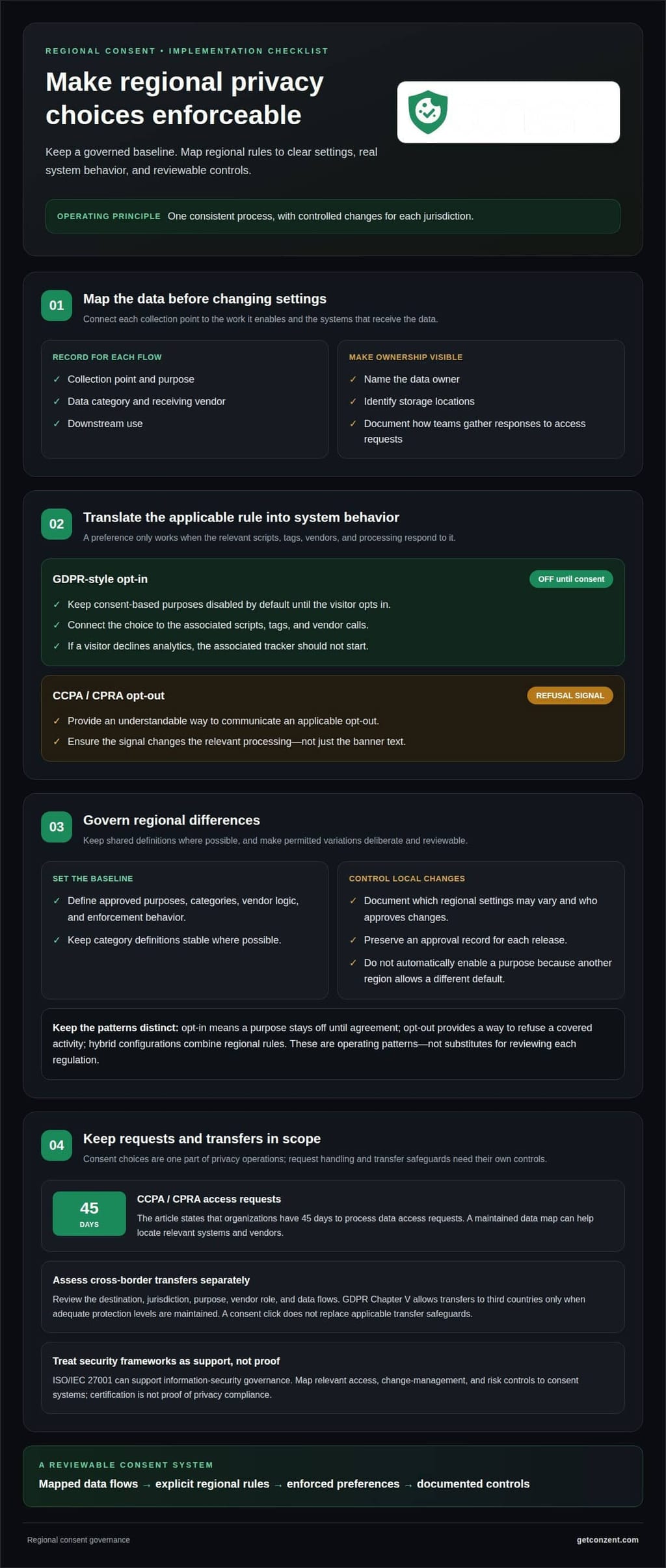
California’s CPRA, Virginia’s VCDPA, and Colorado’s CPA have distinct requirements. A US-wide banner should not assume that one state’s control addresses the rules of every other state. Start with a shared operating model: define approved purposes, categories, vendor logic, and enforcement behavior. Then document which regional settings may vary, who approves changes, and how teams release them. Keep the baseline consistent across properties unless governance permits a validated variation.
Three patterns help explain the configuration choices:
- Opt-in: A purpose stays off until the visitor actively agrees, as in a GDPR-style consent flow.
- Opt-out: The experience provides a way to refuse a covered activity, such as the CCPA right to opt out of sale.
- Hybrid: A platform can combine regional rules, using opt-in controls for some purposes and opt-out controls where applicable.
These labels describe operating patterns, not substitutes for reviewing each regulation. A hybrid setup should not automatically enable a purpose in one region just because another region permits a different default. Keep category definitions stable where possible and map each jurisdiction’s requirements to explicit settings. This makes the logic easier to review when California, Virginia, or Colorado rules call for different treatment.
For international transfers, the European Union says GDPR Chapter V allows transfers to third countries only when adequate protection levels are maintained. This is separate from banner design. Include transfer considerations in governance, but do not treat a consent click as a replacement for applicable transfer safeguards. A sound regional model connects user choices, processing behavior, and jurisdiction-specific review.
GDPR and privacy-by-design considerations
Privacy by design turns data protection into an implementation choice, not a banner added after launch. For a European visitor, consent-based purposes can remain disabled by default until the person opts in. A regional design should connect that choice to the relevant scripts, tags, and vendor calls. If a visitor declines analytics, for example, the associated tracker should not start anyway.
California’s CCPA and CPRA require a different consideration: consumer opt-out rights. A privacy flow should present an understandable way to communicate an applicable opt-out and ensure the signal affects relevant processing. Under the CCPA, businesses may face a fine of $2,500 for each violation, according to the California Legislature. That makes accurate handling more than a banner-text issue. The preference must be reflected in the systems that act on it.
Data mapping provides the foundation. Link each collection point to its purpose, data category, receiving vendor, and downstream use. Then connect each purpose to a consent state and enforcement action. For example, a marketing tag should have a documented purpose, a named recipient, and a defined response when a visitor opts out. This map helps teams identify where regional privacy laws affect processing before changes reach production.
Access requests also depend on operational records. Organizations have 45 days to process data access requests under CCPA/CPRA regulations, according to the California Legislature. A maintained data map can help locate relevant systems and vendors when a request arrives. It should identify the data owner, storage locations, and the process for collecting responses. Keep request handling connected to the same governance controls as consent changes.
Cross-border transfers and third-party vendors add another layer. Requirements can depend on the destination, applicable jurisdiction, processing purpose, and vendor’s role. According to the European Union, GDPR Chapter V restricts transfers to third countries unless adequate protection levels are maintained. A consent banner alone does not address transfer safeguards. Map each vendor’s access and data flows, then assess transfer requirements separately from the visitor’s consent choice. For organizations seeking to streamline third-party intake and verification, cateno.ai enables the onboarding of any entity through a customizable workflow engine.
ISO/IEC 27001 can support this work as an information security governance framework. Map relevant access, change-management, and risk controls to consent-related systems, without treating certification as proof of privacy compliance. For instance, restrict who can change regional settings and preserve an approval record for each release. The resulting control trail helps teams explain how a preference became an enforced rule.
Make privacy controls testable. Validate that a refusal prevents the associated data flow, and confirm that updates do not silently restore a default. Teams assessing the operational fit of a consent platform can review the available platform options alongside their data map and governance needs.
Does Your Consent Management Platform Work the Same in Every Country?
No. A global platform needs a governed baseline and location-aware settings that reflect applicable rules and processing purposes. The same interface can support different regional experiences.
Location-Based Consent Requirements
Location-based consent uses a visitor’s region to select the relevant consent experience. Requirements can differ across the EU, UK, US, Canada, and other regions, so one global default may not suit everyone. The GDPR is relevant in the EU, while US state models take distinct approaches. Map each region to its applicable rules instead of assuming one jurisdiction’s choices work everywhere.
Use the detected region to select the notice, default settings, and available preferences. Define a fallback for unclear location signals, too. A visitor using a proxy, for example, may appear to connect from another region. The fallback should follow a documented rule, not an improvised setting. Review location-based decisions when laws or processing purposes change.
Cookie Banners and Tracking Technologies
Cookie banners communicate choices, while platform settings determine whether tracking technologies act on them. In a GDPR-style flow, consent-based purposes can remain disabled by default until a visitor opts in. An opt-out model instead needs a clear way to express a covered refusal. These approaches affect when analytics tags, advertising pixels, and other scripts may run.
For each region, connect banner choices to the relevant purpose and enforcement behavior. If a visitor rejects analytics, test that the analytics tag stays inactive. If the visitor later changes their preferences, confirm the updated signal reaches applicable tools. A banner that records a click but leaves tracking unchanged does not implement the visitor’s decision.
Sensitive Data, Children, and Targeted Advertising
Sensitive data, children’s information, and targeted advertising require purpose-specific review across regional settings. Applicable requirements depend on location, data use, and audience. Don’t assume a general cookie choice covers every processing purpose. For example, separate analytics and advertising preferences, and identify whether a flow involves sensitive information or a child.
Before activating a purpose, map its data categories, recipients, and regional rules. Set the appropriate default, provide a clear choice, and ensure the resulting signal controls the related processing. This makes regional decisions explicit and gives governance teams a defined point to review when an audience, vendor, or advertising use changes.
Proxy-based testing helps teams check whether location signals produce the expected experience. Use controlled test sessions representing regions such as the EU and California, then inspect the notice, default settings, and resulting preference signal. Include an unclear-location case. Compare actual behavior with the approved regional configuration, not just the banner’s appearance.
Repeat these tests after changes to a site, tag, or regional rule set. A new campaign landing page, for instance, might load tracking before the consent interface applies its settings. Record the test region, purpose, expected behavior, and outcome. This gives teams a practical basis for investigating unexpected differences and improving global consent decisions.
Keeping versioned, audit-ready consent records
A defensible consent program links each recorded choice to the notice and rule set active at the time. Versioning also helps teams trace changes across jurisdictions.
Automated Consent Tracking and Logs
Consent records should connect a visitor’s choice to the system actions that follow. Link each event to its timestamp, notice version, jurisdiction rule set, and relevant purpose. A log can then show whether analytics remained blocked after refusal. A banner record alone cannot demonstrate backend enforcement or show where a signal stopped reaching a vendor.
Build an audit trail around the full operating path. Record when a banner configuration changes, who approved it, and when the change reached production. Then compare preference signals with tag and vendor behavior. If an analytics tag fires after a visitor declines, the event history can help identify whether the error began in configuration, deployment, or downstream enforcement.
Consent Language, Notices, and Recordkeeping
Consent language and notices should match the visitor’s region, stated purposes, and available choices. Preserve the exact banner wording and version, selected preferences, date and time, applicable jurisdiction rule set, and notice version when relevant. These details let reviewers reconstruct what a visitor saw instead of relying on a current banner that may have changed.
Regional privacy laws can create different enforcement risks for invalid consent. The GDPR and California’s CCPA have distinct rules and penalties, so records should link the visitor’s choice to the applicable framework. Keep release approvals and testing evidence alongside the notice version. This gives governance teams context when investigating a complaint or an implementation gap.
Withdrawals, Preference Changes, and Deletion Requests
A withdrawal or preference change should update the recorded choice and trigger corresponding backend enforcement. Send the revised signal to relevant systems and vendors, then log the change and its completion. For example, switching off advertising should stop the associated processing where that preference applies, not merely update the banner display.
Deletion requests need a separate workflow from consent withdrawal. Route each request to the systems and vendors holding relevant data, track its status, and preserve evidence of the actions taken. Applicable response deadlines depend on the governing jurisdiction. A documented process helps teams coordinate changes across systems without treating a consent update as a deletion request.
Use automated checks to compare recorded preferences with live behavior after each release. Test acceptance, refusal, and later changes across representative regional configurations. If a notice changes, retain its previous version and link the release record to the updated wording. This creates a clear chain from governance decision to banner, preference signal, and enforcement result.
Consent management platforms and geo-specific notices
A consent management platform should adapt notices and controls to a visitor’s location while preserving a governed baseline. Managing consent for different regions works best when teams define local variations without losing a consistent operating model. This helps global teams provide relevant choices across countries and keep implementation understandable.
Geo-Specific Consent Notices
A geo-specific notice presents information and choices based on the visitor’s likely jurisdiction. The same website might show an opt-in experience to a visitor in the European Union and different controls to someone in California. Regional wording, available preferences, and default behavior should reflect the approved rule set, not simply translate one banner.
This distinction matters because a notice creates expectations that the website’s behavior must meet. If a California visitor selects an available opt-out, that preference should carry through to relevant processing. If a European visitor declines a purpose, the experience should not suggest that the purpose remains active. Clear regional versions make choices easier to understand.
Location-Adaptive Consent Platforms
A location-adaptive platform selects a consent experience using the visitor’s location and the organization’s approved regional configuration. To build one, map jurisdictions to notices, purposes, default settings, and enforcement behavior. Then define a fallback for uncertain signals, such as a visitor connecting through a proxy. This lets a company adapt the experience without creating unrelated rules for every country.
Keep underlying categories and change processes governed. A regional notice, for example, may use different wording while retaining a shared analytics purpose and controlled release process. Changes to vendor logic or enforcement should be reviewed, not slipped in as local copy edits. This separation supports necessary variation while preserving operational consistency.
Test the whole visitor journey, not just the banner’s first display. Run controlled sessions for representative locations, including regional landing pages and campaign links. Confirm that the right notice appears, each choice produces the intended preference signal, and downstream tools respond accordingly. Proxy-based testing can help simulate a region, but document its location assumptions and expected result.
Monitoring adds an ongoing check. Compare consent outcomes across regions and investigate unexplained differences instead of treating a higher acceptance rate as the only measure of success. Changes in traffic, campaign design, notice wording, or configuration may explain variation. When managing consent for different regions, tie test results to the relevant platform version so teams can trace when behavior changed.
For a practical next step, explore consent platform options that fit your regional operating model and notice requirements.
Conzent
Conzent helps organizations put regional consent policies into practice with its Managed Cloud Consent Platform or Self-Hosted Open Consent Infrastructure. Both support a structured approach to managing notices, preferences, and consent records across jurisdictions.
For teams refining the visitor experience, Consent A/B Testing compares banner variations, while Revenue Impact Analytics helps assess how consent choices relate to revenue outcomes. These tools support informed platform decisions without replacing the organization’s responsibility to define regional rules and governance.
If your consent setup needs to better reflect regional requirements, contact Conzent to discuss your needs.
Make Regional Consent Part of Your Operating Model
Make regional consent a maintained part of how your organization releases digital changes. Assign clear owners to policy decisions and implementation changes. When a new vendor, campaign, or data use is introduced, include its consent impact in the review instead of treating the banner as a separate task.
Managing consent for different regions is an ongoing governance practice, not a one-time configuration. Teams can respond to changing needs with controlled updates while keeping user choices central to the experience. The goal isn’t identical notices everywhere, but a consistent, explainable way to adapt.
If you’re planning that next step, explore regional consent options with Conzent. A regular review of vendor, campaign, and data-use changes helps your team keep consent settings aligned with current practices.
Frequently Asked Questions
Is “jurisdictions” the right word?
Yes. “Jurisdictions” means the countries, states, or other legal areas whose rules may apply to an organization’s data practices. The term is useful when a website serves people in the EU, California, and other locations with different privacy frameworks. Use “regions” for a less legal tone and “jurisdictions” when discussing rule mapping, governance, or the requirements that shape a consent decision.
What breaks when organisations use one consent banner for all ages and regions?
A single banner may present choices that don’t fit a visitor’s location or age-related flow. For example, a broad adult-oriented notice may not explain relevant choices to a younger visitor, while a universal default may not match regional settings. This can lead to confusing messages, inconsistent controls, or a mismatch between the choice shown and the processing that follows. Test distinct audience and location scenarios.
What is Geotargeted Consent?
Geotargeted consent uses a visitor’s apparent location to select a consent notice and related settings. For example, a site can direct visitors in different regions to distinct versions of its consent experience. A key design decision is how to handle an uncertain location signal, such as one affected by a proxy. A documented fallback prevents that case from silently inheriting an unsuitable regional configuration.
What privacy consent laws apply in different regions, including GDPR, US state laws, and PIPEDA?
Applicable rules depend on where an organization operates, whom it serves, and how it processes personal information. The GDPR covers the European model discussed in this guide; US examples include California’s CCPA and CPRA, Virginia’s VCDPA, and Colorado’s CPA. PIPEDA is another privacy law to include in a Canada-focused review. Map each law to relevant activities instead of assuming one global rule applies.
When is opt-in consent required versus opt-out consent by region?
Use the applicable rule and processing purpose to determine which choice model fits. The GDPR generally uses opt-in consent for consent-based processing, while California’s CCPA gives consumers the right to opt out of the sale of personal information. A hybrid experience may therefore use different controls for different purposes or locations. Don’t treat an opt-out control as permission for unrelated processing, or opt-in as a universal requirement.