Multi-Language Cookie Consent: A Resource Guide for Global Compliance in 2026
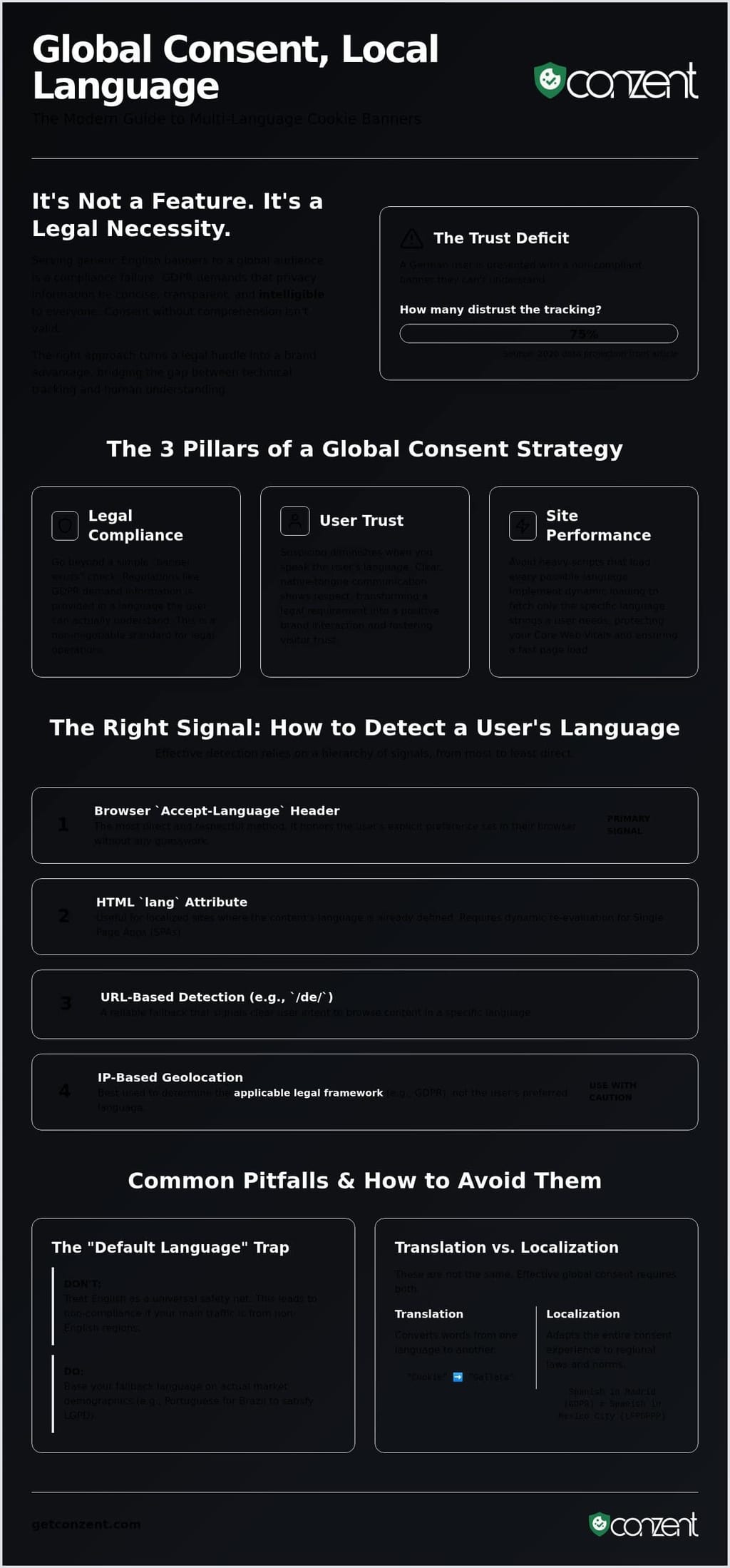
Why does your global website still greet visitors in the wrong language? In 2026, serving a generic English banner to a user in Berlin isn't just a bad user experience. It's a compliance failure that risks alienating the 75% of German users who already distrust non-compliant tracking. Implementing multi-language cookie consent is no longer a luxury for the elite. It's a fundamental requirement for any brand that respects digital rights and technical efficiency.
You've likely dealt with the frustration of heavy translation scripts dragging down your Core Web Vitals or banners that flicker in the wrong dialect before correcting themselves. It's exhausting to track 20 different U.S. state privacy laws while preparing for the October 2026 IAB TCF 2.4 implementation. You deserve a setup that works as hard as your business. This guide will show you how to implement a high-performance, legally compliant strategy that speaks your visitors' languages without breaking your site.
We'll explore how to automate language detection, integrate with Google Consent Mode v2, and maintain a seamless user experience that respects both the law and your page load speed.
Key Takeaways
- Realize that multi-language cookie consent is a legal necessity, not a feature. GDPR demands that your privacy information be concise and intelligible to everyone.
- Stop guessing user preferences. Use browser headers and HTML attributes to automate language detection and serve the right banner instantly.
- Align your global strategy with IAB TCF 2.3 standards. This ensures your vendor lists and disclosures remain compliant across differing regional jurisdictions.
- Protect your site's speed. Learn to implement dynamic loading so you only fetch the specific language strings a user needs, keeping your Core Web Vitals healthy.
- Shift your perspective on compliance. See how open infrastructure makes global privacy attainable for everyone, regardless of their technical resources.
What is Multi-Language Cookie Consent and Why Does It Matter?
Multi-language cookie consent is the practice of serving privacy notices in a language the visitor actually understands. It's not a courtesy. It's a technical standard for digital respect. At its core, it ensures that when a website attempts to set an HTTP cookie, the user knows exactly what they are agreeing to. If they can't read the terms, they haven't truly consented. Consent without comprehension is just noise.
The legal stakes have shifted. In 2026, static English-only banners are no longer a defensible strategy for global brands. Regulators are moving past simple existence checks to quality checks. Under the GDPR, information must be concise, transparent, and intelligible. An intelligible notice in Berlin is written in German. A transparent notice in Tokyo is written in Japanese. Failing this standard doesn't just invite fines; it erodes the trust that powers your data strategy.
Trust is a performance metric. Data from 2024 and 2025 shows that overall consent rates hover between 42% and 47%. However, in regions like Germany and France, fewer than 25% of users accept cookies when presented with a compliant banner. When users encounter a banner in their native tongue, the suspicion of tracking diminishes. They feel seen, not targeted. Clear communication transforms a legal hurdle into a brand advantage. Multi-language cookie consent is the bridge between technical tracking and human understanding.
Translation vs. Localization in Privacy
Translation converts words. Localization adapts to laws. A Spanish visitor in Madrid requires disclosures aligned with the GDPR and AEPD guidelines. A Spanish speaker in Mexico City falls under the LFPDPPP. These are not the same. Effective multi-language cookie consent recognizes these regional nuances. It's an ethical imperative. We must move beyond "Google Translate" privacy and toward legally accurate, localized frameworks that protect user rights in every jurisdiction.
The "Default Language" Trap
Many developers treat English as a universal safety net. It's a trap. Relying on a fallback language can lead to immediate non-compliance if your primary traffic comes from non-English speaking regions. Smart defaults should be based on your actual market demographics, not technical convenience. If a significant portion of your users is in Brazil, your fallback must be Portuguese to satisfy the LGPD. Don't let a lazy default compromise your entire compliance posture. True accessibility means meeting the user where they are, not where it's easiest for your script to land.
How Multi-Language Detection Works: The Technical Mechanics
Effective multi-language cookie consent relies on precision, not guesswork. To achieve this, your Consent Management Platform (CMP) must listen to several signals simultaneously. The most direct signal is the Accept-Language header. This is a browser-level preference that tells your server exactly which languages the user prefers. It's the most respectful way to start the conversation. It honors the user's existing settings without requiring manual input.
Alternatively, many systems look at the HTML lang attribute. This is useful for localized sites where the content's language is already defined at the top-level element. However, standard detection often fails during client-side navigation in Single Page Applications (SPAs). If your React or Next.js app changes content without a full page reload, your cookie banner must be smart enough to re-evaluate the language state dynamically. It shouldn't require a hard refresh to stay compliant.
Legal requirements under GDPR and the ePrivacy Directive demand that users receive clear, plain-language information. This makes URL-based detection a reliable fallback. If a user is browsing example.com/de/, the intent is unmistakable. While IP-based geolocation can suggest a language, it's better used to determine the applicable legal framework. A user in Montreal might prefer English but still requires the specific disclosures mandated by Quebec's Law 25. Detection is a technical infrastructure challenge, not a simple translation task.
Automated vs. Manual Language Switching
Auto-detection is efficient. It isn't infallible. Some users browse in English despite living in a non-English speaking country. The best approach is "automated with a manual escape." Detect the language first. Always provide a visible language switcher within the banner. For brands managing global networks, ensure consent is "sticky." If a user consents on your German subdomain, that preference should persist across your entire ecosystem. This avoids "consent fatigue" and respects the user's time.
Script Overrides for Developers
Modern development requires control. You can use data-attributes to hardcode a specific language for unique app states. This bypasses automatic detection when necessary. It is critical for testing or for specific landing pages where the language is fixed. Most importantly, ensure your consent script executes before any tracking pixels. If the detection logic is slow, you risk "banner flicker." You might even fire cookies before the user has a chance to read the localized notice. Check our flexible deployment options to see how we prioritize execution speed.
Mapping Regional Laws to Language Preferences
Language detection tells you how to speak. Geo-targeting tells you what to say. A common mistake in multi-language cookie consent is assuming that a user's language preference dictates their legal rights. It doesn't. A French speaker in Quebec falls under Canada's Law 25, while a French speaker in Lyon is protected by the GDPR. Your technical stack must distinguish between these scenarios to remain compliant. As of July 2026, 20 U.S. states have comprehensive privacy laws in effect. This creates a fragmented landscape where a single language might require five different legal disclosures depending on the visitor's physical location.
Modern compliance requires synchronizing these signals through Google Consent Mode v2. This framework doesn't just manage the banner. It communicates the user's localized intent directly to your marketing tools. By integrating web internationalization standards with precise geolocation, you ensure that a visitor in Texas sees an opt-out notice while a visitor in Spain sees a strict opt-in requirement. This isn't just about avoiding fines. It's about respecting the specific digital rights of every individual who visits your site.
The IAB TCF 2.3 Standard
The Transparency and Consent Framework (TCF) 2.3 is the backbone of the global ad tech ecosystem. It standardizes how multi-language strings are delivered across the Global Vendor List (GVL). If you use third-party advertising, your CMP must be IAB TCF certified. This certification ensures that the complex purposes and vendor descriptions are translated accurately and legally. TCF 2.3 became the mandatory standard on February 28, 2026. If your current setup uses outdated TCF versions, your multi-language strings may no longer meet the transparency requirements of the latest framework.
Geo-Targeting: Beyond Language
Geo-targeting is the essential partner to language detection. It allows you to implement geo-fencing, which limits strict GDPR banners to European visitors. Users in non-regulated regions don't need to be interrupted by heavy consent dialogues. This reduces "consent fatigue" and protects your conversion goals. An egalitarian approach to privacy doesn't mean forcing the same friction on everyone. It means providing the right level of protection to every user based on their local laws. Balancing these business goals with ethical responsibility requires a platform that understands both the map and the dictionary.
Performance Optimization for Global Consent Scripts
Performance is not a luxury. It is a prerequisite for accessibility. When you implement multi-language cookie consent, you face a significant technical hurdle: script bloat. Most Consent Management Platforms bundle every supported language into a single, massive JavaScript file. If your site supports 30 languages, a visitor in Tokyo is forced to download translation strings for Italian, Portuguese, and Swedish. This unnecessary payload kills your Core Web Vitals. It delays the Largest Contentful Paint (LCP) and increases execution time on the main thread.
The solution is dynamic loading. Instead of a monolithic bundle, your infrastructure should fetch only the required language string on demand. Once the detection mechanics identify the user's preference, the script makes a targeted request for that specific asset. This keeps the initial execution lightweight and purposeful. It also helps minimize Cumulative Layout Shift (CLS). By pre-calculating the banner's dimensions before the localized text arrives, you prevent the page from jumping. A stable UI is a respectful UI.
Latency is the enemy of global compliance. While managed cloud solutions offer ease of use, they often introduce third-party roundtrips that slow down the initial render. Choosing between cloud and self-hosted models depends on your infrastructure needs. High-traffic global portals require a setup that prioritizes speed without compromising legal accuracy. To see how we balance these requirements, you can view our transparent pricing models and choose the plan that fits your performance goals.
Lightweight Infrastructure
Keeping your consent scripts under 50KB is a necessary standard. To achieve this, utilize a Content Delivery Network (CDN) to serve language assets from the edge. This ensures that a visitor in Sydney receives their localized banner from a nearby server, not one across the ocean. Open Consent Infrastructure is a means to decouple compliance from vendor lock-in. By using source-available standards, you ensure your compliance layer remains agile, transparent, and fast. It moves the focus from "black box" scripts to efficient, verifiable code.
Self-Hosting for Maximum Speed
For organizations that demand absolute control, self-hosting your CMP is the superior choice. This approach eliminates third-party roundtrips entirely. You serve the consent logic from your own domain, which reduces DNS lookups and connection overhead. It also ensures 100% uptime for global portals because you control the infrastructure. Beyond speed, self-hosting provides significant security benefits. You keep sensitive consent data on your own servers, maintaining a principled stance on data sovereignty. Speed and sovereignty are two sides of the same coin.
Implementing a Principled Global Strategy with Conzent
Privacy is not a premium feature. It is a public good. At Conzent, we believe that every website, regardless of its budget, should have access to high-performance compliance tools. Global reach shouldn't be reserved for the Fortune 500. It's a standard for everyone. Our approach to multi-language cookie consent is built on this principle of egalitarian access. We provide the technical infrastructure so you can focus on your mission, not on managing complex translation scripts.
Scaling a global network requires more than just translations. It requires intelligence. With our Managed Cloud Consent Platform, you can deploy a unified strategy across hundreds of domains in minutes. It isn't just about showing a banner. It's about optimizing the interaction. By using A/B testing for different language variants, you can directly measure and improve your revenue impact. You don't have to choose between legal safety and business growth. You can have both.
We also address the financial barrier to entry. Our sponsorship-driven pricing model ensures that small businesses and personal projects aren't priced out of the privacy conversation. Compliance shouldn't be a tax on innovation. It should be the foundation of it. By choosing a CMP that treats privacy as a digital right, you signal to your users that you value their transparency as much as their data.
Automated Global Workflows
Efficiency is the enemy of complexity. The Conzent dashboard allows you to set up automated language detection with a few clicks. There's no manual script editing required for every new locale. You can customize the banner CSS to ensure your brand's voice remains consistent, whether your visitor is in Tokyo or Toronto. These workflows integrate seamlessly with your broader GDPR compliance efforts. We make global data audits a matter of routine, not a source of panic. It's a streamlined path to a principled presence.
The Managed Cloud Advantage
The legal landscape moves fast. In 2026, staying compliant means tracking constant shifts in U.S. state laws and international frameworks like IAB TCF 2.4. Our Managed Cloud handles these updates automatically. You don't need to monitor the news for every regulatory change. We do it for you. You also gain access to centralized analytics. See consent rates by country, device, and language in one place. This transparency reduces the "Compliance Tax" by leveraging shared, high-performance infrastructure. It's a collective solution to a global challenge.
Building a Global Standard for Digital Rights
Global compliance in 2026 is not about checking boxes. It is about building trust through technical excellence and moral clarity. You now have the roadmap to move beyond flickering banners and heavy scripts. By automating language detection and prioritizing edge delivery, you ensure that every visitor receives a fast, localized, and legally accurate experience. Implementing multi-language cookie consent is the only way to respect your global audience while meeting modern regulatory standards.
Privacy is a fundamental right, not a premium luxury. We've built our infrastructure to be IAB TCF v2.3 and GCM v2 ready to ensure your site remains at the forefront of industry standards. Our source-available transparency means you never have to guess how your data is handled. Whether you choose our Managed Cloud Consent Platform or a self-hosted setup, you're choosing a path that prioritizes both speed and ethics.
Don't let technical debt or vendor lock-in compromise your digital integrity. You have the power to create a web that's open, fast, and respectful to everyone, regardless of the language they speak. The tools are ready when you are.
Deploy your global consent infrastructure with Conzent
Frequently Asked Questions
Do I need a separate cookie banner for every language on my website?
You don't need a separate banner for every language. A single, high-performance Consent Management Platform handles multiple translations within one script. It swaps the text dynamically based on the visitor's settings. This approach simplifies your technical stack and ensures consistency across your global footprint.
How does a cookie banner detect the visitor’s preferred language?
Detection happens through three primary signals. First, the script checks the Accept-Language header from the browser. Second, it reads the lang attribute in your site's HTML. Finally, it can identify language codes like /fr/ or /es/ in your URL path. This multi-layered approach ensures the user sees the right notice immediately.
Is it legally required to translate my cookie policy into every language I support?
Yes, providing a translated policy is a legal necessity under frameworks like the GDPR. Regulations require that privacy information is "intelligible" and "easily accessible." If you support a specific language on your site but keep your legal disclosures in English, you aren't meeting the standard for informed consent. Transparency is not optional.
Will a multi-language cookie banner slow down my website performance?
A poorly coded banner will slow you down, but a principled setup will not. Use dynamic loading to fetch only the required language string instead of bundling 30+ languages into one file. This keeps your script execution fast and protects your Core Web Vitals. Efficiency is a prerequisite for a good user experience.
Can I show different cookie categories based on the user’s country?
You can and should adjust categories based on the user's location. This is where geo-targeting becomes essential for multi-language cookie consent. For example, you might show a strict opt-in banner with granular categories in the EU while using a simpler opt-out notice for visitors in the United States. This reduces friction while maintaining compliance.
What happens if a user’s language is not supported by my cookie consent tool?
If a language isn't supported, the banner reverts to your designated fallback language. This is usually English or the primary language of your largest market. It's vital to choose a fallback that your team can verify for legal accuracy. Never leave a user with a broken or empty banner because of a missing translation.
How do I handle cookie consent on a multilingual WordPress or Shopify site?
Integration is straightforward with a dedicated CMP. Most platforms offer specific integrations for WordPress or Shopify that sync with popular translation plugins. The goal is to ensure the consent banner recognizes the language state already defined by your CMS. It should feel like a native part of your site's architecture.
What is the difference between language detection and geo-targeting?
These are two distinct technical functions. Language detection identifies the user's preferred tongue so you can communicate clearly. Geo-targeting identifies their physical location to determine which specific privacy laws apply. You need both to deliver a multi-language cookie consent strategy that is both respectful and legally sound.
Frequently Asked Questions
Do I need a separate cookie banner for every language on my website?
You don't need a separate banner for every language. A single, high-performance Consent Management Platform handles multiple translations within one script. It swaps the text dynamically based on the visitor's settings. This approach simplifies your technical stack and ensures consistency across your global footprint.
How does a cookie banner detect the visitor’s preferred language?
Detection happens through three primary signals. First, the script checks the Accept-Language header from the browser. Second, it reads the lang attribute in your site's HTML. Finally, it can identify language codes like /fr/ or /es/ in your URL path. This multi-layered approach ensures the user sees the right notice immediately.
Is it legally required to translate my cookie policy into every language I support?
Yes, providing a translated policy is a legal necessity under frameworks like the GDPR. Regulations require that privacy information is "intelligible" and "easily accessible." If you support a specific language on your site but keep your legal disclosures in English, you aren't meeting the standard for informed consent. Transparency is not optional.
Will a multi-language cookie banner slow down my website performance?
A poorly coded banner will slow you down, but a principled setup will not. Use dynamic loading to fetch only the required language string instead of bundling 30+ languages into one file. This keeps your script execution fast and protects your Core Web Vitals. Efficiency is a prerequisite for a good user experience.
Can I show different cookie categories based on the user’s country?
You can and should adjust categories based on the user's location. This is where geo-targeting becomes essential for multi-language cookie consent. For example, you might show a strict opt-in banner with granular categories in the EU while using a simpler opt-out notice for visitors in the United States. This reduces friction while maintaining compliance.
What happens if a user’s language is not supported by my cookie consent tool?
If a language isn't supported, the banner reverts to your designated fallback language. This is usually English or the primary language of your largest market. It's vital to choose a fallback that your team can verify for legal accuracy. Never leave a user with a broken or empty banner because of a missing translation.
How do I handle cookie consent on a multilingual WordPress or Shopify site?
Integration is straightforward with a dedicated CMP. Most platforms offer specific integrations for WordPress or Shopify that sync with popular translation plugins. The goal is to ensure the consent banner recognizes the language state already defined by your CMS. It should feel like a native part of your site's architecture.
What is the difference between language detection and geo-targeting?
These are two distinct technical functions. Language detection identifies the user's preferred tongue so you can communicate clearly. Geo-targeting identifies their physical location to determine which specific privacy laws apply. You need both to deliver a multi-language cookie consent strategy that is both respectful and legally sound.