
Open Consent: What It Is, How It Works, and How to Evaluate It

Open consent doesn’t mean you have to run a consent platform on your own servers. That’s the key distinction behind openconsent: source availability can make infrastructure inspectable without making every team responsible for hosting, updates, and maintenance. The term is used in different ways, so it helps to separate the broader idea from Conzent’s specific Open Consent Infrastructure.
If you’ve found conflicting explanations, you’re not alone. Open Consent isn’t a formal legal or technical standard, and “open” doesn’t automatically mean open source, free of operational work, or a guarantee of compliance. What matters in practice is what you can inspect, how consent choices are handled, and how the platform fits into your website’s operations.
This guide explains what Open Consent means, how source-available infrastructure works, and what it changes day to day. You’ll compare self-hosting with Conzent’s managed cloud option, including the trade-offs around control, maintenance, updates, and analytics. By the end, you’ll have a practical way to evaluate consent infrastructure against your website’s operations and compliance needs.
Key Takeaways
- openconsent describes a transparent approach to consent infrastructure, not one universal product or formal standard.
- Trace how a platform records visitor choices and passes consent signals to connected tags and services.
- Compare self-hosting and managed hosting by control, maintenance, updates, analytics, and day-to-day responsibility.
- Map your website’s tools and consent workflows before assessing deployment fit, integrations, and measurement.
- Conzent’s source-available infrastructure offers self-hosted and managed cloud operating options, with different levels of operational responsibility.
What Is Open Consent? A Clear Definition for Website Teams
Open Consent describes an approach to consent infrastructure that emphasizes transparency and accessibility. For website teams, that can mean examining how a system works, understanding how consent choices move through a website, and having practical control over how the setup is operated. It isn’t a universal product category or formal legal standard. The label openconsent can refer to an idea, an infrastructure initiative, or a particular platform, depending on where you encounter it.
Source-available and open source aren’t interchangeable. Source-available software makes source code available under stated terms, but the license determines what users may do with it, including whether they can modify or redistribute it. Look beyond the word “open”: identify what is available to inspect and what the license permits. Conzent describes its Open Consent Infrastructure as source-available.
How Open Consent differs from a cookie banner
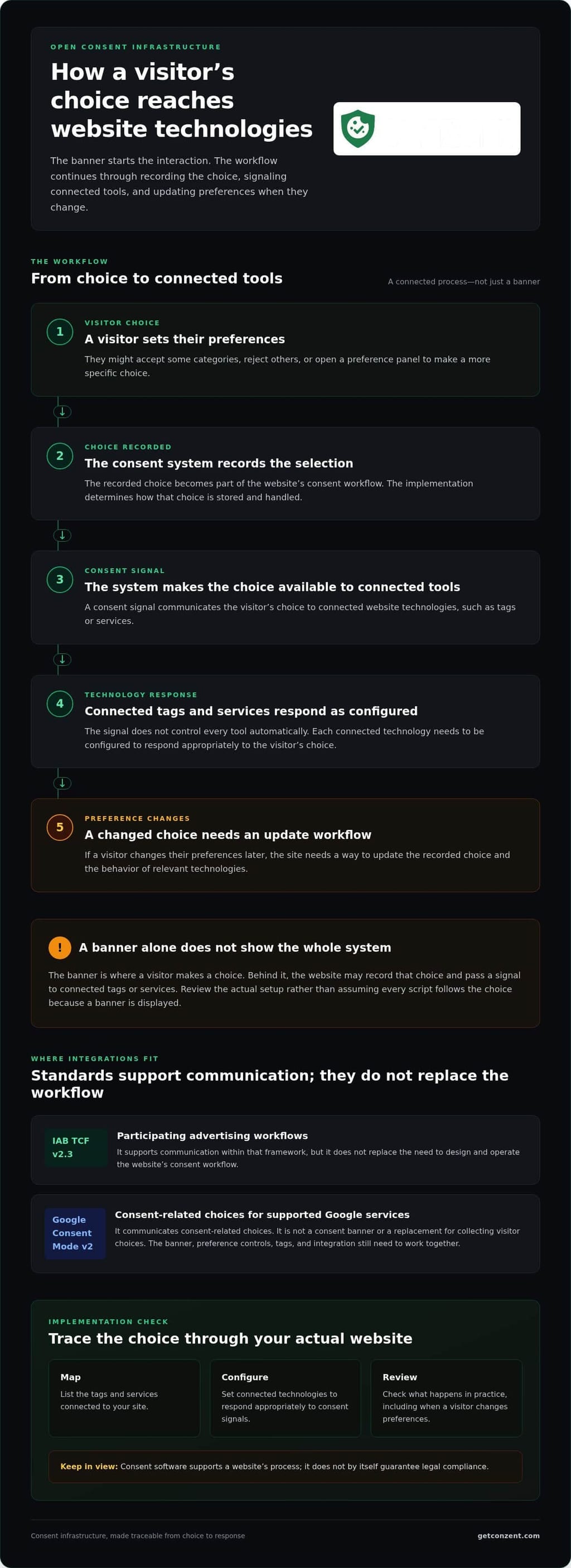
A banner is the visible part of the experience where a visitor makes a choice. It’s not the whole consent workflow. Behind it, a website may record that choice and pass a signal to connected tags or services. The infrastructure can also include integrations and operational controls for managing consent across the website.
For example, a visitor might reject optional cookies in a banner. The website’s connected tools then need to receive and respect that choice. The exact components and behavior depend on the implementation, so a banner alone doesn’t show how the full system works.
Why the term can refer to different things
Search results can mix infrastructure initiatives, consent platforms, and browser tools. They may use similar wording without describing the same service or purpose. A browser extension, for instance, isn’t automatically the infrastructure a website uses to collect and manage visitor choices.
The phrase also has a broader history. Wikipedia describes George Church’s open consent mechanism as an alternative to opaque, traditional consent forms. That reference offers context for the idea, but it doesn’t define every website consent platform.
Use a consistent test: what does “open” refer to, which parts of the system can be examined, and how does the solution handle visitor choices and connected tools? These questions help separate a general principle from a specific product claim. For a website team, the practical focus is consent infrastructure and how it operates, not the label alone. Conzent’s Open Consent Infrastructure is a source-available implementation.
How Open Consent Infrastructure Works Behind a Website
A consent setup connects a visitor’s choice with the technologies running on a website. The banner starts the interaction, but the work continues behind the page: the system records the choice, makes it available to connected tools, and supports changes when the visitor updates their preferences.
A consent signal is information that communicates a visitor’s consent choice to a connected website technology. How a tag or service responds depends on how the website and integration are configured. The signal doesn’t control every tool automatically, and a banner alone can’t show whether all connected technologies use the choice as intended.
From visitor choice to consent signal
A visitor might accept some categories, reject others, or open a preference panel to make a more specific choice. A consent platform can record that selection and provide a signal for connected tags and services. If the visitor later changes their preferences, the site needs a workflow for updating the recorded choice and the behavior of relevant technologies.
Implementation matters. Map the tags on your site and configure them to respond appropriately to consent signals. Review what happens in practice instead of assuming that displaying a banner means every script follows the visitor’s choice. Consent software supports a website’s process; it doesn’t by itself guarantee legal compliance. The GDPR conditions for consent provide legal context for evaluating that process.
Where standards and integrations fit
Standards and integrations help consent infrastructure communicate with other parts of a website’s technology stack. IAB TCF v2.3 is relevant to participating advertising workflows. It supports communication within that framework, but it doesn’t replace the need to design and operate the website’s consent workflow.
Google Consent Mode v2 communicates consent-related choices to supported Google services. It isn’t a consent banner or a replacement for collecting visitor choices. Teams using it still need to consider how their banner, preference controls, tags, and integration work together. See the Google Consent Mode v2 guide for implementation details.
When assessing openconsent, focus on how clearly the system connects visitor choices to the tools on your site. Map those connections before evaluating claims about integrations or controls. If you’re also weighing the operating model, include Conzent’s available plans in your assessment.
Self-Hosted or Managed Open Consent: Compare the Real Trade-Offs
Source availability and hosting are separate decisions. A team can value inspectable consent infrastructure without taking on the work of running it. The right openconsent operating model depends on who will manage hosting, updates, and ongoing maintenance, and whether cloud analytics fit the team’s workflow.
| Consideration | Self-hosted | Managed cloud |
|---|---|---|
| Control | Run the infrastructure in your own environment. | Use the provider’s cloud environment, with less control over the underlying infrastructure. |
| Maintenance | Your team handles hosting and ongoing operation. | The service includes infrastructure maintenance. |
| Updates | Your team manages updates. | Automatic updates are included. |
| Analytics | Plan how analytics will be operated in your environment. | Cloud analytics are included. |
| Operational responsibility | Your team owns the day-to-day infrastructure work. | The provider takes on specified maintenance and update tasks. |
When self-hosting is a practical fit
Self-hosting can suit teams that want to run consent infrastructure in their own environment and have the technical capacity to operate it. The trade-off is clear: your team is responsible for hosting, maintenance, and updates. Conzent makes its self-hosted Open Consent Infrastructure available without a platform fee, but your team still needs to account for the work and resources involved in running its environment.
Review the self-hosting information and guide to understand this operating model in more detail. Self-hosting offers direct operational control, while placing responsibility for ongoing operation with your team.
When managed hosting reduces operational work
Managed hosting is a practical option for teams that prefer not to run consent infrastructure themselves. Conzent’s managed cloud service includes maintenance, automatic updates, and cloud analytics. That shifts those infrastructure tasks to the service, while your team continues to manage its consent setup and website integrations.
Neither model is universally better. A team with infrastructure capacity may prefer self-hosting; a team seeking to reduce maintenance work may favor managed cloud. Transparency doesn’t require every organization to self-host. It means understanding the system and its operating terms, then choosing the division of responsibility that fits your team.
How to Evaluate an Open Consent Platform for Your Website
Compare tools against your actual website, not just a feature checklist. Before evaluating openconsent options, map your website stack, the tags and services it uses, the consent choices visitors need, and who will operate the system. Then assess each platform against five practical areas:
- Deployment fit. Decide whether your team can host and maintain the infrastructure or would rather use managed hosting. Include ongoing updates and operational ownership in the comparison, not just initial setup.
- Consent workflow. Check whether the platform supports a banner and preference controls that fit your needs. Trace how a visitor’s choice is recorded, how they can change it, and how connected tags are configured to respond.
- Integrations. Match integrations to your site’s technologies and use cases. IAB TCF v2.3 may matter for participating advertising workflows, while Google Consent Mode v2 is relevant to supported Google services. Review IAB TCF integration information if that framework is part of your stack.
- Measurement. Consider whether consent A/B testing can help compare banner variations and whether revenue impact analytics can help you examine business effects. Treat these as measurement tools, not a reason to obscure choices or pressure visitors. Define what you want to learn before interpreting results.
- Ongoing operations. Identify who handles maintenance, updates, and review of your website’s tags and integrations. Make sure the chosen operating model makes clear what the platform manages and what remains your responsibility.
Assess workflows, integrations, and outcomes together
These areas connect. A customizable banner matters only as part of a workflow that records choices and communicates them to relevant technologies. Likewise, an integration’s presence in a feature list doesn’t show whether it fits your setup. Test the consent flow against the tags and services you actually use.
Measurement can add useful evidence. A/B testing can compare banner variations, while revenue impact analytics can help examine how consent choices relate to business outcomes. Keep the visitor’s ability to make an informed choice central. A platform can support configurable workflows and measurement, but it doesn’t provide legal advice or guarantee that a website meets its legal obligations. For GDPR questions, review the relevant requirements with appropriate legal guidance.
Use your mapped requirements to compare deployment, workflows, integrations, measurement, and operational effort side by side. To see the available operating options, review Conzent’s plans.
Open Consent with Conzent: Choose the Operating Model That Fits
With the concept and trade-offs clear, match the operating model to your team’s needs. Conzent’s Open Consent Infrastructure is source-available. You can run it on your own infrastructure or use Conzent’s managed cloud service. Source availability and hosting are separate choices: transparency doesn’t require every organization to host and maintain the platform itself.
What Conzent brings to an Open Consent approach
Conzent’s platform supports customizable consent banners, consent A/B testing, and revenue impact analytics. It also supports IAB TCF v2.3 and Google Consent Mode v2, giving website teams options for connecting consent workflows with relevant advertising and Google services. These features help teams manage and measure consent operations, but a platform alone can’t guarantee that a website meets its legal obligations.
Based in Copenhagen, Conzent serves websites worldwide. Teams can operate the infrastructure themselves or use the managed cloud service, which includes maintenance, automatic updates, and cloud analytics.
Compare the available ways to get started
Self-hosting may fit teams that want to run the infrastructure in their own environment and are ready to handle hosting, maintenance, and updates. It’s available without a platform fee, but the team remains responsible for operating its environment.
Managed cloud may suit teams that want to reduce infrastructure work. Conzent handles maintenance and automatic updates as part of the service, and cloud analytics are included. Sponsorships contribute to lower managed service pricing. Compare more than control and convenience: consider your integrations, measurement needs, technical capacity, and who will own ongoing operations.
Before choosing, review the current plan details against your website’s requirements. Review Conzent pricing and choose your path.
Choose a Consent Setup Your Team Can Operate
Open consent is about more than a banner. It means understanding how visitor choices are recorded and communicated across your website. The term openconsent can describe an approach or a specific infrastructure, so assess what a platform makes transparent and how it fits your setup.
The operating model matters just as much. Self-hosting makes your team responsible for the infrastructure and its ongoing operation. Managed hosting can reduce that workload. The right fit depends on your team’s capacity, integrations, and measurement needs.
Conzent’s source-available consent infrastructure supports both self-hosted and managed options, along with IAB TCF v2.3 and Google Consent Mode v2. A consent platform can support your workflow, but it doesn’t guarantee legal compliance. Your website’s configuration and practices still matter.
Ready to compare the operating options against your needs? Review Conzent pricing and choose your path. Start with the model your team can confidently operate.
Frequently Asked Questions
What is Open Consent?
Open Consent describes an approach to consent infrastructure that emphasizes transparency and accessibility. The term can also appear in the names or descriptions of individual tools, so context matters. For website teams, openconsent is best assessed by looking at how a platform records and communicates visitor choices, connects with relevant services, and is operated over time. Don’t assume similarly named products share the same architecture, features, or licensing terms.
Is Open Consent the same as open-source cookie consent software?
No. Open Consent may refer to an infrastructure initiative or a specific service, while open source describes software licensing and access to source code. Conzent describes its infrastructure as source-available, which isn’t automatically the same as open source. Before making assumptions about reuse, modification, or redistribution, review the project’s description and license terms. The word “open” alone doesn’t establish what those terms permit.
Can I use Open Consent without hosting it myself?
Yes. The operating model depends on the platform. Conzent offers both self-hosting on your own infrastructure and a managed cloud service. With self-hosting, your team operates the infrastructure and manages its ongoing work. The managed service includes infrastructure maintenance and automatic updates. Compare those responsibilities alongside your integration and analytics needs. An open approach doesn’t automatically mean you must host and maintain the platform yourself.
How does Open Consent work with Google Consent Mode v2?
A consent platform can communicate visitor choices to connected website technologies, and Google Consent Mode v2 lets supported Google services respond to consent signals. The website’s configuration matters: the integration doesn’t replace collecting visitor choices or checking how connected tags behave. Conzent supports Google Consent Mode v2. Teams planning an implementation should map their website’s tags and review how consent choices flow through the setup.
Does using an Open Consent platform guarantee GDPR compliance?
No. A consent platform alone can’t guarantee that a website meets every legal obligation. It can support consent collection and related workflows, but the site’s purposes, configuration, notices, and use of third-party technologies also matter. Treat platform features as operational support, not legal advice or a substitute for a site-specific compliance review. Conzent provides consent infrastructure, not legal representation.
How do I choose between self-hosted and managed Open Consent?
Start with your team’s capacity to host infrastructure, manage updates, and handle ongoing operations. Self-hosting may suit teams that want to run the platform in their own environment and can support that work. Managed hosting can reduce infrastructure responsibilities. Then compare the consent features, integrations, and analytics your website uses. Conzent offers both options, so choose based on operational fit rather than the label alone.