
Open Source Cookie Consent Management: The 2026 Guide to Transparent Compliance

Why should your compliance strategy rely on a black box that taxes you for every new visitor? Most companies are currently stuck with SaaS vendors that prioritize their own bottom line over your data sovereignty. You want transparency; they provide a locked vault. You need speed; they deliver heavy scripts that hurt your Core Web Vitals. Adopting open source cookie consent management is the only way to stop renting your compliance and start owning your infrastructure. It is a necessary standard for digital ethics, not a premium luxury reserved for the few.
We are here to help you reclaim your privacy stack. This guide explores how source-available tools provide the rigor of Danish engineering while meeting the mandatory February 28, 2026, deadline for IAB TCF 2.3. You'll learn how to lower overhead, integrate consent into existing DevOps workflows, and maintain full ownership of your data. We are moving past the era of opaque vendors and into a future of verifiable, high-performance compliance that respects both your users and your technical resources. It's time to build a consent framework that you actually control.
Key Takeaways
- Understand why open source cookie consent management is the only way to audit your privacy stack and eliminate unpredictable SaaS billing.
- Learn how to shift consent logic to the server side to protect your website performance and Core Web Vitals.
- Get a clear roadmap for implementing mandatory IAB TCF 2.3 and Google Consent Mode v2 standards to maintain your advertising revenue.
- Compare the trade-offs between self-hosting your infrastructure for total control and using managed cloud services for efficiency.
- Discover how to use transparent A/B testing to improve user opt-in rates while maintaining ethical standards.
Table of Contents
What is Open Source Cookie Consent Management?
Open source cookie consent management is a framework where the source code of your compliance tool is public. It's the opposite of a "black box." In a proprietary model, you trust the vendor; in an open model, you verify the code. This transparency allows you to audit exactly how user data is handled and where it's stored. As we head into 2026, regulators are shifting their focus from simple banners to the entire data processing pipeline. They are looking for verifiable signals rather than just visual checkboxes. If your CMP is a closed system, you can't prove what happens behind the scenes.
There's a distinction between "Open Source" and "Source-Available" models. Pure open source, like GPL or MIT licenses, allows anyone to modify and redistribute the code. Source-available models, often called Open Consent Infrastructure (OCI), prioritize transparency and self-hosting while protecting the core sustainability of the project. Both models share a common goal: removing the opaque barrier between the user and the software. Adopting open source cookie consent management ensures you aren't just following rules, but actually respecting digital rights.
The Problem with Proprietary CMPs
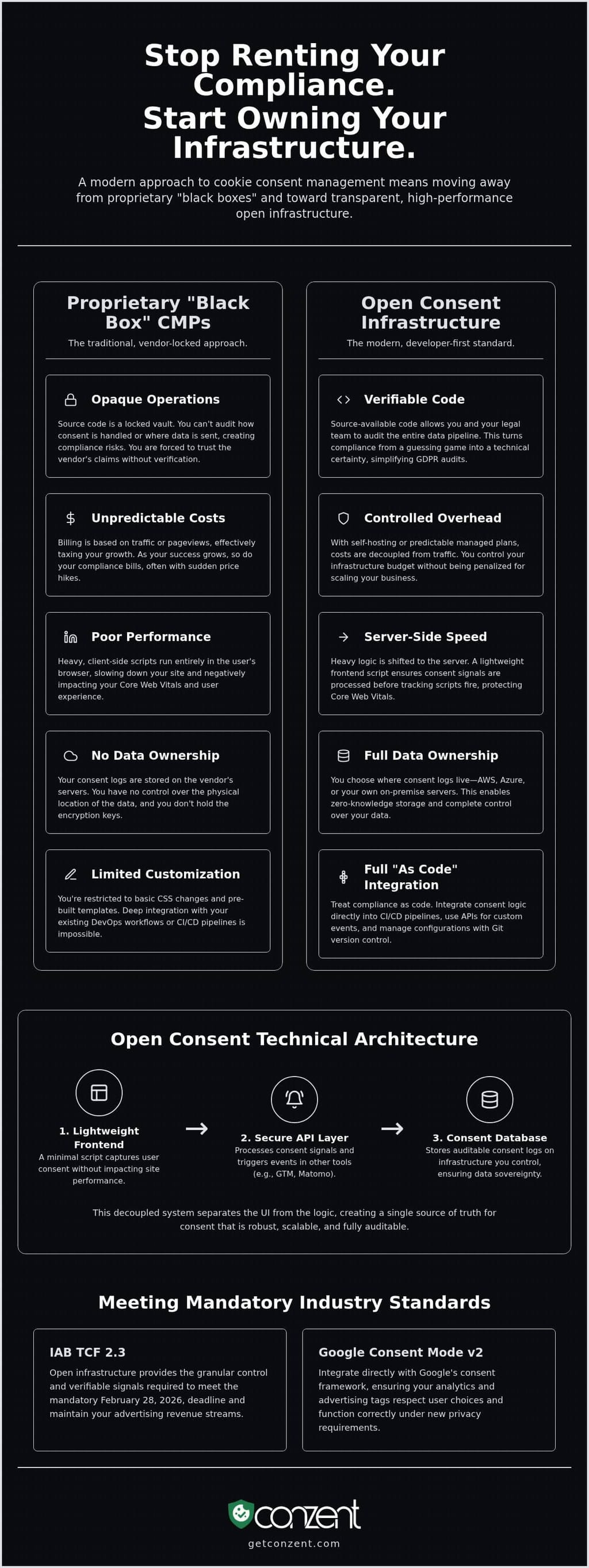
Proprietary platforms often feel like a trap. You start with a low rate, but as your traffic grows, you're hit with unpredictable pricing hikes based on pageviews. It's a tax on your success. Beyond the cost, these "black boxes" often include hidden data processing. You don't know which third-party servers are receiving your users' consent signals. Customization is another hurdle. Most SaaS vendors limit you to basic CSS changes. If you need deep integration with your DevOps workflow, you're out of luck.
Why Transparency is the New Compliance Standard
Privacy is a right, not a feature. Building user trust requires verifiable practices. When your code is open, you simplify the GDPR compliance audit process because your legal team can see exactly how consent is recorded. It turns compliance from a guessing game into a technical certainty. Open code also benefits from community scrutiny. Instead of relying on a single vendor's security team, you have a global network of developers identifying and patching vulnerabilities. Transparency is the only way to prove you aren't hiding anything from your users or the law.
Technical Architecture: How Open Consent Infrastructure Works
Open source cookie consent management is a distributed system. It is not a single line of code. The architecture consists of three primary layers: a robust database for consent logs, a secure API layer for processing, and a lightweight frontend script. By separating these components, you ensure that your compliance doesn't break when you update your website. It turns a visual banner into a functional piece of your technical stack.
Traditional CMPs run everything in the browser. This is inefficient. It slows down your site and creates security risks. Open Consent Infrastructure (OCI) moves the heavy lifting to the server side. This improves Core Web Vitals and ensures that consent signals are processed before any tracking scripts fire. It creates a single source of truth. Whether a user visits your main site or a subdomain, their preferences are synchronized across your entire ecosystem. You no longer have to worry about fragmented data or mismatched consent states.
Modern DevOps teams treat compliance as code. Because the infrastructure is source-available, you can integrate it directly into your CI/CD pipelines. You can test consent workflows in staging before they ever reach production. This reduces the risk of compliance leaks. If you want to see how this fits into your budget, you can explore our managed and self-hosted options.
Decoupling the UI from the Logic
A customizable cookie banner is just the surface. The real work happens in the storage engine. Decoupling these layers allows you to swap out the UI without losing your historical consent data. You can use APIs to trigger specific events in Google Tag Manager or Matomo based on the user's choices. This level of control is impossible with proprietary tools. Version control is also essential. By keeping your consent configurations in a Git repository, you can roll back changes instantly if a new regulation requires a pivot.
Data Sovereignty and Storage
Ownership requires control over physical storage. With open infrastructure, you choose where your consent logs live. You can host them on AWS, Azure, or your own on-premise servers. This is critical for zero-knowledge storage. If you don't hold the keys, you don't own the data. In the context of 2026 data laws, Data Sovereignty means maintaining exclusive legal and technical control over your user data, ensuring it remains subject to the laws of the country where it is stored. It is the difference between being a data owner and a data tenant.
Self-Hosting vs. Managed Cloud: Finding Your Balance
Choosing between self-hosting and a managed cloud isn't a binary decision. It is a strategic choice about where you want to focus your engineering resources. Pure self-hosting offers total data sovereignty. You pay zero license fees. However, you inherit the full responsibility of maintenance and security. Managed cloud models offer scalability and expert support. They ensure you stay compliant without manual intervention. The most efficient route for 2026 is often a hybrid approach. This uses source-available code on managed infrastructure. It bridges the gap between raw code and corporate efficiency.
Calculating your Total Cost of Ownership in 2026 requires looking beyond the sticker price. A proprietary SaaS might look affordable until a pageview spike triggers an unpredictable pricing hike. Conversely, a self-hosted setup might look free until a security audit requires a week of engineering time. The goal is to find a balance that prioritizes your data ownership while minimizing compliance overhead. Effective open source cookie consent management should save you more in time and legal risk than it costs in infrastructure.
When to Choose Self-Hosting
Self-hosting is ideal for teams with deep DevOps expertise. It fits industries where data cannot leave the internal network. Banking and healthcare often require this level of isolation to meet strict internal security protocols. But beware of the "free" trap. You must factor in developer hours, server costs, and the risk of downtime. If your team spends twenty hours a month patching a compliance tool, it isn't free; it's an expensive distraction. Check our Self-Host Guide for the technical requirements needed to maintain a robust environment.
The Benefits of Managed Open Infrastructure
Managed open source provides the best of both worlds. You get the transparency of open source cookie consent management without the operational burden of managing servers. Updates for mandatory standards like IAB TCF 2.3 and Google Consent Mode v2 happen automatically. You also gain access to advanced tools like Revenue Impact Analytics to see how consent affects your bottom line. This model uses a sponsorship approach. As the community grows, the collective cost drops. It turns compliance into a public good rather than a private tax. It is the logical choice for teams that value transparency but need to move fast.
Implementing Google Consent Mode v2 and IAB TCF 2.3
Technical compliance is no longer a matter of aesthetics. It is a matter of survival for your advertising revenue. If your open source cookie consent management system lacks proper certification, Google Ads will flag your domain as "unverified." This leads to immediate data loss for users in the European Economic Area. As of June 15, 2026, Google has made ad_storage the single authority for advertising data collection. You must ensure your stack is not just transparent, but technically precise.
Implementing these standards requires a methodical approach. You aren't just installing a script; you're configuring a communication protocol. Follow these four steps to secure your implementation:
- Step 1: Mapping. Identify every tracking tag and map it to specific consent signals like analytics or personalization.
- Step 2: Broadcasting. Configure your CMP to generate and broadcast the Transparency and Consent (TC) string across your data layer.
- Step 3: Validation. Use browser debugging tools to verify that tags only fire when the correct consent signal is present.
- Step 4: Monitoring. Use your dashboard to track opt-in rates and identify any technical drops in signal transmission.
Precision here prevents the 60-80% reduction in CPMs that publishers face when failing to meet the February 28, 2026, deadline for IAB TCF 2.3. To ensure your setup meets these rigorous standards, you can view our pricing models for managed and self-hosted infrastructure.
Mastering Google Consent Mode v2
You must choose between 'Basic' and 'Advanced' implementation modes. Basic mode blocks tags entirely until consent is granted. Advanced mode sends cookieless pings to Google, allowing for conversion modeling without identifying the user. Open-source tools give you the control to handle ad_user_data and ad_personalization signals with total transparency. You can see exactly how these signals are bundled and sent. For detailed code snippets and implementation logic, refer to our GCM v2 technical guide.
IAB TCF 2.3 for Publishers
The TCF 2.3 framework is complex. It requires integration with the Global Vendor List (GVL) to ensure every third-party provider is disclosed. The new "Disclosed Vendors" segment is now mandatory. It provides a verifiable signal that you've shown the user exactly who is processing their data. Open-source CMPs allow you to manage the delicate balance between 'Legitimate Interest' and 'Consent' without relying on a vendor's hidden logic. It's vital to ensure your platform is IAB TCF certified to maintain access to major demand-side platforms.
Conzent: The Open Consent Infrastructure for Transparent Growth
Conzent is not just another vendor in a crowded market. We are a mission-driven platform dedicated to making high-level compliance accessible through open source cookie consent management. Most businesses feel forced to choose between an expensive, opaque SaaS and a complex, unsupported DIY project. We bridge that gap. We provide the infrastructure you need to grow without sacrificing transparency or data ownership. It is a necessary standard for digital ethics, not a premium luxury reserved for the few.
You don't need dark patterns to achieve high opt-in rates. By leveraging A/B testing, you can optimize your banner's performance based on real-world data. You see what works. You improve the user experience. You stay ethical. It's about data-driven growth, not tricking your visitors into consent. This transparency builds a foundation of trust that proprietary "black box" models simply cannot match.
Our pricing reflects our principled approach. We do not punish you for your success by taxing your pageviews. Instead, we utilize a sponsorship model where costs decrease as the community grows. It is a collective investment in a public good, not a private tax on your success. Migrating from a proprietary CMP to Conzent is a streamlined three-step process:
- Map: Identify your existing vendors and map them to our transparent configuration.
- Deploy: Install the source-available infrastructure on your preferred cloud or use our managed environment.
- Switch: Replace your legacy, heavy scripts with the lightweight Conzent frontend to immediately improve site speed.
Open Source at Heart, Enterprise in Performance
Conzent provides source-available code that you can audit, modify, or host yourself. We offer enterprise-grade features like multi-language support and cross-domain consent synchronization without the typical corporate coldness. You get the power of a global platform with the transparency of a community project. Conzent's Danish roots matter for GDPR because the platform is engineered within one of the world's strictest privacy jurisdictions, ensuring compliance is a core architectural requirement rather than a localized patch.
Ready to Reclaim Your Data?
It is time to stop renting your compliance and start owning your infrastructure. Join the Open Consent Infrastructure movement to take back control of your user data. You can get started with our managed cloud for immediate results or deploy the self-hosted version for total isolation. Check out our pricing tiers to see how our sponsorship model lowers your costs while supporting a more open, ethical web. We invite you to scrutinize our code and collaborate on a better future for digital rights.
Future-Proof Your Privacy Stack
Compliance is no longer a checkbox on a legal document. It is a fundamental technical standard that defines how you respect your users. By adopting open source cookie consent management, you move away from opaque SaaS billing and toward a future of verifiable privacy. You gain the ability to audit your own code, control your data storage, and optimize performance without vendor interference. Trust is built through transparency, not through black-box logic that hides your data processing pipeline.
Conzent provides the bridge between raw code and enterprise efficiency. Our platform is IAB TCF v2.3 certified and Google Consent Mode v2 ready, ensuring your advertising revenue remains protected under the strictest 2026 regulations. You don't have to choose between technical rigor and ethical responsibility. It's time to reclaim your privacy stack and join a community that prioritizes digital rights over proprietary lock-in. View Conzent Pricing and Sponsorship Options to see how our source-available transparency can scale with your business. Let's build a more open web together.
Frequently Asked Questions
Is open source cookie consent actually free?
The software license is typically free, but you must factor in the cost of infrastructure and maintenance. You avoid unpredictable SaaS pageview taxes, but you invest in your own server resources and developer time. It is a shift from paying a vendor for a black box to investing in your own transparent infrastructure.
How does an open-source CMP handle Google Consent Mode v2?
It maps user choices to specific signals like ad_storage or analytics_storage and broadcasts them via your website's data layer. Unlike proprietary SaaS, you can audit the underlying code to ensure pings are only sent when the correct parameters are met. This technical precision is vital for maintaining your advertising data in 2026.
Can I self-host my cookie banner and still be GDPR compliant?
Yes, self-hosting often improves GDPR compliance by ensuring consent data never leaves your controlled environment. You maintain total sovereignty over your consent logs. This prevents unauthorized third-party access and aligns with the strict data processing standards required by European regulators. It turns compliance from a visual banner into a verifiable technical process.
What is the difference between open source and source-available CMPs?
Open source allows for total modification and redistribution under licenses like GPL. Source-available code is public for audit and self-hosting but may include specific commercial restrictions to ensure project sustainability. Both models prioritize transparency and auditability over the opaque proprietary models used by traditional vendors. They empower you to verify what the software actually does.
Will an open-source consent manager slow down my website?
No, it often improves site speed because it lacks the tracking bloat found in proprietary scripts. Adopting open source cookie consent management allows you to move heavy logic to the server side. This protects your Core Web Vitals and ensures that your compliance tools don't hurt your search engine rankings or user experience.
Do I need a developer to install an open-source cookie banner?
Initial setup usually requires a developer to configure the API and database layers for your infrastructure. Once the core system is live, non-technical users can typically manage banner text and A/B tests through a dashboard. It's a one-time technical investment that leads to long-term operational independence and lower compliance overhead.
Can I use an open-source CMP for IAB TCF 2.3 compliance?
Yes, provided the platform is certified to generate valid TC strings and integrate with the Global Vendor List. Certification ensures that major ad networks recognize your signals. This prevents the significant revenue loss that occurs when inventory is treated as unconsented by major demand-side platforms due to unverified technical signals.
How do I migrate my consent data from a SaaS provider to an open-source tool?
You export your historical logs in a standard format like CSV and map them to your new database schema. Most open source cookie consent management tools provide migration scripts to ensure a seamless transition. This process preserves your audit trail and ensures you don't lose proof of consent during the switch to a transparent model.