
Presenting CMP ROI to Stakeholders: A Practical Business Case

A CMP business case loses credibility when it labels every consent-related change as revenue. Presenting CMP ROI to stakeholders means showing what the data supports, what it does not, and where benefits are operational or governance-related rather than financial. Without a clear baseline, even a promising uplift can raise more questions than confidence.
That scrutiny is fair. Consent metrics sit alongside advertising performance, platform costs, and compliance work, often owned by different teams. Stakeholders need a shared view, not a single headline number.
This article shows how to build that view: define a baseline, connect consent analytics to business measures, and use a planned A/B test to assess whether a change contributed to an outcome. It also explains how to compare managed cloud and self-hosted operating costs while keeping measured financial impact separate from workload, flexibility, and risk considerations. The result is a transparent case with explicit assumptions and a practical way to evaluate a CMP.
Key Takeaways
- Consent rates show how people respond, but they do not establish business return on their own. Pair them with relevant revenue and traffic context.
- For presenting CMP ROI to stakeholders, make the decision clear and show the evaluation scope before sharing results.
- Separate observed revenue changes from effects a controlled comparison can reasonably attribute to a consent experience.
- Organize the business case around the baseline, measurement method, results, costs, and limitations so decision-makers can assess the evidence.
- Conzent’s revenue impact analytics and consent A/B testing can support an evaluation plan, but they do not promise a particular outcome.
Why presenting CMP ROI to stakeholders requires more than a consent-rate chart
A consent management platform (CMP) business case should help decision-makers compare an investment with the outcomes they need. It is not a promise that changing a banner will increase revenue. It is a decision framework: define the business question, show the evidence, make assumptions visible, and identify what remains uncertain.
That distinction matters because CMP value spans different teams. Some benefits can be measured in financial terms, such as changes in attributed revenue under a suitable measurement design. Others are operational or governance benefits, such as less manual work or clearer records of how consent choices are managed. These can inform the decision, but they should not be presented as revenue unless they have been measured as revenue.
What stakeholders need from a CMP business case
Different teams need to see how the evaluation connects to their responsibilities. Make those priorities explicit before choosing metrics. This gives the business case a shared purpose instead of forcing every benefit into one financial figure.
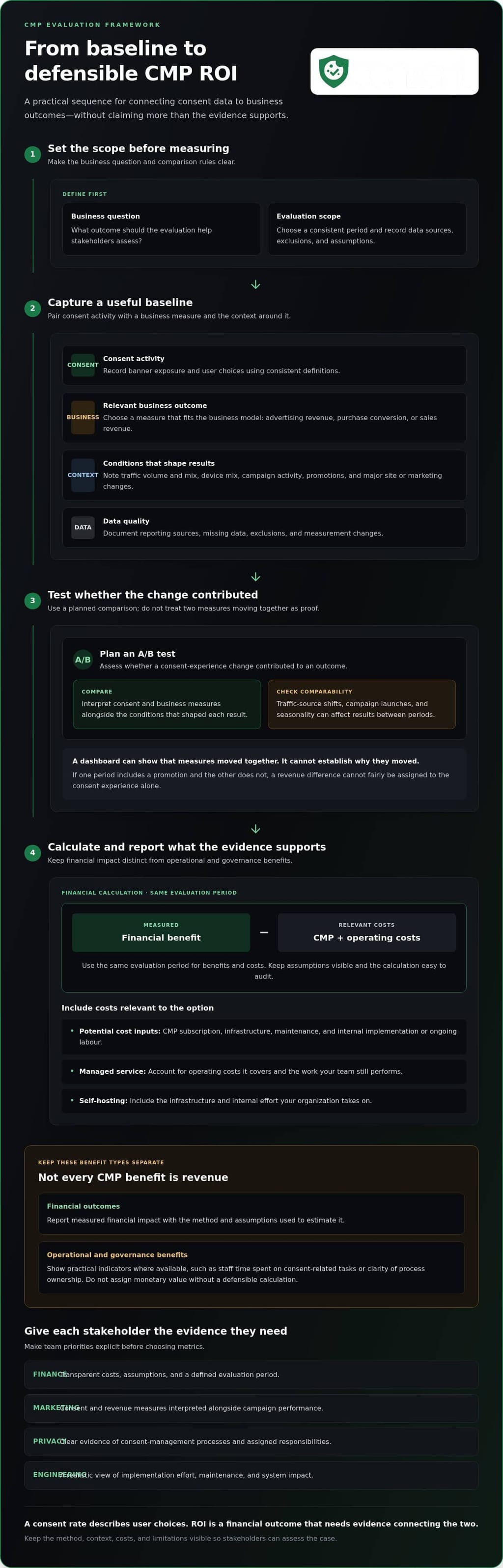
- Finance: Transparent costs, assumptions, and a defined evaluation period.
- Marketing: Consent and revenue measures interpreted alongside campaign performance.
- Privacy: Clear evidence of consent-management processes and assigned responsibilities.
- Engineering: A realistic view of implementation effort, maintenance, and system impact.
Why consent metrics are not ROI by themselves
A consent rate describes the choices people make. It does not tell you the financial value of those choices. Banner views show exposure, and interaction rates show engagement. Neither establishes that a CMP generated a business return.
Results also depend on context. A shift in traffic sources can change who sees the banner. A campaign launch can alter audience behaviour and revenue. Seasonality can move both traffic and conversion patterns. If those factors change between comparison periods, attributing a revenue difference to the CMP alone may mislead stakeholders.
A consent rate is an operational metric; ROI is a financial outcome that needs evidence connecting the two.
Keep the two kinds of evidence distinct. Report financial outcomes with the method and assumptions used to estimate them. Present operational and governance benefits separately, using practical indicators where available, such as staff time spent on consent-related tasks or clarity of process ownership. Do not assign a monetary value to these benefits unless you have a defensible way to calculate it.
That discipline makes presenting CMP ROI to stakeholders more credible. It gives finance a basis for assessing costs, gives marketing context for interpreting performance, and gives privacy and engineering teams room to explain work a chart cannot capture. The goal is not one impressive number. It is a decision stakeholders can examine and trust.
Which CMP ROI metrics should you measure before making the case?
Before changing a consent experience or introducing a CMP, capture how the current setup performs. Without a baseline, you cannot tell whether later movement reflects the change, a campaign shift, or something else. Choose a consistent evaluation period and record the data sources, exclusions, and assumptions behind each measure. That record gives stakeholders a way to scrutinize the comparison, not just its headline.
Choose metrics that connect consent activity to business outcomes
Pair consent-choice trends with revenue analytics, then interpret them alongside the conditions that shaped each result. The right business measure depends on the site and the decision at hand. An advertising-supported publisher may examine advertising revenue, while an online store may focus on purchase conversion or sales revenue. These measures are examples, not interchangeable choices. Use the one that reflects your business model and decision.
Capture enough context to judge whether the periods are comparable. For example, record traffic sources, device mix, campaign activity, and major changes to the site or marketing plan. If one period includes a promotion and the other does not, a revenue difference cannot fairly be assigned to the consent experience alone. A dashboard can show that two measures moved together; it cannot establish why they moved.
- Consent activity: Record banner exposure and user choices, using consistent definitions.
- Business outcomes: Track the relevant revenue or conversion measure and how it is attributed.
- Comparison context: Note traffic volume and mix, campaign changes, and unusual events that may affect results.
- Data quality: Document reporting sources, missing data, exclusions, and any changes to measurement.
Build a transparent CMP ROI calculation
Keep the financial calculation simple enough to audit: measured financial benefit minus CMP and operating costs over the same evaluation period. Cost inputs may include the CMP subscription, infrastructure, maintenance, and internal labour for implementation or ongoing work. Count only costs relevant to the option being evaluated. For a managed service, account for the operating costs it covers and the work your team still performs. For self-hosting, include the infrastructure and internal effort your organization takes on.
Use the CMP pricing information as one input when estimating the subscription component, then assess operating costs separately for your chosen model. Do not fold unpriced governance, trust, or compliance benefits into the financial total. Describe them separately, using evidence such as documented processes or fewer manual steps where you can support the claim.
Every CMP ROI calculation should disclose its baseline, evaluation period, data sources, attribution method, exclusions, and included costs. If the evidence shows correlation rather than a causal effect, say so. That transparency is essential for presenting CMP ROI to stakeholders: they can see what the numbers support, what they do not, and which assumptions could change the decision.
How to prove CMP ROI without overstating attribution or compliance value
A revenue increase after a consent-banner change does not automatically prove the CMP caused it. The same period may include a new campaign, a shift in audience, a site release, or changes to analytics. A before-and-after chart can show that metrics moved together. It cannot, by itself, isolate the reason.
Start by listing changes that could affect the result, then choose a comparison that helps account for them. A controlled test may offer stronger evidence when you can run it without compromising clear, fair consent choices. If a controlled comparison is not practical, report the observed movement as an association, not a proven CMP effect.
Use consent A/B testing to strengthen the evidence
Before testing, write down the hypothesis, the banner variants, the primary success measure, and the planned test period. Include consent choices, but do not treat a higher acceptance rate as the sole measure of success. Consider relevant business outcomes and whether the experience remains clear and usable. Consent A/B testing can support structured comparisons of banner variants, while the measurement plan determines what conclusions the results can support.
Keep the comparison focused. If variants run at the same time for comparable audiences, changes that affect both groups are less likely to explain a difference between them. Still, check how the test was assigned and whether the groups were sufficiently comparable. Record concurrent changes, such as campaign launches, traffic-source shifts, site updates, or changes to analytics. If conditions differ between groups, qualify the result.
Label evidence by confidence, not by sales impact
Present each finding with its comparison method and the factors that could have influenced it. Separate a measured change from a plausible contribution and from an assumption that remains unverified. This makes uncertainty visible instead of burying it in a footnote.
- Observed: A metric changed during the test or comparison period.
- Supported contribution: A controlled comparison indicates that the tested experience may have contributed to the difference.
- Unverified: The explanation is plausible, but the available evidence cannot distinguish it from other causes.
Correlation can show that revenue and consent metrics moved together; it cannot establish that the CMP caused the revenue change. Use that distinction when presenting CMP ROI to stakeholders, and state plainly what the design can and cannot prove.
Apply the same care to compliance and governance benefits. Document relevant process improvements, such as clearer consent records or more defined ownership, when you can substantiate them. Do not convert hypothetical fines, legal exposure, or avoided penalties into projected savings. Those figures can imply a certainty the evidence does not support. Keep documented operational improvements separate from calculated financial return, and describe legal risk without presenting speculation as a measured benefit.
How to turn CMP ROI findings into a stakeholder-ready decision
Start with the decision, not the dashboard. State whether you are asking stakeholders to approve an evaluation, choose an operating model, or proceed with a CMP. Then define the business context and scope: which sites or consent experiences are included, what period the evidence covers, and which teams will own the work. A clear request gives every result a purpose.
Present the evidence in a predictable sequence. This helps readers distinguish what you knew before the evaluation from what changed and what the findings can support.
- Baseline: Describe the starting performance and operating setup.
- Method: Explain the comparison, data sources, and evaluation period.
- Results: Show key findings, including uncertainty and relevant context.
- Costs: Include CMP and operating costs within the same scope.
- Limitations: Name exclusions, confounding factors, and unanswered questions.
Adapt the evidence to each stakeholder
Keep one consistent evidence base, but lead with the questions each team needs answered. Finance will focus on cost assumptions and how the conclusion changes under a conservative scenario. Marketing needs consent experience results connected to relevant revenue measures. Technical teams need implementation effort, integrations, maintenance, and clear operating ownership. Privacy teams need to understand the consent processes and responsibilities the evaluation covers.
Make the recommendation easy to scrutinize
Put the data period, calculation method, and material exclusions beside the results. If assumptions vary, show a conservative scenario alongside the central estimate and explain what drives the difference. Revenue impact analytics can contribute measurement evidence, but the comparison design determines what you can attribute to a CMP.
Use one compact visual to separate financial outcomes from other benefits. Avoid combining them into a single “value” figure unless each component has a defensible method.
Measured financial outcomes
- Revenue or conversion results supported by the stated comparison method
- CMP and operating costs included in the evaluation
Non-financial benefits
- Documented improvements to consent processes or ownership
- Operational effort or governance outcomes reported separately from ROI
Close with an action someone can own. For example, assign a team to validate the measurement inputs, run the agreed evaluation, and bring the results back at a scheduled review point. Name the owner and the decision that review will resolve. That is more useful than a general endorsement because stakeholders know what happens next and how they will judge progress.
If the decision includes comparing CMP operating costs, Conzent’s pricing options can be considered alongside your own infrastructure and staffing assumptions.
How Conzent can support a transparent CMP ROI evaluation
A credible evaluation starts with a measurement plan, not a product promise. Conzent’s revenue impact analytics can help teams examine consent-related revenue measures alongside their chosen baseline and business context. The analytics provide evidence to assess, not automatic proof that the CMP caused a change. The comparison design and factors affecting results still matter.
Consent A/B testing gives teams a way to compare banner variants against a defined plan. Set the hypothesis, variants, success measures, and test conditions before launch. Track consent choices alongside relevant business measures, and document changes that could affect the comparison. Acceptance alone should not define success. Clear, informed user choice remains central to evaluating the experience.
Match the platform model to operating responsibilities
The operating model shapes the cost and workload side of the business case. Conzent’s managed cloud service includes infrastructure maintenance, automatic updates, and cloud analytics dashboards. With self-hosting, your organization operates the platform on its own infrastructure. The self-hosted platform is available at no charge, but infrastructure and internal operating effort still belong in the cost comparison. Compare each approach using the responsibilities your team will own, rather than looking at subscription cost alone.
Before you begin, align the people who will interpret the results. Finance can validate the cost assumptions; marketing can define relevant campaign and revenue context; privacy teams can clarify the processes under review; and engineering can assess implementation and ongoing ownership. Agree on the baseline, evaluation period, metrics, data sources, and exclusions. That shared plan makes findings easier to interpret across teams.
Then decide what evidence would change the decision. For example, stakeholders might agree to evaluate a specific banner experience against the current one, review the resulting consent and business measures, and revisit the operating model using documented internal effort. Keep financial results distinct from operational or governance benefits. This prevents an analytics dashboard or a higher consent rate from being mistaken for a complete ROI conclusion.
These are practical foundations for presenting CMP ROI to stakeholders: a defined question, an agreed measurement method, transparent operating assumptions, and clear ownership of the review. Conzent’s tools can support that evaluation, while your team’s test design determines how confidently it can interpret the findings.
For a cost comparison, Conzent’s plans provide the subscription details to assess alongside your team’s infrastructure and staffing requirements.
Make your next CMP decision easier to evaluate
A CMP evaluation can do more than settle one investment question. It can give your team a repeatable way to assess future consent changes as the site, campaigns, and business priorities evolve. Treat each decision as a chance to learn what deserves further testing, not as a permanent verdict on every consent experience.
That forward-looking approach makes presenting CMP ROI to stakeholders part of better product decision-making. The aim is not to defend a fixed number. It is to keep improving how your organization weighs evidence, user choice, and operational needs.
Use the Conzent plan details as an input when comparing operating models for your evaluation.
Frequently Asked Questions
How do you calculate the ROI of a consent management platform?
Start by defining the alternative the CMP is being compared with: keeping the current setup, changing the consent experience, or adopting a different operating model. These are different decisions and should not be blended into one estimate. A useful additional check is the break-even point: what level of measurable benefit would cover the expected investment? When presenting CMP ROI to stakeholders, label that threshold as a decision aid, not a forecast.
Which metrics should be included in a CMP ROI presentation?
Choose one primary outcome that directly answers the business question, then add guardrail measures to catch trade-offs. For example, if the test aims to improve a business outcome, monitor whether the consent interface remains usable and whether users can complete their choices. Avoid selecting a long list of metrics after results arrive. That makes it easier to spotlight favorable movements and overlook signals that complicate the conclusion.
Can a CMP increase advertising revenue?
A CMP can help teams manage consent signals that advertising systems rely on, but it cannot control advertiser demand, auction conditions, or every downstream system. A revenue change is possible, not assured. Before claiming an increase, trace the path from a user’s choice through the relevant signal and reporting systems. If one link in that chain is missing or changed, the revenue result may have another explanation.
How do you measure the revenue impact of cookie consent changes?
Decide how users will be assigned to each consent experience and keep that assignment consistent for returning visitors. Otherwise, someone may see one version on an initial visit and another later, blurring the comparison. Also align the revenue reporting window with the user exposure window. If reporting systems attribute a conversion differently from the test, reconcile those definitions before drawing conclusions.
What costs should stakeholders include when evaluating a CMP?
Look beyond the steady-state setup. A transition can involve temporary parallel operation, moving configuration or reporting workflows, and retiring an existing tool. These items may not appear in a recurring subscription figure, yet they can affect the decision. Ask owners to identify which costs occur only during the change and which continue afterward. That makes it easier to compare an implementation period with later periods.
How can A/B testing help demonstrate CMP value?
Set a stopping rule before a test begins, including what will happen if the result remains unclear. Without one, teams may stop as soon as a favorable movement appears or keep testing until they find one. An inconclusive result still has value: it can show that the tested variation did not provide enough evidence to justify a rollout and help shape the next experiment.
Should compliance risk be included in a CMP ROI calculation?
Include it in the broader decision record, but do not turn hypothetical exposure into booked savings. A practical approach is to map the consent-management controls being evaluated to their evidence, such as configuration records, process documentation, and named internal owners. Privacy and risk teams can then identify gaps and assess them through the organization’s existing risk process, separately from the financial calculation.
Ready to build a transparent CMP ROI evaluation? Review Conzent’s plans and compare the managed cloud and self-hosted options against your team’s needs.