
Scaling Cookie Consent for High-Traffic Sites

A consent banner is only the visible part of a much larger system. On a high-traffic site, consent needs to coordinate scripts, user choices, and integrations across pages and properties without creating unnecessary friction or compromising performance. That’s why cookie consent for high traffic sites can’t be treated as a banner-only task.
If you’re responsible for a large website, the operational challenges are familiar: changing one tracker can affect other workflows, and consent data can be difficult to connect to business outcomes. More traffic makes clear ownership and reliable monitoring essential.
This article explains how to design, evaluate, and operate consent as a scalable process. You’ll learn how to map consent signals to integrations, monitor the user experience, and assess business impact while respecting user choices. It also compares managed cloud and self-hosted approaches, and explains how consent A/B testing and revenue impact analytics can help teams evaluate results.
Key Takeaways
- Define consent as a coordinated system across visits, scripts, and properties, not simply a banner displayed on a page.
- Map how visitor choices flow through your consent platform to tags and integrations, then test that configured choices are reflected where they need to be.
- Compare managed and self-hosted approaches by weighing control, maintenance, analytics access, integration needs, and team capacity.
- Build a rollout plan around a clear inventory of domains, tags, integrations, owners, and change processes before launch.
- Evaluate cookie consent for high traffic sites with ongoing monitoring and testing, so you can assess user experience and business impact while respecting consent choices.
Why cookie consent for high-traffic sites needs more than a banner
A banner is the part visitors see. The operational work happens across the systems that display it, apply a person’s choices, and communicate those choices to relevant tags and integrations. For cookie consent for high traffic sites, the challenge is coordinating those steps across many visits, scripts, or web properties, then keeping the setup understandable as the site changes.
High-traffic consent management is the coordinated operation of consent choices, scripts, and ownership across a website or web estate serving many visits. There is no universal traffic threshold. Visit volume matters, but so do the number of scripts, the properties in scope, and how teams manage changes. Traffic alone doesn’t determine whether a consent setup is appropriate.
What changes when a website serves many visitors?
More visits amplify the effects of a confusing choice or a configuration mismatch. If a preference is hard to understand, more people may encounter the same friction. If one page template applies a different configuration from another, the inconsistency can affect visitors across that part of the site. Volume makes problems more visible and increases the value of clear ownership and monitoring.
Scale can also come from complexity rather than audience size. A company may operate regional domains, use different content management systems, or share responsibility across marketing, engineering, and privacy teams. Each addition creates coordination work: who approves a change, which pages it affects, and how teams confirm that the live experience matches the intended configuration.
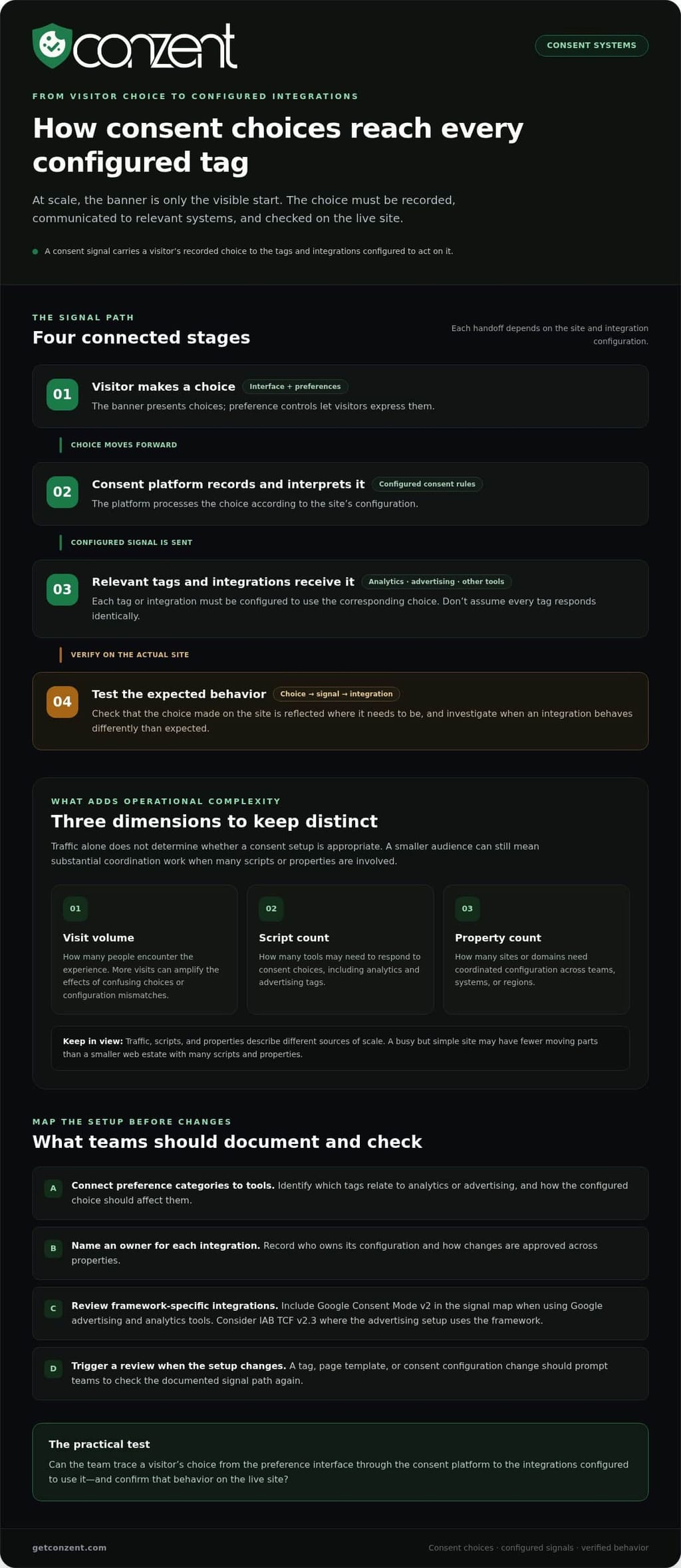
Keep the factors distinct. Visit volume describes how many people encounter the experience. Script count describes how many tools may need to respond to consent choices. Property count describes how many sites or domains need coordinated configuration. A smaller audience with many scripts and properties can face substantial operational complexity, while a busy but simple site may have fewer moving parts.
Why a cookie banner is only one part of consent
An HTTP cookie can help a website remember information between requests. Consent management addresses the choices a visitor makes about relevant uses of cookies and other technologies. The banner presents those choices, preference controls let visitors express them, and the consent system communicates the resulting signals to configured tags and integrations.
Those pieces need to work together. A clear interface cannot, by itself, ensure that downstream systems receive the appropriate choice. Third-party tags and advertising integrations may have their own configuration requirements, so teams need to understand how each integration is set up and test the expected behavior. Don’t assume every tag responds identically.
Interface design still matters. Clear, configurable choices help visitors understand and express their preferences. A customizable cookie banner is one part of the experience, not the whole process. Treat the interface, preference handling, integrations, and operational ownership as connected parts of the system. That gives teams a practical foundation for maintaining consent as a site grows.
How high-traffic cookie consent works across scripts and systems
At scale, consent has to travel reliably from a visitor’s choice to the systems that use it. The path is straightforward in principle: a visitor makes a choice, the consent management platform records and interprets it according to the site’s configuration, and relevant tags or integrations receive a corresponding signal. The details depend on how each site and integration is configured.
A consent signal carries a visitor’s recorded choice from the consent platform to the tags and integrations configured to act on it. For teams managing several sites, mapping that path helps identify where a change needs review. It also gives teams a shared way to investigate when an integration behaves differently than expected.
Map consent choices to tags and integrations
Start by connecting preference categories to the tools on the site. Identify which tags are associated with analytics or advertising, who owns each integration, and how the configured consent choice should affect it. Then test the path from selection to signal on the actual site. A platform can communicate a choice, but each tag and integration must be configured to use it.
For teams using Google’s advertising and analytics tools, Google Consent Mode v2 is an integration to include in the signal map. Treat it as part of the system configuration, not as a replacement for deciding how the site’s consent choices connect to its tags. Document the configuration and its owner so changes to a tag, page template, or consent setup trigger a review.
Coordinate consent across sites and advertising workflows
Multiple properties often share some integrations but not others. A central policy can define common expectations, while property-level configuration reflects differences in domains, content systems, or tools. Record which team owns each configuration and how changes are approved. Without that visibility, one site can drift from the intended setup as teams update scripts or launch new components.
For relevant advertising workflows, the IAB Transparency and Consent Framework provides a structured way to communicate consent-related information among participating parties. IAB TCF v2.3 integration is relevant where a site’s advertising setup uses the framework. Its role depends on the participating vendors and the organization’s configuration, so don’t treat it as a universal signal for every tag or stack.
Make the map operational. Keep a shared record of each property, its consent configuration, connected integrations, and accountable owner. When a team adds or changes a script, review the affected consent path and test it on the relevant property. This turns scattered technical knowledge into a process teams can maintain as the web estate changes.
Conzent supports these workflows with IAB TCF v2.4 integration and Google Consent Mode v2. Compare Conzent’s managed cloud and self-hosted options to see how each operating model fits your team.
Compare cookie consent approaches for high-traffic websites
The choice is not simply between more control and less control. It’s about deciding which responsibilities your organization can own and where your teams need visibility. For cookie consent for high traffic sites, compare the operating model against the people, systems, and processes available to maintain it. Traffic alone doesn’t tell you which approach will fit.
Use this framework to compare self-hosted and managed cloud approaches. The right setup depends on your organization’s requirements and integrations.
When self-hosting fits a high-traffic operation
Self-hosting can suit organizations that want to run open-source consent infrastructure on their own systems and have the technical capacity to operate it. Conzent offers a self-hosted open consent infrastructure option that organizations can run on their own infrastructure for free. The trade-off is responsibility: your team must plan for deployment, maintenance, and coordination with other systems. Consider how that work fits existing ownership and change processes. A self-hosted cookie consent guide can help you examine this model in more depth.
When managed cloud can reduce operational work
A managed cloud approach can fit teams that prefer not to own the consent platform’s infrastructure. Conzent’s managed cloud service includes infrastructure maintenance, automatic updates, and cloud-based analytics dashboards. That shifts infrastructure responsibilities while giving teams access to analytics through the cloud. It doesn’t remove the need to own consent configuration, integrations, or review. Teams still need clear processes for those decisions.
Before choosing, identify who will maintain the platform, what analytics access your teams need, which integrations matter, and how much control your operating model requires. Compare those needs against your team’s capacity, not just projected traffic. Conzent’s managed cloud pricing drops as sponsorships increase, so include managed cloud pricing in your evaluation.
Roll out and monitor consent across a large web estate
A large rollout needs more than a launch date. It needs a shared inventory, clear decision owners, and a review process that keeps pace with changes to sites and integrations. A staged approach helps teams find configuration gaps before they affect the wider estate. For cookie consent for high traffic sites, monitor technical behavior, visitor experience, and business effects as separate questions. Each needs different checks.
Build a controlled rollout plan
- Inventory the estate. List the domains and subdomains in scope, the tags and integrations on each, the teams responsible, and the content systems or templates that may affect deployment. Record where properties share a configuration and where they differ. This gives reviewers a defined scope instead of relying on memory.
- Assign ownership and change paths. Name the people who approve consent configuration, maintain integrations, and review changes to scripts or site components. Document how a proposed change moves from request to approval and testing. Without an owner, a newly added tag can fall outside the consent review process.
- Configure in a controlled environment. Apply the intended choices and integration settings to a limited set of representative properties or templates first. Include different site structures where relevant. Keep a record of what changed, who reviewed it, and which properties use that configuration.
- Run technical and experience checks. Confirm that the consent interface appears as intended, selections are recorded, and relevant tags and integrations receive the configured signal. Test whether visitors can update preferences and whether the change is reflected in subsequent behavior. Review desktop and mobile layouts, as well as key page templates.
- Expand, monitor, and review. Roll out to additional properties after the staged checks pass. Tie monitoring to the inventory so teams can identify which configuration or owner relates to an issue. Revisit the setup when tags, templates, integrations, or site ownership change.
Measure consent experience and business impact
Technical validation answers whether the system behaves as configured. UX testing asks whether people can understand and use the choices. A/B testing can compare consent experiences, such as alternative wording or layouts, while keeping the goal clear: help visitors make informed choices, not steer them toward a preferred answer. Conzent’s consent A/B testing supports structured comparisons.
Business measurement is a separate lens. Compare consent-related patterns with relevant analytics or revenue indicators, and interpret changes in context. A shift in measured activity may reflect changes in what can be observed, not necessarily a change in underlying visitor behavior. Conzent’s revenue impact analytics can help teams examine that relationship. Measurement informs decisions; it doesn’t promise a revenue gain.
To assess an operating model for this work, compare Conzent’s platform options.
Choose a scalable consent platform that stays transparent
A consent platform should make responsibility easier to see, not hide it behind a polished interface. Before choosing, identify the decisions your organization needs to make repeatedly: who can change configuration, how teams review those changes, and how they can tell which setup applies to each property. A strong fit gives people a clear way to answer those questions as the web estate evolves.
Transparency is practical. It means teams can understand how consent decisions connect to their operating processes, identify where review is needed, and explain who owns the next step. A platform can support that work, but it can’t replace clear governance. Make the division of responsibility visible before rollout, especially when several teams share ownership of the same site or integration.
What Conzent brings to a high-traffic consent operation
Conzent provides an open-source cookie consent platform to help websites meet GDPR, ePrivacy, and other privacy regulations. Teams can use customizable consent banners, consent A/B testing, and revenue impact analytics to manage and evaluate the consent experience. For advertising and analytics workflows, the platform integrates with IAB TCF v2.4 and Google Consent Mode.
Choose the operating model that matches your team’s capacity. With Conzent’s managed cloud service, infrastructure maintenance, automatic updates, and cloud-based analytics dashboards are included. Organizations can also self-host the open consent infrastructure on their own systems for free. In either case, teams remain responsible for their consent configuration, integrations, and review process.
Keep the evaluation grounded in your own estate. A configuration that suits one property may need a different review path on another. Map those differences, decide who owns them, and choose the tools and operating model your teams can maintain.
Make the next step based on your operating model
Bring the decision down to three practical questions:
- Ownership: Which team is accountable for configuration decisions, and who reviews changes that affect other teams?
- Visibility: What information do site, analytics, and advertising teams need to understand the active setup and assess its effects?
- Coordination: How will your organization keep decisions consistent across properties while allowing for relevant differences?
Use the answers to decide whether your current processes can support the platform and operating model you’re considering. If you’re evaluating Conzent’s managed service, compare the available plans against your organization’s responsibilities and requirements. Keep the evaluation focused on fit, not assumptions about outcomes.
View Conzent pricing to assess the managed service for your needs. Privacy infrastructure should be understandable, measurable, and manageable. A clear decision process helps make that standard real across your organization.
Build consent into your next stage of growth
Your web estate will keep changing. New properties, campaigns, and integrations can shift how consent needs to be managed. Treat each change as a chance to keep ownership clear and make the visitor experience easy to understand. That discipline helps cookie consent for high traffic sites remain manageable as teams and technology evolve.
Choose an operating model that fits the way your organization works today and can be maintained as it grows. Then make the next step practical: compare how Conzent’s managed cloud service and self-hosted option fit your team’s needs, without losing sight of transparency or user choice.
Explore Conzent pricing for managed consent and choose an operating model for your consent operation. Strong privacy infrastructure is easier to manage when teams can understand it, measure it, and maintain it with confidence.
Frequently Asked Questions
Does high website traffic change cookie consent requirements?
No. High traffic by itself doesn’t create a different cookie-consent standard. What matters is what the site does with data, which technologies it uses, where visitors are located, and which rules apply to those activities. A high-volume site may need stronger operational coordination, but that isn’t the same as a separate legal threshold. For decisions about your circumstances, consult current guidance from relevant regulators and qualified legal counsel.
Can a cookie consent platform slow down a high-traffic website?
It can affect performance, depending on how the platform is implemented, its scripts and integrations, and the site’s architecture. A heavily customized page may behave differently from a simpler template. Don’t assume any tool has zero impact. Capture your usual performance measurements before configuration, then repeat them after deployment on representative pages and devices. Compare like with like, and investigate changes before expanding the rollout.
How do large websites manage cookie consent across multiple domains?
Start by recording each domain and subdomain, assigning an owner for consent configuration, and listing the tags and integrations used by each property. Regional sites, for example, might share a banner design while using different analytics connections. Track those differences rather than assuming a shared setup covers every property. Route new domains, tags, and template changes through a review process, then test each affected site.
What happens if a high-traffic site has inconsistent consent signals?
Tags on different properties may respond differently to similar visitor choices. That can lead to uneven analytics, unclear campaign data, and uncertainty about which configuration is active. Compare each property’s settings with the signals its tags and integrations receive. Record any mismatch, identify the responsible owner, and retest after correcting the configuration. This helps teams understand operational and measurement issues without assuming a specific legal consequence.
Is a self-hosted consent platform better for a high-traffic website?
No single model fits every high-traffic website. Self-hosting can suit an organization that wants to run open-source infrastructure on its own systems and has the people to maintain it. Managed cloud may fit a team that prefers provider-managed infrastructure. Compare technical capacity, control needs, and existing change processes. Traffic volume alone doesn’t determine which operating model is the better fit.
How can a company measure the revenue impact of cookie consent?
Use consent A/B testing to compare defined interface variations, then review results alongside relevant business indicators such as observed revenue or campaign outcomes. Keep visitor choice intact; don’t design a test to pressure acceptance. Revenue impact analytics can support this assessment, but an observed change doesn’t prove consent caused it. Consider other changes, such as campaign timing or site updates, before drawing conclusions.
Does a cookie consent platform guarantee GDPR compliance?
No. A platform can support consent workflows and technical integrations, but it can’t guarantee GDPR compliance by itself. The outcome depends on an organization’s practices, configuration, data uses, and interpretation of applicable requirements. Use the platform to operate and review consent processes, not as a substitute for legal judgment. Consult qualified legal counsel or authoritative guidance when assessing obligations for your specific circumstances.