
Source-Available Consent Management: Privacy Infrastructure You Can Trust

Your consent management platform shouldn't be a black box that holds your user data hostage. Most companies treat privacy as a subscription service, but true compliance isn't something you can rent. It is infrastructure. By choosing source-available consent management, you move away from the "trust us" model of proprietary SaaS and toward a "verify everything" standard. It's about taking back control from vendors who hide their logic behind rising fees and heavy, opaque scripts.
You already know that keeping up with IAB TCF v2.3 and Google Consent Mode v2 has become an expensive, technical burden. It’s frustrating to watch your site speed drop while your compliance costs climb. This guide explains why source-available infrastructure is the only way to achieve true digital sovereignty and regulatory compliance in 2026. We will look at how to build auditable consent logs, slash overhead, and maintain high-performance speed without compromising on the ethical responsibility you owe your users.
Key Takeaways
- Proprietary SaaS creates a black box for user data. Learn how code transparency eliminates hidden privacy risks and vendor lock-in.
- Compliance is infrastructure, not a subscription. See how Open Consent Infrastructure (OCI) delivers the speed that third-party scripts cannot match.
- Implement source-available consent management to maintain auditable logs and meet the mandatory IAB TCF v2.3 standards of 2026.
- Safeguard your marketing revenue by integrating Google Consent Mode v2 directly into your own technical stack.
- Evaluate the transition from managed services to self-hosting to ensure your privacy tools actually serve your users.
The Compliance Paradox: When Privacy Tools Compromise Privacy
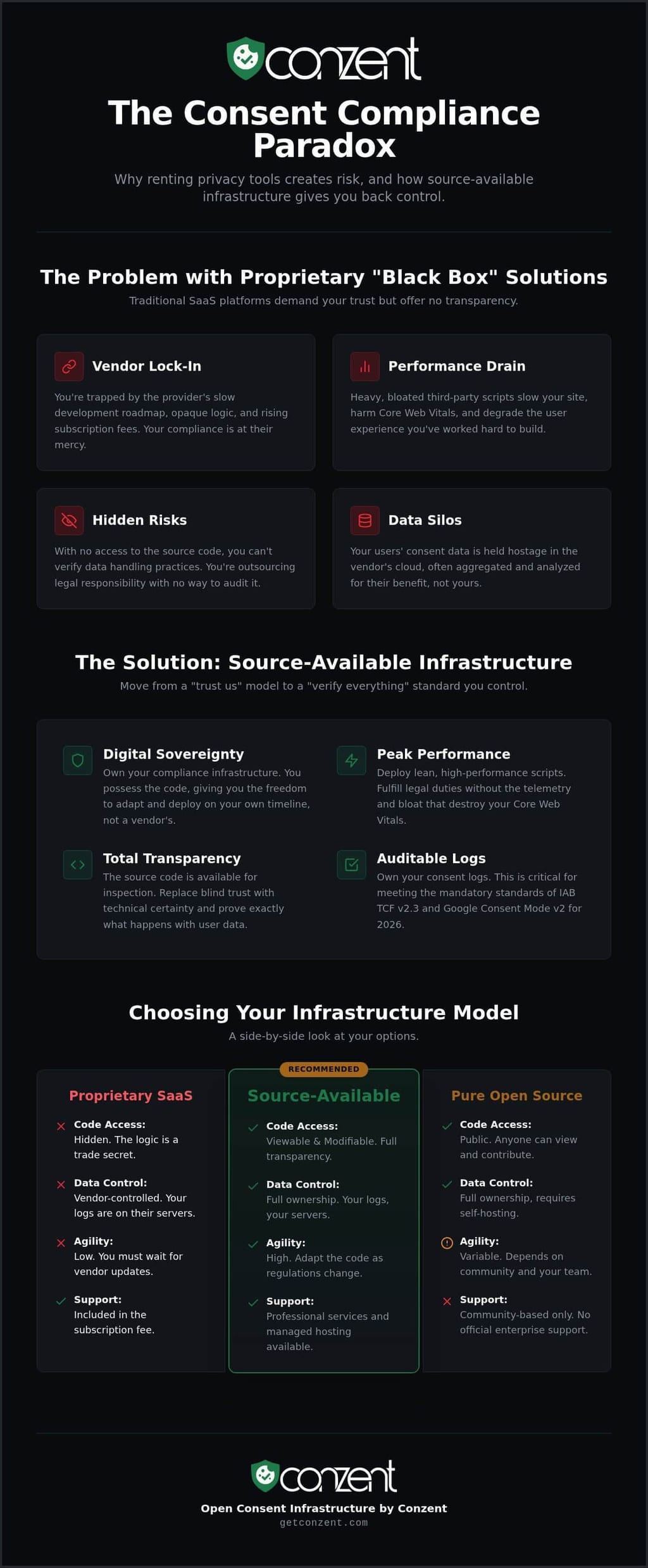
Most privacy tools are built on a fundamental contradiction. You install a script to protect user data, but that script immediately begins harvesting metadata for the vendor's own purposes. It is a "Black Box" model that demands your silence. You cannot see the code. You cannot audit the logic. You simply trust a third-party cloud to handle sensitive consent signals correctly. This creates a new form of privacy debt. If your vendor suffers a breach or quietly changes their data processing terms, your compliance becomes a liability. You aren't just managing consent; you're outsourcing your legal responsibility to an entity that prioritizes its own trade secrets over your transparency.
Proprietary compliance is often a shield for corporate interests. Vendors claim their internal logic is intellectual property, which prevents you from verifying how they handle complex requirements like IAB TCF v2.3. This lack of visibility is a moral hazard. Real compliance requires total clarity. By shifting to source-available consent management, you replace blind trust with technical certainty. You gain the ability to prove exactly what happens when a user clicks "Accept" or "Decline."
Vendor lock-in is a silent killer of technical agility. When regulations change, proprietary users are at the mercy of their provider's development roadmap. If the vendor is slow to update their API, your business carries the risk. Source-available models give you the freedom to patch, adapt, and deploy on your own timeline. You are no longer a passenger in your own compliance journey.
The Problem with Proprietary Data Silos
Standard SaaS solutions often treat your user data as an aggregate asset. They track consent patterns across thousands of domains to optimize their internal products. This is the opposite of digital rights. Conzent operates on a principled mission: privacy tools should be public goods that empower the community. Unlike proprietary platforms that lock your data in a silo, Open Consent Infrastructure ensures that you own the logs. You can inspect the source-available software to confirm that no unauthorized signals are leaking to third-party servers. Auditability shouldn't be a premium upsell; it's a baseline requirement for any ethical business in 2026.
Performance Costs of Generic Scripts
Site speed is a technical right, not a luxury. Many "easy install" CMPs are bloated with legacy code and tracking pixels that destroy your Core Web Vitals. They prioritize their own telemetry over your website performance. This forces a false choice between being compliant and being fast. It doesn't have to be this way. Source-available consent management allows you to strip away the fluff. You can deploy lean, high-performance scripts that fulfill legal duties without causing a performance lag. Whether you choose a self-hosted setup or a Managed Cloud Consent Platform, your infrastructure should empower your site, not slow it down.
What is Source-Available Consent Management (OCI)?
Source-available consent management is a fundamental shift in how we think about digital rights. It is not a product you buy; it is code you possess. At its core, Open Consent Infrastructure (OCI) provides the source code to the user. This allows for total inspection, modification, and the option for self-hosting. While traditional SaaS vendors hide their logic to protect their business interests, OCI exposes its logic to protect yours. It aligns with the NIST Privacy Framework, which emphasizes risk management through transparency and technical control. This model ensures that your compliance tools are as auditable as your financial records.
This approach creates a "goldilocks" zone for enterprise security. Proprietary SaaS is often too restrictive, while pure open source can lack the commercial focus required for rapid regulatory updates. Source-available infrastructure provides the transparency of open source with the professional reliability of a managed service. It democratizes compliance. It makes high-level privacy tools accessible to a solo blogger or a global enterprise. By removing the technical and financial barriers to entry, we ensure that digital sovereignty is a standard for everyone rather than a luxury for the few.
Source-Available vs. Open Source vs. SaaS
Understanding the difference between these models is vital for your technical strategy. SaaS is a rental agreement. You pay for access, but you never own the tools or the data path. Open Source is a community project. It is free to use but often lacks the dedicated support needed for enterprise IAB TCF v2.3 integration. Source-available consent management is different. It is a professional-grade tool where the source code is public, but the license ensures sustainable development. Our use of the Business Source License (BSL) supports a mission-driven approach that prioritizes long-term stability over short-term data harvesting. If you want to see how this fits your budget, you can view our transparent options.
The Technical Architecture of OCI
The architecture of OCI is intentionally lean. It consists of a lightweight script designed to execute with minimal latency. It is API-first. This design allows it to integrate seamlessly with platforms like WordPress, Drupal, and Wix without the bloat of generic third-party plugins. By keeping the footprint small, you maintain your site speed while fulfilling complex requirements like Google Consent Mode v2. Open Consent Infrastructure is the technical foundation for digital sovereignty, ensuring that consent signals remain under your direct supervision at all times.
SaaS vs. Self-Hosted: Choosing Your Infrastructure
Infrastructure is the bedrock of trust. Most proprietary vendors force you into their cloud because it benefits their bottom line. We don't. The choice between self-hosting and a managed service should depend on your technical resources and security requirements. By utilizing source-available consent management, you have the flexibility to switch models as your business grows. You aren't trapped. You're empowered. This framework allows you to decide where your data lives and who has the keys to the kingdom.
Compliance is a technical requirement, but it is also a strategic one. For some, the priority is absolute control. For others, it is the speed of implementation. Our Open Consent Infrastructure (OCI) supports both paths without compromising on the core values of transparency and speed. We have removed the artificial barriers that usually separate "enterprise-grade" tools from community-driven software.
The Case for Self-Hosting
Self-hosting is the ultimate expression of digital sovereignty. When you host the code on your own servers, you eliminate all external data calls to third-party clouds. This is a critical requirement for high-security sectors like FinTech, HealthTech, and government services where data residency is non-negotiable. It is "Free Forever" for developers and organizations with the internal capacity to manage their own stack. You own the code. You own the logs. You own the relationship with your user. For technical teams ready to take control, our self-hosting guide for DevOps provides the roadmap for a clean deployment.
The Case for Managed Cloud
Not every team has the bandwidth to maintain compliance infrastructure. Managed Cloud is the pragmatic choice for businesses that need high-performance results without the maintenance overhead. It offers automatic updates for IAB TCF v2.3 and GCM v2, ensuring you never fall behind regulatory shifts. Beyond ease of use, the managed platform provides access to advanced revenue impact analytics. These tools help you understand exactly how consent choices affect your bottom line. Our model is built on egalitarian principles. As more corporate sponsors join the mission, our pricing scales down for the entire community. We believe compliance should be a public good, not a profit center for SaaS giants.
Practical Implementation: From Code to Compliance
Implementation is where theory meets reality. Most proprietary guides offer a generic summary that ignores the technical depth required for modern privacy. We don't do that. Deploying the OCI script is about establishing a direct line of trust between your server and your user. When you use source-available consent management, you possess the logic that governs your data flow. You start by hosting the script on your own infrastructure or using our managed cloud. This ensures that no consent signals are intercepted or modified by third-party black boxes. Configuring the script involves mapping your existing tags to the OCI event listeners. This process ensures that no tracker loads until the specific consent signal is received. For publishers, integrating IAB TCF 2.3 is the standard for 2026. Our infrastructure automates the transmission of these signals, keeping you compliant without slowing down your site.
The shift to source-available consent management isn't just about code; it's about control. It allows you to audit every firing rule and data path before it goes live. This level of precision is the only way to ensure that your technical output matches your legal obligations.
Mastering Google Consent Mode v2
Google Consent Mode v2 (GCM v2) is essential for preserving your marketing data. It bridges the gap between user privacy and compliant ad tracking. Many developers struggle with "Advanced Mode" because it requires precise technical execution to fire signals correctly. If your tags aren't firing as expected, use the Conzent debugger to find the leak. It is a specific tool built to identify common GCM v2 errors in real time. You shouldn't have to choose between accurate data and user rights. Our infrastructure makes both possible by ensuring signals are sent exactly when and how they are needed.
The Importance of A/B Testing
Compliance doesn't have to hurt your conversion rate. It's a common myth that a privacy-first approach kills revenue. By using A/B testing, you can find the exact balance between a respectful user experience and high opt-in rates. You can test banner positions, colors, and specific wording to see what resonates with your audience. Data shows that transparency actually builds trust. When users feel in control of their data, they are more likely to grant consent. Design transparency is a competitive advantage that builds long-term loyalty. It turns a legal requirement into a moment of brand building.
If you're ready to build a high-performance compliance stack, explore our managed and self-hosted plans.
Conzent: The Mission for Open Consent Infrastructure
Conzent is a disruptor because we challenge the industry standard of "privacy for a price." We believe that compliance is a technical necessity that should be accessible to everyone, regardless of their budget. By championing source-available consent management, we provide a transparent alternative to the black-box vendors that dominate the market. Our mission is to move privacy from a premium luxury to a public good. We aren't just a software provider; we are a community advocate for digital rights and technical efficiency. We believe that your compliance tools should be as open as the standards they uphold.
The role of corporate sponsorship is central to this mission. Instead of charging high fees that scale with your success, we use a sponsorship-driven model. When larger organizations sponsor our infrastructure, it lowers the barrier for everyone else. This creates a sustainable ecosystem where the community benefits from shared technical progress. It is a principled approach that ensures our goals remain aligned with yours. You shouldn't have to choose between financial growth and ethical responsibility. We invite you to contribute to this ecosystem, whether by hosting the code yourself or participating in our managed service.
Egalitarian Compliance for All
Small businesses and non-profits often face the same regulatory burdens as global corporations but with a fraction of the resources. Conzent levels the playing field. Based in Copenhagen, Denmark, our operations are built on a foundation of European privacy standards and moral clarity. We offer a transparent window into how our tools work and how they are funded. This openness is a necessary standard in an industry often clouded by vague terms and hidden data paths. You can see how our model supports users of all sizes on our pricing and sponsorship page.
Joining the Community
Taking the first step toward digital sovereignty is simple. You can get started with the self-hosted version today and host your own Open Consent Infrastructure for free. It is a powerful way to reclaim your data path and eliminate third-party dependencies. For larger organizations with complex requirements, we offer expert support to assist with enterprise-grade deployments and custom integrations. Choosing source-available consent management is an ethical imperative. It is a commitment to transparency, speed, and the belief that your users deserve to be treated with respect. Together, we can build a future where privacy is the default, not an afterthought.
Reclaim Your Technical Sovereignty
Privacy isn't a feature you rent; it's the foundation of your digital estate. We've shown that the traditional SaaS model often creates a new form of privacy debt by hiding logic behind proprietary walls. True digital sovereignty requires a shift toward transparency. By adopting source-available consent management, you gain the ability to inspect every line of code and audit every consent signal. You no longer have to choose between site performance and regulatory duties. Whether you self-host to keep data entirely in-house or use our managed cloud for scale, you're building on a standard of trust rather than a contract of convenience.
Our Danish privacy engineering ensures your stack is IAB TCF v2.3 certified and Google Consent Mode v2 ready. It's time to stop treating compliance as a mounting expense and start seeing it as a public good. You have the tools to protect your users and your revenue simultaneously. Deploy your own Open Consent Infrastructure today and join a community dedicated to digital rights. Together, we can make privacy a universal standard that works for everyone.
Frequently Asked Questions
What is the difference between source-available and open-source consent management?
Source-available code allows you to inspect, audit, and host the software yourself, but it includes specific license terms for commercial use. Open-source software generally allows for unrestricted redistribution. Both models prioritize transparency over the "black box" approach of proprietary SaaS. We use a source-available model to ensure that our infrastructure remains professionally maintained while giving you the total visibility required for modern legal audits.
Is Conzent’s source-available platform free to use?
Yes, our self-hosted Open Consent Infrastructure is free for developers and organizations to deploy on their own servers. We believe that basic compliance tools should be a public good, not a financial barrier to entry. If you prefer a maintenance-free experience, we offer a Managed Cloud Consent Platform. This dual approach ensures that every business can access high-quality privacy tools regardless of their budget.
Does Conzent support Google Consent Mode v2 and IAB TCF 2.3?
We provide full support for both IAB TCF v2.3 and Google Consent Mode v2. These are the mandatory technical standards for publishers and advertisers in 2026. Our infrastructure automates the signaling required to protect your ad revenue while staying compliant. Because we utilize source-available consent management, you can verify exactly how these signals are generated and transmitted to third-party platforms without relying on vendor promises.
Can I switch from self-hosted to managed cloud later?
You can transition between self-hosted and managed cloud at any time. Our architecture is built for technical flexibility, allowing you to migrate your settings and data paths without friction. If your traffic grows or your team's bandwidth decreases, moving to our managed service offloads the maintenance and update burden. We provide the tools to help you maintain data sovereignty and continuity throughout the entire migration process.
How does source-available software improve website performance?
Performance improves because you eliminate the bloat found in generic third-party scripts. Most SaaS platforms include heavy telemetry and tracking pixels that serve the vendor's interests, not yours. Our script is lightweight and API-first. You can host it on your own CDN and strip away unnecessary code. This reduces latency and helps you maintain excellent Core Web Vitals while fulfilling your legal duties to your users.
What are the benefits of self-hosting my own cookie consent manager?
Self-hosting gives you total data sovereignty and eliminates external calls to third-party clouds. This is vital for high-security industries like FinTech or HealthTech where data residency is a priority. It ensures that sensitive user signals never leave your controlled environment. By using source-available consent management, you also avoid vendor lock-in and rising SaaS fees. You own the infrastructure, the code, and the relationship with your users.
How does Conzent handle GDPR and ePrivacy compliance?
We handle compliance through technical enforcement rather than just visual banners. Our platform actively prevents trackers from loading until a valid consent signal is received. We follow Danish privacy engineering principles to ensure your consent logs are auditable and tamper-proof. This approach meets the strict requirements of the GDPR and national cookie laws. We provide the infrastructure you need to prove compliance during a regulatory audit with total clarity.
What is the Revenue Impact Analytics feature?
Revenue Impact Analytics is a specialized tool in our managed cloud that measures how consent choices affect your bottom line. It correlates user opt-in rates with actual conversion data from your marketing platforms. This allows you to see the real-world financial cost of your privacy strategy. You can use these insights alongside A/B testing to optimize your banner design for both user trust and marketing effectiveness.