
Usercentrics Pricing Alternatives: Top 5 CMPs for Scalable Compliance in 2026

Compliance infrastructure should be a transparent public good, not a session-taxed enterprise luxury. If you've watched your invoice balloon during a traffic spike, you've felt the sting of unpredictable billing. Many teams are currently hunting for scalable CMP pricing alternatives to escape proprietary code, rigid contracts, and integration processes that don't fit their tech stacks. It's a common struggle: you want to protect user privacy without handing over a blank check to legacy vendors every month.
You need a sustainable way to manage IAB TCF v2.3 and Google Consent Mode v2 requirements in 2026. You deserve a solution that prioritizes developer experience and offers full control over your consent data infrastructure. This guide explores the top five CMP platforms—including developer-first solutions like Conzent—that balance regulatory rigor with predictable, transparent pricing models.
We'll break down how these alternatives solve the vendor lock-in problem. You'll discover platforms that offer managed cloud options and flexible infrastructure. This ensures your compliance scales as fast as your traffic does, but without the hidden costs, session penalties, or technical debt.
Key Takeaways
- Identify why session-based billing acts as a "success tax" and how to transition to more predictable compliance costs.
- Evaluate the top usercentrics pricing alternatives for 2026 based on developer-first APIs and transparent infrastructure models.
- Learn to spot hidden costs in CMP tiers, including fees for A/B testing, multi-language support, and cross-domain consent.
- Understand the technical advantages of source-available consent infrastructure over proprietary, closed-box vendors.
- Discover how to maintain IAB TCF v2.3 and Google Consent Mode v2 compliance without sacrificing site performance or data ownership.
Beyond the Enterprise Tax: Why Teams Seek Usercentrics Pricing Alternatives
Compliance should be a baseline standard, not a premium luxury. Many companies start with a basic consent banner only to find that as their traffic scales, their costs explode. What was once a manageable tool becomes a significant enterprise expense. This shift is driving a surge in searches for usercentrics pricing alternatives. Teams are looking for solutions that don't penalize them for being successful. In 2026, the demand for Open Consent Infrastructure is growing because it offers a path away from proprietary vendor lock-in. You shouldn't have to choose between legal safety and your development budget.
The Problem with Session-Based Billing
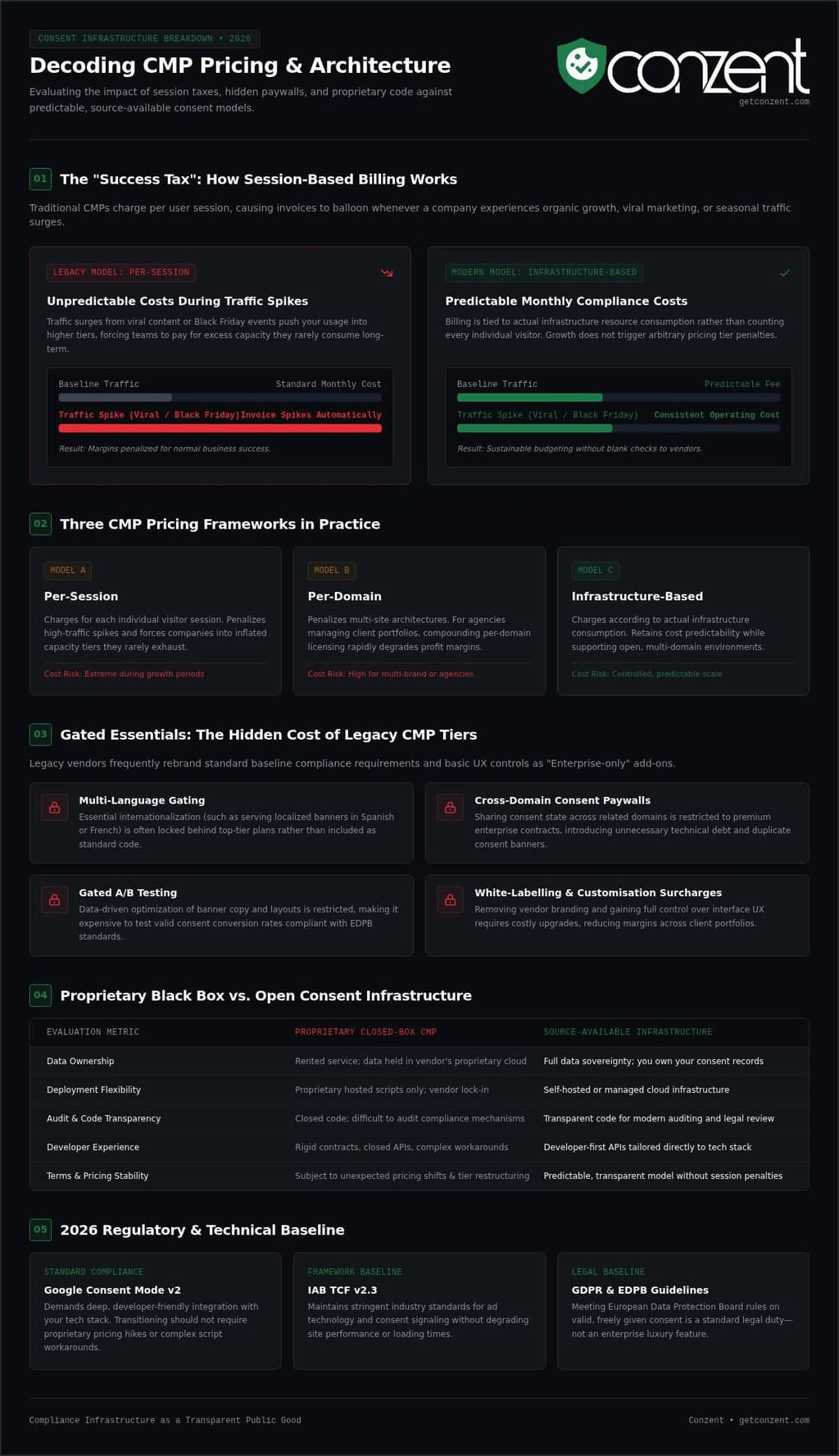
Most traditional CMPs charge based on the number of user sessions. This creates a "success tax" on your growth. If a piece of content goes viral or a Black Friday sale exceeds expectations, your compliance bill spikes alongside your traffic. It makes budgeting nearly impossible for finance teams who value predictability. This model often forces companies into higher tiers where they pay for capacity they rarely use. Under the General Data Protection Regulation (GDPR), you must collect consent, but you shouldn't have to sacrifice your margins to do it. Predictable monthly compliance costs are essential for any business planning for long-term stability.
Proprietary Black Boxes vs. Transparent Code
Relying on closed-source scripts for critical legal infrastructure is a strategic risk. When you use a proprietary "black box" CMP, you don't truly own your consent data. You're renting a service that can change its terms or pricing at any time. It's a brittle foundation for a global business. In contrast, source-available models provide the transparency needed for modern auditing. This is why many are moving toward self-hosted options. These solutions provide full data sovereignty while maintaining the ease of managed cloud support. It's about moving from a distant vendor relationship to a collaborative, technical partnership that respects your infrastructure.
The transition to Google Consent Mode v2 has further complicated this landscape. It requires deeper integration with your tech stack, making developer-friendly documentation more important than ever. If your CMP doesn't offer a clear API and transparent code, you're stuck in a cycle of complex workarounds and rising costs. Switching to usercentrics pricing alternatives that prioritize technical efficiency is no longer just a cost-saving measure. It's a requirement for scalable, ethical growth in 2026. You need a system that works for your developers, not against them.
Decoding CMP Pricing: Session Limits, Domain Fees, and Hidden Tiers
Compliance is a baseline requirement, not a premium feature. Most legacy vendors treat it as the latter. They hide essential tools behind "Enterprise" paywalls, forcing you to pay for a brand name rather than functional code. When looking for usercentrics pricing alternatives, you'll encounter three main billing models. Per-session models charge you for every visitor. Per-domain models penalize multi-site architectures. Infrastructure-based models, however, focus on the resources you actually consume. The shift to TCF 2.3 and Google Consent Mode v2 has often been used as a justification for price hikes, but these requirements should be standard in any modern CMP tier.
Watch out for the "feature creep" that inflates your bill. Multi-language support, cross-domain consent, and A/B testing are frequently gated. You shouldn't have to upgrade to a top-tier plan just to show a banner in Spanish or French. These tactics create a "success tax" where growth leads to higher costs without adding new value. Ensuring your banner meets the EDPB guidelines on valid consent is non-negotiable. It shouldn't require an enterprise-level budget to achieve legal safety.
The Hidden Costs of Customisation
Legacy CMPs often charge a premium for "full customisation." This is a misnomer. In a transparent ecosystem, you should have full control over the UI and UX from day one. For agencies, the cost of white-labelling can be prohibitive, eating into margins across dozens of client portfolios. Instead of paying for a "Premium Support" tier to fix a proprietary script, you're better off with source-available infrastructure. This allows your developers to solve problems directly without waiting for a vendor's ticket queue. It's about technical autonomy versus vendor dependency.
Calculating the Total Cost of Ownership (TCO)
A "cheap" CMP can become expensive very quickly. You must factor in the developer hours spent on complex integrations and ongoing maintenance. If the documentation is poor, your team wastes time. If the script is heavy, your site speed suffers. The real cost includes the potential for compliance errors and the lost conversions from a clunky UI. Using revenue impact analytics helps you see the direct link between consent rates and your bottom line. It turns compliance from a cost center into a performance metric. If you want to see how a more transparent model fits your budget, you can explore predictable pricing options that scale with your needs.
The Best Usercentrics Alternatives for Mid-Market and Enterprise in 2026
Choosing a compliance partner in 2026 requires looking past the marketing gloss. The market has split into two distinct philosophies. You can choose legal-first suites that bundle banners with policy generators, or you can opt for specialized consent infrastructure. For mid-market and enterprise teams, the latter is becoming the standard. These usercentrics pricing alternatives prioritize regulatory coverage, developer experience, and total pricing transparency. You need a solution that integrates with your tech stack, not one that dictates it.
The rise of source-available solutions has changed the standard for what an enterprise CMP should be. Managed cloud flexibility is now the baseline. It allows you to deploy quickly while maintaining the option to audit the underlying code. This transparency is vital for meeting the latest regulatory requirements without sacrificing site performance. You deserve a partner that treats compliance as a public good rather than a proprietary secret. It's about moving toward technical maturity and away from restrictive vendor relationships.
Enzuzo: The Mid-Market Contender
Enzuzo has carved out a space by offering flat-rate simplicity. It's an excellent choice for companies managing multiple domains that want to avoid the complexity of session-based billing. Their fast deployment and Google CMP Gold certification make them a reliable partner for standard web environments. It ensures your IAB TCF v2.3 and GCM v2 signals are handled correctly from day one. However, where it falls short is in deep infrastructure customisation. If your 2026 roadmap includes complex SaaS workflows or unique data sovereignty requirements, you might find its API depth limiting compared to more specialized infrastructure models.
Bundled Compliance Platforms
Many organizations start with bundled compliance platforms that offer "all-in-one" legal document generation alongside their consent banner. These tools have a low barrier to entry and are useful for smaller teams without dedicated legal resources. The challenge arises as your technical stack grows. These suites can feel fragmented when integrated into high-traffic, custom-built applications. They often lack the developer-first documentation and granular API control needed to maintain a seamless user experience across a global product ecosystem. This is why many growing brands eventually seek more specialized usercentrics pricing alternatives that offer deeper technical control.
Conzent: The Open Infrastructure Choice
For teams that have outgrown generic scripts, Open Consent Infrastructure (OCI) offers a principled path forward. Conzent provides a managed cloud platform that is source-available, giving you the transparency of open source with the reliability of a hosted service. It is fully certified for IAB TCF v2.3 Integration and Google Consent Mode v2. This model allows you to maintain full control over your consent data while benefiting from a sponsorship model that keeps community costs low. It represents a shift toward treating compliance as a public good rather than a proprietary secret. You get the flexibility to self-host or use a managed service, ensuring your compliance scales without the enterprise tax. If you're ready to move toward a more transparent model, you can explore our predictable pricing options.
Developer Experience vs. Legal Complexity: Choosing an Integration Path
The "one-click" banner is a marketing trap. It looks simple in a demo; it becomes a technical nightmare in production. Marketing teams want speed. DevOps teams want stability. You shouldn't have to choose between them. Many usercentrics pricing alternatives fail because they hide complexity behind a brittle UI. True compliance requires native support for IAB TCF v2.3 and GCM v2. This isn't an "extra" feature. It is the baseline for modern digital rights management.
APIs and documentation are the silent engines of compliance. If your CMP documentation is a maze of outdated PDFs, your maintenance costs will soar. Clear, versioned API docs reduce the time developers spend debugging proprietary scripts. We believe in providing tools that empower engineers rather than restricting them. Technical efficiency leads to legal rigour. When your code is clean, your compliance is verifiable.
Integration Speed vs. Infrastructure Control
A "one-click" install is often a mask for technical debt. Complex enterprise stacks require more than a copy-paste script. They require auditability. Source-available code allows your security team to see exactly what is happening under the hood. It turns a "black box" into a transparent tool. This is why DevOps teams are migrating toward self-hosted OCI. Control isn't a luxury; it's a security requirement. You own the code. You own the data. You own the outcome. This transparency is a core reason why teams seek usercentrics pricing alternatives that respect their infrastructure.
Optimising for Performance and Core Web Vitals
Bloated CMP scripts kill site speed. They drag down your Largest Contentful Paint (LCP) and Cumulative Layout Shift (CLS) scores. In 2026, user experience is the primary driver of search visibility. Lightweight consent is a non-negotiable metric for 2026 SEO. Cloud-managed scripts should be lean and purposeful. They must deliver compliance without the latency of legacy enterprise tools. When performance drops, your revenue drops with it.
We address this by including built-in revenue impact analytics. This data bridges the gap between legal requirements and business performance. You can finally see how consent rates affect your bottom line in real-time. It turns a legal obligation into a performance-tuning opportunity. If you're ready to stop paying the enterprise tax for a slow script, you can explore our predictable pricing options today.
Conzent: Managed Cloud Consent with a Source-Available Heart
Conzent is a mission, not just a product. It is a source-available platform designed for the Open Consent Infrastructure (OCI) mission. Most usercentrics pricing alternatives are simply different versions of the same proprietary model. They rent you a solution while keeping the code behind a curtain. We do the opposite. We provide the transparency of open-source code with the reliability of a managed service. You choose the deployment that fits your security needs, whether that's our managed cloud or your own servers. This flexibility ensures your compliance strategy remains resilient and auditable.
Our sponsorship model is what truly sets us apart in the 2026 landscape. Large corporate sponsors contribute to the core development, which lowers the barrier to entry for the entire community. It's a principled approach to a shared digital problem. We don't see compliance as a way to tax your success; we see it as a baseline requirement for an ethical internet. This model ensures that even as you scale, you aren't paying an "enterprise tax" for features that should be standard. It's why we're the leading choice among usercentrics pricing alternatives for technically literate teams.
Scaling with Predictability
We've eliminated the session-based "success tax" entirely. With our managed cloud pricing, your costs remain predictable regardless of traffic volatility or viral spikes. You get full access to revenue impact analytics and A/B testing without an enterprise surcharge. This allows you to make data-driven decisions that respect user rights while protecting your margins. Source-available code acts as your ultimate insurance policy. Unlike proprietary SaaS, you aren't tied to a single vendor's survival. You have the code. You have the control. You have the data infrastructure.
Getting Started with Conzent
The migration path from legacy CMPs to Conzent is direct and purposeful. We've built our infrastructure to integrate seamlessly with modern DevOps workflows and custom tech stacks. You can immediately begin using our A/B testing features to optimize your opt-in rates. This isn't about hiding the banner. It's about making it work for your users through better UX and performance. We provide the documentation and API support that developers actually need to succeed. You can stop fighting with your compliance tool and start building your product.
Choosing Conzent means choosing a partner that respects your technical autonomy and your budget. We offer the moral clarity of a community-focused project with the professional support of a global platform. It's time to leave unpredictable billing and vendor lock-in behind for good. View our egalitarian pricing and start scaling today.
Take Control of Your Compliance Infrastructure
Compliance is a technical standard, not a luxury. We've explored how session-based billing creates an artificial success tax that penalizes your growth. By moving toward usercentrics pricing alternatives, you escape proprietary black boxes and reclaim your data sovereignty. The 2026 landscape demands more than just a banner. It requires infrastructure that empowers your developers and respects your users.
The shift to IAB TCF v2.3 and Google Consent Mode v2 doesn't have to be a budget-breaking event. You can leverage source-available transparency and built-in revenue impact analytics to turn a legal obligation into a performance advantage. This isn't just about avoiding fines; it's about building a faster, more ethical digital presence that scales alongside your success. You don't have to settle for unpredictable costs or vendor lock-in.
Ready to build a sustainable compliance foundation? View Conzent Pricing & Sponsorship Options to find an egalitarian model that fits your mission. You have the power to create a more transparent internet. Let's start today.
Frequently Asked Questions
Is there a free alternative to Usercentrics?
Yes, self-hosting is the primary way to access professional compliance without recurring fees. Conzent offers a source-available version of its platform that you can run on your own infrastructure for free. This is a powerful option for teams seeking usercentrics pricing alternatives who have the technical resources to manage their own servers. It provides the same legal rigour as the managed cloud version without the monthly subscription costs.
How does session-based pricing work in most CMPs?
Session-based pricing ties your monthly bill to the number of visitors who interact with your site. Every time a user loads your page and the banner triggers, it counts as a session against your plan limit. If you exceed this limit during a traffic spike, you're often automatically upgraded to a more expensive tier. This model makes compliance costs unpredictable and effectively taxes your website's growth and marketing success.
What is the difference between source-available and proprietary CMPs?
Proprietary CMPs are "black boxes" where you rent access to closed-source code. You can't see how the data is processed or easily audit the infrastructure. Source-available platforms, like Conzent, provide full visibility into the codebase. This transparency allows your developers to inspect, debug, and even self-host the solution. It shifts the relationship from a restrictive vendor lock-in to a flexible, infrastructure-based partnership that prioritizes data sovereignty.
Can I self-host my cookie consent banner to save on costs?
You can certainly self-host your consent infrastructure to eliminate recurring SaaS fees. By using Conzent's self-hosted Open Consent Infrastructure, you take full control of the deployment on your own servers. This removes the "success tax" associated with session-based billing. While it requires internal DevOps resources for maintenance and updates, it provides the highest level of data privacy and long-term cost predictability for high-traffic enterprise applications.
Why is Google Consent Mode v2 important for CMP pricing?
Google Consent Mode v2 is a mandatory requirement for websites using Google Ads and Analytics in the EEA. Many legacy vendors use this technical requirement as a reason to move users into higher-priced "Premium" or "Enterprise" tiers. However, native support for GCM v2 should be a standard feature in any modern compliance tool. It ensures your marketing tags respect user choices while allowing Google to model conversions for users who opt out.
What are the hidden costs of switching CMP providers?
The most significant hidden cost is the developer time required for integration and testing. You must ensure the new script correctly blocks and unblocks all third-party trackers across your entire tech stack. Other costs include potential dips in consent rates if the UI isn't optimized and the time spent migrating historical consent logs. Choosing usercentrics pricing alternatives with clear documentation and a developer-friendly API helps minimize these transition expenses.
Does Conzent support IAB TCF v2.3 and GDPR?
Conzent is fully certified for IAB TCF v2.3 and is built specifically to meet GDPR and ePrivacy requirements. The platform provides the technical framework needed to collect valid, granular consent that stands up to regulatory scrutiny. Whether you use the managed cloud service or the self-hosted infrastructure, you get access to the latest compliance standards. This includes automated vendor list updates and the specific signaling required by the IAB framework.
How do I measure the revenue impact of my cookie banner?
You can use built-in revenue impact analytics to see exactly how consent choices affect your bottom line. This tool correlates opt-in rates with your advertising and e-commerce data. It helps you understand if a specific banner design or placement is causing a drop in trackable conversions. By using this data alongside A/B testing, you can optimize for both legal compliance and business performance without guessing about your ROI.