
Usercentrics vs Cookiebot Performance: The 2026 Core Web Vitals Showdown

What if the two biggest names in consent management are actually the same corporate entity slowing down your site in two different ways? It's a frustrating reality for digital teams. You shouldn't have to choose between legal safety and a fast user experience. Comparing Usercentrics vs Cookiebot performance reveals a shared struggle with High Total Blocking Time. These late-loading banners don't just hurt your Core Web Vitals. They actively drain your revenue by delaying consent initialization for your most valuable scripts.
We've analyzed the latest 2026 data to help you make a technical decision based on speed rather than marketing. You'll discover which legacy tool handles execution more efficiently and where the critical bottlenecks live. While Usercentrics currently holds a slight performance edge over Cookiebot, both platforms rely on centralized cloud delivery that creates inherent latency. This article explores the trade-off between convenience and speed. We'll show you how to protect your site performance by moving beyond the legacy CMP monopoly and into infrastructure-first consent.
Key Takeaways
- Learn why the Usercentrics parent company owns both platforms and how this corporate consolidation affects your technical options.
- Compare Usercentrics vs Cookiebot performance data to see which script weight and Total Blocking Time (TBT) metrics impact your Core Web Vitals.
- Understand the direct link between slow consent initialization and lost ad revenue from increased bounce rates.
- Discover why centralized cloud dependencies create latency and how self-hosting your consent infrastructure can eliminate third-party bottlenecks.
- Identify whether your site needs the automated simplicity of Cookiebot or the enterprise-grade complexity offered by Usercentrics.
Table of Contents
The Illusion of Choice: Usercentrics and Cookiebot in 2026
Compliance is the baseline. It is the entry fee for doing business online. By 2026, meeting the requirements of the GDPR or CCPA is a solved problem. The real differentiator is now performance. When you evaluate Usercentrics vs Cookiebot performance, you must look past the different logos. Usercentrics A/S owns both platforms. This corporate consolidation has turned the CMP market into a legacy monopoly. It keeps users trapped in an ecosystem where both options rely on the same centralized delivery models to manage every HTTP cookie on your site.
The Corporate Connection
The 2021 merger between Usercentrics and Cookiebot's parent company changed the landscape. It wasn't just about market share. It was about consolidating development resources. This creates a specific type of vendor lock-in. While they offer different pricing tiers, the core infrastructure remains centralized. For the site owner, this means your Core Web Vitals are at the mercy of a single provider's uptime and script efficiency. Shared development often leads to feature parity, but it also leads to shared technical debt. If you want to break free from this latency, you need to consider Open Consent Infrastructure that prioritizes your own server speed over a vendor's cloud delivery network.
Market Positioning vs. Technical Reality
Marketing teams have done their job well. They've created a narrative where Cookiebot is for the small WordPress blog and Usercentrics is for the global publisher. Cookiebot is the simple, automated scanner. Usercentrics is the API-driven, customizable powerhouse. The technical reality is much more blurred. They both use "auto-blocking" scripts that can hijack your main thread. They both force your visitors to wait for a third-party server to respond before the page becomes interactive. This "black box" approach to consent management is the primary cause of high Total Blocking Time in 2026.
The branding hides several technical similarities that impact your site's bottom line:
- Shared Bottlenecks: Both platforms rely on external DNS lookups and SSL handshakes that add milliseconds to every page load.
- Script Weight: The "Enterprise" version of Usercentrics often carries the same legacy code burden as the "SMB" version of Cookiebot.
- Centralized Logic: Neither platform allows you to run consent logic truly natively on your own edge or origin server.
Compliance shouldn't be a tax on your site speed. It should be a standard that works with your infrastructure, not against it. Choosing between these two brands often feels like choosing between two different wrappers for the same underlying performance problems. To truly optimize, you have to look outside the monopoly.
Technical Benchmarking: Script Weight and Latency
Performance isn't just about how fast a banner appears. It's about what happens to the browser while the script executes. When comparing Usercentrics vs Cookiebot performance, the "auto-blocking" feature is the primary culprit for slow sites. This feature promises convenience by scanning and blocking scripts automatically. In reality, it forces the browser to pause and evaluate every element on the page. This creates a heavy legacy of JavaScript payload that the user's device must process before anything else happens. You're trading your site's interactivity for a vendor's automated compliance scanner.
Total Blocking Time (TBT) is where these legacy CMPs fail most often. They hijack the main thread. While the script downloads and parses, the page is effectively frozen. Users can't scroll. They can't click. As US regulators demand more transparent and symmetrical consent interfaces, these scripts only get more complex. Every new regulatory requirement adds another layer of logic to the bundle, further bloating the execution time on the client side.
Loading Strategies: Sync vs. Async
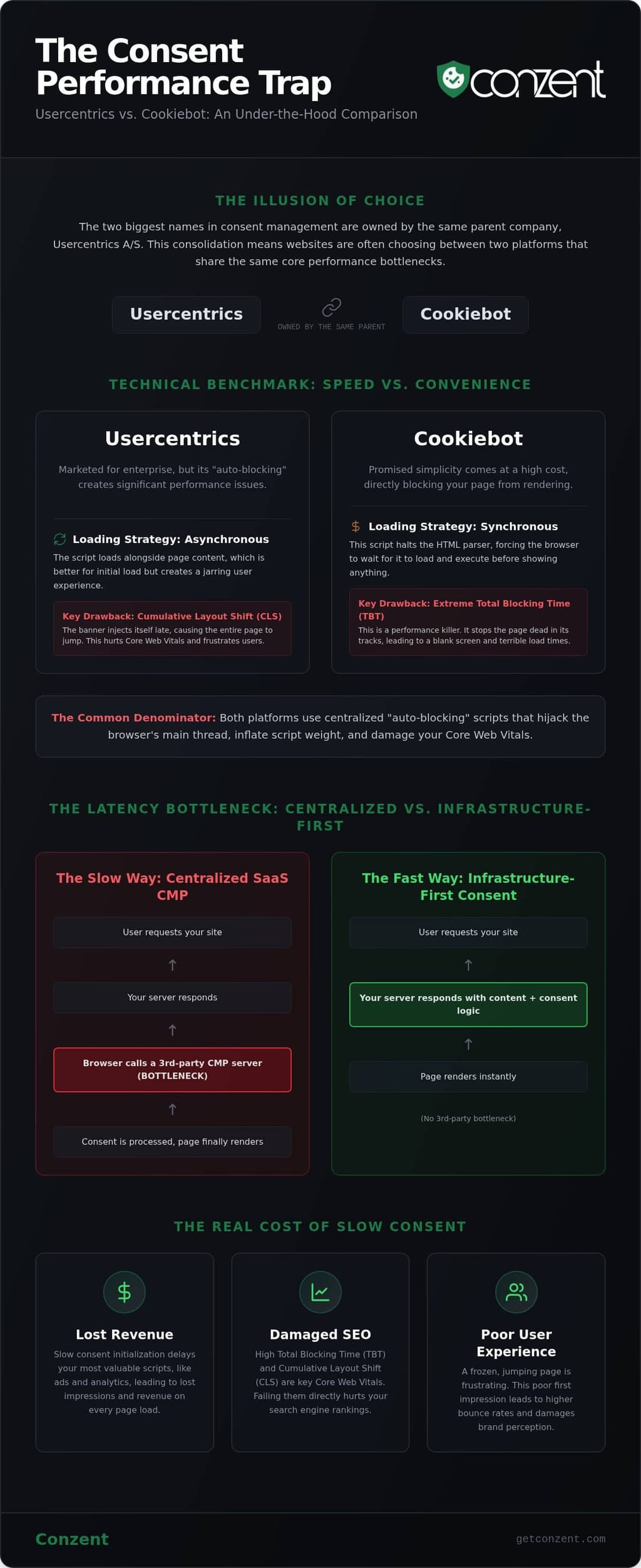
Cookiebot often requires a synchronous script tag to ensure its auto-blocking works before other trackers fire. This is a performance killer. It stops the HTML parser in its tracks. Usercentrics generally uses an asynchronous approach. This is better for initial page load speed but introduces a different problem: Cumulative Layout Shift (CLS). If the banner injects itself late, the whole page jumps. This "Flash of Unconsented Content" is jarring for users and penalizes your SEO scores. If you find these trade-offs unacceptable, it's worth exploring performance-focused options that offer leaner alternatives.
Core Web Vitals Impact
Largest Contentful Paint (LCP) suffers when the banner is a large, complex element that the browser prioritizes over your hero image or headline. First Input Delay (FID) increases because the CPU is busy parsing the CMP's logic. Even if the script is small, the execution lag on a mid-range smartphone is significantly higher than what a desktop simulation suggests. Don't rely solely on Lighthouse scores. Lighthouse runs in a clean lab environment. Your actual users are on mobile devices with varying signals, where the weight of a legacy CMP becomes a literal bottleneck for engagement.
Revenue Performance: Consent Rates and Ad Revenue
Speed isn't just a technical vanity metric. It's a direct driver of your bottom line. When analyzing Usercentrics vs Cookiebot performance, you've got to look at the "Time to Opt-in." If a banner takes 1.5 seconds to render, a significant portion of your mobile traffic has already scrolled past the fold or bounced. This delay causes "consent fatigue." Users who are forced to wait for a legal hurdle before seeing content are less likely to engage positively. They don't just ignore the banner; they leave the site entirely.
This latency has a ripple effect on your data. Google Consent Mode v2 relies on early signals to model behavior for users who decline tracking. If your CMP script is slow, these pings are delayed or never sent. You lose the ability to recover lost data through conversion modeling. High latency effectively blinds your marketing team. It makes your ad spend less efficient because you're bidding on users you can't even track properly. You're paying for traffic that you can't measure because your compliance tool couldn't keep up.
Optimization through A/B Testing
Usercentrics generally holds an advantage over Cookiebot in this area. It offers built-in tools to test different layouts and wording. This is crucial because UI performance directly impacts user trust. A snappy, well-integrated interface feels like a part of the brand. A laggy, generic banner feels like a security risk. To get the best results, you need more than just a checkbox. You need robust Conzent A/B Testing Features to verify which designs actually convert without sacrificing site speed or user confidence.
Revenue Impact Analytics
You can't manage what you don't measure. In 2026, quantifying the cost of a 100ms delay is essential for any high-traffic site. Slow CMPs break the IAB TCF 2.3 signal chain. If the consent string isn't ready when the ad request fires, you serve non-personalized ads by default. This can result in a 30% to 50% drop in CPM value for that specific impression. By Measuring Revenue Impact, you move from guessing about performance to seeing the actual dollar amount your legacy CMP is costing you. Speed isn't just about SEO anymore. It's about protecting your digital revenue stream from unnecessary friction.
The Hidden Latency of Centralized SaaS CMPs
Every third-party script is a guest in your technical stack that you cannot fully control. When you look at Usercentrics vs Cookiebot performance, the discussion usually centers on the size of the JavaScript file. This ignores the silent killers of site speed: DNS lookups and SSL handshakes. Every time a browser loads a legacy CMP, it must connect to an external domain. This process adds a layer of latency before a single line of code even executes. It is a mandatory delay that you cannot optimize away as long as you rely on a centralized SaaS model.
This "SaaS Tax" is a performance and privacy liability. You are forcing your users to connect to a third-party server just to receive a privacy notice. This architecture creates a bottleneck. Your site is only as fast as the vendor's weakest server. If their infrastructure lags, your Core Web Vitals suffer. By 2026, the standard for high-performance websites has shifted. Compliance is no longer something you outsource to a distant cloud. It is a first-party requirement that should live on your own infrastructure.
Edge Delivery vs. Centralized Clouds
Cookiebot utilizes a centralized scanning and delivery model that can struggle with complex, dynamic site architectures. Usercentrics attempts to mitigate this with global CDN distribution to handle traffic spikes. However, both remain vulnerable to regional outages. If their centralized cloud goes down, your consent banner fails to load. In many jurisdictions, a missing banner means you must legally halt all tracking and data collection immediately. This centralized dependency turns a minor performance lag into a major compliance risk that can shut down your analytics and ad revenue in an instant.
The Self-Hosting Performance Advantage
The most effective way to eliminate this latency is to move toward Self-Hosted Open Consent Infrastructure. When you host the consent logic on your own origin or edge server, you remove the need for additional DNS lookups. The browser reuses the existing SSL connection it already established with your website. This isn't just about shaving off a few milliseconds. It is about technical sovereignty. Self-hosting improves security by keeping user consent signals within your own perimeter. It transforms the CMP from a third-party bottleneck into a native, high-speed component of your website.
Take control of your site's technical destiny. You can compare our managed and self-hosted plans to find the right balance between convenience and raw performance.
Choosing the Best CMP for Performance in 2026
Selecting a CMP in 2026 isn't just about a legal checkbox. It's about technical strategy. When evaluating Usercentrics vs Cookiebot performance, you're essentially choosing between two different flavors of the same centralized cloud model. The right choice depends on your site's scale and your team's technical capacity. Compliance is a baseline requirement, but your choice of provider determines how much speed you're willing to sacrifice for that compliance.
Stick with Cookiebot if you manage a small site with low technical overhead. Its automated scanning is a "set and forget" solution for SMBs who don't have the resources to manually categorize every HTTP cookie. However, for enterprise needs with complex IAB TCF 2.3 requirements, Usercentrics is the better legacy option. It offers deeper customization and API-driven controls that high-traffic publishers need to manage consent across multiple platforms. Both tools are reliable for legal safety, but they both carry the weight of third-party execution lag.
If your organization prioritizes performance as a competitive advantage, the legacy monopoly isn't the answer. This is why Conzent is the logical choice for performance-first teams. We don't treat your site as a host for heavy third-party scripts. Instead, we provide an infrastructure-first approach that keeps your Core Web Vitals healthy and your revenue streams protected from latency-driven bounces.
Performance Audit Checklist
Before switching or renewing your contract, run a technical audit to see the real-world impact of your current setup. Use these steps to quantify the "SaaS Tax" on your speed:
- Measure TBT: Run a Lighthouse test before and after activating your CMP to see how many milliseconds it hijacks from the main thread.
- Unused JavaScript: Check PageSpeed Insights for "Reduce unused JavaScript" warnings specifically tied to your CMP's domain.
- GCM v2 Timing: Use the browser console to verify how quickly Google Consent Mode v2 signals fire after the initial page load.
The Future of Consent: Infrastructure as Code
The "black box" SaaS model is reaching its limits. The future of consent lies in source-available, infrastructure-first solutions. Moving toward infrastructure as code allows your team to treat consent management with the same technical rigor as your core application. This transparency builds user trust and ensures that your legal requirements never compromise your technical efficiency. It's time to stop outsourcing your site speed to a third-party bottleneck. Explore the Conzent Managed Cloud Platform to see how we've rebuilt consent for the modern, high-performance web.
Reclaim Your Site Speed and Technical Sovereignty
The 2026 digital landscape proves that compliance is no longer a valid excuse for poor site speed. Analyzing Usercentrics vs Cookiebot performance highlights a shared flaw in the legacy SaaS model. Both platforms rely on centralized delivery that hijacks your main thread and inflates your Total Blocking Time. You shouldn't have to sacrifice your Core Web Vitals to satisfy a regulator. True performance requires a move toward infrastructure-first consent.
By utilizing source-available Open Consent Infrastructure, you eliminate third-party bottlenecks and reclaim your page speed. We provide Managed Cloud scaling that grows with your business while maintaining total moral clarity. You can finally stop guessing about the cost of latency by using our built-in Revenue Impact Analytics to track your bottom line. It's time to treat your consent management as a core part of your technical stack rather than an outsourced afterthought. You have the power to build a faster, more ethical web that respects both your users and your performance budgets.
Switch to a performance-first CMP with Conzent and see how fast your site can really be. You are ready to lead the way in technical efficiency.
Frequently Asked Questions
Does Cookiebot or Usercentrics have a bigger impact on Core Web Vitals?
Cookiebot typically has a more significant impact on Total Blocking Time (TBT) because its auto-blocking feature often requires synchronous script execution. Usercentrics is generally more flexible with asynchronous loading, but it can still trigger Cumulative Layout Shift (CLS) if the banner isn't styled to reserve space. Both platforms add weight to the main thread that can penalize your mobile performance scores.
Can I use Usercentrics or Cookiebot with Google Consent Mode v2 without slowing down my site?
It's difficult to maintain peak performance with these legacy scripts. Google Consent Mode v2 requires consent signals to fire early so that data modeling can begin immediately. If your CMP script is heavy or relies on slow third-party connections, these pings are delayed. This latency can lead to data gaps in your analytics and less accurate conversion modeling.
Why are Usercentrics and Cookiebot often compared together?
They are the two dominant players in the market and have been owned by the same parent company since 2021. Digital teams frequently compare Usercentrics vs Cookiebot performance because they represent the standard SaaS approach to compliance. While Cookiebot targets smaller sites and Usercentrics focuses on enterprise needs, they both utilize similar centralized cloud delivery models.
What is the fastest way to load a cookie consent banner?
The fastest delivery method is self-hosting your consent logic. By serving the script from your own server or edge network, you eliminate the need for additional DNS lookups and SSL handshakes. This allows the banner to load as a native component of your website, removing the inherent bottlenecks found in third-party SaaS infrastructures.
Does a slow cookie banner affect my SEO ranking in 2026?
Yes, because Google continues to use Core Web Vitals as a ranking signal. A CMP that delays page interactivity or causes layout shifts will directly lower your performance scores. Beyond the technical metrics, slow banners increase bounce rates. If users leave your site because it feels unresponsive, search engines interpret that as a poor user experience.
How do I measure the revenue impact of my CMP performance?
You measure it by correlating your "Time to Opt-in" with your overall conversion rate. Specialized tools like Revenue Impact Analytics help you identify the exact moment a user bounces because of a slow banner. By quantifying how many visitors leave before giving consent, you can calculate the literal dollar amount lost to CMP latency.
Is there a free, high-performance alternative to Usercentrics and Cookiebot?
Source-available and open-infrastructure platforms are the best alternatives for performance-focused teams. While legacy vendors offer limited free tiers, they often include heavy branding and restricted features. A self-hosted infrastructure allows you to avoid the "SaaS Tax" and maintain a lean technical stack without the high costs of enterprise-level SaaS subscriptions.
What is the benefit of self-hosting a consent management platform?
Self-hosting provides technical sovereignty and eliminates third-party dependencies. It ensures your compliance tools stay online even if a major SaaS provider experiences a regional outage. This approach allows your developers to control the exact execution order of scripts, making sure that legal requirements never get in the way of a fast, interactive user experience.