
White Label Cookie Consent: An Agency Guide for 2026

A branded consent banner can make a service look white-label, but it doesn’t make the whole platform yours. White label cookie consent can mean anything from removing a vendor logo to rebranding a management portal, while the infrastructure behind it remains a separate question. Agencies should understand that distinction before presenting consent as part of their client service.
It’s reasonable to want a consistent, client-ready experience across multiple sites. It’s also worth considering whether hiding a third-party provider would build trust or weaken it. A stronger approach is to explain what your agency manages and what the technology provides.
This guide explains the different white-label models and the practical capabilities to assess, from multi-site management to testing, analytics, and integrations. It also considers transparent infrastructure as part of a credible service. Conzent offers agencies a choice between managed cloud consent and self-hosting its open-source platform on their own infrastructure, so you can assess which operating model fits your work.
Key Takeaways
- Define what your agency includes in its white label cookie consent service, from banner configuration to client communication and reporting.
- Assess consent choices and visitor experience alongside multi-site administration, not just visual branding.
- Compare managed cloud, self-hosted infrastructure, and agency-operated service by control, maintenance, and responsibility.
- Set a clear workflow for setup, ongoing maintenance, client updates, and analytics before rolling out consent across client sites.
- Explore how Conzent’s open-source infrastructure offers a choice between free self-hosting and a managed cloud service.
What Does White Label Cookie Consent Mean for an Agency?
A client reviews a consent banner on their website and spots another company’s name. The banner may work as intended, but the third-party identity can prompt questions: who set this up, who manages it, and who should the client contact when something changes?
White-label cookie consent means delivering consent functionality as part of an agency-branded service, with the agency defining what it manages and how it supports the client. It’s more than installing a banner. An HTTP cookie is a small piece of data stored by a website or service in a visitor’s browser; consent tools help present choices about relevant cookie use. White-label scope varies, so consider branding, account access, and commercial terms separately.
What can white-labeling cover?
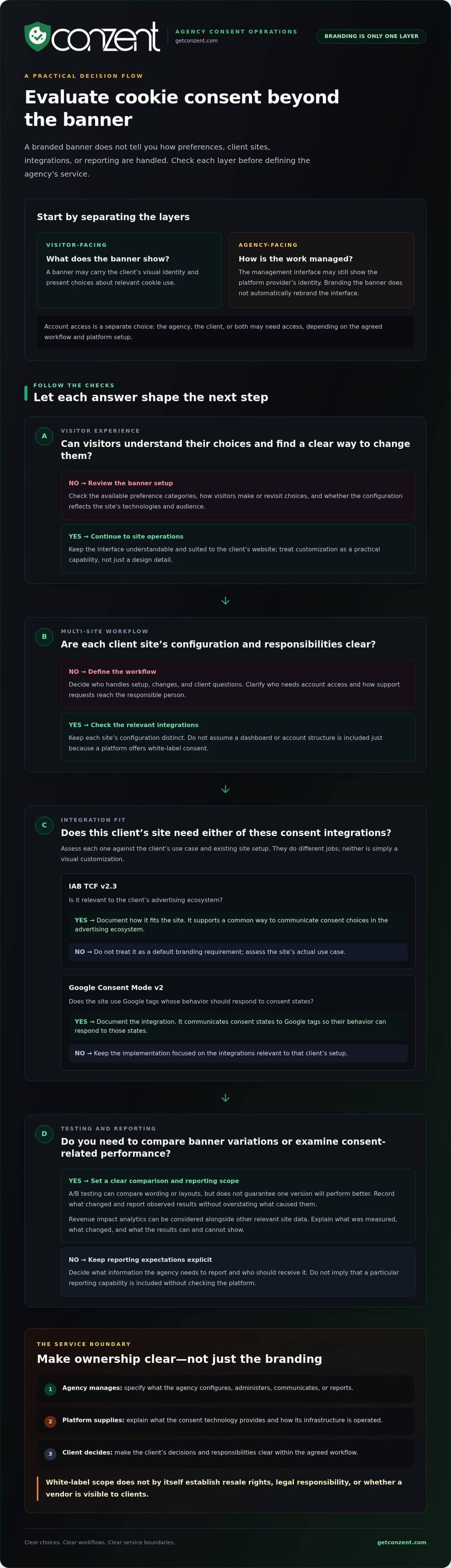
Separate what visitors see from what the agency uses to manage the work. A banner may carry a client’s visual identity, while the management interface still shows the platform provider’s identity. Changing one doesn’t automatically change the other. Account access is another decision: the agency, client, or both may need access, depending on the agreed workflow and platform setup.
Packaging the service for clients is a commercial decision, too. Resale rights and permission to present software as an agency’s own offering don’t automatically follow from a white-label label. The term also doesn’t establish whether a vendor is visible to clients or determine who carries legal responsibility. Make the service boundary clear: what the agency configures, what the platform supplies, and where the client’s decisions sit.
Why agencies consider a branded consent service
A consistent client experience can make consent management feel like a considered part of the agency relationship, rather than a disconnected tool added at launch. But branding alone doesn’t create ownership. Ownership comes from clear implementation and support: explain the setup, record who handles changes, and give clients a straightforward point of contact for service questions.
This work may sit alongside website maintenance or other privacy-related services. For example, an agency might include banner configuration in a site launch and set a separate process for reviewing updates or discussing performance. The precise scope matters more than the label.
White-labeling doesn’t automatically create recurring revenue. An agency’s value depends on the service it actually delivers, such as setup, ongoing administration, client communication, or reporting. A narrow, clearly described offer can be more credible than presenting third-party infrastructure as a fully proprietary platform. Explain the operating model and set expectations clients can understand.
Which Cookie Consent Capabilities Matter Beyond Branding?
A polished banner is only the visitor-facing layer. Agencies also need consent infrastructure that supports clear choices, dependable implementation, and a workable process across client sites. Evaluate those capabilities separately from branding. A branded appearance doesn’t tell you how a tool handles preferences, integrations, or day-to-day administration.
Start with the visitor experience. Can people understand the available choices and find a clear way to change them? Can the agency configure the banner for each client’s website and needs? Treat customizable cookie consent banners as a practical capability, not just a design feature. The goal is an interface that fits the website and makes choices understandable.
Then assess the agency workflow. Managing several client sites means keeping each site’s configuration distinct and knowing who handles setup, changes, and client questions. Decide what information the agency needs to report, who needs access, and how support requests will move from the client to the person responsible. Don’t assume a platform includes a particular dashboard or account structure just because it offers white-label consent.
Consent controls, standards, and integrations
Match consent controls to the client’s use case. Review the preference categories available, how visitors can make or revisit choices, and whether the configuration reflects the site’s technologies and audience. Standards integrations are separate from banner branding. IAB TCF v2.3 supports a common way to communicate consent choices in the advertising ecosystem. Google Consent Mode v2 communicates consent states to Google tags so their behavior can respond to those states. One integration doesn’t replace the other, and neither is simply a visual customization.
For each client, document which integrations are relevant and how they fit the site’s existing setup. Treat this as an implementation decision, not a promise of legal compliance.
Reporting and experimentation for agency teams
Consent A/B testing can compare banner variations, such as different wording or layouts, to help an agency understand how changes relate to user choices. A test doesn’t guarantee that one version will perform better. Set a clear comparison goal, record what changed, and report the observed result without overstating what caused it. Cookie consent A/B testing can make those comparisons part of an evidence-based review.
Revenue impact analytics can help agencies examine consent-related performance alongside other relevant site data. Use reporting to explain what was measured, what changed, and what the results can and can’t show. This gives clients more than a banner screenshot: it provides a grounded account of the consent setup and its performance.
When comparing capabilities for a white label cookie consent service, map them to actual client needs rather than relying on a feature checklist. To assess how the available service options fit your agency workflow, review Conzent’s consent platform options.
How Should Agencies Compare White-Label Consent Models?
Compare operating responsibility before branding. Managed cloud and self-hosting describe where the consent platform runs and who handles its infrastructure. An agency-operated service describes who delivers the work to clients. These are different dimensions, not interchangeable software options. An agency can build its service around a hosted platform or self-hosted infrastructure, then define its own client support and reporting.
| Model | Control | Infrastructure and maintenance | Client-facing management |
|---|---|---|---|
| Managed cloud | The platform provider operates the hosted service; the agency works within the platform’s available configuration. | The provider manages the hosting infrastructure. The agency remains responsible for its agreed client-service tasks. | The agency defines how it communicates setup, support, and results. Don’t assume the management interface is rebranded. |
| Self-hosted | The agency chooses and operates the platform on its own infrastructure, with control shaped by its technical setup. | The agency takes responsibility for its hosting environment and ongoing infrastructure maintenance. | The agency can shape its service workflow, but client access and interface branding depend on the tools and setup used. |
| Agency-operated service | The agency controls the service scope and its role in delivering consent management. | Responsibility depends on whether the underlying platform is managed or self-hosted. | The agency sets expectations, handles assigned support, and explains its work to clients. This service model doesn’t itself change software branding. |
Managed cloud versus self-hosted infrastructure
A managed cloud model reduces the agency’s direct responsibility for running the hosting environment. It can suit a team focused on client delivery rather than infrastructure operations. With self-hosting, the agency has more direct control over its environment, but infrastructure upkeep becomes part of the workload. Neither model is automatically better. Choose based on your technical capacity, desired control, and willingness to own maintenance.
Open source and white-label branding are separate properties. Open-source infrastructure provides access to the software’s source under its applicable terms; it doesn’t automatically provide a branded portal, resale rights, or an invisible vendor relationship. Self-hosted consent infrastructure is one operating approach for agencies that want to run the platform in their own environment.
Questions that clarify the actual white-label scope
Before presenting white label cookie consent to clients, separate the decisions. What will visitors see on the banner? What identity will appear in agency-facing or client-facing management access? What do commercial terms allow the agency to sell or represent? Who controls the technical environment? The answers may differ. Set them out plainly rather than treating “white label” as a promise that covers every layer.
Then assign responsibilities. Decide who configures consent, handles routine maintenance, responds to client questions, and explains reporting. A useful decision rule is simple: choose managed cloud when your team wants less infrastructure work; choose self-hosting when your technical capacity and need for control justify owning that work. Define the agency-operated service around the support and communication your team can reliably deliver.
How Can an Agency Build a Cookie Consent Service for Clients?
A repeatable service starts with clear boundaries. For each client, decide what the agency will configure and maintain, how it will communicate changes, and what it will report. Consent software supports implementation; it doesn’t replace legal advice or determine a client’s legal responsibilities.
Use a consistent sequence, then document who owns each task:
- Define the service scope. List the work the agency will deliver, such as initial setup, banner configuration, testing, maintenance, or performance reporting. State what falls outside that scope so clients know what to expect.
- Select the infrastructure. Choose a managed cloud service if the team prefers a hosted operating model, or self-hosted infrastructure if it has the capacity to operate the platform in its own environment. Conzent’s managed cloud consent platform options provide a starting point for reviewing the hosted model.
- Configure consent. Inventory each site’s technologies and relevant integrations, then configure the consent experience for the client’s needs. Record the decisions and identify who reviews them before implementation.
- Report outcomes. Agree on the client’s questions, select relevant measures, and explain results in context. Keep observations distinct from conclusions about what caused them.
Turn agency needs into a repeatable delivery process
Build an onboarding record for every site. Capture its consent-management needs, relevant integrations, configuration decisions, and client review status. Use the same checkpoints across projects, but tailor the configuration to each site. A standard process reduces missed handoffs; it shouldn’t force every client into an identical setup.
Assign an owner for routine maintenance and for communicating platform or configuration changes. Make the workflow explicit: who identifies a change, who assesses its effect on the setup, and who updates the client. Clear ownership matters whether the agency uses a hosted service or runs infrastructure itself.
Make reporting useful to clients
Start reporting with the client’s stated business question. A/B testing can compare consent banner variations, while revenue impact analytics can help examine consent-related performance. Neither guarantees a preferred result. Record what changed, what was measured, and what the data can reasonably support. The revenue impact of cookie consent is a useful reporting topic when clients want to understand performance in context.
Keep reports direct. Separate measured results from interpretation, note the period or configuration being discussed, and identify any next step the agency recommends. This makes analytics useful for decisions, not just a collection of numbers.
A credible white label cookie consent service rests on transparent responsibilities and a process the team can deliver consistently. Review Conzent’s consent platform options to compare the managed cloud model with your agency’s service needs.
How Conzent Can Support a Transparent Agency Consent Offering
Conzent provides agencies with a choice of consent infrastructure. Its open-source platform lets agencies review the software’s source under its applicable terms and assess how it fits their operations. Branding, client access, and commercial arrangements are separate parts of an agency’s service design. Being clear about those distinctions helps agencies describe their offer accurately.
The platform supports practical agency work with customizable consent banners, consent A/B testing, revenue impact analytics, IAB TCF v2.4 integration, and Google Consent Mode v2. These capabilities help teams configure a consent experience, test variations, examine performance, and connect consent signals with relevant standards and tools. They support implementation and reporting, but don’t replace legal advice or guarantee compliance.
Choose the operating model that fits your agency
With self-hosting, an agency runs Conzent’s open-source infrastructure in its own environment. This can suit a team that wants direct control and has the technical capacity to operate the platform and maintain its infrastructure. Self-hosting is free, but the agency still needs to account for the work involved in running its own environment.
With managed cloud, Conzent provides the hosted service, including infrastructure maintenance, automatic updates, and cloud-based analytics dashboards. This can suit teams that prefer not to host the platform themselves. The trade-off is straightforward: self-hosting places infrastructure responsibility with the agency, while managed cloud avoids that particular responsibility. Choose based on your team’s technical resources, preferred level of control, and the client support you intend to provide.
Managed cloud pricing follows a sponsorship-linked principle: pricing decreases as sponsorships increase. This can inform an agency’s evaluation, but it doesn’t establish a specific rate for a particular client or project. Compare the current options with the service you plan to deliver rather than building your offer around an assumed price.
Assess the next step for your client service
Before adopting either model, map the platform to your client workflow. Identify which sites need consent management, what integrations matter, who will configure banners, and who will explain testing or analytics. Decide what clients will see and what the agency will own. Clear boundaries help you build a service around the technology without implying that the software itself provides your agency’s branding, support, or legal advice.
For agencies developing white label cookie consent as a client service, transparency is part of the offer. Make the infrastructure choice clear. State what your team controls and manages, then assess the available operating and pricing options against your technical capacity and service scope. Explore Conzent pricing to compare the options. Practical control begins with clear responsibilities, not hidden infrastructure.
Make Your Consent Service Clear From the Start
Turn your agency’s approach into a service clients can understand and rely on. Decide what your team will manage, how you’ll explain the technology behind the consent experience, and what clients can expect from your reporting. Clear boundaries build credibility. A hidden vendor name or polished banner can’t replace them.
Use that service definition to guide your platform decision. Consider the infrastructure your team can operate, the control it needs, and how the model fits the support you plan to provide. Then shape your white label cookie consent offer around work your agency can deliver consistently, not assumptions about branding or software.
Compare Conzent's pricing and consent platform options to see which operating model fits your agency’s plans. Build with transparency, define responsibilities clearly, and give clients a consent service they can trust.
Frequently Asked Questions
What is white-label cookie consent?
White-label cookie consent is a consent service an agency delivers within its own client offering. The agency may coordinate setup and support while relying on a separate consent platform underneath. For example, an agency could include consent configuration in a website launch package, then explain clearly which parts it manages and which depend on the platform. The term alone doesn’t specify how the service is branded or who operates its infrastructure.
Is a white-label cookie banner the same as a rebranded CMP dashboard?
No. A banner is the interface visitors encounter on a website; a CMP dashboard is used to manage consent settings or the service. Changing the banner’s appearance doesn’t automatically change the dashboard’s branding, access, or features. An agency planning client access should map out what visitors see and what staff or clients use behind the scenes, then describe each layer accurately.
Can an agency resell cookie consent software under its own brand?
Only if the software’s commercial terms permit that arrangement. Branding a banner or adding consent work to an agency package doesn’t automatically grant resale rights. Before offering it, define how the client receives access, who bills for the software, and which party provides ongoing support. Keep those terms distinct from the agency’s own fees for configuration, reporting, or client communication.
Does white-label cookie consent guarantee GDPR compliance?
No. A consent platform can support implementation, but a branded interface or software subscription can’t guarantee that a website meets GDPR requirements. The right setup depends on how the site collects and uses data, among other factors. Agencies should describe the platform’s role accurately, avoid presenting configuration as legal advice, and direct clients to qualified legal guidance for questions about their obligations.
Can an agency self-host a cookie consent platform?
Yes. Conzent offers open-source consent infrastructure that agencies can run on their own infrastructure. Its self-hosting option is free, but the agency is responsible for operating its environment. Before choosing this model, identify who will handle platform maintenance and how that work fits the team’s existing technical capacity. Self-hosting gives the agency a different operating role than using a hosted service.
How much does white-label cookie consent software cost?
There isn’t one price that applies to every agency setup. The cost depends on the operating model and the current terms for the chosen service. Conzent offers free self-hosting, while its managed cloud service uses a sponsorship-linked pricing structure. Review the current options before setting client fees, and account separately for the agency’s own implementation and support work. See Conzent’s current pricing options.
What should an agency include in a cookie consent service?
Set out the work clients will receive and how it will be delivered. That might include an initial site review, configuration, a client approval step, a named support contact, and an agreed reporting schedule. Explain what the agency handles versus what the platform provides. For example, a monthly report could describe configuration changes and observed test results without promising a particular consent rate or business outcome.