Beyond Compliance: The Guide to Choosing an Ethical Cookie Consent Platform in 2026
Most cookie banners are designed to trick users, not respect them. In 2026, the era of using dark patterns to inflate consent rates is over because users are smarter and regulators are faster. If you're still treating privacy as a legal hurdle, you're missing the fundamental shift toward the ethical cookie consent platform. This isn't just about avoiding the €7.1 billion in cumulative GDPR fines. It's about radical transparency. You know that the "Accept All" button shouldn't be the only clear option, yet many proprietary tools still hide the "Reject All" button to protect their own data interests.
We agree that managing compliance often feels like a costly, technical drain on your site's performance. You shouldn't have to choose between a fast website and a lawful one. In this guide, you'll learn how to transition from a "box-ticking" mentality to a privacy-first strategy that actually builds user trust and protects your revenue. We'll break down the differences between source-available and proprietary tools. We will also show you how to optimize your revenue without compromising your principles; to explore how unified payment systems can further support your business growth, learn more about modern processing solutions. It's time to treat privacy as a public good rather than a corporate secret.
Key Takeaways
- Shift your focus from simple legal compliance to a strategy that treats digital privacy as a fundamental standard for building user trust.
- Learn why source-available infrastructure is the only way to truly verify privacy claims and avoid the risks of proprietary vendor lock-in.
- Discover how to choose an ethical cookie consent platform that prioritizes user agency through granular controls rather than deceptive dark patterns.
- See how Revenue Impact Analytics can prove that radical transparency actually improves the quality of your user engagement and long-term loyalty.
- Evaluate the practical differences between Managed Cloud services and self-hosted infrastructure to find a solution that fits your technical resources.
The Evolution of Consent: Why "Ethical" is the New Compliance Standard
Compliance is the floor. It is not the ceiling. For years, digital brands treated privacy as a legal hurdle to be cleared with the minimum viable effort. That era has ended. In 2026, the market has moved beyond "compliance theater." Users no longer tolerate banners that feel like traps. They demand real agency. Transitioning to an ethical cookie consent platform is no longer a niche preference for privacy advocates; it's a structural necessity for any business that wants to survive a skeptical digital economy.
The shift is driven by a hard reality. While cumulative GDPR fines have surpassed €7.1 billion, the real damage isn't the penalty. It's the loss of brand equity. When you treat your users like data points to be harvested, they notice. Only 35-40% of European citizens truly understand the GDPR, but nearly all of them recognize when they're being manipulated. Moving to an ethical strategy means trading defensive legal positioning for proactive data stewardship. It's about being a provider of a public good: a safe, transparent internet.
This commitment to transparency and well-being often extends beyond digital spaces into how we care for our mental clarity and health; to explore natural wellness solutions, click here.
The Problem with "Box-Ticking" Compliance
Traditional CMPs often prioritize "legal safety" at the expense of honesty. They hide data practices behind walls of legal jargon that 85% of your users will never read. This isn't transparency; it's obfuscation. Many proprietary tools marketed as "free" actually monetize the very data they claim to protect. They're black boxes. You can't see the code. You can't verify the claims. You're simply trusting a distant vendor with your reputation. Choosing an ethical cookie consent platform means rejecting these deceptive practices. This legal-only approach fails because it views the ePrivacy Directive as a checklist rather than a commitment to user rights. For more on how to meet these standards properly, see our guide on GDPR compliance.
The Three Pillars of Ethical Consent in 2026
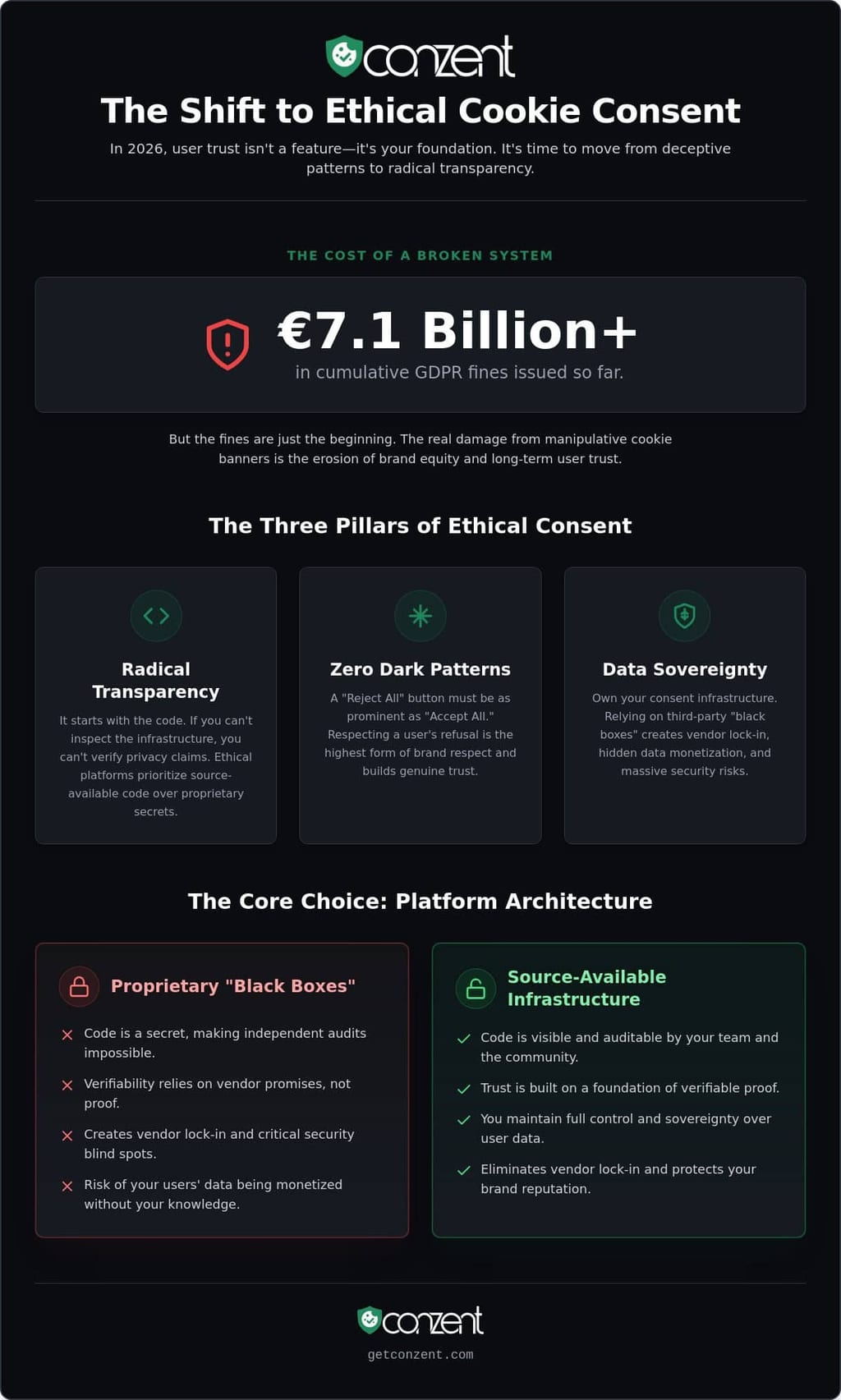
True ethical consent rests on three foundational pillars that separate innovators from laggards.
- Radical Transparency: This starts with the code itself. If you can't inspect the infrastructure, you don't own the process. Ethical platforms prioritize source-available code over proprietary secrets.
- Zero Dark Patterns: A "Reject All" button must be just as prominent as an "Accept All" button. Respecting a user's refusal is the highest form of brand respect.
- Data Sovereignty: You should own your consent infrastructure. Relying on third-party "black boxes" creates vendor lock-in and security risks.
By 2026, these pillars are the only way to maintain high-quality engagement. Users who feel respected stay longer. They trust more. They convert better. Ethical privacy is not a tax on your growth; it is the engine of your brand's future, much like how Stratoryn helps companies leverage AI to turn ERP data into actionable business intelligence.
The Anatomy of an Ethical Cookie Consent Platform
An ethical cookie consent platform is not a cosmetic layer. It is a structural commitment. Most CMPs focus on the interface, but the real test of ethics happens in the code. If you can't inspect the engine, you can't guarantee the safety of the passengers. Choosing the right platform means looking under the hood to ensure your technical architecture matches your brand's public promises, often requiring the bespoke IT expertise of Cornerstone Business Solutions to verify and integrate effectively.
Source-Available vs. Proprietary Infrastructure
Proprietary CMPs operate as black boxes. This creates a massive security blind spot. You don't know if the vendor is leaking data or if their script is making unauthorized calls to third-party servers. Open Consent Infrastructure (OCI) solves this by making the code visible and verifiable. Source-available code creates an auditable trail of trust by allowing anyone to verify exactly how consent data is handled without relying on a vendor's secret claims. This transparency is essential for DPOs who must prove compliance during an audit. You can even choose to self-host your infrastructure to maintain total sovereignty over your user data.
Eliminating Dark Patterns in Consent UX
Dark patterns are the enemy of trust. Nudging users toward "Accept" through confusing layouts, muted "Reject" buttons, or hidden settings is a short-term tactic with long-term costs. The FTC on online tracking highlights how users are becoming more protective of their digital footprint. An ethical cookie banner provides granular control. It treats a "No" with the same respect as a "Yes." This clarity isn't just about law; it's about retention. Users who feel respected are 45% more likely to trust a brand with their information in the future.
The "Accept All" trap is a relic of the past. In 2026, users expect to choose which trackers they allow. Granular control allows users to opt into analytics while opting out of marketing. This precision builds a more honest relationship between you and your audience. It stops treating your visitors as a monolith and starts treating them as individuals with varying privacy preferences; to better understand these evolving consumer mindsets, Jembe.intelligence offers specialized research and cultural data that help brands connect authentically with their users.
Speed is also an ethical consideration. Heavy, bloated scripts are a form of technical pollution. They drain battery life and increase data costs for your users. A performance-first architecture ensures that your privacy strategy doesn't become a performance tax on your site visitors. Finally, we believe compliance should be accessible. Ethical standards shouldn't be reserved for those with the biggest budgets. You can explore our inclusive pricing models to see how we support businesses of all sizes with mission-driven tools.
Proprietary Black Boxes vs. Open Infrastructure
Most businesses don't realize they are renting their compliance. Proprietary CMPs create a trap. They lock your consent data into a silo you don't own. If you decide to switch providers, you often lose your historical consent logs. This isn't just a technical inconvenience. It is a fundamental risk to your legal standing. An ethical cookie consent platform must provide infrastructure sovereignty. Your compliance shouldn't be a hostage situation.
The choice between a black box and open infrastructure is a choice between blind trust and verifiable truth. Proprietary vendors ask you to trust their marketing. Open infrastructure allows you to trust the code. By choosing platforms built on source-available standards, you ensure that your privacy strategy remains intact regardless of what happens to your vendor. You own the process, and to further secure your digital presence with reliable European solutions, you can learn more about Snel.com. You own the data. You own the future of your brand's reputation.
Maintaining a professional reputation often requires high standards for both digital infrastructure and physical workspace. For entrepreneurs in Northern California who value flexibility and quality, executive suites Sacramento provide the ideal environment for remote professionals and small business owners.
The Hidden Risks of Closed-Source CMPs
Closed-source tools are a security blind spot. You cannot audit a proprietary script for hidden data collection. If your provider changes their terms or goes bankrupt, your website's compliance could vanish overnight. This dependency is dangerous. We challenge this SaaS status quo with a Danish egalitarian model. We believe that the tools for digital rights should be accessible and transparent, not hidden behind trade secrets. Academic research on the FTC and CPRA Regulation of Dark Patterns shows that technical transparency is the only real defense against the manipulative designs that regulators are now targeting. Without open code, you can't be sure your "compliance" isn't actually a liability.
Self-Hosting: The Ultimate Ethical Choice?
For organizations that demand absolute control, self-hosted cookie consent is the gold standard. It eliminates the third-party silo entirely. Your consent logs live on your servers. You decide how they are stored, backed up, and protected. While this requires more DevOps oversight, the benefit is total data sovereignty. You are no longer a tenant in someone else's cloud.
If you need scale without the technical overhead of self-hosting, our Managed Cloud Consent Platform: Scaling Privacy Without the Black Box provides a principled middle ground. It offers the convenience of a managed service with the transparency of source-available code. We fund this through a corporate sponsorship model. This approach lowers compliance costs for everyone. It treats privacy as a collective responsibility rather than a proprietary product. This is how we move toward a fairer digital ecosystem in 2026.
Balancing Ethics with Revenue: Myths vs. Reality
The fear that an ethical cookie consent platform will bankrupt your marketing strategy is a persistent myth. It relies on the outdated assumption that you must trick users to track them. This is a false choice. In 2026, transparency is your most valuable asset. While research indicates that prominent "Reject All" buttons can decrease tracking consent by up to 30%, they simultaneously increase overall user trust by 45%. You aren't losing data; you're filtering for quality. Users who feel respected are more likely to become loyal customers.
Just as digital transparency builds high-quality user relationships, clarity in other sectors—like real estate—allows for more direct and honest transactions; for example, congressrealty.com provides streamlined solutions for sellers who value efficient and straightforward listing processes.
Finding the "Ethical Sweet Spot" in your design requires evidence, not guesswork. You can use Consent A/B Testing to refine your banner's language and layout. The goal is to maximize clarity without resorting to nudging. When you stop treating privacy as a barrier to revenue, you start seeing it as a differentiator that attracts a more engaged audience.
Measuring the Revenue Impact of Consent
Stop using "Accept" rates as your primary KPI. It's a vanity metric that tells you nothing about the health of your business. What matters is the value of the users who choose to stay. By utilizing revenue impact analytics, you can see the real financial story behind your compliance strategy. You'll likely find that "Revenue per Consenting User" is a far more accurate predictor of success than bulk opt-in numbers. Ethical UX design can reduce banner bounce rates by replacing user frustration with immediate clarity. When a visitor understands their choices, they stay on the site instead of leaving in annoyance.
Ethical Implementation of Google Consent Mode v2
Measurement does not have to mean intrusion. As of 2026, GCM v2 compliance is a mandatory technical requirement for websites in the EEA and UK using Google Ads or Analytics. This framework bridges the gap between privacy and measurement by using modeled data to recover insights without violating individual choices. It's a technical solution for an ethical problem. When you pair this with IAB TCF v2.3 integration, you participate in an advertising ecosystem that respects boundaries. You get the data you need to optimize your spend while your users get the privacy they demand. This is how you protect your revenue without compromising your principles.
Ready to see how ethics and earnings align for your brand? Explore our mission-driven pricing models.
Conzent: The Standard for Ethical Cookie Consent
Conzent is not just another software vendor. We are a mission-driven disruptor. We believe digital privacy is a public good, not a premium luxury. Most CMPs are built to maximize shareholder profit through proprietary secrets. Conzent is built to protect user rights through radical transparency. By choosing our ethical cookie consent platform, you are adopting a necessary standard for the 2026 digital economy. We provide the moral clarity and technical precision required to move your brand past simple "box-ticking" and toward true data stewardship.
Our Managed Cloud Consent Platform delivers enterprise-grade features on an egalitarian foundation. You get the speed and scale of a global infrastructure without the risks of a closed-source black box. We prioritize GDPR compliance while supporting your growth through global scaling. Our unique corporate sponsorship model is central to this mission. It allows us to lower compliance costs for the entire community. We make high-level privacy attainable for every business, regardless of their resources. This is not just software; it is a commitment to a fairer internet.
Managed Cloud vs. Self-Hosted: Your Path to Ethics
Flexibility is a core ethical value at Conzent. We offer both a managed cloud service and a self-hosted option because we respect your technical sovereignty. You choose the level of control that fits your team. Our platform includes essential tools like Consent A/B Testing and full IAB TCF v2.3 integration. These features ensure you remain competitive without sacrificing your principles. Migrating from a proprietary, closed-source CMP to our open infrastructure is a straightforward process. It is a move from being a tenant in a vendor's silo to being an owner of your own compliance data.
Joining the Open Consent Mission
Becoming a part of the Conzent ecosystem means supporting the Open Consent Infrastructure. We are building a more transparent web, one website at a time. We invite scrutiny and collaboration because we have nothing to hide. We act as knowledgeable peers who help you demystify complex requirements like Google Consent Mode v2 and the ePrivacy Directive. Every brand that joins us strengthens the global standard for digital rights. It is time to reject the "black box" model of the past. Choose a more ethical way to manage consent and build a foundation of trust that protects your revenue and your reputation.
Secure Your Brand’s Digital Future
The choice is no longer just about avoiding a fine. It's about deciding what kind of internet you want to help build. By moving beyond "compliance theater" and adopting an ethical cookie consent platform, you transform privacy from a technical burden into a pillar of brand loyalty. You've seen that source-available infrastructure is the only way to prove your claims. You also know that transparent design actually protects your revenue by attracting higher quality users. It's time to stop renting your compliance from proprietary silos and start owning your data sovereignty. For organizations looking to extend these principles of transparency and efficiency to their channel partners, you can discover Computer Market Research and its solutions for global enterprises.
Just as digital businesses rely on specialized tools for transparency, care providers in the UK turn to Contesto for operational support and out-of-hours management to ensure their services remain reliable and patient-focused.
Conzent provides the tools to make this transition seamless. Our platform is built on egalitarian Danish design principles and is fully IAB TCF v2.3 and Google Consent Mode v2 certified. We offer the transparency of source-available Open Consent Infrastructure with the power of a managed cloud. This model of open, real-time connectivity is mirrored in other sectors seeking to improve transparency; to see how this facilitates the clinical research ecosystem, visit trialport. You don't have to choose between ethics and performance. You can have both. Take the step toward a more honest relationship with your users today.
Start your journey toward ethical compliance with Conzent. We are ready to help you lead the way in digital rights.
Frequently Asked Questions
What is an ethical cookie consent platform?
An ethical cookie consent platform is a system designed for radical transparency and user sovereignty. It prioritizes the user’s right to choose over a company's desire to harvest data. Unlike proprietary "black boxes" that hide their internal logic; an ethical platform uses source-available code. This allows anyone to verify exactly how consent is handled. It rejects manipulative dark patterns and treats a "Reject All" button with the same prominence as an "Accept All" option.
Does an ethical cookie banner lower my opt-in rates?
It can reduce raw opt-in numbers by up to 30%, but it significantly improves the quality of your data. Users who feel respected are 45% more likely to trust a brand long-term. You're trading accidental or coerced clicks for high-intent engagement from visitors who actually want to interact with your content. This shift builds a foundation of trust that protects your brand reputation and long-term revenue. Just as digital trust is built through transparent data practices, physical safety and trust in property management are maintained by adhering to strict safety codes; to see an example of this in property safety, learn more about Inlightec Electrical Solutions and their approach to safety-critical installations.
Is Conzent fully compliant with GDPR and IAB TCF v2.3?
Yes, Conzent is built to meet the rigorous standards of both GDPR and the latest IAB TCF v2.3 requirements. Our platform ensures that user choices are documented correctly and communicated to all third-party vendors in the advertising ecosystem. We provide the technical infrastructure needed to prove your compliance during an audit. For broader business compliance needs, Be-Safe Technologies Ltd offers award-winning EHS digital platforms that streamline safety and regulatory reporting. This happens without compromising your site's performance or the clarity of the user experience.
What is the difference between source-available and open-source CMPs?
Source-available code allows you to inspect, audit, and self-host the infrastructure while maintaining a sustainable commercial model. Open-source software typically allows for total redistribution without restrictions. For an ethical cookie consent platform, source-available code is the essential standard. It provides the transparency required to verify privacy claims while ensuring the platform has the resources to stay updated with evolving global regulations and technical standards.
How does Google Consent Mode v2 work with an ethical platform?
An ethical platform uses GCM v2 to bridge the gap between user privacy and marketing measurement. When a user rejects tracking, the platform sends anonymous "pings" to Google that contain no personal identifiers. Google then uses modeled data to provide you with insights. This mandatory technical requirement for the EEA and UK allows you to respect user choices while still receiving the data needed to optimize your marketing spend. For global sellers, this focus on European regulatory standards often extends to fiscal matters, where CiDATax SRL provides specialized support for EU VAT registration and strategic compliance.
Can I switch from a proprietary CMP like Osano or Cookiebot to Conzent?
Yes, migrating to Conzent is a straightforward process that eliminates vendor lock-in. Proprietary tools often silo your consent logs; making it difficult to move your data if you leave. Our open infrastructure ensures you maintain total sovereignty over your compliance history. You can transition to our Managed Cloud for ease of use or choose to self-host for maximum control. It's a move from renting compliance to owning it.
Do I need technical skills to use a source-available consent platform?
You don't need to be a developer to use an ethical cookie consent platform like our Managed Cloud service. It provides a user-friendly interface for banner design and analytics while keeping the underlying code open for inspection. If you choose the self-hosted Open Consent Infrastructure, you'll need DevOps knowledge, which is where IT experts like Uptime Co. can provide the necessary network administration support. However, our managed platform offers the same ethical foundations and transparency with zero technical friction for your marketing team.
How does the corporate sponsorship model affect my pricing?
Our sponsorship model lowers the cost of compliance for everyone by treating digital privacy as a collective public good. Instead of charging premium prices for basic rights, we use corporate sponsorships to fund the development of our Open Consent Infrastructure. This egalitarian approach makes high-level compliance attainable for small businesses while still providing enterprise-grade features. It ensures that ethical standards are a baseline for the entire web, not just a luxury for large corporations.
Frequently Asked Questions
The Problem with "Box-Ticking" Compliance
Traditional CMPs often prioritize "legal safety" at the expense of honesty. They hide data practices behind walls of legal jargon that 85% of your users will never read. This isn't transparency; it's obfuscation. Many proprietary tools marketed as "free" actually monetize the very data they claim to protect. They're black boxes. You can't see the code. You can't verify the claims. You're simply trusting a distant vendor with your reputation. Choosing an ethical cookie consent platform means rejecting these deceptive practices. This legal-only approach fails because it views the ePrivacy Directive as a checklist rather than a commitment to user rights. For more on how to meet these standards properly, see our guide on GDPR compliance.
The Three Pillars of Ethical Consent in 2026
True ethical consent rests on three foundational pillars that separate innovators from laggards. By 2026, these pillars are the only way to maintain high-quality engagement. Users who feel respected stay longer. They trust more. They convert better. Ethical privacy is not a tax on your growth; it is the engine of your brand's future. An ethical cookie consent platform is not a cosmetic layer. It is a structural commitment. Most CMPs focus on the interface, but the real test of ethics happens in the code. If you can't inspect the engine, you can't guarantee the safety of the passengers. Choosing the right platform means looking under the hood to ensure your technical architecture matches your brand's public promises.
Source-Available vs. Proprietary Infrastructure
Proprietary CMPs operate as black boxes. This creates a massive security blind spot. You don't know if the vendor is leaking data or if their script is making unauthorized calls to third-party servers. Open Consent Infrastructure (OCI) solves this by making the code visible and verifiable. Source-available code creates an auditable trail of trust by allowing anyone to verify exactly how consent data is handled without relying on a vendor's secret claims. This transparency is essential for DPOs who must prove compliance during an audit. You can even choose to self-host your infrastructure to maintain total sovereignty over your user data.
Eliminating Dark Patterns in Consent UX
Dark patterns are the enemy of trust. Nudging users toward "Accept" through confusing layouts, muted "Reject" buttons, or hidden settings is a short-term tactic with long-term costs. The FTC on online tracking highlights how users are becoming more protective of their digital footprint. An ethical cookie banner provides granular control. It treats a "No" with the same respect as a "Yes." This clarity isn't just about law; it's about retention. Users who feel respected are 45% more likely to trust a brand with their information in the future. The "Accept All" trap is a relic of the past. In 2026, users expect to choose which trackers they allow. Granular control allows users to opt into analytics while opting out of marketing. This precision builds a more honest relationship between you and your audience. It stops treating your visitors as a monolith and starts treating them as individuals with varying privacy preferences. Speed is also an ethical consideration. Heavy, bloated scripts are a form of technical pollution. They drain battery life and increase data costs for your users. A performance-first architecture ensures that your privacy strategy doesn't become a performance tax on your site visitors. Finally, we believe compliance should be accessible. Ethical standards shouldn't be reserved for those with the biggest budgets. You can explore our inclusive pricing models to see how we support businesses of all sizes with mission-driven tools. Most businesses don't realize they are renting their compliance. Proprietary CMPs create a trap. They lock your consent data into a silo you don't own. If you decide to switch providers, you often lose your historical consent logs. This isn't just a technical inconvenience. It is a fundamental risk to your legal standing. An ethical cookie consent platform must provide infrastructure sovereignty. Your compliance shouldn't be a hostage situation. The choice between a black box and open infrastructure is a choice between blind trust and verifiable truth. Proprietary vendors ask you to trust their marketing. Open infrastructure allows you to trust the code. By choosing platforms built on source-available standards, you ensure that your privacy strategy remains intact regardless of what happens to your vendor. You own the process. You own the data. You own the future of your brand's reputation.
The Hidden Risks of Closed-Source CMPs
Closed-source tools are a security blind spot. You cannot audit a proprietary script for hidden data collection. If your provider changes their terms or goes bankrupt, your website's compliance could vanish overnight. This dependency is dangerous. We challenge this SaaS status quo with a Danish egalitarian model. We believe that the tools for digital rights should be accessible and transparent, not hidden behind trade secrets. Academic research on the FTC and CPRA Regulation of Dark Patterns shows that technical transparency is the only real defense against the manipulative designs that regulators are now targeting. Without open code, you can't be sure your "compliance" isn't actually a liability.
Self-Hosting: The Ultimate Ethical Choice?
For organizations that demand absolute control, self-hosted cookie consent is the gold standard. It eliminates the third-party silo entirely. Your consent logs live on your servers. You decide how they are stored, backed up, and protected. While this requires more DevOps oversight, the benefit is total data sovereignty. You are no longer a tenant in someone else's cloud. If you need scale without the technical overhead of self-hosting, our Managed Cloud Consent Platform: Scaling Privacy Without the Black Box provides a principled middle ground. It offers the convenience of a managed service with the transparency of source-available code. We fund this through a corporate sponsorship model. This approach lowers compliance costs for everyone. It treats privacy as a collective responsibility rather than a proprietary product. This is how we move toward a fairer digital ecosystem in 2026. The fear that an ethical cookie consent platform will bankrupt your marketing strategy is a persistent myth. It relies on the outdated assumption that you must trick users to track them. This is a false choice. In 2026, transparency is your most valuable asset. While research indicates that prominent "Reject All" buttons can decrease tracking consent by up to 30%, they simultaneously increase overall user trust by 45%. You aren't losing data; you're filtering for quality. Users who feel respected are more likely to become loyal customers. Finding the "Ethical Sweet Spot" in your design requires evidence, not guesswork. You can use Consent A/B Testing to refine your banner's language and layout. The goal is to maximize clarity without resorting to nudging. When you stop treating privacy as a barrier to revenue, you start seeing it as a differentiator that attracts a more engaged audience.
Measuring the Revenue Impact of Consent
Stop using "Accept" rates as your primary KPI. It's a vanity metric that tells you nothing about the health of your business. What matters is the value of the users who choose to stay. By utilizing revenue impact analytics, you can see the real financial story behind your compliance strategy. You'll likely find that "Revenue per Consenting User" is a far more accurate predictor of success than bulk opt-in numbers. Ethical UX design can reduce banner bounce rates by replacing user frustration with immediate clarity. When a visitor understands their choices, they stay on the site instead of leaving in annoyance.
Ethical Implementation of Google Consent Mode v2
Measurement does not have to mean intrusion. As of 2026, GCM v2 compliance is a mandatory technical requirement for websites in the EEA and UK using Google Ads or Analytics. This framework bridges the gap between privacy and measurement by using modeled data to recover insights without violating individual choices. It's a technical solution for an ethical problem. When you pair this with IAB TCF v2.3 integration, you participate in an advertising ecosystem that respects boundaries. You get the data you need to optimize your spend while your users get the privacy they demand. This is how you protect your revenue without compromising your principles. Ready to see how ethics and earnings align for your brand? Explore our mission-driven pricing models. Conzent is not just another software vendor. We are a mission-driven disruptor. We believe digital privacy is a public good, not a premium luxury. Most CMPs are built to maximize shareholder profit through proprietary secrets. Conzent is built to protect user rights through radical transparency. By choosing our ethical cookie consent platform, you are adopting a necessary standard for the 2026 digital economy. We provide the moral clarity and technical precision required to move your brand past simple "box-ticking" and toward true data stewardship. Our Managed Cloud Consent Platform delivers enterprise-grade features on an egalitarian foundation. You get the speed and scale of a global infrastructure without the risks of a closed-source black box. We prioritize GDPR compliance while supporting your growth through global scaling. Our unique corporate sponsorship model is central to this mission. It allows us to lower compliance costs for the entire community. We make high-level privacy attainable for every business, regardless of their resources. This is not just software; it is a commitment to a fairer internet.
Managed Cloud vs. Self-Hosted: Your Path to Ethics
Flexibility is a core ethical value at Conzent. We offer both a managed cloud service and a self-hosted option because we respect your technical sovereignty. You choose the level of control that fits your team. Our platform includes essential tools like Consent A/B Testing and full IAB TCF v2.3 integration. These features ensure you remain competitive without sacrificing your principles. Migrating from a proprietary, closed-source CMP to our open infrastructure is a straightforward process. It is a move from being a tenant in a vendor's silo to being an owner of your own compliance data.
Joining the Open Consent Mission
Becoming a part of the Conzent ecosystem means supporting the Open Consent Infrastructure. We are building a more transparent web, one website at a time. We invite scrutiny and collaboration because we have nothing to hide. We act as knowledgeable peers who help you demystify complex requirements like Google Consent Mode v2 and the ePrivacy Directive. Every brand that joins us strengthens the global standard for digital rights. It is time to reject the "black box" model of the past. Choose a more ethical way to manage consent and build a foundation of trust that protects your revenue and your reputation. The choice is no longer just about avoiding a fine. It's about deciding what kind of internet you want to help build. By moving beyond "compliance theater" and adopting an ethical cookie consent platform, you transform privacy from a technical burden into a pillar of brand loyalty. You've seen that source-available infrastructure is the only way to prove your claims. You also know that transparent design actually protects your revenue by attracting higher quality users. It's time to stop renting your compliance from proprietary silos and start owning your data sovereignty. Conzent provides the tools to make this transition seamless. Our platform is built on egalitarian Danish design principles and is fully IAB TCF v2.3 and Google Consent Mode v2 certified. We offer the transparency of source-available Open Consent Infrastructure with the power of a managed cloud. You don't have to choose between ethics and performance. You can have both. Take the step toward a more honest relationship with your users today. Start your journey toward ethical compliance with Conzent. We are ready to help you lead the way in digital rights.
What is an ethical cookie consent platform?
An ethical cookie consent platform is a system designed for radical transparency and user sovereignty. It prioritizes the user’s right to choose over a company's desire to harvest data. Unlike proprietary "black boxes" that hide their internal logic; an ethical platform uses source-available code. This allows anyone to verify exactly how consent is handled. It rejects manipulative dark patterns and treats a "Reject All" button with the same prominence as an "Accept All" option.
Does an ethical cookie banner lower my opt-in rates?
It can reduce raw opt-in numbers by up to 30%, but it significantly improves the quality of your data. Users who feel respected are 45% more likely to trust a brand long-term. You're trading accidental or coerced clicks for high-intent engagement from visitors who actually want to interact with your content. This shift builds a foundation of trust that protects your brand reputation and long-term revenue.
Is Conzent fully compliant with GDPR and IAB TCF v2.3?
Yes, Conzent is built to meet the rigorous standards of both GDPR and the latest IAB TCF v2.3 requirements. Our platform ensures that user choices are documented correctly and communicated to all third-party vendors in the advertising ecosystem. We provide the technical infrastructure needed to prove your compliance during an audit. This happens without compromising your site's performance or the clarity of the user experience.
What is the difference between source-available and open-source CMPs?
Source-available code allows you to inspect, audit, and self-host the infrastructure while maintaining a sustainable commercial model. Open-source software typically allows for total redistribution without restrictions. For an ethical cookie consent platform, source-available code is the essential standard. It provides the transparency required to verify privacy claims while ensuring the platform has the resources to stay updated with evolving global regulations and technical standards.
How does Google Consent Mode v2 work with an ethical platform?
An ethical platform uses GCM v2 to bridge the gap between user privacy and marketing measurement. When a user rejects tracking, the platform sends anonymous "pings" to Google that contain no personal identifiers. Google then uses modeled data to provide you with insights. This mandatory technical requirement for the EEA and UK allows you to respect user choices while still receiving the data needed to optimize your marketing spend.
Can I switch from a proprietary CMP like Osano or Cookiebot to Conzent?
Yes, migrating to Conzent is a straightforward process that eliminates vendor lock-in. Proprietary tools often silo your consent logs; making it difficult to move your data if you leave. Our open infrastructure ensures you maintain total sovereignty over your compliance history. You can transition to our Managed Cloud for ease of use or choose to self-host for maximum control. It's a move from renting compliance to owning it.
Do I need technical skills to use a source-available consent platform?
You don't need to be a developer to use an ethical cookie consent platform like our Managed Cloud service. It provides a user-friendly interface for banner design and analytics while keeping the underlying code open for inspection. If you choose the self-hosted Open Consent Infrastructure, you'll need DevOps knowledge. However, our managed platform offers the same ethical foundations and transparency with zero technical friction for your marketing team.
How does the corporate sponsorship model affect my pricing?
Our sponsorship model lowers the cost of compliance for everyone by treating digital privacy as a collective public good. Instead of charging premium prices for basic rights, we use corporate sponsorships to fund the development of our Open Consent Infrastructure. This egalitarian approach makes high-level compliance attainable for small businesses while still providing enterprise-grade features. It ensures that ethical standards are a baseline for the entire web, not just a luxury for large corporations.