
Building User Trust With Transparent Data Practices

What can users actually verify about the data they share, beyond a promise that it’s handled responsibly? Building user trust with transparent data practices starts with answering that question plainly. People are right to question broad assurances when privacy notices are dense, controls are hard to find, and product behaviour doesn’t match the words on the page.
Trust isn’t earned by publishing more policy text. It grows when people can understand what data is collected and why, see how their choices affect their experience, and find evidence that an organization follows through. Transparency should be specific, accessible, and backed by consistent decisions across teams.
This article explains how to describe data practices in clear language, make visibility and control part of the user experience, and connect public promises to checkable processes. You’ll also learn how consent interfaces can make choices easier to understand, and why they support a wider trust strategy rather than prove it on their own.
Key Takeaways
- Make it easy for users to find clear answers about what data you collect, why you use it, and what happens next.
- Explain collection, purpose, access, sharing, retention, and user choices in specific language. Flag details that vary by product or context.
- Building user trust with transparent data practices means keeping claims current and checkable, then ensuring actual behaviour supports them.
- Use a practical workflow to map data practices, identify user questions, improve explanations, test them, and review them over time.
- Assess consent infrastructure by comparing control, operational responsibility, and support needs. It can make choices visible, but it can’t replace clear explanations.
What Building User Trust With Transparent Data Practices Actually Means
Users have a reasonable question: what data does this service collect, why does it need it, and what happens next? A useful answer names the relevant data, explains its purpose, and describes what the organization does with it. It also gives users a way to check key details, such as their settings or an explanation of data sharing.
Transparent data practices are clear, accessible explanations of how an organization handles data, backed by behaviour users and teams can observe. That is more than a privacy notice, which is one place to explain practices. It is more than a consent banner, which can present choices. A compliance claim is not evidence by itself. Building user trust with transparent data practices requires the explanation and the actual product experience to line up. Transparency can reduce uncertainty, but it can’t guarantee trust.
What information do users need to understand?
Start with the details that help people understand what happens to their information. Use familiar language, not internal system labels. For example, explain whether a service uses information to provide a requested feature, measure usage, or personalize content, but only when those purposes reflect the actual product.
- Data categories: Describe the kinds of information involved, using terms users can recognize.
- Purpose and sharing: Explain why the information is used and whether it is shared with other parties.
- Choices and verification: Show where people can review or change available settings, and where they can find supporting details.
Keep the essential explanation easy to find. Put technical details, such as system-specific terminology, in supporting material for readers who need them. Don’t make users search dense documentation to find the basic answer.
Why do transparency and trust need to work together?
Clear explanations give users a better basis for understanding and evaluating a service. Words alone can’t show whether the organization follows them. Check that product settings reflect the choices offered, teams can explain who handles data and why, and published information stays current when practices change. These are practical signals, not proof of perfect handling.
Information privacy provides a broader overview of the concepts behind personal data and its use. For a related resource on GDPR, see this GDPR compliance overview. It’s an informational resource, not legal advice. A useful test is straightforward: can a person understand the explanation, find relevant controls, and see whether the product behaves consistently with what the organization says?
Which Data-Practice Details Should You Explain and How?
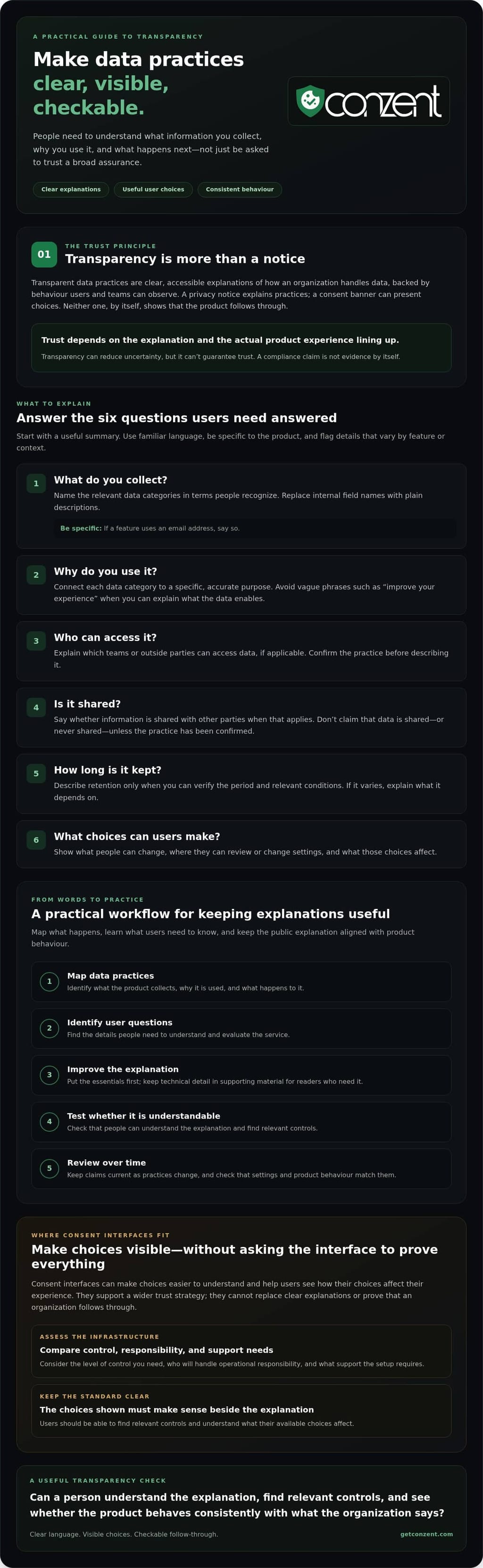
Give people the useful summary first, then a clear path to more detail. Organize it around six questions: What do you collect? Why? Who can access it? Is it shared? How long is it kept? What choices can users make? Answer only what’s true for the specific product, and identify details that vary by feature or context instead of implying one answer fits every situation.
- Collection: Name relevant data categories in familiar terms. For example, if a feature uses a person’s email address, say so rather than relying on an internal field name.
- Purpose: Connect each category to a specific use. Replace “improve your experience” with an accurate explanation of what the data enables.
- Access and sharing: Explain which teams or outside parties can access data, if applicable. Don’t say data is shared, or never shared, unless you’ve confirmed the practice.
- Retention: Describe how long data is kept only when you can verify the period and any relevant conditions. If it varies, explain what it depends on.
- User choices: State what people can change, where they can do it, and what those choices affect.
This approach also makes explanations easier to check internally. The Federal Data Strategy practices offer examples of communicating data uses as part of responsible data management. Treat them as a reference, not a substitute for describing your own product accurately.
How can you explain data use in plain language?
Use direct verbs such as collect, use, store, share, or delete, when they accurately describe the practice. Pair the purpose with the data category when you can confirm both. Avoid vague assurances and explain unfamiliar terms the first time you use them. Then ask people unfamiliar with your product or internal terminology to read the explanation. If they can’t tell what happens, revise it.
Keep the first explanation short, with links to supporting material for technical detail. A layered explanation respects readers’ time without hiding information. Make sure each page points to current details, especially when a product feature or data flow changes.
How should consent choices support transparency?
Explain the available choices and their effects before asking users to decide. Keep the interface wording consistent with the product’s actual settings and practices. A customizable cookie banner can provide a visible place for explanations and choices, but its wording still needs to reflect how the site works.
If you’re evaluating consent tools, review the consent platform pricing options alongside your needs for control and ongoing operation.
Does Transparency Alone Build User Trust? Claims, Evidence, and Limits
No. Publishing a privacy notice or adding a consent interface doesn’t prove the organization’s practices match its claims. Transparency gives people information to assess. Trust also depends on what the product actually does, how the organization handles data, and whether it follows through when something changes. Building user trust with transparent data practices means making claims people can check, not treating disclosure as proof.
Useful transparency is specific, current, and easy to connect to a real practice. “We respect your privacy” offers little to assess. A clear explanation of what a particular setting controls, paired with a setting that behaves as described, gives users something concrete. More information isn’t automatically better. Dense explanations can obscure key facts just as effectively as vague reassurance.
What makes a transparency claim credible?
Link each statement to an observable practice, such as a product setting, a consent choice, or an explanation of how data is handled. Be precise about scope. If behaviour differs by feature or context, say so rather than suggesting every user journey works the same way. Avoid universal promises, trust scores, or statistics unless you can support them with reliable evidence.
Transparency also has limits. Clear words cannot replace responsible product decisions or operational follow-through. Harvard Business School Working Knowledge discusses the need to proactively manage customers' sensitive data, a reminder that privacy depends on more than what an organization publishes.
How can teams avoid transparency theatre?
Test the explanation against the real experience. Follow the same path a user would, then compare what the public statement says with what product settings and consent flows actually do. Ask the teams responsible for those systems to confirm the details. A mismatch, even if unintentional, weakens the explanation and leaves users without a reliable basis for choice.
- Assign an owner: Make a person or team responsible for reviewing explanations when product features or data practices change.
- Check the evidence: Compare each claim with current settings, consent flows, and operational practices.
- Record unresolved gaps: Note what remains unclear, who will address it, and what statements need correction.
Fix inaccurate claims before promoting them. If a detail is still being confirmed, say that plainly and avoid implying certainty. This won’t guarantee that users trust an organization. It does make its explanations more honest and gives people a firmer basis for deciding whether the stated practices deserve confidence.
How to Make Transparent Data Practices Useful in Everyday Journeys
Turn transparency into a routine product process, not a one-time copywriting task. Start where a data-related choice or question arises, then improve the explanation and check whether people understand it. Prioritize moments involving meaningful choices or repeated confusion, based on your own product and user feedback. Data flows differ, so don’t assume every site needs the same touchpoints.
Use this workflow:
- Map practices: Document the data involved, its purpose, where it moves, and which team can confirm the details.
- Identify user questions: Review recurring questions from support, research, and product feedback. Note where people seem unsure about a choice or its effect.
- Revise explanations: Answer those questions in familiar language, using the same terms across notices, settings, and support material.
- Test comprehension: Check whether people can explain the practice or choice in their own words. Test understanding, not which version gets more people to choose a preferred outcome.
- Review and update: Recheck explanations when product changes affect data practices or user choices. Set a review cadence that fits the pace of those changes.
How do you turn user questions into clearer explanations?
Don’t treat each question as an isolated support issue. Connect it to the confirmed practice, the team responsible for it, and the explanation a user can access. If someone asks whether a setting changes a particular use of data, for example, confirm the setting’s actual effect before rewriting its description. If teams can’t agree on the answer, resolve that gap before promising clarity.
Consistent terms matter. If a setting uses one phrase and a notice uses another for the same choice, people may not recognize that they refer to the same thing. Create a shared vocabulary, then use it across the user journey.
How should teams check whether explanations work?
Ask users to describe what a choice does, what information it relates to, or what they expect to happen next. Their answers can reveal confusing wording or interface design. If you compare interface variations, judge whether each makes the choices and their effects easier to understand, not whether it nudges people toward a particular response.
A consent A/B testing feature can help teams compare interface variations as part of that work. The measure should serve user understanding, not replace it. Building user trust with transparent data practices means keeping the explanation aligned with the experience as both change.
If you’re assessing consent tools for this work, review consent platform options and compare them with your team’s needs.
How Consent Infrastructure Can Support More Transparent Data Practices
Consent infrastructure can give users a clear place to review available choices and give teams a more organized way to present them. It can’t make an unclear policy understandable or prove that an organization’s data practices match its claims. Start with the explanations and product behaviour, then assess whether a consent platform can support them.
Evaluate a platform against your actual needs. Can you customize the interface to explain relevant choices in plain language? Does it fit your existing systems? Who will operate it, maintain it, and review how it works? A useful tool should support an experience your team can responsibly run, not add complexity you can’t maintain.
When might self-hosted or managed infrastructure fit?
The right approach depends on your team’s control requirements and operating capacity. With self-hosted infrastructure, your organization manages the hosting environment and related operational work. That can suit teams that want direct control and have the capacity to maintain it. Review the self-hosted consent infrastructure option to understand this approach.
A managed service shifts some infrastructure work to the provider. Conzent’s managed cloud service includes infrastructure maintenance, automatic updates, and cloud analytics. Its source-available platform also lets teams examine the available source, though access to source alone doesn’t establish that a product or its users’ data are handled responsibly. Confirm current feature details and availability as part of your evaluation.
What should you assess in a consent platform?
Look beyond the banner. Check whether its wording can reflect your confirmed practices, whether the available choices are clear, and how the platform fits your systems and team’s responsibilities. Also ask how each hosting option handles infrastructure, updates, analytics, and the work your organization retains. A managed cloud consent platform guide can offer a deeper hosting discussion.
For building user trust with transparent data practices, treat consent infrastructure as support for clear explanations and user choice, not a substitute for either. Compare the consent platform options if you’re weighing managed and self-hosted approaches, and verify that the current details suit your needs. No platform can guarantee trust or compliance. Those depend on accurate explanations and consistent practices across the organization.
Make Transparency Part of How Your Product Works
Building user trust with transparent data practices takes more than publishing a notice. Explain what data you use and why, make available choices understandable, and check that product behaviour matches what you tell people. Keep explanations current as practices change. Clear, verifiable information gives users a stronger basis for making their own decisions, even though it can’t guarantee trust.
Consent infrastructure can support that work by giving people a visible place to review choices. It’s one tool, not a substitute for accurate policies or responsible operations. Conzent offers a source-available consent platform, with a self-hosted option available without a platform charge. Its managed cloud service includes infrastructure maintenance, automatic updates, and cloud analytics.
If you’re comparing ways to manage consent, compare Conzent’s plans and hosting options against your team’s needs and capacity. Start with the practices your users need to understand, then build the systems and explanations to support them. Steady, honest improvements can make data choices clearer for everyone.
Frequently Asked Questions
What does building user trust with transparent data practices mean?
Building user trust with transparent data practices means explaining how data is handled in clear, specific language and making sure actual product behaviour matches those explanations. Users should be able to understand what information is collected, why it’s used, and what choices they have. Transparency gives people a basis to assess a service. It doesn’t guarantee trust, which also depends on consistent behaviour and follow-through.
How can a business be transparent about how it uses data?
Describe data practices in plain language, connecting each relevant data category to its purpose. Explain who can access or receive the data, how long it’s kept when that’s known, and what choices users can make. Avoid broad phrases such as “improve your experience” unless you explain what that means. Keep key points easy to find, link to supporting details, and update explanations when product practices change.
Does a privacy notice guarantee that users will trust a business?
No. A privacy notice can explain practices, but publishing one doesn’t show that the product or organization follows what it says. Users may still find the language unclear or struggle to locate relevant choices. Compare statements with product settings, consent flows, and operational practices. A current, understandable notice is useful, but trust also depends on accurate information and consistent behaviour over time.
What data practices should a company disclose to users?
Explain the data categories involved, the purposes for using them, who can access or receive them, how long they’re retained when confirmed, and what choices users can exercise. Be specific to the product. For example, name an email address only if the service actually uses it, and describe the confirmed purpose. If sharing or retention varies by feature or context, say so instead of implying one rule applies everywhere.
Can transparent data practices improve consent experiences?
Yes. Clear explanations can help people understand the choices presented and what those choices affect. A consent interface can bring relevant explanations and controls together, but it must reflect the product’s actual practices. Keep wording consistent across the interface, privacy information, and settings. Don’t treat a clear banner as proof that data handling is responsible or that users understand every detail. Test whether people can explain the choice in their own words.
How do you measure whether users understand your data practices?
Ask users to explain a data practice or consent choice in their own words. For example, ask what a setting changes or what they expect to happen after making a choice. Their answers can show where terms, explanations, or interface labels cause confusion. Test comprehension and usability, not whether people choose the outcome your organization prefers. Review feedback after relevant product changes and revise unclear explanations.
Is open-source or source-available consent software enough to build trust?
No. Source availability can support scrutiny, but it doesn’t prove that an organization’s configuration, policies, or data handling are responsible. Teams still need to check how the software is used and whether user-facing explanations match actual behaviour. Conzent offers a source-available consent platform, a self-hosted option without a platform charge, and a managed cloud service. These are hosting and access options, not guarantees of trust or compliance.