Compliant Ad Revenue Tracking: How to Bridge the Privacy-Data Gap in 2026
If you think your ad revenue reports are accurate, you're likely missing up to 50% of the truth. In 2026, the gap between platform-reported conversions and actual business results is often as high as 30% to 50%. This "data black hole" isn't just a technical glitch. It's the result of unconsented users becoming invisible to traditional tools. You shouldn't have to choose between massive legal fines and the death of your ad performance. Effective compliant ad revenue tracking isn't a premium luxury; it's a fundamental requirement for any ethical, sustainable business.
We understand the pressure. You're caught between evolving Google Consent Mode v2 requirements and the expiration of "right to cure" grace periods in states like Delaware and Montana. This article provides a clear framework to bridge that gap. You'll learn how to maintain precise metrics while staying fully compliant with GDPR and the latest Google standards. We'll show you how to recover "lost" data through modeling and build a setup that satisfies both your legal counsel and your ad ops team. It's time to stop guessing and start measuring with integrity.
Key Takeaways
- Identify the "Consent Gap" that hides half your audience. Learn why traditional tracking is obsolete and how it distorts your true ROAS.
- Bridge the data divide with Google Consent Mode v2. Use technical pings to recover essential insights without relying on restricted cookies.
- Turn privacy UX into a revenue driver. Honest, clear banner designs build the user trust required to boost your opt-in rates.
- Implement a robust framework for compliant ad revenue tracking. This stack satisfies strict legal requirements while delivering the metrics ad ops needs.
- Prioritize transparency over black-box solutions. Discover why source-available infrastructure is the ethical standard for modern data security.
The Data Black Hole: Why Traditional Ad Revenue Tracking is Obsolete
Tracking by default is dead. For years, digital marketing operated on a "catch-all" philosophy. Scripts fired, cookies dropped, and data flowed without a second thought. In 2026, that model isn't just outdated; it's a direct threat to your business. Traditional Web tracking has transitioned from a background utility to a front-and-center legal requirement. If you aren't asking for permission, you aren't just losing data. You're inviting litigation.
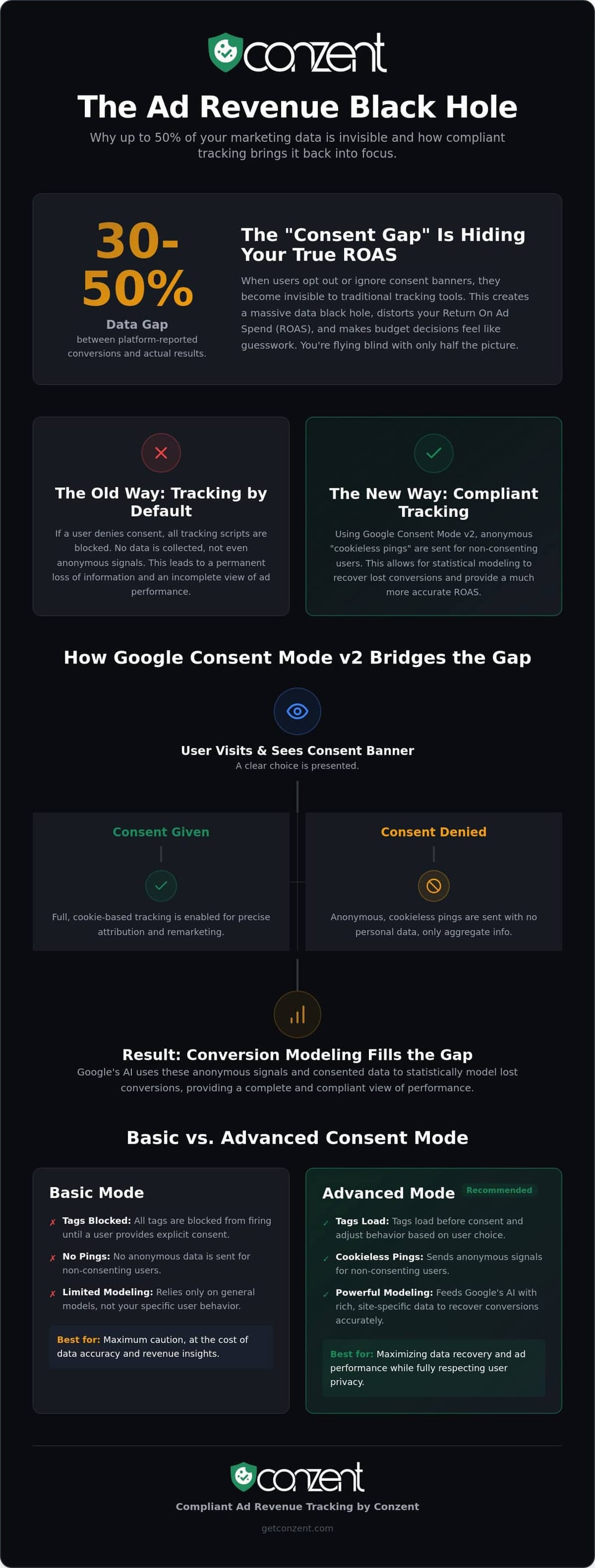
This shift has created what we call the "Consent Gap." When users opt out or simply ignore your banner, they vanish from your analytics. You see the ad spend going out, but you don't see the revenue coming in. This creates a data black hole that skews your Return on Ad Spend (ROAS) and makes scaling impossible. Without compliant ad revenue tracking, you're essentially flying blind. You're making budget decisions based on a fraction of the truth.
The regulatory environment of 2026 has removed the "wait and see" luxury. With new privacy laws in Indiana, Kentucky, and Rhode Island taking effect on January 1, 2026, the definition of a legacy script has changed. It's now any tracking mechanism that processes personal data without a verifiable signal of consent. We've moved past the era of surveillance. We've entered the era of compliant attribution.
The Cost of Non-Compliance in Ad Ops
The risks go beyond simple fines. While GDPR compliance remains critical, platform-level enforcement is the more immediate threat. Google and Meta now require verified consent signals to power their attribution models. If your tags lack these signals, your accounts face restricted functionality or total suspension. Beyond the tech, there's the brand risk. Users in 2026 are privacy-literate. They don't see tracking as a service. They see it as an invasion if it isn't transparent and honest.
Defining Compliant Ad Revenue Tracking
Compliant tracking is not about collecting less data. It's about collecting data with a clear legal basis. It differentiates between anonymous aggregation, which preserves privacy, and personal data processing, which requires explicit opt-in. A Consent Management Platform (CMP) acts as the gatekeeper. It ensures that compliant ad revenue tracking only occurs when the user says "yes." By integrating with Google Consent Mode v2, you can bridge the gap between user privacy and marketing necessity without sacrificing your bottom line.
How Google Consent Mode v2 Enables Compliant Tracking
Google Consent Mode v2 (GCM v2) is the industry standard for bridging the gap between user privacy and data collection. It acts as a technical translator. It communicates the user's specific consent choices directly to Google tags. Since March 2024, implementing GCM v2 has been mandatory for advertisers targeting the European Economic Area. In 2026, it is the only way to maintain a functional link between Google Ads and GA4 without risking account suspension or data loss. This transition toward Privacy-First Advertising is no longer optional. It is the baseline for survival.
The primary innovation of GCM v2 is the use of "cookieless pings." When a user denies consent, traditional tracking simply stops. GCM v2 is different. It sends anonymous, non-identifying signals to Google's servers. These pings contain no personal data and do not store cookies. Instead, they provide high-level context like the time of day and the conversion type. This allows you to maintain compliant ad revenue tracking by providing enough metadata for Google to understand that a conversion happened, even if they can't see exactly who triggered it.
Basic vs. Advanced Consent Mode
You have two implementation choices. Basic Consent Mode is the conservative route. Tags remain blocked until a user clicks "Accept." No data, not even anonymous pings, is sent for non-consenting users. Advanced Consent Mode is the revenue-focused choice. Tags load immediately but adjust their behavior based on the consent signal. If a user denies cookies, the tags automatically switch to cookieless pings. For sites where every attribution signal counts, the Advanced mode is essential to fuel the machine learning models that recover your lost revenue data.
The Role of Modeled Revenue in Your Dashboard
Conversion Modeling is the statistical recovery of lost attribution signals through machine learning. Google uses the behavior of your consented users to predict the behavior of those who opted out. Research indicates that this can fill a 30% to 50% gap in your conversion data. However, this modeling isn't magic. It requires a solid baseline of "observed" data to be accurate. If your opt-in rates are too low, the model lacks the information it needs to predict revenue accurately. Finding the right balance between legal rigor and data volume is key. You can explore our flexible pricing plans to find a solution that helps you scale your consented data baseline.
By using compliant ad revenue tracking through GCM v2, you move away from fragmented reports and toward a unified truth. You stop seeing "zero" revenue from a large portion of your traffic and start seeing a modeled reality that reflects your true business performance.
Privacy UX: Optimizing Opt-In Rates for Better Data
Data quality is a design problem. Your dashboard might look sophisticated, but if your opt-in rates are low, your insights are hollow. In the U.S., a consented user generates approximately 50% more ad revenue than a non-consented user. This isn't just a statistic; it's a direct reflection of how trust translates into dollars. Effective compliant ad revenue tracking starts the moment a visitor lands on your site. If your banner feels like a trap, they will leave. If it feels like a choice, they might stay.
Transparency is your most powerful optimization tool. We have moved past the era of "dark patterns" and hidden buttons. Modern regulations, including the California Delete Act and various state laws effective in 2026, demand clarity. Using a standardized framework like IAB TCF v2.3 ensures you meet these legal bars. It provides a consistent language for consent that both browsers and ad tech platforms understand. A clear, honest banner doesn't just satisfy your legal team. It provides the high-quality baseline of data required for accurate conversion modeling.
A/B Testing Your Consent Banner
Compliance does not mean static design. Small changes in copy, button placement, or color contrast can significantly shift your opt-in percentages. You should optimize your opt-in rates with A/B testing to find the balance that works for your specific audience. It is a process of refinement. It is about discovering which explanations resonate and which layouts reduce friction. When you treat your consent banner with the same rigor as a checkout page, your data volume grows.
Reducing Bounce Rates Caused by Intrusive Banners
The "Wall of Privacy" is a conversion killer. If a banner blocks the entire screen before a user can see your value proposition, they will bounce. This hurts your SEO and your Core Web Vitals. Your compliant ad revenue tracking stack must be lightweight. It should load fast and stay out of the way. The goal is a seamless user experience where privacy feels like a feature, not an obstacle. By balancing legal requirements with performance, you protect your revenue and your reputation simultaneously.
Step-by-Step: Building a Compliant Ad Tracking Stack
Building a resilient marketing stack requires more than just installing a plugin. It requires a methodical audit of your current data flow. You cannot manage what you haven't identified. Start by cataloging every script, pixel, and tag currently firing on your site. Determine exactly what data each tag collects and where that data is sent. In 2026, a single unmapped script can trigger immediate enforcement under expiring "right to cure" grace periods in states like Montana and New Jersey. A successful compliant ad revenue tracking setup relies on a clean hierarchy of tags.
Once your audit is complete, select a certified Consent Management Platform (CMP). Avoid black-box vendors that hide their logic behind proprietary code. We believe in transparency. Source-available or self-hosted options provide the technical clarity required for true data sovereignty. This setup ensures that you, not a third-party vendor, control the flow of user information. After selecting your CMP, configure Google Consent Mode v2. As of June 2026, the `ad_storage` parameter is the sole authority for advertising data collection. Your CMP must communicate this signal directly to Google Tag Manager to ensure your tags behave according to the user's explicit choice.
Integrating with Your CMS
Your tracking stack must live where your content lives. Whether you use Shopify, custom code, or require compliant ad tracking for WordPress sites, the implementation logic remains the same. The CMP must load before any other marketing scripts. This prevents "consent leakage," where tags fire and collect data before the user has made a choice. If a tag fires too early, the signal is tainted. The data becomes a liability rather than an asset.
Setting Up Revenue Impact Analytics
Compliance is not just a legal hurdle; it is a financial metric. You need to visualise the revenue impact of privacy to understand the health of your business. This dashboard allows you to compare "observed" revenue from consented users against "modeled" revenue from those who opted out. Use these insights to adjust your ad spend regionally. You might find that high-consent regions justify higher bids, while low-consent areas require a more aggressive shift toward first-party data strategies. This data-driven approach turns compliance into a competitive advantage.
Verification is your final safeguard. Use debugging tools like Google Tag Assistant to inspect the consent strings in real time. Ensure that `ad_user_data` and `ad_personalization` parameters are passing correctly with every hit. This verification is the final safeguard for compliant ad revenue tracking. Review our transparent pricing options to find the right infrastructure for your scale and start building a stack that respects your users and your bottom line.
The Conzent Advantage: Transparent Compliance as a Service
Most Consent Management Platforms (CMPs) operate as black boxes. They ask for your trust but hide their logic behind proprietary code. Conzent is the direct antithesis of this model. We provide source-available infrastructure because we believe privacy shouldn't be a secret. Transparency is a technical requirement, not a marketing slogan. When you can see the code, you can verify the compliance. This level of openness is the only way to ensure compliant ad revenue tracking that actually stands up to legal scrutiny.
Our mission is to make privacy accessible to every publisher, regardless of their technical resources. We've moved past the era where data protection was a manual, high-cost burden. By providing an egalitarian framework for consent, we help you transition from a defensive "cost-center" mindset to a proactive revenue-optimization mindset. You don't just "deal" with compliance; you use it to build a more resilient business.
Managed Cloud vs. Self-Hosted Privacy
Choice is a core value of our Open Consent Infrastructure. We offer two primary paths to help you stay ahead of shifting global legislations:
- Managed Cloud Consent Platform: We handle the infrastructure and automatic updates as laws change in states like Delaware and New Jersey.
- Self-Hosted Open Consent Infrastructure: You maintain total control over your data residency and infrastructure costs.
You can explore our Open Consent Infrastructure to determine which path fits your technical stack. Both options lead to the same result: a verified legal basis for every dollar you track.
We don't just give you a banner; we give you the tools to prove its value. Our Revenue Impact Analytics dashboard helps you justify your privacy spend by showing exactly how much revenue is recovered through modeling. It's about clarity. It's about seeing the cost of compliance versus the cost of invisibility. This data helps you make better decisions about ad spend and regional targeting across your entire portfolio.
The Future of Tracking in a Post-Cookie World
Preparing for 2026 and beyond means treating first-party consent as your most valuable asset. The industry is moving away from third-party identifiers, making direct relationships with your users the only sustainable path forward. Building a "privacy-first" brand isn't just about following the law; it's about earning the trust that powers your data ecosystem. For a deeper dive into the technical nuances of this shift, read our Google Consent Mode Advanced vs Basic: The 2026 Strategic Guide.
Integrity and efficiency are not mutually exclusive. By implementing compliant ad revenue tracking with a transparent partner, you protect your users and your performance. You stop hiding behind complexity and start leading with honesty. That is the Conzent advantage.
Future-Proof Your Data Strategy
The era of invisible users and fragmented reporting must end. We've established that you don't have to sacrifice performance to respect visitor privacy. By embracing Advanced Consent Mode and optimizing your privacy UX, you turn a legal mandate into a strategic advantage. You move from guessing at your ROAS to seeing a modeled reality that reflects your true business health. Compliance is not a hurdle; it is the roadmap for 2026.
Compliant ad revenue tracking is the foundation of a sustainable marketing ecosystem. This requires infrastructure that is as transparent as the laws it satisfies. Our source-available model ensures you aren't locked into a black box. With an IAB TCF v2.3 Certified CMP that is Google Consent Mode v2 Ready, you gain the technical clarity needed for 100% transparency. You protect your brand and your bottom line simultaneously.
Don't leave your attribution to chance in an increasingly regulated landscape. It's time to choose a partner that prioritizes your data sovereignty and your growth. Start measuring your revenue impact with Conzent today. You have the tools to lead with integrity and win with data.
Frequently Asked Questions
Does compliant ad revenue tracking actually work without cookies?
Yes, it works by utilizing cookieless pings and conversion modeling. These pings send anonymous, non-identifying metadata, such as the time of day and conversion type, without storing personal identifiers on the user's device. This allows your analytics platform to attribute value through statistical signals rather than direct surveillance.
This method ensures your compliant ad revenue tracking remains functional even when a user denies consent. You stop relying on fragile third-party cookies and start building a data strategy based on durable, privacy-first signals that satisfy both legal teams and marketers.
Will Google Consent Mode v2 slow down my website and affect SEO?
No, Google Consent Mode v2 will not slow down your site if you use a lightweight, high-performance Consent Management Platform (CMP). Efficient scripts ensure your Core Web Vitals remain healthy and your page load speeds stay fast. SEO rankings depend on a seamless user experience, which includes a responsive and non-intrusive consent interface.
A fast-loading banner prevents users from bouncing before they interact with your content. By balancing technical efficiency with legal requirements, you protect your search visibility while maintaining full compliance with global standards.
Is it legal to use modeled data for ad revenue reporting under GDPR?
Yes, modeled data is legal because it relies on aggregate, non-identifiable signals to predict broader trends. It does not process the personal data of individual non-consenting users. This approach aligns with the GDPR principle of data minimization by providing business insights without compromising individual privacy.
Modeling fills the gaps in your reporting by using the behavior of consented users as a baseline. It provides a statistically accurate view of your performance while ensuring that no personal data is processed without a verifiable legal basis.
What happens if I don't implement Google Consent Mode v2 by the deadline?
You lose the ability to measure conversions and build remarketing audiences for traffic from the European Economic Area (EEA). Google made Consent Mode v2 mandatory in March 2024 for all advertisers using Google Ads and GA4 in the EEA. Failure to comply results in restricted account functionality and a total loss of attribution for non-consenting visitors.
Ignoring this requirement creates a massive "data black hole" in your reports. Your ROAS metrics will look artificially low because the revenue generated by EEA users will no longer be linked to your ad spend.
How much ad revenue do I lose on average when a user rejects cookies?
You lose approximately 50% of the potential revenue per user when they reject cookies. Sourced data from July 2026 confirms that consented users are significantly more valuable because they allow for precise targeting and attribution. Without compliant ad revenue tracking, these non-consenting users become invisible to your optimization tools.
This invisibility leads to inefficient bidding and wasted budget. When you can't see the revenue a user generates, your ad platform assumes the visit had no value, causing it to under-invest in high-performing segments.
Can I track ad revenue on Shopify while staying GDPR compliant?
Yes, you can track revenue on Shopify by integrating a certified CMP with your store's theme and Google Tag Manager. This setup ensures that tracking pixels and scripts only fire after a user provides explicit consent. It allows you to capture essential transaction data while adhering to strict privacy laws.
The key is ensuring the consent signal is passed correctly to your marketing tags. A robust integration prevents "consent leakage" and ensures that your Shopify store remains a safe, compliant environment for your customers.
What is the difference between IAB TCF and Google Consent Mode?
IAB TCF is a standardized industry framework that communicates consent choices to the entire ad tech ecosystem, including vendors and publishers. Google Consent Mode is a specific technical bridge designed to communicate consent status directly to Google's own tags. They are not competitors; they are complementary tools.
Using both together provides a comprehensive solution. IAB TCF handles the broad legal requirements for the ad industry, while Google Consent Mode ensures your Google Ads and GA4 data remains accurate and compliant.
Frequently Asked Questions
Does compliant ad revenue tracking actually work without cookies?
Yes, it works by utilizing cookieless pings and conversion modeling. These pings send anonymous, non-identifying metadata, such as the time of day and conversion type, without storing personal identifiers on the user's device. This allows your analytics platform to attribute value through statistical signals rather than direct surveillance. This method ensures your compliant ad revenue tracking remains functional even when a user denies consent. You stop relying on fragile third-party cookies and start building a data strategy based on durable, privacy-first signals that satisfy both legal teams and marketers.
Will Google Consent Mode v2 slow down my website and affect SEO?
No, Google Consent Mode v2 will not slow down your site if you use a lightweight, high-performance Consent Management Platform (CMP). Efficient scripts ensure your Core Web Vitals remain healthy and your page load speeds stay fast. SEO rankings depend on a seamless user experience, which includes a responsive and non-intrusive consent interface. A fast-loading banner prevents users from bouncing before they interact with your content. By balancing technical efficiency with legal requirements, you protect your search visibility while maintaining full compliance with global standards.
Is it legal to use modeled data for ad revenue reporting under GDPR?
Yes, modeled data is legal because it relies on aggregate, non-identifiable signals to predict broader trends. It does not process the personal data of individual non-consenting users. This approach aligns with the GDPR principle of data minimization by providing business insights without compromising individual privacy. Modeling fills the gaps in your reporting by using the behavior of consented users as a baseline. It provides a statistically accurate view of your performance while ensuring that no personal data is processed without a verifiable legal basis.
What happens if I don't implement Google Consent Mode v2 by the deadline?
You lose the ability to measure conversions and build remarketing audiences for traffic from the European Economic Area (EEA). Google made Consent Mode v2 mandatory in March 2024 for all advertisers using Google Ads and GA4 in the EEA. Failure to comply results in restricted account functionality and a total loss of attribution for non-consenting visitors. Ignoring this requirement creates a massive "data black hole" in your reports. Your ROAS metrics will look artificially low because the revenue generated by EEA users will no longer be linked to your ad spend.
How much ad revenue do I lose on average when a user rejects cookies?
You lose approximately 50% of the potential revenue per user when they reject cookies. Sourced data from July 2026 confirms that consented users are significantly more valuable because they allow for precise targeting and attribution. Without compliant ad revenue tracking, these non-consenting users become invisible to your optimization tools. This invisibility leads to inefficient bidding and wasted budget. When you can't see the revenue a user generates, your ad platform assumes the visit had no value, causing it to under-invest in high-performing segments.
Can I track ad revenue on Shopify while staying GDPR compliant?
Yes, you can track revenue on Shopify by integrating a certified CMP with your store's theme and Google Tag Manager. This setup ensures that tracking pixels and scripts only fire after a user provides explicit consent. It allows you to capture essential transaction data while adhering to strict privacy laws. The key is ensuring the consent signal is passed correctly to your marketing tags. A robust integration prevents "consent leakage" and ensures that your Shopify store remains a safe, compliant environment for your customers.
What is the difference between IAB TCF and Google Consent Mode?
IAB TCF is a standardized industry framework that communicates consent choices to the entire ad tech ecosystem, including vendors and publishers. Google Consent Mode is a specific technical bridge designed to communicate consent status directly to Google's own tags. They are not competitors; they are complementary tools. Using both together provides a comprehensive solution. IAB TCF handles the broad legal requirements for the ad industry, while Google Consent Mode ensures your Google Ads and GA4 data remains accurate and compliant.