
Consent Rate Optimization Impact on Revenue: The 2026 Performance Guide

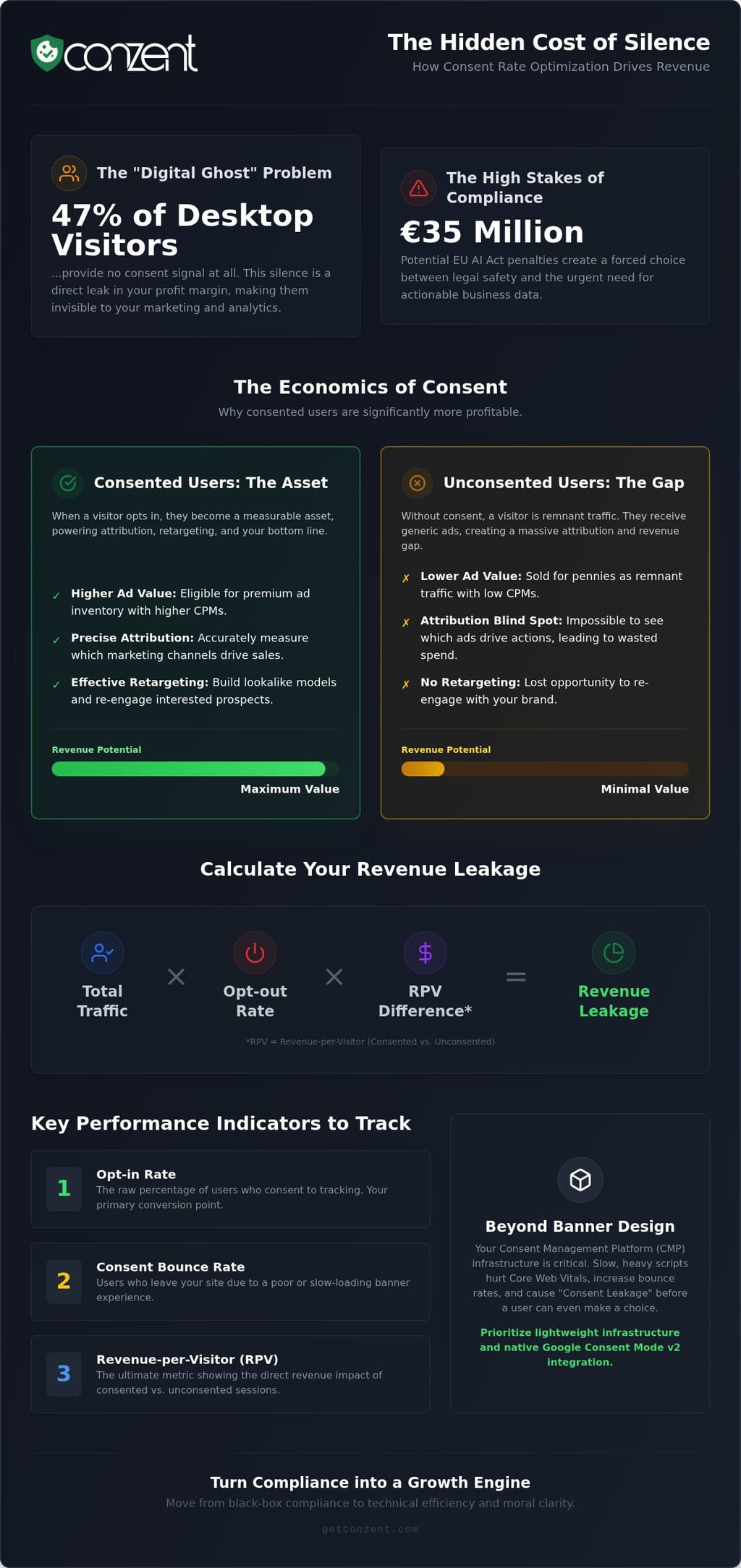
In 2026, over 47% of desktop visitors provide no consent signal at all. They are digital ghosts. This silence is not just a compliance gap; it is a direct leak in your profit margin. You are likely watching your ad attribution accuracy decline while balancing the fear of a €35 million EU AI Act penalty against the urgent need for actionable data. It feels like a forced choice between legal safety and business growth.
We agree that the current state of privacy is broken. Heavy CMP scripts shouldn't slow your site to a crawl, and ethical design shouldn't kill your conversion rates. This guide explores the consent rate optimization impact on revenue to help you quantify exactly what you're losing. We will show you how to reclaim that data through transparent infrastructure and better integration with Google Consent Mode v2. You'll learn to build a clear ROI model that treats consent as a performance metric rather than a legal hurdle. We're moving from black-box compliance to technical efficiency and moral clarity.
Key Takeaways
- View consent as a technical performance metric that directly influences your ability to scale marketing efforts and attribution accuracy.
- Analyze the consent rate optimization impact on revenue to understand how unconsented traffic drives down average CPMs and limits your remarketing potential.
- Prioritize lightweight infrastructure to solve "consent leakage" caused by slow-loading banners that hurt Core Web Vitals and bounce rates.
- Implement native Google Consent Mode v2 and Revenue Impact Analytics to turn privacy requirements into a competitive growth advantage.
The Invisible Revenue Leak: What is Consent Rate Optimization (CRO)?
Consent Rate Optimization (CRO) is the ethical practice of maximizing the percentage of users who choose to share their data. It is not about tricking users into clicking a button; it's about building a technical bridge between legal compliance and marketing performance. While many teams view the cookie banner as a legal hurdle, high-performing organizations treat it as their most important conversion point. If you don't secure the signal, you can't measure the success of your spend.
The consent rate optimization impact on revenue is staggering in its scale. In 2026, industry data shows that a mere 10% drop in consent rates can trigger a 25% collapse in measurable ad revenue. This happens because unconsented traffic is essentially invisible to your optimization algorithms. When you lose the signal, you lose the ability to bid effectively. The "Accept All" button is likely the most valuable asset on your website. It powers your attribution, your retargeting, and your bottom line. Without it, you are flying blind.
The 2026 Privacy Landscape
Compliance has moved beyond simple checkboxes. We've shifted from "ticking a box" to "managing an identity signal." This evolution was accelerated by Google Consent Mode v2, which became the mandatory standard for anyone using personalized ads in the EEA. This framework, alongside the foundational requirements of the ePrivacy Directive, forces a more sophisticated approach to data. You're no longer just asking for permission. You're providing the technical context that ad platforms need to model missing data. Similarly, IAB TCF v2.3 has raised the floor for programmatic bidding. If your banner fails to pass a valid signal, your inventory value drops instantly.
Acceptance Rate vs. Data Quality
A high acceptance rate is a vanity metric if the underlying data is junk. We often see businesses suffer from "Consent Debt." This occurs when broken technical setups collect signals that don't actually fire the tags correctly. You realize months later that your attribution is a mess, and by then, the revenue is gone. To avoid this, you must look at specific KPIs:
- Opt-in Rate: The raw percentage of users who consent to tracking.
- Consent Bounce Rate: Users who leave your site specifically because of a poor banner experience.
- Revenue-per-Visitor (RPV): The ultimate metric showing the revenue impact of consented vs. unconsented sessions.
Optimization means making these signals work together. It's about speed, clarity, and technical integrity. We aren't just trying to get a click; we're trying to secure a high-quality data stream that fuels growth.
The Economics of Consent: Why Consented Users Are Worth More
Consented users are not just more compliant; they are significantly more profitable. When a visitor opts in, they become a measurable asset. You can retarget them, build lookalike models, and attribute their journey with precision. Without consent, that visitor is a remnant. They receive generic ads that carry much lower CPMs because ad tech platforms cannot verify their identity or intent. This creates a massive attribution gap. If you can't see which ads drive sales, you will inevitably waste your budget on underperforming channels. For mid-market publishers, this invisible gap often represents a revenue difference exceeding $500,000 annually.
CPM and Bid Floor Dynamics
The programmatic market has split into two tiers. Premium traffic carries a valid IAB TCF v2.3 string; remnant traffic does not. Supply-Side Platforms (SSPs) and Demand-Side Platforms (DSPs) prioritize users with clear signals because they offer predictable returns. The way you structure these options, often referred to as Choice Architecture and Consumer Welfare, directly dictates whether a visitor becomes a high-value signal or a generic remnant. This dynamic sets a bid floor that punishes sites with poor consent UX. Ad tech platforms ignore non-consented signals to avoid the legal risks associated with unauthorized tracking. This means your unconsented inventory is sold for pennies compared to the dollars paid for consented users.
Calculating Your Personal Revenue Impact
Understanding the consent rate optimization impact on revenue starts with a simple formula. Multiply your total traffic by your opt-out rate, then multiply that by the difference in Revenue-per-Visitor (RPV) between consented and unconsented sessions. This number is your "leakage." Industry and geography play a major role in this calculation. For example, news and media sites in 2026 often see consent rates as low as 45% to 55%, while travel and e-commerce sites can maintain rates between 65% and 80%. If you're operating in the EU, where the average consent rate is 55% to 65%, your exposure is likely higher than in less regulated markets. You can use Revenue Impact Analytics to automate this calculation and see the real-time cost of every refusal. Building a sustainable data strategy requires tools that respect both the law and your growth targets. If you're ready to stop guessing your ROI, check out our transparent pricing options for managed and self-hosted infrastructure.
Beyond Design: How CMP Infrastructure Impacts Revenue
While colors and button placement matter, they're secondary to infrastructure speed. If your consent banner loads three seconds after your content, you've already lost. We call this the "Race to the Banner." When a user interacts with a page before the CMP initializes, you lose the ability to track that session entirely. This technical failure is a major contributor to the consent rate optimization impact on revenue. It's not a design flaw; it's a latency flaw. If the infrastructure is slow, the data is gone.
Heavy CMP scripts are a liability. They bloat your Largest Contentful Paint (LCP) and cause Cumulative Layout Shift (CLS) when the banner finally pops into view. Search engines penalize slow, unstable sites, which means your choice of consent tool can actively suppress your organic traffic. Understanding the economic consequences of data privacy requires looking at these hidden performance costs. High latency doesn't just lower your opt-in rates; it erodes your SEO-driven revenue. Speed is a moral and financial imperative.
Managed Cloud vs. Self-Hosted Performance
Most managed cloud CMPs introduce unnecessary DNS lookups and third-party script dependencies. Every millisecond spent fetching a script from a distant server is a millisecond where your marketing tags are blocked. To eliminate this, many high-performance teams are choosing to self-host their consent infrastructure. By serving the CMP from your own domain, you remove external bottlenecks. This approach ensures the banner is part of the initial page load, significantly reducing bounce rates and improving the overall user experience. It's about taking total control of your technical environment.
Global Latency and Edge Delivery
Geography shouldn't dictate your data quality. In 2026, regional latency remains a silent killer of consent rates in non-US and non-EU markets. If your visitor is in Tokyo but your CMP server is in Frankfurt, the Time to First Banner (TFB) will be unacceptable. We solve this by serving banners at the edge. A high-availability managed cloud infrastructure ensures that the consent signal is processed as close to the user as possible. Trust begins with a fast response. If you respect the user's time, they're more likely to respect your request for data. Technical efficiency isn't a luxury; it's a prerequisite for any meaningful consent rate optimization impact on revenue strategy.
A Framework for Ethical Consent Rate Optimization (CRO)
Scaling your digital growth requires a shift from passive compliance to active optimization. This framework focuses on building a technical and moral foundation that respects the user while securing the data your business needs to grow. The consent rate optimization impact on revenue is most visible when you stop treating your banner as a legal disclaimer and start treating it as a critical touchpoint in the customer journey. It's the moment where you define the relationship with your visitor.
Your first step is a baseline audit. You must measure your "Consent Leakage", which is the gap between users who arrive on your site and those who actually provide a valid signal. Once you have a baseline, move to technical hardening. This involves ensuring your Google Consent Mode v2 and IAB TCF v2.3 integrations are firing correctly. If the technical handshake fails, the most beautiful design in the world won't save your attribution. Finally, prioritize transparency. Building long-term trust is the only sustainable way to lower future opt-out rates and stabilize your data stream.
Ethical A/B Testing Strategies
Optimization is not an excuse for dark patterns. We use data to find the intersection of user comfort and business necessity. You should A/B test your cookie banner by focusing on placement and messaging. Does a center modal drive higher engagement than a bottom bar? Often, yes. But does it also increase your bounce rate? Testing legalistic jargon against benefit-driven language often reveals that users respond better to honesty than to complexity. For example, explaining that data sharing helps personalize their experience is often more effective than a dry list of technical purposes. Use these iterations to refine your approach without compromising your ethical standards.
Trust Signals and Privacy UX
Privacy UX is the new competitive advantage. In a market where 47% of desktop visitors provide no signal, being the brand that makes consent easy and transparent sets you apart. This means reducing friction through a "One-Click" compliance standard. Users shouldn't have to hunt for the "Reject" button or navigate three layers of menus to manage their preferences. Integrating trust signals, such as clear certifications and plain-language data usage summaries, into the banner itself reinforces your commitment to digital rights. When you make the right choice the easiest choice, you naturally see an improvement in your consent rate optimization impact on revenue. If you're ready to deploy a platform that balances speed with principled design, explore our managed and self-hosted infrastructure options.
Turning Compliance into a Growth Engine with Conzent
Compliance is often sold as a defensive tax on your business. We see it differently. Conzent is not a black box designed to hide complexity; it is a transparent performance platform built to surface opportunity. By shifting your focus toward the consent rate optimization impact on revenue, you move from merely avoiding fines to actively reclaiming lost data. We provide the tools to measure exactly how your consent strategy affects your bottom line. You stop guessing and start growing.
Our Native Revenue Impact Analytics dashboard provides the granular visibility that legacy CMPs lack. You can see the real-time correlation between opt-in rates and your advertising bid floors. This transparency allows you to justify every design change and technical adjustment with hard currency metrics. Whether you choose our Managed Cloud or our source-available Open Consent Infrastructure (OCI), you gain a partner dedicated to technical efficiency and moral clarity. We believe that privacy should be a public good, not a proprietary secret.
Why Managed Cloud is the 2026 Standard
Regulations do not stand still. As IAB TCF v2.3 and Google Consent Mode v2 evolve, your infrastructure must adapt instantly. Our Managed Cloud provides automatic updates that keep you ahead of regulatory shifts without requiring constant developer intervention. It offers seamless integration with platforms like WordPress, Shopify, and custom stacks. This approach lowers your total cost of ownership by leveraging our community-driven sponsorship model. You get the reliability of a global enterprise platform with the agility of a modern performance tool.
Getting Started: From Compliance to Performance
The path to better data starts with a clean migration. You can move from a legacy, black-box CMP to Conzent in minutes. We prioritize zero vendor lock-in, giving you the freedom to self-host your consent infrastructure if you require maximum speed and total data sovereignty. Once deployed, your first priority should be setting up the Revenue Impact dashboard. This allows you to quantify the consent rate optimization impact on revenue across different regions and device types.
You don't have to choose between ethics and earnings. By using a platform that respects both the user and the browser, you build a sustainable foundation for the next decade of digital marketing. For a deeper look at how to scale these efforts, read our guide on the Managed Cloud Consent Platform: Scaling Privacy Without the Black Box. It is time to treat consent as the performance metric it has always been.
Reclaiming Your Data and Your Growth
The era of treating privacy as a legal barrier is over. High-performance teams now recognize that every millisecond of latency and every confusing UX choice directly drains the bottom line. You've seen how the consent rate optimization impact on revenue is quantifiable and fixable. By moving away from black-box solutions and toward source-available transparency, you reclaim control over your attribution and your brand's integrity.
Technical precision is the new standard for 2026. Whether you're leveraging IAB TCF v2.3 or integrating Google Consent Mode v2, your infrastructure must work for you, not against you. Don't let your data remain a remnant of a broken system. You have the power to turn compliance into a competitive engine through speed and ethical clarity. It's about building a necessary standard rather than a temporary fix.
It's time to stop guessing your ROI and start measuring it. Maximize your ad revenue with Conzent’s Revenue Impact Analytics and deploy an infrastructure built for the future. You can build a digital environment that respects the user while fueling your business. Your growth depends on trust, and trust starts with transparency. Let's build something better together.
Frequently Asked Questions
How does a low consent rate directly impact my Google Ads revenue?
Low consent rates break the conversion tracking and remarketing loops that Google Ads requires for optimization. When users opt out, the platform cannot attribute sales to specific ads, causing the algorithm to bid blindly. This results in generic targeting and higher customer acquisition costs. Without these signals, your ad spend becomes less efficient, which leads to a significant drop in your overall return on ad spend.
Is A/B testing a cookie banner legal under GDPR?
A/B testing is legal if every variation remains fully compliant with GDPR and the ePrivacy Directive. You cannot test variations that use deceptive colors or hide the "Reject" button to force a choice. Optimization should focus on improving messaging clarity and banner placement. The goal is to find the most transparent way to communicate value to the user while respecting their right to refuse tracking.
What is a good average consent acceptance rate for 2026?
In 2026, a good rate depends heavily on your industry and geography. E-commerce sites typically see acceptance rates between 65% and 75%, while travel and gaming sites often reach 80%. However, news and media publishers frequently struggle with lower rates, averaging between 45% and 55%. If your rates fall below these industry benchmarks, you likely have technical friction or a lack of trust in your banner design.
How does Google Consent Mode v2 help recover lost revenue?
Google Consent Mode v2 uses advanced behavioral modeling to fill data gaps when users deny consent. It allows Google to estimate conversions and user behavior without accessing personal data. This provides a more accurate view of your marketing performance. By restoring these modeled signals, you give the Google Ads algorithm enough data to optimize bids effectively, which directly improves your profit margins and campaign scaling.
Can a slow-loading cookie banner affect my SEO rankings?
Yes, a slow banner can damage your organic visibility. Heavy CMP scripts negatively impact Core Web Vitals, specifically Largest Contentful Paint. Search engines prioritize fast, stable websites that provide a good user experience. A banner that delays page loading or causes layout shifts increases bounce rates. This signals to search engines that your site is underperforming, which can lead to lower rankings and reduced organic revenue.
What is the difference between dark patterns and consent optimization?
Dark patterns use deception to coerce a user into a specific choice, while optimization focuses on clarity and speed. For example, making the "Accept" button much larger than the "Reject" button is a dark pattern. Ethical optimization involves testing banner placement or using benefit-driven language to explain why data sharing is useful. It is about removing friction from the decision process while keeping the choice fair and transparent.
How do I measure the revenue impact of my cookie banner?
You can quantify the consent rate optimization impact on revenue by comparing the Revenue-per-Visitor of consented sessions against unconsented ones. Multiply the difference by your total unconsented traffic to find your "leakage." Tools like our Revenue Impact Analytics dashboard automate this by correlating consent signals with transaction data. This shows you the exact financial cost of every opt-out and the ROI of every technical adjustment you make.
Why should I choose a managed cloud consent platform over a free plugin?
Free plugins often lack the infrastructure to handle global latency or evolving standards like IAB TCF v2.3. A managed cloud consent platform provides edge delivery for faster loading and automatic updates for legal changes. This ensures your banner doesn't hurt your site performance. While a plugin might seem cheaper, the consent rate optimization impact on revenue from a faster, more reliable platform far outweighs the initial cost of professional infrastructure.