
Cookie Banner Dark Patterns Avoidance: The 2026 Guide to Ethical Consent

Your cookie banner isn't just a legal hurdle. It's the first handshake your brand offers every new visitor. In September 2025, the CNIL fined Google a record €325 million for making the refusal process more difficult than acceptance. This signals a permanent shift in how regulators view digital design and cookie banner dark patterns avoidance. You likely feel the tension between maintaining high opt-in rates and the looming threat of heavy GDPR fines. It's a difficult balance. Multi-region compliance often feels like a moving target that hurts your user experience and inflates bounce rates.
This guide proves that ethical consent is a strategy for better data, not a legal burden. You'll learn how to eliminate deceptive design to build a high-converting flow that earns genuine user trust. We'll show you how to align with Google Consent Mode v2 and meet the February 2026 IAB TCF v2.3 deadline without sacrificing your analytics. We'll examine the latest CPPA enforcement trends and provide a clear roadmap for replacing deceptive nudges with technical transparency and principled design.
Key Takeaways
- Distinguish between ethical "Privacy by Design" and manipulative "Privacy Zuckering" to ensure your interface respects individual autonomy.
- Identify and remove the five most common deceptive design traps, including "Roach Motels" that make opting out significantly harder than opting in.
- Understand the 2026 regulatory landscape to ensure your strategy for cookie banner dark patterns avoidance satisfies the latest FTC and GDPR requirements.
- Use Consent A/B Testing and Revenue Impact Analytics to optimize your opt-in rates without resorting to psychological trickery.
- Evaluate how self-hosted consent infrastructure provides the highest level of technical transparency for your DevOps and compliance teams.
Table of Contents
Understanding Dark Patterns in 2026 Cookie Banners
A Dark pattern is a design choice that prioritizes business metrics over human intent. It's a digital nudge that subverts a user's true preference for the sake of data collection. In the 2026 regulatory environment, these patterns are no longer just "poor form"; they are active legal liabilities. We contrast these deceptive tactics with "Privacy by Design." This is an egalitarian approach where privacy is the default, not a hidden option. Deceptive "Privacy Zuckering" tricks users into sharing more than they intended. It's a short-term win that causes long-term damage to your reputation.
Regulators have shifted from issuing warnings to enforcing strict penalties. The record €325 million CNIL fine against Google in late 2025 set the tone for the current year. Cookie banner dark patterns avoidance is now a core part of any professional compliance strategy. Beyond the risk of fines, there is a heavy psychological cost. Deceptive banners erode brand equity. They tell your visitors that you value their data more than their autonomy. In a market where trust is a competitive advantage, manipulation is a losing strategy that drives users away.
The Evolution of Deceptive Design
Deception has become more complex. It moved from simple pre-checked boxes to "Interface Interference." This occurs when a site makes the "Reject All" button a tiny, grey link while the "Accept" button is a vibrant, oversized pulse. Many sites also utilize "Consent Fatigue." This is a deliberate strategy of overwhelming users with technical jargon and endless toggles. The goal is to make the user give up and click "Accept" just to make the banner disappear. Under the updated IAB TCF v2.3 and GDPR Article 4(11), this "Accept All" dominance is a direct path to non-compliance and heavy fines.
Why Users (and Browsers) Reject Manipulation
Manipulation has technical consequences. Intrusive banners that cause layout shifts will tank your Core Web Vitals and damage your SEO rankings. Modern browsers are now actively blocking non-compliant banner structures that don't respect automated privacy signals. The "Transparency Gap" is the disconnect between a company's public privacy promise and the hidden tracking scripts running in the background. Bridging this gap requires moving toward source-available transparency. If you want to see how this works in practice, you can explore compliant cookie banner features that prioritize clarity over trickery.
The 5 Most Common Dark Patterns to Eliminate
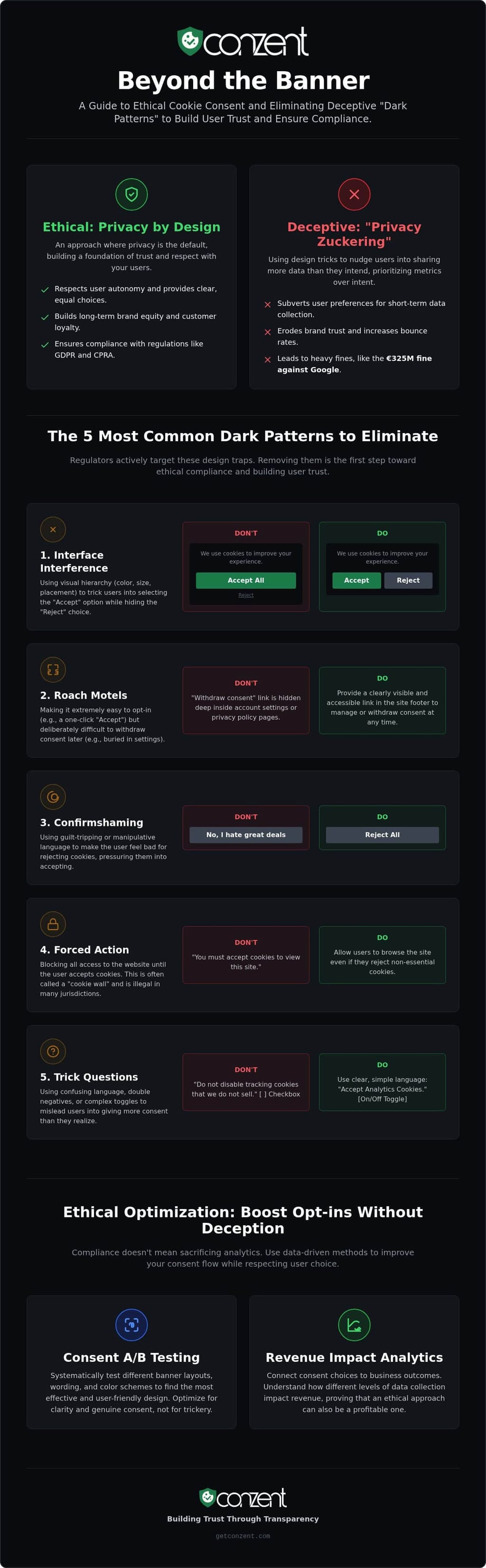
Regulators are no longer ignoring the subtle tricks used to inflate consent rates. To master cookie banner dark patterns avoidance, you must first identify the specific design traps that trigger audits. These patterns range from visual trickery to psychological manipulation. They don't just frustrate users; they invalidate the consent you collect. We've identified five primary offenders that must be removed from your 2026 compliance strategy:
- Interface Interference: Using visual hierarchy to hide the "Reject" option while highlighting "Accept."
- Roach Motels: Making it easy to opt-in but nearly impossible to find the "withdraw consent" link.
- Confirmshaming: Using emotional manipulation or guilt-tripping language in button text.
- Forced Action: Blocking site access entirely until a user clicks "Accept," also known as a "cookie wall."
- Trick Questions: Using double negatives or confusing phrasing to lead the user toward a specific choice.
Interface Interference and Visual Hierarchy
Visual hierarchy is a powerful tool. In ethical design, it guides users toward information. In deceptive design, it misleads them. The "Same Weight" rule is the current legal standard for 2026. This means your "Accept" and "Reject" buttons must share the same size, color contrast, and prominence. If your "Accept" button is a bold primary color while your "Reject" button is a faint grey link, you are practicing interface interference.
This tactic is a primary focus of the FTC report on dark patterns, which highlights how sophisticated design can trap consumers. Ethical consent notices avoid "grey-out" tactics. They ensure that granular settings are just as visible as the "Accept All" option. High color contrast isn't just for accessibility. It's a requirement for informed consent. When you make choices clear, you build a relationship based on respect rather than trickery.
The "Easy to Withdraw" Standard
The "Roach Motel" is a particularly offensive pattern. It occurs when a website allows a user to opt-in with a single click but buries the withdrawal settings deep within a sub-menu or footer. GDPR is explicit: withdrawing consent must be as easy as giving it. If it took one click to say yes, it must take one click to say no. Parity is the standard. Anything less is a compliance failure.
Implementing a persistent "floating" privacy icon provides instant access to these settings. This removes the friction of searching through a site for a tiny "Cookie Settings" link. You can see how we prioritize withdrawal accessibility through technical standards that respect user autonomy. By removing these traps, you transform your consent flow into a trust-building asset. If you're ready to align your site with these high-integrity standards, you can explore our flexible platform options to find the right fit for your technical infrastructure.
Regulatory Consequences: GDPR, CPRA, and IAB TCF 2.3
The FTC's 2026 stance on digital interfaces is unequivocal: deceptive design is a deceptive act. Regulators no longer view cookie banner dark patterns avoidance as a design preference but as a fundamental legal requirement. Under GDPR Article 4(11), consent must be freely given, specific, informed, and unambiguous. Dark patterns make these conditions impossible to meet. If your interface nudges a user toward a specific choice, that consent is legally void. You aren't collecting data; you're collecting a liability.
Compliance is more than avoiding a headline-grabbing fine. While GDPR violations can reach €20 million or 4% of global annual turnover, the reputational damage of a Data Protection Impact Assessment (DPIA) failure is often more permanent. A failed DPIA signals to partners and investors that your technical infrastructure is built on shaky ethical ground. In the 2026 landscape, transparency is the only viable path to long-term scalability.
IAB TCF 2.3 and the Transparency Requirement
The advertising ecosystem has undergone a massive shift with the IAB TCF v2.3 update. All participants were required to support this updated signal by February 28, 2026. This version significantly limits how vendors are presented to ensure users aren't overwhelmed by a "wall of names." Using IAB TCF certified CMPs is now the standard for avoiding regulatory scrutiny in the ad tech space. The Standardized UI requirement in TCF 2.3 ensures that users receive a consistent, non-manipulative experience across every website they visit. This removes the "Transparency Gap" by forcing vendors to be honest about their data processing purposes.
Global Standards: Beyond the EU
California's CPPA regulations regarding dark patterns took full effect on January 1, 2026. These rules prohibit any interface that subverts or impairs user autonomy. The agency can issue fines of up to $2,500 for unintentional violations and $7,500 for intentional ones. Crucially, these regulations mandate support for the Global Privacy Control (GPC), an automated signal that allows users to set their preferences once at the browser level.
Global SaaS companies cannot afford a fragmented approach to privacy. Definitions of what constitutes a "dark pattern" are harmonizing across international borders. Whether you are dealing with the GDPR in Europe or the CPRA in California, the core principle remains the same: respect the user's intent. Building a unified, ethical consent infrastructure isn't just about avoiding fines. It's about creating a professional standard that works everywhere. If you need to verify your current standing, you can review our legislation guide for a deeper look at specific regional requirements.
Ethical Optimization: Boosting Opt-In Rates Without Deception
Optimization is often mistaken for manipulation. In the context of cookie banner dark patterns avoidance, optimization means removing friction, not creating traps. You don't need to trick users into consenting if you provide a clear, value-driven choice. Ethical optimization focuses on long-term data quality rather than short-term opt-in spikes. By following a structured, principled approach, you can maintain high performance while staying fully compliant with 2026 standards.
- Step 1: Use A/B testing to find the clearest language, not the most manipulative.
- Step 2: Implement Google Consent Mode v2 for compliant "unidentified" pings.
- Step 3: Analyze revenue impact to see how privacy-first users actually convert.
- Step 4: Use multi-language support to build trust through native-tongue clarity.
- Step 5: Transition to a source-available infrastructure to prove transparency.
Ethical A/B Testing Framework
A/B testing should clarify, not confuse. Test button placement to ensure the "Reject" option is easy to find, rather than testing which color hides it best. Accidental clicks lead to "Bounced Consent." This is when a user accepts a banner but leaves your site immediately because they felt coerced. Using A/B testing features allows you to measure "True Consent." This is a signal from a user who understands your value proposition and chooses to engage. It's about building a standard of honesty that respects the reader's time and intelligence.
Protecting Ad Revenue with Google Consent Mode v2
Google Consent Mode v2 is the technical bridge between privacy and tracking. It allows you to recover data lost to non-consent through conversion modeling. There is a critical difference between "Basic" and "Advanced" implementation. Basic mode blocks all tags until consent is granted. Advanced mode sends "unidentified" pings that don't contain personal data, allowing Google to fill in the gaps. Implementing Google Consent Mode v2 correctly ensures you remain compliant with the February 2026 IAB TCF v2.3 deadline while protecting your marketing ROI. It turns compliance from a cost center into a data advantage. If you want to see how these ethical standards can improve your bottom line, you can view our platform options to start your transition today.
Conzent: Building a Transparent Consent Infrastructure
Privacy is a public good. It is not a corporate secret or a premium luxury hidden behind proprietary walls. At Conzent, we believe every website deserves access to high-integrity compliance tools. This mission drives our commitment to cookie banner dark patterns avoidance through technical openness. We don't just provide a banner. We provide a foundation for trust between you and your users. By making our infrastructure source-available, we invite scrutiny and collaboration rather than hiding behind complexity.
Our platform offers two distinct paths for your DevOps team. You can choose our Managed Cloud Consent Platform for immediate deployment or our Self-Hosted Open Consent Infrastructure for ultimate control. One offers speed. The other offers total technical autonomy. Both paths include Revenue Impact Analytics. This tool allows you to see how ethical banners drive better data quality. You can finally prove that a transparent interface leads to higher conversion rates among privacy-conscious users. We act as a community advocate for digital rights. Our corporate sponsorships help lower compliance costs for everyone. We want to make ethical consent the industry standard, not the exception.
Why Source-Available Matters
Proprietary CMPs are often black boxes. You cannot see how they handle your user data or if they are technically compliant at the network level. Source-available code eliminates this ambiguity. It allows your security team to verify every line of code. Choosing to use Self-Hosting OCI ensures that your consent data never leaves your own infrastructure. You maintain full ownership. This transparency is the highest form of privacy by design. It removes the risk of third-party data leakage and strengthens your technical security posture.
Managed Cloud for Scaling SaaS
Scaling a business requires efficiency. Our Managed Cloud Consent Platform handles the heavy lifting of compliance for you. It includes automatic updates to keep pace with evolving 2026 regulations like the IAB TCF v2.3 and new CPRA mandates. We provide seamless integration with WordPress, Shopify, and major CMS platforms. This allows you to focus on growth while we ensure your consent flow remains non-deceptive and high-performing. You can explore the Revenue Impact of Cookie Consent to understand how privacy-first growth is the only sustainable strategy for the future. We provide the tools. You provide the trust.
Leading the Shift to Ethical Consent
Deceptive design is a liability that erodes user trust and invites regulatory scrutiny. Choosing cookie banner dark patterns avoidance is a commitment to a higher standard of digital rights. You've seen how removing traps like interface interference and "roach motels" protects your brand equity. Parity between acceptance and rejection is no longer a premium luxury; it's a necessary standard for any professional entity. Moving toward technical transparency isn't just about avoiding fines. It's about owning your data quality and respecting your audience's autonomy.
Our platform is IAB TCF v2.3 Certified and Google Consent Mode v2 Ready. We offer Source-Available Transparency because we believe your consent infrastructure should never be a black box. You can bridge the gap between privacy and performance without sacrificing your integrity. Take the next step toward a principled consent flow that prioritizes human intent and technical efficiency. View Conzent Managed Cloud Pricing. Build a site that respects your users and thrives in the 2026 landscape.
Frequently Asked Questions
What exactly are dark patterns in cookie banners?
Dark patterns are design choices that manipulate or nudge users into making decisions that benefit the business at the cost of the user's privacy. They subvert intent through visual trickery, confusing language, or hidden options. It's the opposite of a neutral, egalitarian interface. These tactics prioritize business metrics over human autonomy, making them a direct violation of modern ethical standards and 2026 regulations.
Is it illegal to have a larger "Accept" button than "Reject" button?
Yes, under 2026 GDPR and CPRA regulations, buttons for "Accept" and "Reject" must have equal prominence. If your "Accept" button is larger, brighter, or more colorful, you are practicing interface interference. Regulators like the CNIL and CPPA explicitly require parity to ensure consent is freely given. Cookie banner dark patterns avoidance requires that both choices are visually identical to avoid coercive nudging.
How can I increase my cookie opt-in rate without using deceptive design?
You can boost opt-in rates by using A/B testing to find the clearest language and the most non-intrusive placement. Focus on explaining the value proposition of your tracking rather than hiding the "Reject" button. Ethical optimization relies on building trust, which results in higher quality data and lower bounce rates. Transparent communication is a strategy for long-term growth, not a legal burden.
Does Google Consent Mode v2 help avoid dark patterns?
Google Consent Mode v2 is a technical framework that supports ethical design by allowing you to collect data without personal identifiers when consent is refused. It removes the business pressure to use dark patterns by providing a compliant way to recover conversion data through modeling. It's a tool for technical transparency. By using GCM v2, you can maintain your analytics without resorting to deceptive design.
Can I be fined for a cookie banner that is technically compliant but confusing?
Yes, technical compliance at the network level doesn't protect you from design-based fines. GDPR Article 4(11) requires consent to be "unambiguous" and "informed." If your banner uses trick questions or double negatives, it fails the legal standard for clarity, regardless of how well your tracking scripts function. Confusion is a compliance failure that regulators are now actively penalizing in 2026.
What is the "Roach Motel" pattern in privacy settings?
A "Roach Motel" is a design that makes it easy to opt-in but nearly impossible to withdraw consent later. Under GDPR, withdrawing consent must be as easy as giving it. If you have a one-click "Accept" but hide the withdrawal link deep in a sub-menu or footer, you are using a deceptive pattern. Parity in the withdrawal process is a non-negotiable requirement for ethical consent.
How does IAB TCF 2.3 affect cookie banner design?
IAB TCF 2.3 mandates a standardized UI that prevents vendors from using deceptive layouts to hide data processing purposes. It requires clear disclosures and limits how vendors are presented to reduce "consent fatigue." This version reinforces cookie banner dark patterns avoidance by ensuring a consistent, honest experience across the ad tech ecosystem. It forces a level of transparency that proprietary "black box" systems often avoid.
Is a "Consent Wall" considered a dark pattern under GDPR?
A "Consent Wall" is generally considered a dark pattern because it denies site access until a user clicks "Accept." This invalidates the "freely given" requirement of the GDPR. While some limited exceptions exist for specific content, most regulators view blocking access as a coercive tactic that subverts user autonomy. Ethical design provides access to information regardless of a user's tracking preferences.