Revenue Impact of Cookie Consent: The 2026 Guide to Privacy-First Growth
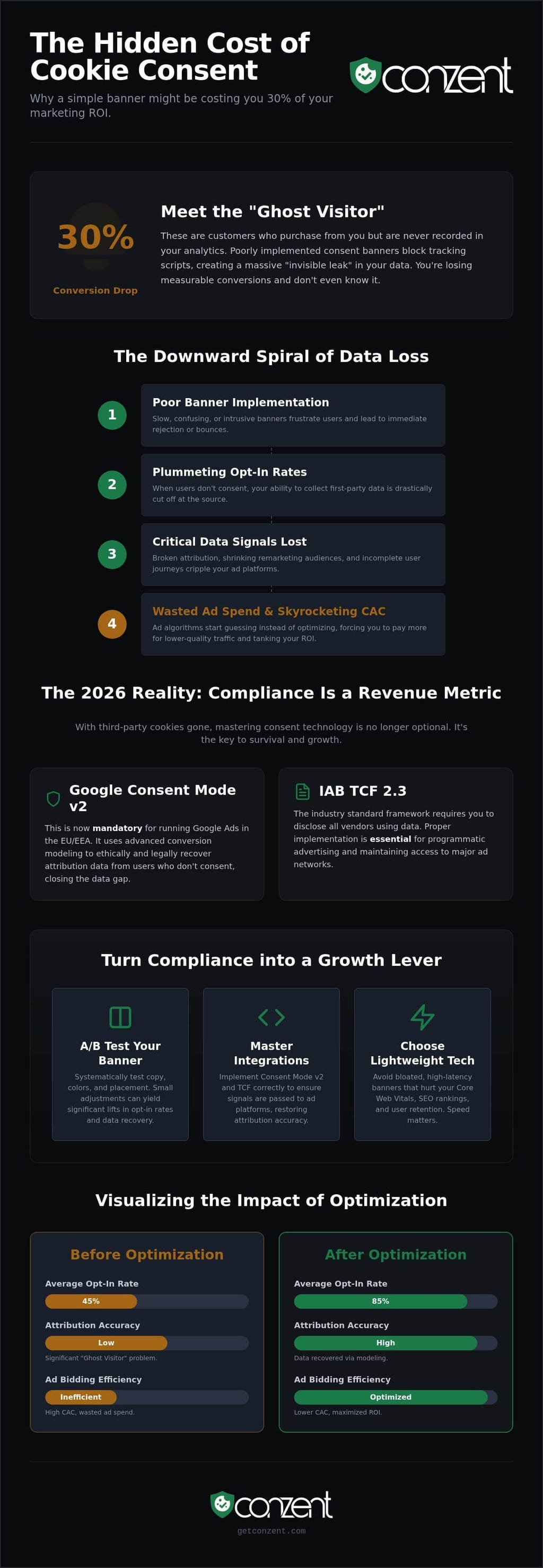
If you think your consent banner is just a compliance checkbox, you're likely ignoring a 30% drop in your measurable Google Ads conversions. This isn't just about legal safety. It's about your bottom line. The revenue impact of cookie consent is now a primary driver of marketing ROI. You've likely felt the sting of shrinking remarketing audiences and broken attribution in your dashboards. It's frustrating to watch high-intent traffic bounce because of an intrusive, poorly optimized banner. It feels like you're being punished for following the rules.
You don't have to choose between privacy and profit. This guide shows you how to quantify and reclaim your lost marketing data. We'll help you transform consent from a technical hurdle into a revenue optimization strategy. We'll examine the 2026 requirements for Google Consent Mode v2 and the mandatory "Disclosed Vendors" segment in IAB TCF v2.3. You'll get a clear framework for A/B testing your banners to restore data signals legally. We're moving beyond checking boxes and toward a privacy-first growth model that actually scales.
Key Takeaways
- Identify the "Ghost Visitor" problem where conversions occur but remain unrecorded. Quantifying this gap is essential to understanding the full revenue impact of cookie consent on your marketing ROI.
- Implement a systematic A/B testing framework for your consent banners. Small adjustments in placement and copy can significantly recover lost marketing signals.
- Master technical integrations like Google Consent Mode v2 and IAB TCF 2.3. These tools use advanced modeling to restore attribution accuracy in a cookieless environment.
- Choose the right infrastructure for your scale. Learn why switching from bloated, heavy banners to lightweight cloud or self-hosted solutions improves site speed and user retention.
The 2026 Reality: Why Cookie Consent is a Primary Revenue Metric
The revenue impact of cookie consent is the measurable difference between your total conversion potential and the data your marketing stack actually receives. It's the cost of silence. In 2026, the transition to a privacy-first web is no longer a forecast. It's the law of the land. Third-party cookies are gone. First-party data is the only currency that matters for brands that want to scale without overpaying for traffic.
Most companies view consent as a compliance tax. They want to avoid a GDPR fine, which can reach €20 million or 4% of global revenue, and then move on. This is a mistake. A revenue-first strategy treats the consent banner as the most important step in your conversion funnel. If a user doesn't opt in, your attribution breaks. Your remarketing lists shrink. Your Customer Acquisition Cost (CAC) skyrockets because your ad platforms are bidding in the dark. When you lose signals, you lose money. We call this the "Consent Gap," the invisible leak in your profit margin that occurs when your technical stack fails to capture legitimate intent.
The Death of Third-Party Cookies and the Rise of Consent
2026 marks the end of "guessing" user intent. You can't rely on shadow tracking anymore. You have to ask. Understanding What are HTTP cookies? helps clarify why this shift is so seismic. Tracking used to be passive and background-based. Now, managing consent signals is a competitive advantage. Brands with high opt-in rates have better data, lower CAC, and more efficient spend than those relying on "black box" modeling. High-quality first-party data strategies aren't just a luxury; they're the only way to build a sustainable marketing engine when the old tracking methods are dead.
The Direct Link Between Opt-in Rates and Ad ROI
Your ad algorithms are only as good as the data you feed them. When consent signals are missing, platforms like Google and Meta lose the ability to optimize for your best customers. This creates a "Blind Spot" where your analytics might show 20-30% fewer sales than your bank account actually records. This happens because non-compliant setups fail to trigger the necessary pings to ad servers. Signal loss is the primary driver of wasted ad spend in 2026. To fix this, you must audit your data flow using tools like Revenue Impact Analytics. Once you see the gap, you can use Cookie Consent A/B Testing to reclaim that lost visibility without compromising on ethics or speed.
The Invisible Leak: Quantifying Revenue Loss from Poor CMP Implementation
You aren't just losing data. You're losing money you've already spent. Every time a user interacts with a slow, confusing, or broken consent banner, a "Ghost Visitor" is born. These are people who navigate your site, find what they need, and even convert, but they never appear in your marketing reports. The scripts were blocked before they could fire. This is the core revenue impact of cookie consent. When your technical implementation is flawed, your profit margins suffer through three primary pillars: attribution failure, audience shrinkage, and increased bounce rates.
The cost of a heavy, high-latency cookie banner extends beyond the user experience. It directly impacts your SEO. If your banner script is poorly optimized, it can destroy your Core Web Vitals, specifically your Largest Contentful Paint (LCP) and First Input Delay (FID). In 2026, search engines penalize slow sites. A banner that adds 400ms of latency is a double tax. You lose search rankings, and you drive away frustrated users before they even see your value proposition.
Consider the math of bidding efficiency. If your opt-in rate drops by just 10%, your ad platforms don't just lose 10% of their power. They often lose 30% or more of their bidding efficiency. Ad algorithms require a high volume of signals to identify high-value users. When you starve the machine of data, it stops optimizing and starts guessing. This leads to higher bids for lower-quality traffic and a direct hit to your ROI.
Attribution Failure and the "Unknown" Traffic Trap
Your CRM and your analytics platforms will never align if your consent mapping is broken. Hard-blocking scripts is a blunt instrument. It's compliance without strategy. This approach creates the "Unknown" traffic trap where sales are recorded in your bank account but attributed to "Direct" or "Other" in your dashboard. Without Google Consent Mode v2, you lose the ability to use conversion modeling to fill these gaps. This broken attribution leads to poor budget allocation. You might cut spending on your most profitable channel simply because you can't see the signals.
Audience Shrinkage in Remarketing and Lookalikes
Remarketing lists fail when consent strings are malformed or missing. It's a technical mismatch. If the `ad_storage` parameter isn't correctly communicated to the ad tag, the user is never added to the audience pool. This doesn't just kill your retargeting; it ruins your lookalike modeling. You can't find "more people like your buyers" if the platform doesn't know who your buyers are. To fix this, you must adopt Privacy UX Design Patterns that build trust and encourage opt-ins. If you're ready to stop the data leak, explore our platform options to see how we restore visibility.
Consent Optimization: Turning Compliance into a Growth Lever
Stop treating compliance as a cost center. It is a conversion rate optimization (CRO) opportunity. If you optimize your checkout page but ignore your consent banner, you're leaving money on the table. The revenue impact of cookie consent is directly tied to how well you balance legal clarity with user trust. In 2026, a high opt-in rate is a competitive advantage that fuels your entire marketing machine. It's the difference between a data-rich strategy and a shot in the dark.
Step 1: Audit your baseline. Use Revenue Impact Analytics to see how much data you're currently losing. You can't fix what you haven't measured. Knowing the delta between your server-side sales and your analytics dashboard is the first step toward recovery.
Step 2: Start testing. Implement Cookie Consent A/B Testing to evaluate different banner placements and copy. Every audience is different. A bottom bar might work for mobile-first retailers, while a center modal might perform better for high-trust B2B services. Copy and placement aren't guesses; they're data points that dictate your ROI.
Step 3: Optimize for "Consent UX". This isn't about using dark patterns to trick users. It's about reducing friction. Make the "Accept" and "Settings" options equally clear. Transparency builds the trust necessary for long-term data collection. If users feel manipulated, they leave.
Step 4: Align the design. A generic, gray banner looks suspicious. It feels like a third-party intrusion. Match your banner's typography and color palette to your brand identity. It should feel like a native part of your site experience, not a legal afterthought.
Step 5: Monitor signals in real-time. Watch how changes to your banner affect your conversion signals in your ad dashboards. Optimization is a cycle, not a one-time event. Keep your data flow healthy by responding to user behavior as it evolves.
The Power of A/B Testing Your Cookie Banner
Don't guess what your users want. Test it. Small changes, like the color of an "Accept All" button versus a textual link for "Settings", can shift opt-in rates significantly. We've seen major differences between center-modal layouts and bottom-bar configurations. Using Conzent’s A/B testing features allows you to find the "sweet spot" where compliance meets conversion. It's about making data-driven decisions, not aesthetic preferences. You're building a bridge between legal requirements and marketing performance.
Reducing Bounce Rates Through Better Privacy UX
A slow banner is a bounce-rate catalyst. In 2026, users won't wait for a heavy script to load. If your consent banner delays the page content, users exit immediately. They also reject "legal-speak" that feels intentionally confusing. They want honest, direct communication. For a deeper dive into technical performance and design, see our guide on How to Reduce Cookie Banner Bounce Rate. High-performance consent infrastructure is a prerequisite for keeping visitors on your site and maintaining your search rankings.
Advanced Revenue Shields: Google Consent Mode v2 and IAB TCF 2.3
Technical errors in your consent implementation are silent killers of ROI. If your Google Ads account flags "Consent Errors," the platform doesn't just lose a few data points. It often triggers account-wide signal suppression. This is where the revenue impact of cookie consent becomes a technical crisis. You aren't just missing a few conversions; you're losing the ability to train the bidding algorithms that find your customers. In 2026, these frameworks are not optional. They are the shields that protect your marketing spend from total data decay.
For e-commerce brands, "Advanced Mode" in Google Consent Mode v2 (GCM v2) is the most critical recovery tool available. Unlike "Basic Mode," which hard-blocks tags until consent is granted, Advanced Mode sends cookieless pings. These pings allow Google to use conversion modeling to bridge the gap between intent and outcome. It is a sophisticated way to respect privacy while maintaining the data signals required for growth. Without it, you face a projected 20-30% decrease in measurable conversions for users in the EEA and UK.
Google Consent Mode v2: Modeling the Unseen
Modeling is how you recover up to 70% of lost conversion journeys. When a user declines cookies, Google uses the behavior of similar, consented users to estimate the actions of the non-consented group. This isn't guesswork; it's high-precision statistical inference. To leverage this, you must meet specific GCM v2 compliance standards. GCM v2 is a revenue recovery tool, not just a legal requirement. It ensures your bidding strategies remain aggressive and accurate even when direct tracking is impossible.
IAB TCF 2.3 for Publishers and Advertisers
The Transparency & Consent Framework (TCF) is the "language of money" in programmatic advertising. As of March 2026, TCF v2.3 is fully enforceable. It now requires a mandatory "Disclosed Vendors" segment in the consent string. If your CMP produces malformed strings, your CPMs and fill rates will plummet. Demand-side platforms (DSPs) simply stop bidding on your inventory if they can't verify consent. You must ensure your setup is IAB TCF certified to avoid this immediate bid-loss. Protecting your programmatic revenue starts with technical precision. If you are ready to secure your data infrastructure, view our managed and self-hosted plans.
The Conzent Advantage: Data Infrastructure Built for Performance
Most consent management platforms are built as marketing afterthoughts. They are heavy, third-party scripts that bloat your site and frustrate your users. We believe consent is a core technical requirement. It belongs in your infrastructure, not just your legal documents. The revenue impact of cookie consent is often decided by the speed of your scripts. If your banner adds significant latency to your First Input Delay (FID), you're losing customers before they even see your brand. Conzent provides lightweight, high-performance tools that protect your Core Web Vitals while securing your data signals.
Transparency is our standard. We don't hide behind proprietary "black box" systems that force you into a closed ecosystem. By integrating Revenue Impact Analytics, you can prove the tangible value of your CMP to stakeholders. You can show exactly how many conversions were recovered through optimized banners and proper technical mapping. This data-driven approach turns a compliance requirement into a documented growth driver. It's about moral clarity and technical efficiency working together to scale your business.
Managed Cloud vs. Self-Hosted: Which Scales Your Revenue?
Your business needs flexibility, not a one-size-fits-all solution. Our Managed Cloud Consent Platform is designed for speed. It's for teams that need to implement GCM v2 and TCF 2.3 immediately with zero maintenance. It's fast, reliable, and scales automatically with your traffic. It isn't a luxury; it's a standard for modern growth teams.
For enterprise DevOps teams, we offer Self-Hosted Open Consent Infrastructure. This is about maximum control. You own the data perimeter. You eliminate third-party dependencies and optimize performance to the millisecond. Our pricing model supports this scaling without adding "compliance taxes" that penalize your growth. You choose the deployment method that fits your technical stack and your revenue goals.
Infrastructure as a Growth Strategy
In 2026, your CMP is a primary part of your tech stack. It's the gateway to your first-party data. Treating it as a detached script is a strategic error. We advocate for Open Consent Infrastructure (OCI) because open standards lead to better trust and long-term ROI. When your infrastructure is transparent, your users feel safer, and your data remains cleaner. This is how you build a sustainable marketing engine in a privacy-first world. Don't let a bloated banner drain your profits. Optimize your revenue impact with Conzent today and take control of your data signals.
Take Control of Your Privacy-First Growth Strategy
The web has changed. You can't rely on passive tracking to fuel your growth anymore. In 2026, your marketing success depends on your ability to manage consent signals with technical precision. We've explored how the revenue impact of cookie consent reaches into every corner of your business, from Google Ads bidding efficiency to your Core Web Vitals. Ignoring the "Consent Gap" is a choice to leave money on the table. It's time to move beyond the checkbox mentality and treat data signals as the asset they are.
You need infrastructure that respects both your users and your bottom line. Conzent provides a principled approach through source-available Open Consent Infrastructure and integrated A/B testing. Our platform is fully IAB TCF 2.3 and GCM v2 certified, ensuring your data signals remain strong and compliant. Stop guessing about your data loss and start measuring it. Start measuring your revenue impact with Conzent and turn your compliance hurdles into a growth lever. You have the power to build a transparent, profitable future today.
Frequently Asked Questions
How exactly does cookie consent affect my Google Ads revenue?
Cookie consent directly controls your conversion volume and bidding efficiency. When users opt out or your banner fails to send signals, Google Ads can't optimize for your target ROAS. This leads to higher acquisition costs and lower total revenue because the algorithm is forced to bid blindly without knowing which clicks actually lead to sales.
Can I legally A/B test my cookie banner to increase opt-in rates?
Yes, you can legally test banner elements as long as you avoid "dark patterns" that manipulate user choice. Testing different placements, colors, and clear copy helps you find a configuration that respects privacy while maximizing opt-ins. Transparency is a requirement for compliance, but it isn't a barrier to data-driven design improvements.
What is the "Consent Gap" in digital marketing?
The Consent Gap is the delta between your actual business sales and the conversion data captured in your marketing analytics. It represents the "ghost" traffic that converts but remains unrecorded due to non-consented tracking blocks. Closing this gap is the only way to accurately measure the revenue impact of cookie consent and justify your ad spend.
Does Google Consent Mode v2 actually recover lost conversion data?
Google Consent Mode v2 uses conversion modeling to bridge attribution gaps. By analyzing the behavior of consented users, Google's AI estimates the conversion probability for those who opted out. This allows you to recover a significant portion of lost signals without violating user privacy or storing personal data on the device.
How much revenue am I losing by using a generic cookie banner plugin?
Generic plugins often cause a 20% to 30% decrease in measurable conversions because they lack advanced signaling features like GCM v2. They also tend to be heavy, slowing down your site and increasing bounce rates. You lose money through both the loss of data signals and a degraded user experience that drives visitors away.
What is the difference between Basic and Advanced Google Consent Mode v2?
Basic mode hard-blocks tags until the user consents, providing zero data for opt-outs. Advanced mode sends "cookieless pings" even when consent is denied. These pings don't store personal information but provide the necessary metadata for Google to perform the conversion modeling required for accurate revenue reporting and optimization.
How does CMP script weight impact my e-commerce conversion rate?
Heavy CMP scripts increase First Input Delay and degrade your Core Web Vitals. For e-commerce sites, even minor latency can reduce conversion rates and hurt search rankings. Lightweight infrastructure ensures your consent banner doesn't become a performance bottleneck that causes users to abandon their carts before the page fully loads.
Is IAB TCF 2.3 mandatory for programmatic ad revenue in 2026?
Yes, IAB TCF 2.3 is mandatory for programmatic advertising as of March 2026. Without a valid TCF v2.3 string, major ad exchanges and demand-side platforms will stop bidding on your inventory. This leads to immediate revenue loss for publishers through lower fill rates and significantly lower CPMs across all programmatic channels.
Frequently Asked Questions
Managed Cloud vs. Self-Hosted: Which Scales Your Revenue?
Your business needs flexibility, not a one-size-fits-all solution. Our Managed Cloud Consent Platform is designed for speed. It's for teams that need to implement GCM v2 and TCF 2.3 immediately with zero maintenance. It's fast, reliable, and scales automatically with your traffic. It isn't a luxury; it's a standard for modern growth teams. For enterprise DevOps teams, we offer Self-Hosted Open Consent Infrastructure. This is about maximum control. You own the data perimeter. You eliminate third-party dependencies and optimize performance to the millisecond. Our pricing model supports this scaling without adding "compliance taxes" that penalize your growth. You choose the deployment method that fits your technical stack and your revenue goals.
How exactly does cookie consent affect my Google Ads revenue?
Cookie consent directly controls your conversion volume and bidding efficiency. When users opt out or your banner fails to send signals, Google Ads can't optimize for your target ROAS. This leads to higher acquisition costs and lower total revenue because the algorithm is forced to bid blindly without knowing which clicks actually lead to sales.
Can I legally A/B test my cookie banner to increase opt-in rates?
Yes, you can legally test banner elements as long as you avoid "dark patterns" that manipulate user choice. Testing different placements, colors, and clear copy helps you find a configuration that respects privacy while maximizing opt-ins. Transparency is a requirement for compliance, but it isn't a barrier to data-driven design improvements.
What is the "Consent Gap" in digital marketing?
The Consent Gap is the delta between your actual business sales and the conversion data captured in your marketing analytics. It represents the "ghost" traffic that converts but remains unrecorded due to non-consented tracking blocks. Closing this gap is the only way to accurately measure the revenue impact of cookie consent and justify your ad spend.
Does Google Consent Mode v2 actually recover lost conversion data?
Google Consent Mode v2 uses conversion modeling to bridge attribution gaps. By analyzing the behavior of consented users, Google's AI estimates the conversion probability for those who opted out. This allows you to recover a significant portion of lost signals without violating user privacy or storing personal data on the device.
How much revenue am I losing by using a generic cookie banner plugin?
Generic plugins often cause a 20% to 30% decrease in measurable conversions because they lack advanced signaling features like GCM v2. They also tend to be heavy, slowing down your site and increasing bounce rates. You lose money through both the loss of data signals and a degraded user experience that drives visitors away.
What is the difference between Basic and Advanced Google Consent Mode v2?
Basic mode hard-blocks tags until the user consents, providing zero data for opt-outs. Advanced mode sends "cookieless pings" even when consent is denied. These pings don't store personal information but provide the necessary metadata for Google to perform the conversion modeling required for accurate revenue reporting and optimization.
How does CMP script weight impact my e-commerce conversion rate?
Heavy CMP scripts increase First Input Delay and degrade your Core Web Vitals. For e-commerce sites, even minor latency can reduce conversion rates and hurt search rankings. Lightweight infrastructure ensures your consent banner doesn't become a performance bottleneck that causes users to abandon their carts before the page fully loads.
Is IAB TCF 2.3 mandatory for programmatic ad revenue in 2026?
Yes, IAB TCF 2.3 is mandatory for programmatic advertising as of March 2026. Without a valid TCF v2.3 string, major ad exchanges and demand-side platforms will stop bidding on your inventory. This leads to immediate revenue loss for publishers through lower fill rates and significantly lower CPMs across all programmatic channels.