
Cookie Consent for Adtech: Maximizing Ad Revenue in the 2026 Privacy Landscape

Ad-supported media sites are currently seeing opt-in rates as low as 23 percent. This isn't just a legal hurdle. It's a technical drain on your programmatic yield. You've likely dealt with the frustration of latency-driven ad timeouts or the fear of non-compliance fines. Implementing cookie consent for adtech shouldn't mean sacrificing your revenue to satisfy a checkbox. We believe privacy infrastructure should be transparent, fast, and accessible to every publisher, regardless of their resource level.
You can satisfy IAB TCF v2.3 requirements without watching your CPMs crater. This article explains how to deploy a high-performance consent strategy that prioritizes technical efficiency. We'll cover how to recover lost data through A/B testing and ensure seamless integration with Google Consent Mode v2. You'll see exactly how to move from a clunky, third-party banner to a streamlined infrastructure that treats consent as a performance metric. Let's stop treating compliance as a tax and start treating it as a technical optimization.
Key Takeaways
- Stop letting latency kill your programmatic yield. Discover how to build a consent strategy that eliminates ad timeouts and prioritizes technical efficiency.
- Master the technical requirements of IAB TCF v2.3 and Google Consent Mode v2. These frameworks aren't just hurdles; they're your primary tools for recovering lost data.
- Learn to optimize cookie consent for adtech through rigorous A/B testing. We'll show you how design choices directly impact your opt-in rates and your bottom line.
- Evaluate the benefits of Managed Cloud versus Self-Hosted Open Consent Infrastructure. Choose the model that gives you the best balance of speed, scale, and data sovereignty.
- Build a transparent privacy stack that integrates with WordPress, Drupal, and custom adtech. Move away from black-box vendors and toward source-available infrastructure that respects user rights.
The Adtech Compliance Crisis: Why Traditional CMPs Fail in 2026
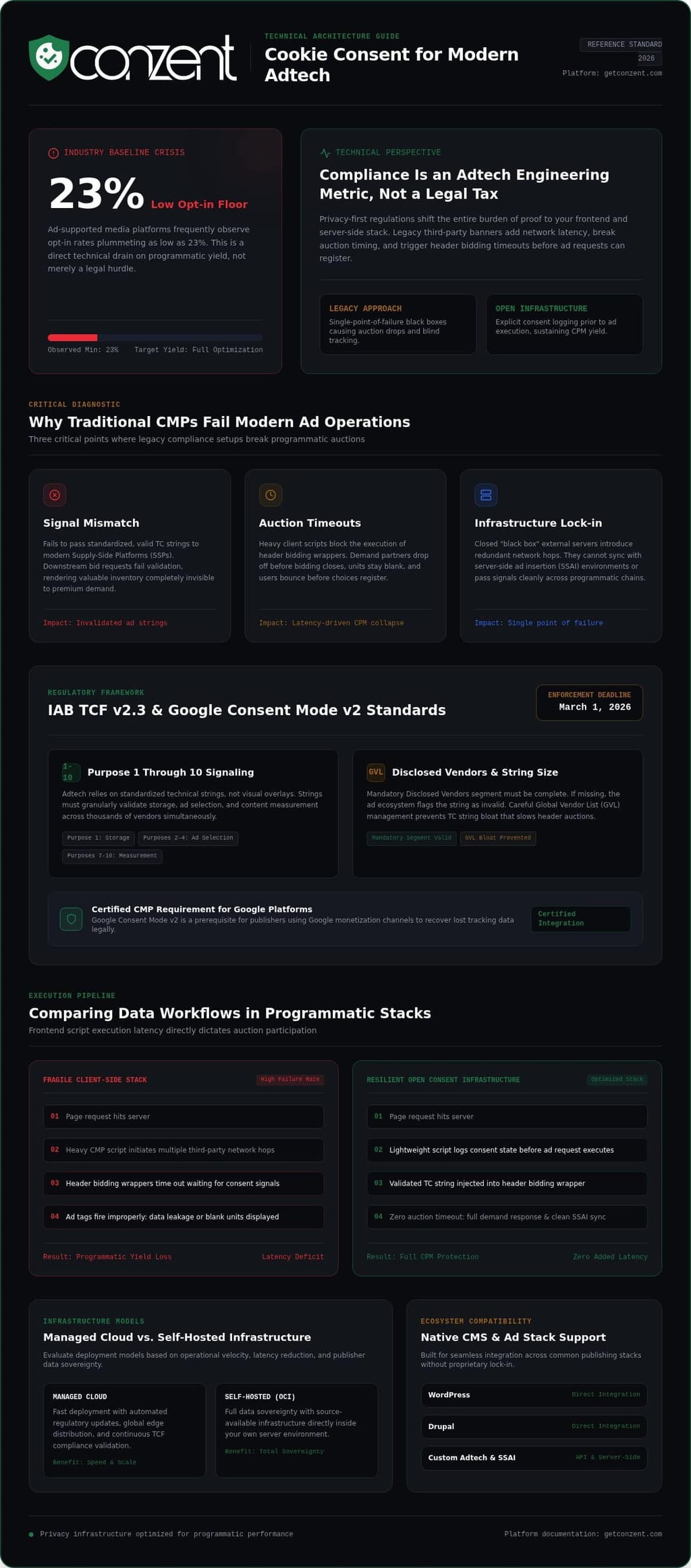
The mechanics of the traditional HTTP cookie have fundamentally changed. Privacy-first regulations have shifted the entire burden of compliance proof onto the publisher's technical stack. Legacy tools built for simple legal compliance can no longer protect your programmatic yield. They rely on generic banners that fail to deliver the granular signaling modern Supply-Side Platforms (SSPs) require. When your compliance tool operates as a closed, "black box" SaaS solution, it becomes a single point of failure for your ad operations. High-performance cookie consent for adtech isn't about legal box-checking. It's a technical optimization problem where transparency directly drives your bottom line.
Traditional CMPs fail because they treat privacy as an isolated legal requirement rather than an integrated adtech component. This mismatch manifests in three distinct ways:
- Signal mismatch: Failing to pass valid strings to modern SSPs.
- Auction timeouts: Blocking the fast execution of header bidding wrappers.
- Infrastructure lock-in: Relying on external servers that add unnecessary network hops.
The High Cost of Consent Latency
Heavy compliance scripts are the silent killers of programmatic revenue. When a consent banner delays script execution, your header bidding auctions time out before they even start. Demand partners drop off. Ad units remain blank. This latency creates a direct correlation between slow banner load times and rising bounce rates. If a user leaves before the consent string registers, you lose both the audience and the monetization opportunity. Adtech requires a lightweight, performance-optimized script. Speed isn't a premium feature; it's an absolute technical requirement for survival in programmatic auctions.
Data Leakage and Privacy-First Ad Stacks
Fragile client-side scripts create severe data leakage risks. Traditional CMPs often fail to block tags properly, firing tracking code before a user's choice is technically registered or transmitted. This invalidates downstream ad strings and invites heavy regulatory fines. These legacy platforms also fail to synchronize with modern server-side ad insertion (SSAI) environments. They cannot pass consent data seamlessly across complex programmatic chains. To secure your revenue, you must transition from brittle frontend overlays to a robust, open consent infrastructure. Your setup must log consent states explicitly before any ad request executes. It's the difference between a superficial visual patch and a resilient, privacy-first ad stack.
IAB TCF v2.3 and Google Consent Mode v2: The Adtech Standard
The adtech industry doesn't speak in banners. It speaks in standardized signals. IAB TCF v2.3 is the framework that allows you to communicate user choices to thousands of vendors simultaneously. Without it, your bid requests are effectively invisible to premium demand. By the March 1, 2026 enforcement deadline, the framework shifted to require even more granular vendor disclosures. This ensures that third-party tracking cookies are only deployed when a user has explicitly granted permission for specific purposes. Implementing a certified CMP is now a hard requirement for any publisher using Google's ad platforms.
Modern compliance requires strict adherence to Purpose 1 through 10 signaling. These signals cover everything from basic storage to complex ad selection and content measurement. A robust cookie consent for adtech strategy ensures that these technical strings are valid and complete. If your TC string lacks the mandatory Disclosed Vendors segment, the ecosystem treats it as invalid, and your revenue disappears.
Navigating TCF v2.3 Requirements
Precision is more important than broad compliance. TCF v2.3 requires you to manage your Global Vendor List (GVL) with care. Adding every possible vendor increases the TC string size. This bloat can slow down your header auctions and trigger timeouts. You must also communicate Legitimate Interest without violating GDPR principles, a balance that requires technical clarity rather than legal jargon. We believe these standards should be accessible to all publishers, not just those with massive legal budgets. You can learn more about IAB TCF compliance to see how we simplify this complexity.
Mastering Google Consent Mode v2
Google Consent Mode v2 is the bridge between privacy and measurement. It has been mandatory for EEA traffic since March 2024. The framework uses two critical signals: ad_user_data and ad_personalization. These tell Google exactly how to handle user data for its advertising services. On June 15, 2026, the ad_storage parameter became the single controlling parameter for all advertising data in linked Google Ads accounts. A smart cookie consent for adtech setup uses Advanced implementation to recover data through conversion modeling, even when users opt out. This fills the gaps that would otherwise leave your ROI in the dark. For a deeper technical dive, read our technical guide to GCM v2.
Building a high-performance stack shouldn't be a financial burden. You can review our pricing options to see how egalitarian infrastructure fits your growth plans.
Maximizing Ad Revenue: Optimization Strategies for High Opt-in Rates
Consent is fundamentally a user experience challenge. It directly dictates your programmatic fill rates and CPMs. When your consent banner is poorly designed, your opt-in rates plummet, often hitting the 23 to 30 percent floor typical for ad-supported media sites. Many publishers respond by deploying manipulative dark patterns to force consent. This is a critical mistake. Regulators actively penalize deceptive designs, and users simply abandon the site. Optimization isn't about tricking the user; it's about building a clean, transparent interface that respects choices while preserving your bottom line.
To protect your yield, you must treat consent as a core performance metric. A successful cookie consent for adtech framework relies on empirical data rather than guesswork. By measuring how specific layout variations affect your programmatic bids, you can build a compliant system that maximizes revenue.
Design Patterns for Higher Consent Rates
Every pixel matters. Testing shows that a center modal commands immediate attention but increases user friction, while a subtle footer banner often gets ignored, leading to unconsented pageviews. Button hierarchy and color psychology also play massive roles. Regulators demand an equal choice, meaning your reject button must be as prominent as your accept button. However, clear typography and honest micro-copy can drastically reduce accidental rejections. Utilizing the right cookie banner features allows you to test these layouts cleanly without breaking your ad stack.
Revenue Impact Analytics
You can't optimize what you don't measure. Traditional consent tools tell you your opt-in percentage, but they fail to show the financial consequences. You need to know exactly which programmatic partners lose the most revenue under specific consent states. Does an SSP drop its bid by 80 percent without personalization, or does it stop bidding entirely? Using Revenue Impact Analytics gives you clear visibility into these discrepancies. This data allows you to continuous A/B test your layout, copy, and vendor list. It's the only reliable way to build a sustainable, compliant ad revenue strategy that protects your programmatic yield.
Implementing Consent Infrastructure: Managed Cloud vs. Self-Hosted
Choosing a deployment model for cookie consent for adtech is a strategic decision about control. Most vendors force you into a proprietary cloud. We believe in a different path. You should choose between the operational ease of a Managed Cloud and the total sovereignty of self-hosted infrastructure. Both options must prioritize speed. A slow banner is a revenue leak. Source-available code ensures that your compliance stack isn't a black box hidden from your own developers. It turns a legal requirement into a transparent technical asset.
Traditional SaaS pricing models often punish success by charging per pageview. This creates a luxury tax on your growth. We're disrupting this by offering egalitarian infrastructure that scales with you. Whether you want a hands-off cloud solution or a deeply integrated local setup, your ad revenue remains the priority. Compliance should be a standard, not a premium burden.
The Case for Self-Hosting in Adtech
Self-hosting is the performance-first choice. It eliminates third-party script dependencies. This directly improves your Core Web Vitals by removing external network hops. When you host your own Self-Hosted Open Consent Infrastructure, you gain full control over your consent logs. This makes your stack audit-ready without relying on a vendor's uptime. It's about data sovereignty. You own the code. You own the logs. You own the performance. It's the most resilient way to handle cookie consent for adtech in a high-traffic environment.
Managed Cloud for Rapid Deployment
Managed Cloud is for publishers who want compliance without the maintenance. It scales privacy without the operational overhead. You get automatic updates for evolving standards like IAB TCF v2.3 and Google Consent Mode v2. Global CDN delivery ensures your banner renders instantly for every user, regardless of their location. This setup keeps your ad stack agile. You don't have to worry about manual patches when regulations shift. You can check out our Managed Cloud pricing options to see how we make high-performance compliance attainable for everyone.
Don't let legacy vendors dictate your technical roadmap. You can view our transparent pricing plans and choose the infrastructure that fits your mission.
Future-Proofing Your Ad Stack with Conzent
Conzent isn't just another vendor. We're a Copenhagen-based team on a mission to fix a broken industry. Traditional CMPs treat privacy as a luxury or a tax. We treat it as a technical standard that should be open to everyone. By providing source-available tools, we empower you to take back control of your ad stack. Whether you run on WordPress, Drupal, or a custom-built adtech engine, your infrastructure should be yours. The Open Consent Infrastructure (OCI) isn't just about code. It's about lowering compliance costs so that every publisher can thrive.
Implementing cookie consent for adtech shouldn't require a six-figure legal budget or a team of data scientists. It requires a performance-first mindset. We've built our platform to integrate seamlessly with the tools you already use. This ensures your programmatic revenue stays protected as privacy laws evolve. We don't believe in black boxes. We believe in transparency and speed.
Principled Compliance for Modern Publishers
We believe in egalitarian pricing. Compliance shouldn't be a premium feature restricted to enterprise giants. Our community-driven development model ensures that our tools evolve alongside the needs of real publishers. We aren't just building a product; we're advocating for digital rights. This means creating a transparent ecosystem where users understand their choices and publishers maintain their independence. You can join the mission at Conzent and help us set a new industry standard.
Next Steps: From Audit to Optimization
Transitioning to a performance-first strategy starts with an honest look at your current setup. Don't wait for a regulatory notice or a sudden drop in CPMs to act. Follow this checklist to future-proof your revenue:
- Audit your CMP: Ensure your current provider is fully TCF v2.3 certified and handling the mandatory vendor segments correctly.
- Analyze Latency: Use developer tools to measure how long your banner takes to fire the first ad signal. Every millisecond counts.
- Verify GCM v2: Confirm that
ad_user_dataandad_personalizationsignals are reaching Google Ads accurately. - Test Revenue Impact: Set up an A/B test to compare different banner layouts against actual programmatic yield.
You don't have to navigate this alone. You can review our Pricing and Sponsorship tiers to find a model that supports your growth. We're here to help you move beyond simple compliance and toward genuine optimization. Let's build a faster, more ethical web together.
Securing Your Programmatic Future
The 2026 privacy landscape doesn't have to be a threat to your bottom line. We've established that high-performance cookie consent for adtech is a technical optimization, not just a legal checkbox. By integrating IAB TCF v2.3 and Google Consent Mode v2, you maintain the standardized signals that premium demand partners require. Moving away from black-box SaaS toward source-available infrastructure eliminates the latency that kills programmatic auctions. You now have the roadmap to use A/B testing and revenue impact analytics to recover lost yield and build user trust.
Conzent provides the tools to make this transition seamless. Our platform is IAB TCF v2.3 Certified and Google Consent Mode v2 Ready, offering the transparency you need to stay audit-ready. We believe that efficient, ethical compliance should be accessible to every publisher. It's time to stop paying a growth tax to legacy vendors and start owning your data. You can View Managed Cloud Pricing and Sponsorship Options to find a plan that fits your mission. You're ready to build a faster, more resilient ad stack.
Frequently Asked Questions
How does cookie consent affect my programmatic ad revenue?
Consent levels dictate whether demand partners can bid on your inventory. Without a valid TC string, premium SSPs often stop bidding entirely. This leads to lower fill rates and crashing CPMs. Research shows ad-supported media sites often see opt-in rates as low as 23 percent when using clunky banners. Optimizing your cookie consent for adtech ensures you capture the necessary signals while maintaining high user engagement and programmatic yield.
What are the main changes in IAB TCF v2.3 for 2026?
The transition to IAB TCF v2.3 became fully enforceable on March 1, 2026. The primary shift requires a mandatory "Disclosed Vendors" segment in every TC string to prove vendor disclosure. Any string missing this segment is now considered invalid by the ad ecosystem. This update focuses on transparency, ensuring users have a clearer understanding of which specific vendors are processing their data before any consent is logged or transmitted.
Do I need Google Consent Mode v2 if I don’t use Google Ads?
You still need it if you use Google Analytics 4 (GA4) and target users in the European Economic Area. Google Consent Mode v2 has been mandatory since March 2024 for these services. It communicates user choices to Google's tags, allowing the platform to model conversions and fill data gaps. Failing to implement it results in losing statistical data for approximately 52 percent of website sessions that opt out.
Can I self-host my cookie consent manager to improve website speed?
Yes, self-hosting is the most effective way to eliminate third-party script dependencies. By using our Self-Hosted Open Consent Infrastructure, you remove external network hops that typically slow down page rendering. This directly improves your Core Web Vitals and reduces the risk of ad unit timeouts. You gain full data sovereignty while ensuring your consent logic executes at the same speed as your own internal site scripts and server functions.
What is the difference between a black-box CMP and a source-available platform?
A black-box CMP hides its logic and infrastructure behind proprietary code, often creating a single point of failure for your revenue. In contrast, a source-available platform like Conzent offers total transparency. You can inspect, modify, and host the code yourself. This approach avoids vendor lock-in and ensures your compliance stack isn't a mystery to your developers. It treats privacy as a public good rather than a hidden commercial secret.
How can A/B testing improve my cookie consent opt-in rates?
A/B testing allows you to find the exact balance between regulatory compliance and high conversion. You can test banner placement, color psychology, and button hierarchy to see what resonates with your specific audience. Small changes in design can prevent opt-in rates from dropping by the 20 to 30 percent seen when "Reject All" buttons are placed poorly. It turns UX guesswork into a data-driven strategy for long-term revenue protection.
Is Conzent compatible with my CMS like WordPress or Drupal?
Conzent is designed for broad compatibility across the digital ecosystem. We provide specific integrations for WordPress, Drupal, Joomla, and other major CMS platforms. The platform also works seamlessly with custom adtech stacks and header bidding wrappers. Whether you choose our Managed Cloud or a self-hosted setup, the integration process is straightforward. We aim to make high-performance cookie consent for adtech attainable for every publisher regardless of their technical resources.
How do I measure the revenue impact of GDPR consent on my site?
You can use our Revenue Impact Analytics dashboard to correlate consent states with actual programmatic yield. This tool shows you exactly how much revenue you lose when users opt out of specific purposes or vendors. Instead of guessing, you see the direct financial consequences of your opt-in rates. This data allows you to justify your CMP spend and fine-tune your vendor list for maximum fill rates and CPM performance.