
Cookie Consent for Programmatic Advertising: Protecting Yield in 2026

Compliance isn't a tax on your programmatic revenue. It's the foundational infrastructure that validates and protects it. Many publishers treat cookie consent for programmatic advertising as a hurdle to clear. This mindset is a mistake. It leads to heavy scripts, broken data flows, and lost yield. You've likely felt the sting of low opt-in rates or the technical friction of TCF 2.3. It's frustrating to watch revenue drop because of a clunky banner or a misconfigured Google Consent Mode v2 setup.
Privacy shouldn't be a trade-off for performance. You deserve a system that respects digital rights without starving your business. This guide teaches you how to bridge the gap between strict compliance and high-yield programmatic revenue. We'll examine how high-performance infrastructure and better UX drive opt-in rates upward. You'll learn to implement GCM v2 with zero errors and move away from black box vendors that hide your own data. It's time to turn your consent layer into a competitive advantage.
Key Takeaways
- Generic banners create dark pool traffic that advertisers won't touch. Learn to replace them with a valid consent-signal framework that protects your inventory.
- Technical standards like IAB TCF 2.3 and Google Consent Mode v2 are non-negotiable. These tools bridge the gap for unconsented users through advanced data modeling.
- Script latency kills ad yield before the first bid is even made. High-performance cookie consent for programmatic advertising requires infrastructure built for speed and global delivery.
- Compliance isn't a "set it and forget it" task. Use revenue impact analytics and A/B testing to optimize opt-in rates without compromising on legal requirements.
- Shift away from black box vendors that hide your data. Source-available infrastructure offers the transparency and control needed for the next era of digital advertising.
The Programmatic Challenge: Why Standard Banners Fail in 2026
The programmatic ecosystem has undergone a fundamental shift. We've moved past the era where advertising relied solely on third-party cookies. Today, the industry runs on consent signals. If your site doesn't broadcast a valid, standardized signal, you're effectively invisible to premium buyers. This is the reality of programmatic advertising in 2026. You can't rely on luck or legacy systems anymore.
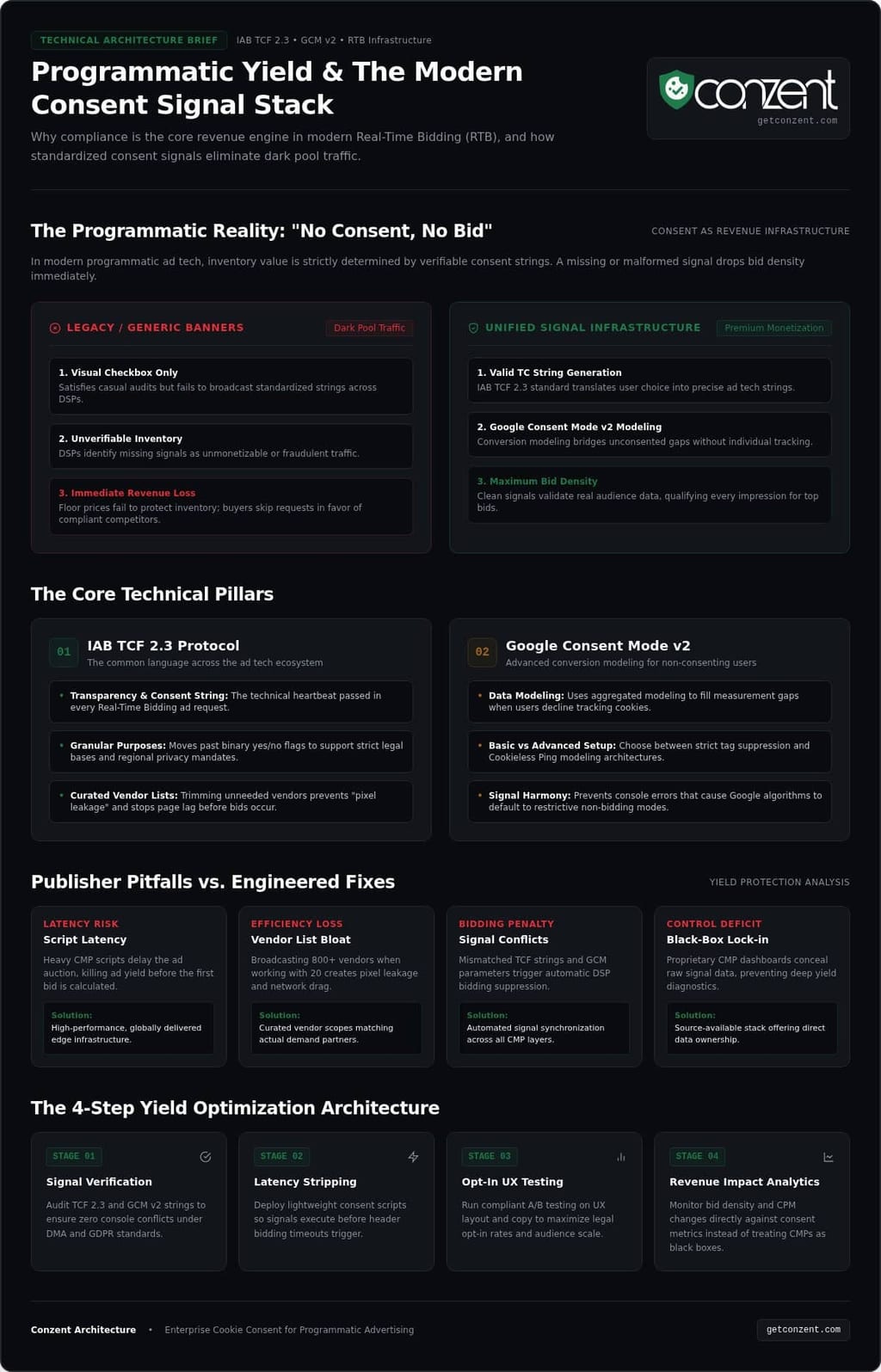
Standard cookie banners often fail because they treat compliance as a visual checkbox rather than a technical requirement. A generic banner might satisfy a casual legal audit, but it creates "dark pool" traffic. To a Demand-Side Platform (DSP), traffic without a verifiable consent string looks like unmonetizable or fraudulent inventory. Advertisers won't bid on what they can't verify. Fragmented privacy laws like GDPR, CCPA, and the DMA create a complex web of requirements that a simple pop-up cannot handle. You need a unified signal infrastructure that translates user choices into the specific technical strings required by each region's ad tech stack.
The Cost of Non-Compliance in RTB
The "No Consent, No Bid" rule is now absolute. In the world of Real-Time Bidding (RTB), your inventory's value is tied directly to the TCF signal it carries. If these signals are missing or malformed, your floor prices won't matter; the bids simply won't arrive. This isn't just about the GDPR anymore. The Digital Markets Act (DMA) has forced gatekeepers to tighten their requirements. They now demand explicit, granular signals before any data processing occurs. Missing a IAB TCF v2.3 integration means immediate revenue drops as open market buyers skip your requests in favor of compliant competitors.
Consent as Your New Revenue Infrastructure
Stop viewing cookie consent for programmatic advertising as a legal tax. It's actually your most critical piece of revenue infrastructure. High-performance publishers understand that a transparent consent layer builds long-term advertiser trust. When you provide a clear, error-free signal, you're telling the market that your data is clean and your audience is real. This clarity is what drives higher bid density and better yields.
There's a sharp contrast here between principled infrastructure and black-box vendor lock-in. Many legacy CMPs hide your data behind proprietary dashboards. They prioritize their own ecosystem over your yield. A better approach uses source-available infrastructure that gives you total control over your signals. You shouldn't have to choose between privacy and profit. True efficiency comes from owning the stack that validates your traffic and ensures every impression is eligible for the highest possible bid.
Technical Essentials: IAB TCF 2.3 and Google Consent Mode v2
Success in modern programmatic advertising depends on two technical pillars: the IAB Transparency and Consent Framework (TCF) and Google Consent Mode (GCM). These aren't redundant systems. They're complementary. TCF 2.3 acts as the industry's common language, passing user preferences across the entire ad tech stack. GCM v2 serves a different purpose. It bridges the data gap when users decline cookies, using conversion modeling to fill holes without tracking individuals. Mastering cookie consent for programmatic advertising requires these two systems to work in perfect harmony.
Implementation pitfalls are common and costly. If your TCF strings and GCM signals don't align, you trigger "Consent Mode" errors. These errors don't just look bad in a developer console; they actively suppress your ability to bid on premium inventory. When signals conflict, DSPs and Google's bidding algorithms default to the most restrictive setting. You lose data, you lose yield, and you lose the chance to optimize your campaigns effectively.
Mastering IAB TCF 2.3 for Publishers
The Transparency and Consent String (TC String) is the heartbeat of every ad request. The 2026 updates to TCF 2.3 demand absolute precision regarding granular purposes and legal bases. It's no longer enough to offer a binary choice. Conzent ensures your IAB TCF 2.3 compliance is automated and technically sound. A major risk for publishers is vendor list bloat. If your CMP broadcasts 800 vendors but you only work with 20, you risk "pixel leakage" and unnecessary performance lag. We help you curate these lists to protect both user privacy and page speed.
Implementing Google Consent Mode v2 Correctly
Publishers must choose between Basic and Advanced implementation based on their specific risk profile. Basic implementation blocks tags entirely until consent is given. Advanced implementation sends anonymous "pings" that allow for data modeling. Using Conzent to fix Google Consent Mode v2 errors ensures your setup remains valid under scrutiny. Modeled conversions recover a significant portion of "lost" revenue by providing the algorithms with enough signal to function. If you're ready to stabilize your ad stack, you can view our platform options to find the right fit for your traffic volume.
Managed Cloud vs. Self-Hosted: Performance for Programmatic
In programmatic auctions, milliseconds determine your yield. If your cookie consent for programmatic advertising script is bloated, your ad units won't initialize until the user interacts or the script finishes loading. This latency is a silent killer. It directly reduces your Viewability scores. Lower Viewability means lower CPMs and fewer bids from premium buyers. It's a chain reaction that begins with poor infrastructure and ends with a significant hit to your bottom line. You can't afford to let a compliance tool dictate your site's speed.
Publishers shouldn't be forced into a one-size-fits-all model. Many legacy CMPs operate as black boxes, forcing you onto their servers and under their terms. Conzent's Open Consent Infrastructure (OCI) changes this dynamic. We provide the choice between a managed cloud environment and a self-hosted setup. This isn't just about technical preference. It's about data sovereignty and operational efficiency. You decide where your code lives and how your data is handled.
The Impact of CMP Latency on Core Web Vitals
Performance isn't a luxury; it's a technical requirement. A slow consent banner delays the "DOMContentLoaded" event, pushing back your ad server's call. Lightweight, asynchronous scripts are non-negotiable for programmatic publishers. Conzent prioritizes speed by stripping away the unnecessary bloat found in traditional enterprise tools. We ensure your consent signal is ready before the auction begins. By minimizing performance lag, you protect your Core Web Vitals and keep your inventory attractive to high-value advertisers who demand fast, responsive environments.
Choosing Your Compliance Path
Deciding how to deploy your consent layer depends on your team's resources and goals. You can choose Self-Hosted OCI for maximum privacy and zero recurring infrastructure costs. This is the ideal path for developers who want total data ownership and the ability to scale without increasing monthly fees. It provides the ultimate level of control over your technical stack. There are no hidden fees or vendor lock-ins.
In contrast, a Managed Cloud Consent Platform offers zero-maintenance convenience and global CDN delivery. It's built for agencies and publishers that need to scale fast across hundreds of domains without managing their own server infrastructure. You get the benefits of principled, transparent code with the simplicity of a managed service. Both paths deliver the same high-performance result. The choice depends on whether you value hands-off simplicity or deep technical sovereignty. Finding the balance between free infrastructure and managed convenience is finally possible.
Optimizing for Yield: A/B Testing and Revenue Analytics
Treating your consent layer as a static legal requirement is a mistake that costs you money every day. In the programmatic market, your opt-in rate is your liquidity. If 20% of your visitors leave before making a choice, you've lost 20% of your potential auction participants. This "Consent Churn" is often invisible unless you're looking for it. Success with cookie consent for programmatic advertising requires a shift from passive compliance to active optimization. You wouldn't leave your checkout page unoptimized. Don't do it to your consent banner.
Data-Driven Banner Design
Design is never neutral. Every color choice and button placement sends a signal to your user. A banner that feels like a technical error will be closed or rejected. A banner that feels like a transparent invitation to a better experience wins the opt-in. You can use Conzent A/B testing features to iterate on these elements in real-time. Test your micro-copy. Compare a "Reject All" button against a "Manage Preferences" link. But stay ethical. Dark patterns, like hiding the reject button or using deceptive colors, will eventually backfire. Regulators are watching, and premium advertisers will blacklist sites that trick users. Principled design is a long-term revenue strategy.
Visualizing the Revenue Gap
You can't manage what you don't measure. Most publishers have no idea what their "Cost of Reject" actually is. They see a drop in revenue and blame the market, when the culprit is often a misconfigured consent flow. By using a Revenue Impact Analytics dashboard, you can bridge the gap between your CMP and your ad server. This transparency allows you to see exactly how much yield you're leaving on the table. You can identify Consent Churn by tracking where users drop out of the funnel before a signal is even generated.
Some industry professionals report that refining the consent UX can recover up to 15% of previously lost programmatic yield. This isn't about trickery; it's about reducing friction. When you make the choice easy and transparent, users stay on the page and advertisers bid higher on the validated signals. To start reclaiming your lost yield today, explore our managed and self-hosted plans and see the data for yourself.
Future-Proofing Your Ad Stack with Conzent
Programmatic advertising is not getting simpler. The industry is currently moving toward a landscape defined by the Privacy Sandbox, first-party data, and complex signal modeling. In this environment, a "set it and forget it" approach to cookie consent for programmatic advertising is a liability. You need a system that evolves alongside these standards. Principled, source-available infrastructure is the only way to ensure your revenue remains secure as third-party cookies continue to fade. You shouldn't be locked into a proprietary vendor that might change its terms or hide your own data behind a paywall.
Conzent is built for publishers and agencies that value technical sovereignty. Whether you're managing a single high-traffic domain or a portfolio of client sites, our infrastructure scales with you. We support digital agencies in managing multi-client compliance by providing a unified interface that doesn't compromise on speed or transparency. You can start with local development on a self-hosted instance and move to our global managed cloud as your requirements grow. We provide the tools; you maintain the control.
Principled Privacy as a Competitive Advantage
By 2026, the most successful publishers are those who treat transparency as a product feature. Advertisers are no longer just buying impressions; they're buying verified, compliant signals. When you can provide a transparent consent audit, you become a preferred partner for premium PMP deals and direct buys. Our Danish-based, GDPR-native expertise gives you a distinct advantage in a global market. We understand the moral and legal clarity required to navigate European regulations because we live them every day. We aren't just a vendor. We're an infrastructure partner that helps you turn privacy into a competitive strength.
Next Steps for Your Programmatic Strategy
Your first step is a technical audit. Verify that your current CMP is passing TCF 2.3 and GCM v2 signals with 100% accuracy. Check your latency. If your banner is slowing down your ad server, you're losing yield before the first bid is even placed. Evaluate the long-term cost-benefit of moving to an open infrastructure model. The savings on recurring SaaS fees and the gains from higher opt-in rates often pay for the transition within months. Ready to secure your programmatic yield? View our principled pricing and plans to see how we can help you build a more resilient ad stack.
Reclaiming Control of Your Ad Stack
Compliance is not a barrier to growth. It's the foundation of a healthy, high-yield programmatic ecosystem. You've seen how standard banners fail by creating dark pool traffic and how technical precision with IAB TCF 2.3 and Google Consent Mode v2 keeps your inventory visible to premium buyers. By choosing transparent, high-performance infrastructure over restrictive black box vendors, you protect your site's speed and your data sovereignty. Optimizing cookie consent for programmatic advertising is the most direct way to stabilize your revenue in an increasingly complex market.
You have the power to turn privacy requirements into a competitive advantage. Whether you choose to self-host for total control or use our managed cloud for effortless scale, you're building on a platform that is IAB TCF 2.3 Certified and Google Consent Mode v2 Ready. Our Source-Available Transparency ensures you never have to guess how your signals are being handled. It's time to stop losing yield to clunky scripts and missing data.
Secure your programmatic revenue with Conzent and start building a more resilient digital business today. Your future yield depends on the infrastructure you choose now.
Frequently Asked Questions
Does cookie consent actually affect programmatic ad prices (CPM)?
Yes, cookie consent for programmatic advertising directly impacts your CPMs. Premium advertisers use consent signals to verify that data processing is legal. Without a valid signal, your inventory is often flagged as unconsented, which leads to lower bid density. Many publishers see higher CPMs on consented traffic because it allows for behavioral targeting and frequency capping. Missing signals force buyers to bid lower or skip the auction entirely.
What happens to my ad revenue if I don't implement IAB TCF 2.3?
If you don't implement IAB TCF 2.3, you risk an immediate revenue drop in the open market. Most major Demand-Side Platforms require a valid Transparency and Consent string to process personal data. Without it, you effectively lock yourself out of premium demand. Your traffic becomes dark pool inventory that advertisers won't touch. This standard ensures every player in the ad tech stack understands the user's choices accurately.
Can I use Google Consent Mode v2 without a certified CMP?
No, you shouldn't use Google Consent Mode v2 without a Google-certified CMP if you want to maintain access to advanced features. Google requires publishers in the EEA and UK to use certified partners to ensure that signals are captured accurately. Using an uncertified tool can lead to data discrepancies or the suspension of modeling features. Conzent provides a certified path for both managed and self-hosted users to stay compliant.
How do I reduce the bounce rate caused by my cookie banner?
Reducing bounce rate requires a balance of speed and design. Ensure your banner doesn't block the main content before it loads, as this frustrates users. Use A/B testing to find the least intrusive placement and colors that build trust. Lightweight scripts are essential; a banner that delays page rendering is a primary cause of immediate exits. Focus on clear, transparent language rather than complex legal jargon to keep users engaged.
Is there a difference between cookie consent for web and mobile programmatic?
The core principles remain the same, but the technical delivery differs. Web programmatic uses JavaScript-based platforms, while mobile app programmatic requires SDK integration to pass consent signals to the ad server. For mobile web, the challenge is often the limited screen real estate. You must ensure your banner is responsive and doesn't trigger accidental clicks. Improper mobile implementation can lead to advertiser blacklisting or a poor user experience.
How does Conzent's self-hosted version differ from the managed cloud version?
The self-hosted version offers total data sovereignty and zero recurring infrastructure costs. You manage the server environment, making it ideal for developers who want full control. The managed cloud version is a SaaS model where we handle maintenance, updates, and global CDN delivery. Both versions include IAB TCF v2.3 and Google Consent Mode v2 support. The choice depends on whether you value hands-off simplicity or deep technical independence.
What is the 'Z-index' problem in programmatic advertising and how do I fix it?
The Z-index problem occurs when your cookie banner appears behind other site elements, like headers or ad units. This prevents users from interacting with the banner, which blocks signals and kills your yield. You fix this by setting a high CSS Z-index value for the banner container. It's a simple technical check that ensures your cookie consent for programmatic advertising is always visible and functional for every visitor on your site.
Does a higher opt-in rate always mean higher revenue?
Generally, yes, because more consented users mean more inventory is eligible for premium bidding. However, revenue also depends on the quality of the signals you pass. If you use dark patterns to force opt-ins, you might see a temporary boost, but you risk long-term penalties from Google or regulators. The goal is a high opt-in rate achieved through trust and transparency. This attracts higher-quality advertisers and leads to more stable CPMs.