
Cookie Consent Rate Optimization: The 2026 Strategy for Ethical Data Recovery

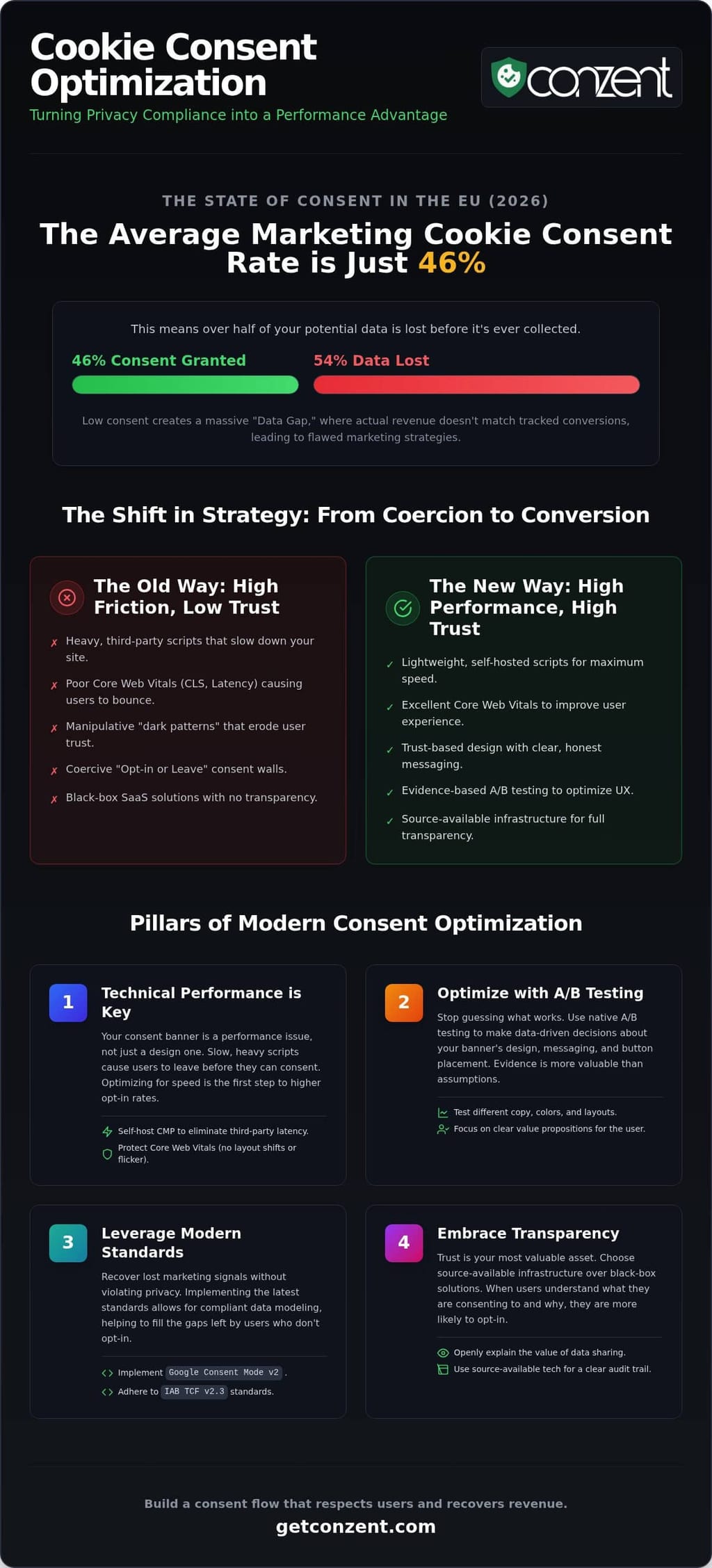
As of August 2026, the average marketing cookie consent rate in the EU has stalled at just 46%. This means more than half of your potential data vanishes before it ever reaches your analytics dashboard. You're likely struggling with massive gaps in your attribution reports while fearing that aggressive "nudge" tactics will trigger a GDPR audit. It's a frustrating balance between legal safety and marketing performance. Relying on bloated, third-party scripts that tank your Core Web Vitals only makes the situation worse. You need a strategy for cookie consent rate optimization that values user trust as much as it values technical precision.
Privacy shouldn't be a barrier to growth. It's a standard that demands better engineering, not more manipulative "dark patterns." This guide shows you how to reclaim your lost ad revenue by moving toward ethical, high-performance infrastructure. We'll explore how to use native A/B testing, IAB TCF v2.3 standards, and Google Consent Mode v2 to build a consent flow that actually converts. You'll learn to optimize for speed and transparency; this ensures your site stays fast while your data remains compliant and actionable.
Key Takeaways
- Move beyond coercive consent walls. Trust is your most valuable asset for long-term data recovery and user retention.
- Stop letting heavy CMP scripts drag down your Core Web Vitals. High performance leads to higher retention and more opt-ins.
- Stop guessing about your banner design. Use native A/B testing to drive cookie consent rate optimization through evidence-based UX changes.
- Leverage Google Consent Mode v2 and IAB TCF v2.3 to recover lost marketing signals without violating user privacy.
- Choose source-available infrastructure over black-box SaaS. Transparency is a technical advantage, not just a legal requirement.
What is Cookie Consent Rate Optimization (CRO)?
Cookie consent rate optimization is the technical and creative process of ethically increasing the percentage of users who grant permission for tracking. It isn't a legal formality or a graphic design project. It's a core performance metric. In 2026, the average marketing cookie consent rate in the EU sits at 46%. If your rates fall below this benchmark, your marketing data is effectively a coin flip. Low consent leads to broken attribution, blind spots in GA4, and wasted ad spend on invisible audiences. Optimization is the bridge between total data loss and actionable insights.
The strategy has shifted. In previous years, many brands relied on "Opt-in or Leave" walls. These are failing in 2026. Users now demand agency. Trust-based models are winning because they treat the visitor as a peer rather than a target. True cookie consent rate optimization focuses on transparency and technical efficiency. It's about showing the user what they gain from a personalized experience while ensuring the banner itself doesn't degrade the site's performance.
The Math Behind Consent Rates
Calculating your baseline is the first step. You must compare total unique visitors against explicit consents. However, the most dangerous user action in 2026 isn't a rejection; it's the "Ignore." When a user ignores your banner, they remain untracked by default. This creates a massive "Data Gap" where your backend sales don't match your frontend tracked conversions. To fix this, you need revenue impact analytics to identify exactly where the leakage occurs. If your tracked data only accounts for 40% of your actual revenue, your optimization strategy is failing.
Ethical Optimization vs. Dark Patterns
Navigating the line between "nudging" and "dark patterns" is a legal necessity. Under current GDPR enforcement and the ePrivacy Directive, regulators are strict. You cannot hide the "Reject All" button or make it smaller than the "Accept" option. Hiding the exit doesn't build consent; it builds resentment. It also flags your site for regulatory scrutiny. Optimization is not manipulation. It's the use of declarative UX—clear, punchy messaging that respects user choice while explaining the value of data sharing. High-performing banners in 2026 use open, honest language to invite collaboration. They don't use technical complexity to bury the truth.
Technical Performance: The Hidden Lever of Consent Rates
Technical performance is the most overlooked factor in cookie consent rate optimization. Most marketing teams treat banners as a design problem. They're wrong. It's a performance problem. If your CMP script adds 500ms of latency, you've lost the user before they even see your "Accept" button. Heavy SaaS CMPs act as a bottleneck. They force the browser to wait for external DNS lookups and script execution. This latency trap causes immediate bounces. You can't get consent from a user who has already left your site.
Optimizing for Core Web Vitals
Maintaining healthy Core Web Vitals requires lightweight cookie consent scripts that don't block the main thread. Poorly injected banners often cause Cumulative Layout Shift (CLS). When a banner pops in and pushes your content down, it creates a jarring experience. Users don't reward frustration with consent. They reward speed. You must measure the direct correlation between your PageSpeed scores and your opt-in rates. Eliminating "flicker"—where the banner appears late or flashes—ensures your interface feels stable. This stability is a prerequisite for effective cookie consent rate optimization.
Self-Hosting for Maximum Speed
Moving from a client-side SaaS model to self-hosting your CMP on your own CDN changes your performance profile. It removes third-party dependencies. You control the delivery. This is critical for regional markets where third-party script lag is often more pronounced. By reducing DNS lookups and serving the script from your own infrastructure, you ensure the banner is ready as soon as the DOM is interactive. It makes the compliance layer feel like a native part of your site rather than a bolted-on afterthought.
Technical efficiency isn't just about speed; it's about the integrity of the data signal. When you implement Google Consent Mode v2, the speed at which the consent state reaches the tag manager determines how much modeled data you recover. A slow script means missed signals. High-performance compliance is a technical standard, not a luxury. If you're ready to move away from bloated scripts and prioritize speed, you can explore our infrastructure options to find the right fit for your stack.
A/B Testing Strategies for Maximum Opt-Ins
Intuition is a poor substitute for evidence. You cannot guess your way to a 90% consent rate. Effective cookie consent rate optimization requires isolating variables and measuring their impact on user behavior. It is a rigorous technical discipline. It is not a series of random aesthetic choices. To build a system that works, you must move beyond generic templates and start testing the specific elements that influence your unique audience.
Optimization is a process of refinement, not manipulation. When designing your framework, you should consult this comprehensive guide to creating a sustainable cookie program to ensure your tests remain within ethical and legal boundaries. Testing allows you to find the intersection of user trust and data recovery without resorting to non-compliant tactics.
Variables to Test in Your Consent Banner
Engagement varies based on screen real estate. A center modal demands immediate attention but can feel intrusive to some users. A bottom bar is subtle but often suffers from "banner blindness." You should test both layouts to see which drives higher engagement for your specific traffic mix. Your copywriting also carries significant weight. Messaging that uses a collaborative tone, such as "Help us improve your experience," often outperforms colder, legalistic phrases. Even the visibility and placement of your "Manage Preferences" link changes the trust dynamic. Small adjustments in button color or trigger timing can lead to significant shifts in opt-in volume.
Geography dictates behavior. A Danish user, accustomed to strict privacy norms, interacts with consent banners differently than a user in the United States. You must localize your testing strategy. What works in Copenhagen might fail in Chicago. Regional testing ensures that your cookie consent rate optimization efforts respect local cultural expectations while maximizing your global data footprint.
Analyzing the Results with Revenue Impact Analytics
Most platforms stop at the opt-in rate. That's a mistake. You need to know the quality of your consent, not just the quantity. By connecting consent events to your e-commerce checkout data, you can identify "High-Value" opt-ins versus "Low-Value" bounces. Some banner designs might drive high opt-in rates but lead to immediate user exits. Others might result in lower opt-in numbers but higher overall conversion values. You should leverage native A/B testing features to find the sweet spot where compliance meets profitability. Continuous improvement is the only way to stay ahead of shifting user sentiment and evolving browser standards.
Advanced Tactics: Google Consent Mode v2 and TCF 2.3
Effective cookie consent rate optimization in 2026 requires more than a visible banner. It requires a sophisticated technical handshake between your website and the global advertising ecosystem. You must move from an "all or nothing" approach to a nuanced, consent-aware data strategy. This transition is no longer optional. As of June 15, 2026, Google has made Consent Mode the exclusive control for advertising data collection in any property linked to Google Ads. The era of manual signals is over. You must adopt standardized frameworks to maintain your competitive edge.
Recovering Data with Google Consent Mode v2
GCM v2 is a recovery tool, not just a compliance gate. When a user denies consent, "Advanced Mode" allows your site to send anonymous, cookieless pings to Google. These pings don't identify the individual. Instead, they provide the raw material for AI modeling. This process fills the gaps in your reports, allowing you to attribute conversions that would otherwise be invisible. To implement this correctly, your CMP must support the mandatory ad_user_data and ad_personalization parameters. Without these, your Google Ads performance will degrade as the system loses the ability to model user behavior accurately.
Standardizing with IAB TCF 2.3
If you rely on programmatic revenue, IAB TCF 2.3 is non-negotiable. The mandatory deadline of February 28, 2026, has passed. Any signals generated using older versions are now invalid. Your infrastructure must communicate seamlessly with the Global Vendor List (GVL) to ensure every ad partner receives a valid TC string. This standardization reduces "Consent Fatigue" by providing users with a consistent interface for preference management. It replaces complexity with clarity. When users see a familiar, standardized preference center, they are more likely to engage rather than bounce.
Trust is also built through localization. Serving different banners based on IP geolocation ensures you aren't over-complying in regions with laxer laws while remaining airtight in the EEA. Language targeting is equally critical. A native-language banner significantly increases opt-in rates by removing the friction of translation. It demonstrates respect for the user's context. By combining these advanced technical frameworks with cultural relevance, you turn compliance into a performance driver. If you're ready to deploy these advanced frameworks across your entire portfolio, you can view our managed and self-hosted plans to start recovering your data today.
Transparency as a Strategy: The Conzent Advantage
Transparency is not a hurdle. It is a strategy. Most businesses view compliance as a defensive measure to avoid fines. We view it as an opportunity to build a positive brand differentiator. When you treat users with respect, they reward you with their data. This is the foundation of sustainable cookie consent rate optimization. You don't build trust by hiding your tracking logic; you build it by being the most honest player in the room.
Moving away from "Black Box" SaaS is the first step toward this goal. Proprietary platforms often hide their data handling processes. They force you to rely on their interpretation of privacy law without any way to verify their claims. We challenge this norm. By providing a source-available alternative, we make enterprise-grade tools accessible to everyone. This egalitarian approach ensures that technical efficiency and legal safety aren't reserved for the largest corporations with the deepest pockets.
The "Open Infrastructure" Difference
Conzent’s Open Consent Infrastructure (OCI) changes the power dynamic between vendors and businesses. It allows for full auditability. You can inspect the code to ensure it meets your specific security and privacy standards. Ownership of your consent data is a competitive advantage. It prevents vendor lock-in and ensures that your compliance history remains under your control. When you own the infrastructure, you own the trust. This transparency is a powerful signal to your users that you value their digital rights as much as your own marketing metrics. It transforms a legal requirement into a core brand value.
Implementing a Managed Cloud Consent Platform
You don't have to choose between ease of use and technical openness. A managed cloud option offers the scalability of traditional SaaS without the opaque "black box" limitations. It automates the complex work of maintaining GDPR compliance as regulations evolve. This allows your team to focus on growth rather than legal updates. Scaling your cookie consent rate optimization efforts across multiple domains becomes a streamlined process. You get the benefit of a high-performance, managed environment while retaining the clarity of an open-source foundation.
The future of CRO is privacy-first growth. As third-party cookies continue to lose their utility, your first-party consent data becomes your most valuable asset. Building long-term customer loyalty requires ethical data practices that go beyond the bare minimum. It requires a commitment to speed, openness, and user agency. By adopting a transparent infrastructure today, you're not just solving a 2026 compliance problem. You're building a resilient data strategy for the decade to come.
Reclaiming Your Data with Ethical Precision
The era of black box compliance is over. To thrive in 2026, you must treat your consent layer as a high-performance asset rather than a legal burden. We've established that technical speed, revenue-linked analytics, and standardized frameworks like IAB TCF 2.3 and Google Consent Mode v2 work together to recover lost signals. True cookie consent rate optimization isn't about tricking users. It's about building a transparent environment where users feel safe enough to share their data. This approach turns privacy from a bottleneck into a brand differentiator.
By choosing an open, source-available infrastructure, you eliminate third-party script lag and take full ownership of your data ecosystem. Conzent serves as a certified partner for IAB TCF 2.3 and GCM v2, providing the revenue-focused A/B testing required to turn compliance into a competitive advantage. Stop guessing and start building a privacy-first strategy that actually scales. Your marketing reports deserve accuracy, and your users deserve honesty.
Start Optimizing Your Consent Rates with Conzent
Frequently Asked Questions
What is a "good" cookie consent rate in 2026?
A "good" rate in 2026 is anything above the current EU average of 46%. While benchmarks vary by industry and region, reaching 60% or higher through ethical optimization is a strong target. You shouldn't compare your current performance to pre-2024 data. Stricter enforcement on button prominence has lowered industry-wide averages. Focus on high-quality, informed consent rather than chasing inflated numbers through non-compliant or coercive design tactics.
Does a "Reject All" button significantly lower consent rates?
Including a "Reject All" button usually causes an initial drop in opt-in rates, but it's a legal requirement under current GDPR enforcement. Hiding this option is a dark pattern that invites regulatory fines and erodes user trust. You can mitigate this drop by using clear, value-oriented copy and ensuring your banner loads instantly. Trust-based models often lead to better long-term retention and more accurate data than manipulative designs.
How does Google Consent Mode v2 help with optimization?
Google Consent Mode v2 is essential for cookie consent rate optimization because it allows for modeled data recovery. When a user denies consent, the system sends anonymous pings to Google. AI then uses these signals to fill reporting gaps in Google Ads and GA4. This ensures you maintain an accurate picture of your conversion performance without needing to track individual users. It's the technical standard for privacy-first marketing.
Can I A/B test my cookie banner without violating GDPR?
You can A/B test your banner as long as every variation remains fully compliant with transparency and choice requirements. Testing different layouts, copy, or button colors helps you identify what resonates with your audience without resorting to dark patterns. Conzent provides native A/B testing tools designed specifically for this purpose. This allows you to find the most effective compliant design based on real user behavior rather than guesswork or generic templates.
How do I measure the revenue impact of my cookie consent banner?
You measure revenue impact by connecting consent events directly to your e-commerce checkout data. This allows you to see the actual monetary value associated with users who opt in versus those who bounce. Using revenue impact analytics helps you move beyond basic opt-in percentages. You can determine if a specific banner design drives high-value customers or if technical lags are causing your most profitable segments to exit the site prematurely.
What are the most common dark patterns to avoid in 2026?
The most common dark patterns to avoid include making the "Reject All" button less prominent than "Accept All" or using pre-ticked boxes for non-essential cookies. You should also avoid "cookie walls" that block access to content unless a user consents. Regulators in 2026 prioritize equal choice. Any design that uses psychological trickery to steer a user toward consent is considered non-compliant and carries a significant risk of enforcement action.
How does page load speed affect cookie opt-in rates?
Page load speed has a direct impact on your opt-in rates. If your CMP script is heavy, users often bounce before the banner even appears. This results in "ignored" consent states and lost data. Using lightweight scripts or self-hosting your infrastructure ensures the compliance layer loads as fast as your content. High-performance sites see higher engagement with consent banners because the user experience remains smooth and uninterrupted by technical lag.
Should I use a different consent banner for mobile vs. desktop?
You should optimize your banner for different devices because screen real estate dictates user behavior. A center modal that works on desktop might be too intrusive on a small mobile screen, leading to higher bounce rates. Mobile-specific cookie consent rate optimization often involves testing bottom sheets or more compact layouts. Tailoring the interface to the device ensures that your compliance requirements don't interfere with the mobile-first browsing habits of your audience.