Enterprise Cookie Consent Solution: The 2026 Guide to Scalable Privacy
What if your compliance strategy is actually the biggest leak in your marketing budget? For global organizations, a clunky enterprise cookie consent solution often creates a "black box" where ad revenue vanishes and technical debt accumulates. You've likely dealt with heavy scripts that slow down your site or opaque pricing models that feel more like a tax than a service. Compliance shouldn't be a barrier to your growth. It should be the foundation of your data sovereignty.
We believe privacy is a technical infrastructure challenge, not just a legal checkbox. You can achieve full GDPR and TCF 2.3 compliance while actually improving your data accuracy. This guide explores how to balance global regulatory requirements with measurable revenue impact. We will preview how to deploy transparent, enterprise-grade consent infrastructure that respects your users and your bottom line, moving beyond the banner into a new era of digital rights.
Key Takeaways
- Move beyond "set and forget" banners to a multi-domain governance model that ensures technical transparency across every global property.
- Evaluate the total cost of ownership between Managed Cloud platforms and self-hosted infrastructure to find the right enterprise cookie consent solution for your stack.
- Use A/B testing and revenue impact analytics to prove that ethical privacy standards protect your marketing data rather than limiting it.
- Streamline deployment via Tag Management Systems and use automated geo-targeting to handle regional requirements like GDPR and India's DPDP Act.
- Discover how the sponsorship model and principled Danish design provide a friction-less path to global compliance without the trap of black-box pricing.
The Enterprise Consent Landscape in 2026: Beyond the Banner
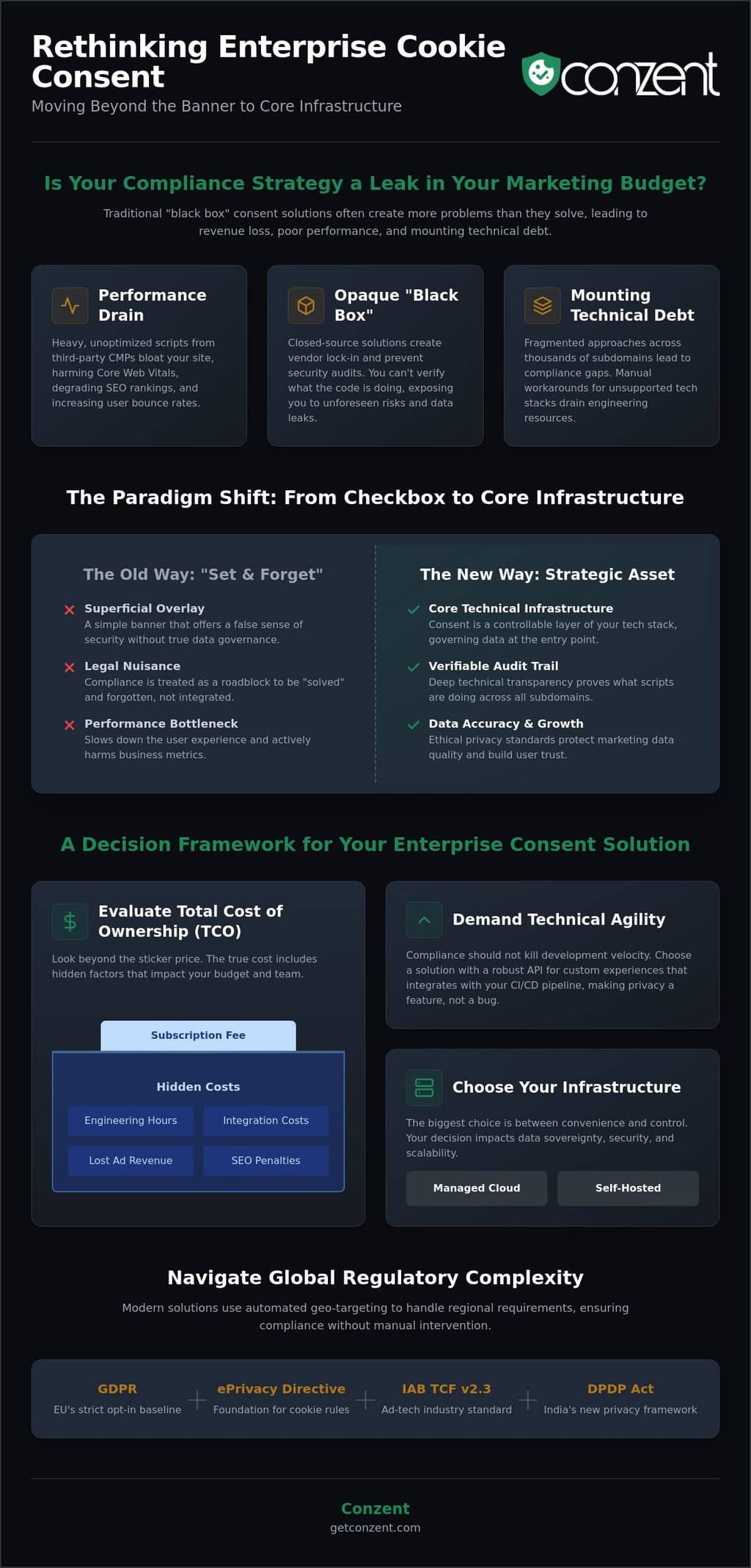
By 2026, the era of the "set and forget" cookie banner is dead. Global organizations have realized that a superficial overlay cannot handle the weight of modern privacy laws. An effective enterprise cookie consent solution must function as core infrastructure. It isn't just about showing a button; it is about establishing a verifiable audit trail across thousands of subdomains. You need deep technical transparency to prove what your scripts are doing in real time. Compliance is no longer a legal nuisance. It's a layer of your technical stack.
Traditional models treated consent as a checkbox. Forward-thinking companies treat it as a strategic asset. If you can't control the flow of data at the point of entry, you can't govern it downstream. High-velocity performance is now a non-negotiable requirement. A slow consent script doesn't just annoy users. It actively degrades your search rankings and conversion rates. You need a system that offers multi-domain governance without the bloat of traditional enterprise software.
Regulatory Complexity: GDPR, ePrivacy, and TCF 2.3
The regulatory environment has shifted from broad directives to granular technical standards. The ePrivacy Directive laid the groundwork, but the implementation of IAB TCF v2.3 has raised the stakes for digital advertising. Enterprises must now solve for extreme regional variance. What works for the CCPA in California will fail under the strict opt-in requirements of the EU. Maintaining GDPR compliance is the baseline for cross-border data flows. It requires dynamic geo-targeting that adjusts your consent logic based on the user's physical location. This isn't just about legal safety; it's about respecting the digital rights of your global audience.
The Hidden Cost of "Black Box" Solutions
Many proprietary CMPs hide behind "black box" pricing and closed-source code. This creates dangerous vendor lock-in. When you can't see the code powering your compliance, you can't audit its security. These heavy third-party scripts often bloat your site, dragging down Core Web Vitals. An enterprise cookie consent solution should be lean and transparent. Transparency in the codebase is no longer a luxury. It is a security requirement. If your compliance tool is a performance bottleneck, it's costing you more in lost ad revenue and SEO impact than its subscription fee. You need a solution that balances rigorous standards with technical efficiency.
Evaluating Enterprise Cookie Consent Solutions: A Decision Framework
Choosing an enterprise cookie consent solution isn't just about picking a vendor. It's about defining your long-term technical architecture. When you manage thousands of subdomains, a fragmented approach leads to compliance gaps and technical debt. You need a framework that prioritizes scalability and auditability. A critical part of organizing a corporate cookie strategy involves deciding where your data lives and who controls the code. For global enterprises, source-available code is a security requirement. It allows your internal teams to audit the logic without relying on a third-party "black box."
Total Cost of Ownership (TCO) extends far beyond the monthly subscription fee. Consider the engineering hours spent on custom integrations for React, Vue, or complex CMS environments. A solution that lacks native support for your tech stack will inflate your costs through manual workarounds. You want a CMP that integrates seamlessly with your existing CI/CD pipelines. This ensures that privacy checks are part of your development flow, not an afterthought that breaks your site during a deployment. Efficiency is found in automation, not in adding more manual tasks for your developers.
Technical Agility vs. Legal Rigidity
Compliance shouldn't kill your development velocity. Many teams struggle when legal requirements conflict with technical performance. You need a robust Cookie Banner API to build custom experiences that don't compromise on legal rigidity. It is about balance. You can meet IAB TCF v2.3 standards without sacrificing a clean, high-converting UX. If your CMP feels like a roadblock to your product sprints, you've chosen the wrong tool. Privacy should be a feature, not a bug that slows down your site.
Infrastructure Sovereignty: Self-hosting vs. Managed Cloud
The biggest choice you'll make is between sovereignty and convenience. Some organizations require absolute data control for security or regulatory reasons. In these cases, Self-Hosted Open Consent Infrastructure is the only logical choice. It removes the vendor from the data loop entirely. Others prefer the speed of a Managed Cloud Consent Platform. This model offers the same transparency but offloads the maintenance burden to experts. A hybrid approach often works best; you use managed services for global delivery while retaining full access to the underlying codebase. You can explore how different deployment models affect your pricing and infrastructure costs to make an informed decision for your organization.
Maximizing Opt-ins and Revenue without Compromising Privacy
Compliance is frequently treated as a cost center. This is a narrow view that ignores the reality of modern digital marketing. An effective enterprise cookie consent solution acts as a performance lever for your entire marketing stack. When users refuse consent, your data goes dark. You lose the ability to attribute sales, optimize ad spend, and understand user behavior. This loss isn't an inevitable result of regulation. It's often a direct consequence of poor user experience.
Banners that feel intrusive or untrustworthy alienate users before they even engage with your brand. High-performing global organizations treat consent as the first touchpoint in the customer journey. They understand that trust is the foundation of data collection. By prioritizing clarity and speed, you can maintain high opt-in rates that fuel your ad campaigns. Consent Rate Optimization is the practice of refining banners to maximize legal data collection.
Consent A/B Testing for Enterprise Scale
You shouldn't guess which design will build the most trust. You should test it. A/B testing allows you to experiment with banner placement, color schemes, and button copy to find the right balance. Agencies use these results to justify design decisions to global stakeholders. It isn't about using deceptive "dark patterns" to trick users into clicking "Accept." That approach leads to long-term brand damage and regulatory scrutiny. Instead, focus on creating a transparent interface that makes the value exchange clear. When users feel in control, they are more likely to participate in your data ecosystem.
Measuring the Real Revenue Impact
Marketing teams and legal departments often exist in silos. One focuses on growth; the other focuses on risk. To build a sustainable strategy, you must bridge this gap. You need to identify the "consent gap" in your marketing attribution. Revenue Impact Analytics allows you to see exactly how much ad spend is at risk due to consent choices. This data transforms privacy from a legal obligation into a strategic asset. If you can prove that a specific banner design increases attributed revenue by a measurable margin, compliance becomes a profit-driven priority. It's about moving from defensive compliance to offensive data excellence.
Implementation and Integration: Scaling Across Global Properties
Scaling an enterprise cookie consent solution across a global portfolio requires technical precision. It isn't a manual task. You need a system that integrates with your existing Tag Management Systems (TMS) like Google Tag Manager or Tealium. The goal is automation. First, configure your consent categories. Second, map your marketing tags to these specific consent states. Third, deploy. This ensures no tracker fires without the correct permission. It's about creating a reliable, repeatable process for every new property you launch.
Global reach brings regional complexity. You can't show a GDPR banner to a user in a jurisdiction with different rules. Automated geo-targeting is the solution. The CMP detects the user's location and serves the legally required interface instantly. This includes multi-language support that scales without manual translation overhead. Don't forget accessibility. Meeting WCAG 2.2 standards ensures your consent interface is inclusive for all users. It's a moral and technical requirement. If your banner isn't accessible, your compliance is incomplete.
Google Consent Mode v2 and IAB TCF v2.3
By 2026, preserving your marketing signals requires strict adherence to GCM v2. This isn't optional for Google Ads users. You must also implement the IAB TCF v2.3 framework to participate in the programmatic advertising ecosystem. These standards provide a common language for consent. Being Google Certified is a non-negotiable requirement for any enterprise-grade CMP. It guarantees that your data flows meet the technical rigors of the world's largest ad platforms. Without this certification, your ad performance will suffer from signal loss.
CMS and Global Scalability
Your infrastructure shouldn't dictate your compliance. Whether you use enterprise CMS platforms like Drupal or Umbraco, integration should be native. For those using headless architectures, a robust API is essential. This allows you to manage consent across web, mobile, and IoT devices from a single source of truth. Centralizing your consent logs is the final step. It ensures you are ready for a legal audit across every business unit. You can view our enterprise pricing and deployment options to see how we handle global scale.
Conzent: The Managed Cloud Alternative to Traditional Enterprise CMPs
Most enterprise tools are designed to hide complexity behind high fees and opaque contracts. Conzent is built to dismantle that model. Our Danish roots define our approach to digital rights. In Denmark, privacy is not a luxury; it is a matter of public trust and technical efficiency. This perspective drives us to offer an enterprise cookie consent solution that prioritizes moral clarity over corporate jargon. We don't see compliance as a hurdle to clear. We see it as a standard to uphold for a healthier digital ecosystem.
We reject the "black box" pricing models that dominate the industry. Instead, we utilize a sponsorship model. This egalitarian approach ensures that as our community grows, the cost of maintaining high-grade compliance infrastructure decreases for everyone. It is a collective investment in transparency. You gain the power of a global Managed Cloud platform while retaining the openness of a source-available codebase. This ensures you never have to sacrifice infrastructure sovereignty for the sake of deployment speed.
Future-proofing your privacy stack is critical as we move further into 2026. The post-cookie world requires more than just a banner; it requires a resilient architecture that respects user intent across every touchpoint. Conzent provides the tools to handle this transition without the technical debt associated with legacy systems. We offer a friction-less path to global compliance that scales with your organization, ensuring your data practices remain ethical and effective as regulations continue to evolve.
Principled Compliance vs. Corporate Complexity
Conzent provides moral clarity in a market of complex legal jargon. We believe that enterprise-level tools should be accessible to all organizations, regardless of their resource depth. Our approach is intentionally transparent. We invite technical scrutiny because we have nothing to hide. Working with a partner who values openness means your security and legal teams can audit our logic with total confidence. We are a community advocate for digital rights, providing a necessary standard rather than a premium luxury.
Getting Started with a Transparent Enterprise Solution
Transitioning your global properties to a more ethical framework doesn't have to be a burden. You can review our pricing models to see how our sponsorship model scales with your needs. If you are managing a complex enterprise migration, our expert support team is available to provide technical guidance. Stop settling for opaque vendors who hide behind complexity. It is time to implement a solution that respects both your users and your bottom line. Explore Conzent’s Enterprise Solutions today and take control of your privacy infrastructure.
Transition to Transparent Consent Governance
Compliance in 2026 is no longer a peripheral task. It is the foundation of your digital infrastructure. You've seen how a scalable enterprise cookie consent solution moves beyond simple banners to provide deep technical transparency and measurable revenue impact. By prioritizing infrastructure sovereignty and ethical data standards, you protect your brand from regulatory risk while maintaining the marketing signals necessary for growth. It's about building trust that scales across every global property you manage.
Conzent offers a clear path away from opaque, proprietary systems. As a Google Certified CMP that is fully IAB TCF v2.3 ready, we provide the technical rigors required by the world's largest ad platforms. Our source-available infrastructure and adherence to Danish privacy standards ensure you retain total control over your codebase and your data. It's time to replace corporate complexity with moral clarity. You can build a privacy stack that serves your users and your bottom line simultaneously. Start leading with transparency and turn privacy into your most reliable strategic advantage.
Deploy Your Enterprise Consent Solution with Conzent
Frequently Asked Questions
What makes a cookie consent solution truly "enterprise-grade" in 2026?
An enterprise cookie consent solution requires more than a basic banner. It must provide multi-domain governance, source-available code for security audits, and high-velocity performance that doesn't drag down Core Web Vitals. True enterprise-grade tools offer infrastructure sovereignty, allowing you to choose between managed cloud or self-hosted models. It is about establishing a verifiable audit trail across thousands of subdomains while maintaining technical transparency for your internal teams.
How does Google Consent Mode v2 impact enterprise ad revenue?
Google Consent Mode v2 is mandatory for advertisers targeting European users. It preserves your marketing signals by allowing Google to model conversions even when users decline cookies. Without this integration, you face significant data gaps and decreased campaign efficiency. By using a certified CMP, you bridge the gap between privacy compliance and performance marketing. It ensures your ad spend remains effective while respecting the digital rights of your audience.
Can we self-host our cookie consent platform to maintain data sovereignty?
Yes, you can utilize our Self-Hosted Open Consent Infrastructure to keep your consent data within your own environment. This model removes the third-party vendor from the data processing loop entirely. It is the ideal choice for organizations with strict security requirements or those who view data sovereignty as a strategic asset. You gain full control over the codebase and data storage without sacrificing the scalability needed for global properties.
What is the difference between IAB TCF 2.2 and 2.3 for publishers?
IAB TCF v2.3 introduces stricter requirements for transparency and user control than its predecessor. It focuses on eliminating deceptive dark patterns and ensuring that "Reject All" options are as prominent as acceptance buttons. For publishers, this version provides a more robust legal framework for programmatic advertising. It simplifies the communication of consent signals across the digital advertising supply chain, ensuring you meet the latest industry standards for data transparency.
How does Conzent handle consent across multiple subdomains and regions?
We use automated geo-targeting to detect a user's location and serve the specific banner required by local laws like GDPR or CCPA. Our platform centralizes governance across thousands of subdomains, allowing you to manage global policies from a single source of truth. This prevents the fragmentation of consent data and ensures a consistent user experience. You can deploy regional variations without the technical overhead of manual configuration for every individual site.
Is it possible to A/B test cookie banner designs for better opt-in rates?
Consent A/B Testing is a core feature of our platform. You can experiment with banner placement, colors, and button copy to find the most effective design for your specific audience. This data-driven approach helps you optimize opt-in rates legally and ethically. It proves that clear, transparent communication can actually increase user participation. You no longer have to guess which design choices will protect your marketing data.
How does the Conzent sponsorship model affect enterprise pricing?
Our sponsorship model is designed to lower the cost of compliance as our community grows. Unlike traditional vendors with opaque pricing, we offer a transparent structure where the collective investment of all users reduces individual fees. It is an egalitarian approach that makes an enterprise cookie consent solution accessible to organizations of all sizes. We prioritize ethical responsibility and technical efficiency over the typical corporate drive for high-margin software locks.
Does Conzent integrate with enterprise CMS like Drupal or Umbraco?
We provide native integrations for major enterprise CMS platforms, including Drupal and Umbraco. These integrations ensure that your consent management is part of your content workflow rather than a separate technical burden. For organizations using headless architectures, our robust API allows for seamless deployment across any technical stack. This flexibility ensures your compliance infrastructure scales effortlessly alongside your digital properties, regardless of the underlying technology.
Frequently Asked Questions
What makes a cookie consent solution truly "enterprise-grade" in 2026?
An enterprise cookie consent solution requires more than a basic banner. It must provide multi-domain governance, source-available code for security audits, and high-velocity performance that doesn't drag down Core Web Vitals. True enterprise-grade tools offer infrastructure sovereignty, allowing you to choose between managed cloud or self-hosted models. It is about establishing a verifiable audit trail across thousands of subdomains while maintaining technical transparency for your internal teams.
How does Google Consent Mode v2 impact enterprise ad revenue?
Google Consent Mode v2 is mandatory for advertisers targeting European users. It preserves your marketing signals by allowing Google to model conversions even when users decline cookies. Without this integration, you face significant data gaps and decreased campaign efficiency. By using a certified CMP, you bridge the gap between privacy compliance and performance marketing. It ensures your ad spend remains effective while respecting the digital rights of your audience.
Can we self-host our cookie consent platform to maintain data sovereignty?
Yes, you can utilize our Self-Hosted Open Consent Infrastructure to keep your consent data within your own environment. This model removes the third-party vendor from the data processing loop entirely. It is the ideal choice for organizations with strict security requirements or those who view data sovereignty as a strategic asset. You gain full control over the codebase and data storage without sacrificing the scalability needed for global properties.
What is the difference between IAB TCF 2.2 and 2.3 for publishers?
IAB TCF v2.3 introduces stricter requirements for transparency and user control than its predecessor. It focuses on eliminating deceptive dark patterns and ensuring that "Reject All" options are as prominent as acceptance buttons. For publishers, this version provides a more robust legal framework for programmatic advertising. It simplifies the communication of consent signals across the digital advertising supply chain, ensuring you meet the latest industry standards for data transparency.
How does Conzent handle consent across multiple subdomains and regions?
We use automated geo-targeting to detect a user's location and serve the specific banner required by local laws like GDPR or CCPA. Our platform centralizes governance across thousands of subdomains, allowing you to manage global policies from a single source of truth. This prevents the fragmentation of consent data and ensures a consistent user experience. You can deploy regional variations without the technical overhead of manual configuration for every individual site.
Is it possible to A/B test cookie banner designs for better opt-in rates?
Consent A/B Testing is a core feature of our platform. You can experiment with banner placement, colors, and button copy to find the most effective design for your specific audience. This data-driven approach helps you optimize opt-in rates legally and ethically. It proves that clear, transparent communication can actually increase user participation. You no longer have to guess which design choices will protect your marketing data.
How does the Conzent sponsorship model affect enterprise pricing?
Our sponsorship model is designed to lower the cost of compliance as our community grows. Unlike traditional vendors with opaque pricing, we offer a transparent structure where the collective investment of all users reduces individual fees. It is an egalitarian approach that makes an enterprise cookie consent solution accessible to organizations of all sizes. We prioritize ethical responsibility and technical efficiency over the typical corporate drive for high-margin software locks.
Does Conzent integrate with enterprise CMS like Drupal or Umbraco?
We provide native integrations for major enterprise CMS platforms, including Drupal and Umbraco. These integrations ensure that your consent management is part of your content workflow rather than a separate technical burden. For organizations using headless architectures, our robust API allows for seamless deployment across any technical stack. This flexibility ensures your compliance infrastructure scales effortlessly alongside your digital properties, regardless of the underlying technology.