How to A/B Test Cookie Banner Designs for Revenue and Trust in 2026
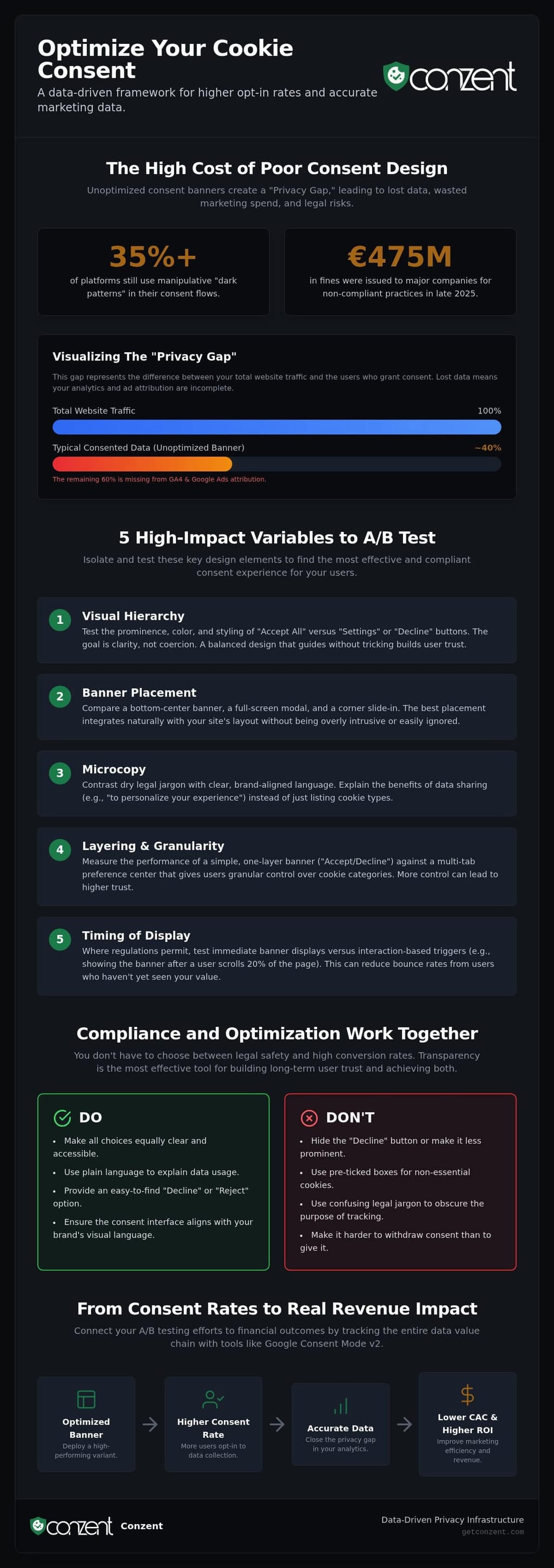
Over 35% of online platforms still rely on dark patterns to manipulate users, a tactic that resulted in €475 million in total fines for major players in late 2025. You shouldn't have to choose between legal safety and your marketing budget, which is why it is essential to A/B test cookie banner designs using a transparent, data-driven approach. It's exhausting to watch your GA4 and Google Ads attribution vanish simply because an intrusive interface drives users to bounce.
We agree that privacy shouldn't be a hurdle to clear; it's a standard to uphold. This guide teaches you how to optimize your consent rates and recover vital marketing data using a compliant A/B testing framework. We will explore high-impact design variables, measure real revenue impact through Google Consent Mode v2, and provide a step-by-step setup to restore your data flow without resorting to deception.
Key Takeaways
- Identify the "Privacy Gap" where low opt-in rates lead to inaccurate marketing spend and learn how systematic testing restores data integrity.
- Pinpoint high-impact variables like visual hierarchy and banner placement to effectively A/B test cookie banner designs for higher engagement.
- Bridge the gap between consent rates and financial outcomes using Revenue Impact Analytics and Google Consent Mode v2.
- Master a step-by-step framework for setting baselines and testing hypotheses while maintaining total regulatory compliance.
- Leverage managed cloud infrastructure to remove the technical friction of scaling a high-performance privacy strategy.
Why Cookie Banner A/B Testing is a Business Necessity in 2026
In the current digital landscape, privacy is no longer a peripheral concern handled by a legal team in a vacuum. It is a core component of your technical infrastructure. To A/B testing cookie banner designs is to perform a systematic comparison between two different consent interfaces to determine which one better balances user experience with data collection. It is not an exercise in manipulation. It is an exercise in clarity. By presenting different versions of a banner to distinct segments of your audience, you can identify exactly where friction exists and where trust is built.
The "Privacy Gap" is the discrepancy between total traffic and consented data.
When you ignore this gap, you ignore the health of your business. Most companies settle for "compliance-only" banners that meet the bare minimum of the law but fail to respect the user's time or intent. A revenue-optimized privacy interface, however, treats consent as a conversion point. It recognizes that a user who understands their rights is a user who is more likely to engage with your brand. In 2026, simply having a banner is not enough. You must have a banner that performs.
The Cost of Unoptimized Consent
Missing data is a direct tax on your marketing efficiency. When your consent interface is poorly designed, your opt-in rates plummet, leading to inflated Customer Acquisition Costs (CAC). You might be spending thousands on Google Ads, but if your banner drives users to bounce before the tracking scripts even fire, your attribution becomes a work of fiction. Consent fatigue is a measurable technical problem. If a banner is too intrusive or confusing, users will leave your site entirely rather than engaging with your content. With the stricter enforcement of regulations seen in 2026, recovering this lost data through better design has become a top-tier priority for every growth-focused team.
Compliance vs. Optimization: The False Dichotomy
There is a common misconception that legal safety and high conversion rates are mutually exclusive. This is a false dichotomy. You can be 100% GDPR compliant and still maintain a banner that converts at a high level. Transparency is your most effective tool for long-term user retention. When you provide clear options and an intuitive layout, you demystify the data collection process for your visitors. This honesty builds a foundation of trust that "dark patterns" could never achieve. For a detailed breakdown of these legal requirements, you can review our Conzent Compliance Overview. When you A/B test cookie banner designs, you are searching for the most efficient way to be both honest and profitable. It is a standard of operation, not a luxury.
5 High-Impact Design Variables to Test for Better Consent
To effectively A/B test cookie banner designs, you must isolate the elements that actually drive user decisions. It is not about guessing. It is about testing specific variables that reduce friction and improve transparency. When you refine these five areas, you move away from intrusive interruptions and toward a respectful dialogue with your visitors.
- Visual Hierarchy: Compare the prominence of "Accept All" versus "Settings" buttons. High contrast can guide users, but a lack of balance can look like a dark pattern.
- Banner Placement: Test whether a bottom-center anchor, a full-screen modal, or a corner slide-in feels more natural for your site's layout.
- Microcopy: Contrast dry, legal jargon with brand-aligned language that explains the benefit of data sharing.
- Layering: Measure the difference between a simple, one-layer banner and a multi-tab preference center that gives users granular control.
- Timing: Explore immediate displays versus interaction-based triggers, such as showing the banner after a user scrolls 20% of the page, where local regulations permit.
The Psychology of the "Accept" Button
Button design is more than an aesthetic choice. It is a functional signal. When you test button shapes, colors, and border-radius, you are aligning the consent interface with your brand's existing visual language. This consistency reduces cognitive load. Users shouldn't have to think about whether a button is part of your site or a third-party pop-up. However, you must avoid deceptive tactics. Current research on cookie banner compliance highlights that making the "Decline" button invisible or significantly less prominent is a major legal risk under GDPR. True optimization means making every choice clear and accessible, not hiding the ones you don't like.
Microcopy and Brand Voice
The words you choose define the relationship before it even starts. Moving away from generic phrases like "We use cookies" toward transparent statements like "How we respect your privacy" can fundamentally change user perception. You should test labels like "Learn More" against "Cookie Settings" to see which creates a sense of agency for the visitor. Clarity in copy often outperforms cleverness in conversion. When users understand what they are consenting to, they are more likely to opt in. This level of honesty is a standard we believe every business should meet. If you are ready to implement these tests without the technical overhead, consider viewing our transparent pricing for managed consent solutions.
Testing these variables allows you to build a banner that doesn't just satisfy a checklist. It creates a seamless part of the user journey. By focusing on clarity and balance, you ensure that your data collection remains robust while your brand reputation stays intact.
Beyond Opt-in Rates: Measuring Real Revenue Impact
Many marketers fall into the trap of obsessing over acceptance percentages. This is a vanity metric. A 90% opt-in rate is technically worthless if your interface fails to communicate with your tracking stack. When you A/B test cookie banner designs, your primary goal shouldn't be a simple button click. It should be the restoration of your marketing data flow. If your banner design is visually appealing but technically disconnected, you're essentially flying blind while paying for the privilege.
High acceptance rates don't always translate to high revenue. If your design causes users to click "Accept" but fails to trigger your tracking scripts correctly, your ad platforms remain starved of conversion data. You need to see the financial result of your privacy strategy, not just a green bar in a dashboard. We recommend integrating your test results directly with your ad platform's conversion modeling to see how design shifts impact your bottom line. You can explore our full analysis on the Revenue Impact of Cookie Consent to understand how privacy-first growth works in 2026.
Google Consent Mode v2 and A/B Testing
Different designs fundamentally change how users interact with "granted" versus "denied" signals. You aren't just testing aesthetics; you're testing the signal-to-noise ratio of your conversion modeling. A successful A/B test shows a measurable uplift in modeled conversions. This proves that your design choice helps platforms like Google Ads accurately estimate the behavior of non-consenting users. Without proper Google Consent Mode v2 support, your "optimized" banner might actually be suppressing the very data you're trying to recover. It's a technical requirement, not a suggestion.
IAB TCF 2.3 and Publisher Revenue
For publishers, the stakes are even higher. Banner design directly impacts the Transmission of Consent Strings to ad tech vendors. If your banner is non-compliant with the latest IAB TCF 2.3 features, vendors will ignore your consent signals. This results in your fill rates crashing and your CPMs dropping. You must test for "TCF error rates" alongside basic opt-in metrics. Ensuring that your consent string is correctly formatted and transmitted is the only way to keep your programmatic revenue stream uninterrupted. Transparency isn't just about the user; it's about the technical ecosystem.
During the testing phase, you may encounter data gaps that make decision-making difficult. This is where "Synthetic Data" becomes a vital tool. It allows you to maintain a clear picture of your performance while your A/B test gathers enough statistical significance to justify a permanent design shift. It's a bridge between your current baseline and your optimized future. By focusing on these technical outcomes, you ensure that your privacy strategy supports your revenue goals rather than undermining them.
How to Set Up a Compliant A/B Test Step-by-Step
Optimization is a methodical process. It is not a series of guesses. To successfully A/B test cookie banner designs, you need a framework that prioritizes data integrity and legal safety. Follow this sequence to ensure your results are both valid and actionable.
- Establish a baseline: Measure your current consent rate for at least 7 days. This accounts for weekly traffic fluctuations and provides the control data you need.
- Formulate a hypothesis: Don't just "try things." State a specific goal: "Moving the banner to the center will increase opt-ins by 5%."
- Configure the traffic split: A 50/50 split is the fastest path to results. If you're risk-averse, use a 90/10 split to protect your baseline while gathering initial data.
- Ensure consistency: The same user must see the same banner on return visits. Discrepancies here erode trust and skew your metrics.
- Analyze and implement: Use a significance calculator. Don't crown a winner until you're sure the results aren't due to random chance.
Avoiding Legal Pitfalls During Testing
Legal safety is a constant. It is not a variable. Every version you test must adhere to GDPR and other relevant privacy laws. You cannot test "dark patterns" against compliant designs. Testing a version with no "Decline" button against a compliant version is a legal liability, not a valid experiment. You must also record consent logs for every variation. An audit trail is your primary defense during a regulatory check. Optimization should never come at the cost of legal integrity.
Technical Performance and Core Web Vitals
A banner that slows down your site will fail, regardless of its design. Pay close attention to Cumulative Layout Shift (CLS). If your banner causes the page content to jump, your bounce rate will climb and your SEO rankings will suffer. The solution is to use a CMP with a lightweight script that integrates seamlessly into your existing infrastructure. You can see how we handle these technical requirements in our Conzent Cookie Banner Features. Speed is a feature of privacy, not an afterthought.
High-performance privacy requires the right tools. If you're ready to move beyond basic banners and start driving real data recovery, view our plans to launch your first compliant test today.
The Conzent Advantage: Data-Driven Privacy Infrastructure
Most platforms force you to load heavy, external scripts that tank your Core Web Vitals just to run a simple test. This is a technical debt you don't have to carry. When you A/B test cookie banner designs with Conzent, the functionality is native to the infrastructure. This means your site stays fast, your Cumulative Layout Shift remains low, and your SEO rankings stay protected. We don't believe in adding bloat to achieve compliance. We believe in technical efficiency that serves both the business and the user.
Our platform offers a choice between a Managed Cloud Consent Platform and a Self-Hosted Open Consent Infrastructure. If you want the speed of a turnkey solution, our cloud handles the heavy lifting. If you demand total control over your data environment, our source-available infrastructure allows you to host the platform yourself. Both options include Native Revenue Impact Analytics. You won't just see which banner won; you'll see the actual dollar value that the winning design added to your marketing budget. It is transparency that you can take to the bank.
We take a principled approach to privacy. Our platform refuses to support illegal dark patterns. We don't build tools to trick users; we build tools to respect them. This moral clarity is backed by global compliance features. Our system utilizes automatic geo-targeting to ensure you are testing the right banner in the right region. You don't have to worry about showing a California-compliant banner to a user in Berlin. We handle the complexity so you can focus on the results.
Built-in A/B Testing for Everyone
Marketing teams shouldn't need a degree in data science to optimize a banner. We've simplified the setup process to make it accessible for everyone. Our mission is to lower the cost of compliance through a community-focused sponsorship model. This "Open Infrastructure" approach ensures that ethical data practices aren't a luxury for the few, but a standard for the many. You can explore the full capabilities of our Conzent A/B Testing Feature to see how we've removed the technical friction from the optimization process.
Ready to Recover Your Data?
The journey from blind compliance to optimized revenue starts with a single test. You've seen how unoptimized banners lead to a "Privacy Gap" that swallows your marketing data. You've learned that design variables like visual hierarchy and microcopy can restore that flow. Now, it's time to implement those insights using a platform built for the standards of 2026. Stop guessing and start measuring the real impact of your privacy strategy. Optimize Your Revenue with Conzent by starting your managed cloud trial today. It's time to build trust and revenue on a foundation of technical excellence.
Own Your Data and Your Integrity
The era of choosing between legal safety and marketing performance is over. In 2026, the standard is clear: you must respect user rights while maintaining the technical integrity of your attribution stack. By taking the time to A/B test cookie banner designs, you bridge the "Privacy Gap" and turn a regulatory requirement into a competitive advantage. You've seen how design hierarchy, microcopy, and technical triggers impact your bottom line. Now, you need the infrastructure to scale those insights without the burden of heavy scripts or legal ambiguity.
Conzent provides the only IAB TCF v2.3 and Google Consent Mode v2 certified platform with native Revenue Impact Analytics. We are trusted by global SaaS companies and digital agencies to deliver transparent, high-performance consent management. It is time to stop guessing and start recovering your lost marketing data through principled, data-driven design. Trust is not a luxury; it is a technical necessity.
Start Optimizing Your Consent Rates with Conzent today. Building a more transparent web is a collective responsibility, and your business deserves a platform that treats technical efficiency as a public good. You have the framework; now take the first step toward a more profitable and ethical future.
Frequently Asked Questions
Is it legal to A/B test a cookie banner under GDPR?
It is legal to test variations as long as every version remains strictly compliant with GDPR and local regulations. You cannot legally test a "dark pattern" version against a compliant one. Your experiments should focus on legitimate design improvements, such as button placement or color contrast, that respect user choice while seeking better engagement. Compliance is a constant, not a variable.
What is a typical opt-in rate for a compliant cookie banner?
Opt-in rates for compliant banners typically range from 60% to 80% depending on your industry and audience. Research indicates that over 60% of users often accept cookies without reading the full policy. However, your goal isn't just a high percentage. You want a rate that reflects genuine user trust. A well-optimized design achieves this by removing friction without resorting to deception.
How long should I run a cookie banner A/B test?
Run your test for a minimum of seven to fourteen days to capture a full cycle of user behavior. Achieving statistical significance is more critical than the total number of days. You need enough traffic to ensure that your results reflect a real trend rather than random variance. Don't rush to implement changes before your data reaches a 95% confidence level.
Can I A/B test cookie banners on mobile and desktop separately?
Segmenting your tests by device is a technical necessity because mobile and desktop users have different interaction patterns. Mobile users have less screen real estate and rely on touch navigation, which changes how they perceive banner placement. To effectively A/B test cookie banner designs, you must ensure that each layout feels native and unobtrusive on the specific device being used.
Do I need a developer to set up A/B testing for my consent manager?
You don't need a developer if you use a platform with native testing functionality. Modern managed cloud solutions allow marketing teams to configure traffic splits and design variations directly through a dashboard. This removes the need for manual code changes or complex script injections. It makes optimization accessible to those who understand the audience best, rather than just those who write the code.
How does A/B testing impact my website loading speed?
Native testing has a negligible impact on speed, whereas external scripts can significantly increase load times. Using a lightweight, built-in framework ensures that your experiments don't cause layout shifts or latency. Speed is a fundamental component of user trust. If your testing tool slows down the page, your bounce rates will climb, and your consent data will become skewed by frustrated users.
What is the best "winning metric" for a cookie banner test?
Focus on revenue impact and modeled conversion uplift rather than simple click-through rates. A high acceptance rate is technically useless if the banner fails to trigger Google Consent Mode v2 correctly. Use analytics to see how your A/B test cookie banner designs translate into actual marketing data recovery. The true winner is the design that restores your attribution while maintaining total legal compliance.
Can I test different languages in my cookie banner A/B test?
Localized microcopy tests are essential for global brands to ensure clarity across different cultures. Translation quality and tone vary significantly across regions, and what works in English might feel cold or confusing in another language. Testing different linguistic variations ensures that your banner feels respectful and clear to every visitor. Transparency requires that your message is understood, not just displayed.
Frequently Asked Questions
Ready to Recover Your Data?
The journey from blind compliance to optimized revenue starts with a single test. You've seen how unoptimized banners lead to a "Privacy Gap" that swallows your marketing data. You've learned that design variables like visual hierarchy and microcopy can restore that flow. Now, it's time to implement those insights using a platform built for the standards of 2026. Stop guessing and start measuring the real impact of your privacy strategy. Optimize Your Revenue with Conzent by starting your managed cloud trial today. It's time to build trust and revenue on a foundation of technical excellence. The era of choosing between legal safety and marketing performance is over. In 2026, the standard is clear: you must respect user rights while maintaining the technical integrity of your attribution stack. By taking the time to A/B test cookie banner designs, you bridge the "Privacy Gap" and turn a regulatory requirement into a competitive advantage. You've seen how design hierarchy, microcopy, and technical triggers impact your bottom line. Now, you need the infrastructure to scale those insights without the burden of heavy scripts or legal ambiguity. Conzent provides the only IAB TCF v2.3 and Google Consent Mode v2 certified platform with native Revenue Impact Analytics. We are trusted by global SaaS companies and digital agencies to deliver transparent, high-performance consent management. It is time to stop guessing and start recovering your lost marketing data through principled, data-driven design. Trust is not a luxury; it is a technical necessity. Start Optimizing Your Consent Rates with Conzent today. Building a more transparent web is a collective responsibility, and your business deserves a platform that treats technical efficiency as a public good. You have the framework; now take the first step toward a more profitable and ethical future.
Is it legal to A/B test a cookie banner under GDPR?
It is legal to test variations as long as every version remains strictly compliant with GDPR and local regulations. You cannot legally test a "dark pattern" version against a compliant one. Your experiments should focus on legitimate design improvements, such as button placement or color contrast, that respect user choice while seeking better engagement. Compliance is a constant, not a variable.
What is a typical opt-in rate for a compliant cookie banner?
Opt-in rates for compliant banners typically range from 60% to 80% depending on your industry and audience. Research indicates that over 60% of users often accept cookies without reading the full policy. However, your goal isn't just a high percentage. You want a rate that reflects genuine user trust. A well-optimized design achieves this by removing friction without resorting to deception.
How long should I run a cookie banner A/B test?
Run your test for a minimum of seven to fourteen days to capture a full cycle of user behavior. Achieving statistical significance is more critical than the total number of days. You need enough traffic to ensure that your results reflect a real trend rather than random variance. Don't rush to implement changes before your data reaches a 95% confidence level.
Can I A/B test cookie banners on mobile and desktop separately?
Segmenting your tests by device is a technical necessity because mobile and desktop users have different interaction patterns. Mobile users have less screen real estate and rely on touch navigation, which changes how they perceive banner placement. To effectively A/B test cookie banner designs, you must ensure that each layout feels native and unobtrusive on the specific device being used.
Do I need a developer to set up A/B testing for my consent manager?
You don't need a developer if you use a platform with native testing functionality. Modern managed cloud solutions allow marketing teams to configure traffic splits and design variations directly through a dashboard. This removes the need for manual code changes or complex script injections. It makes optimization accessible to those who understand the audience best, rather than just those who write the code.
How does A/B testing impact my website loading speed?
Native testing has a negligible impact on speed, whereas external scripts can significantly increase load times. Using a lightweight, built-in framework ensures that your experiments don't cause layout shifts or latency. Speed is a fundamental component of user trust. If your testing tool slows down the page, your bounce rates will climb, and your consent data will become skewed by frustrated users.
What is the best "winning metric" for a cookie banner test?
Focus on revenue impact and modeled conversion uplift rather than simple click-through rates. A high acceptance rate is technically useless if the banner fails to trigger Google Consent Mode v2 correctly. Use analytics to see how your A/B test cookie banner designs translate into actual marketing data recovery. The true winner is the design that restores your attribution while maintaining total legal compliance.
Can I test different languages in my cookie banner A/B test?
Localized microcopy tests are essential for global brands to ensure clarity across different cultures. Translation quality and tone vary significantly across regions, and what works in English might feel cold or confusing in another language. Testing different linguistic variations ensures that your banner feels respectful and clear to every visitor. Transparency requires that your message is understood, not just displayed.