
Mastering IAB TCF v2.3 Requirements: The 2026 Compliance Guide

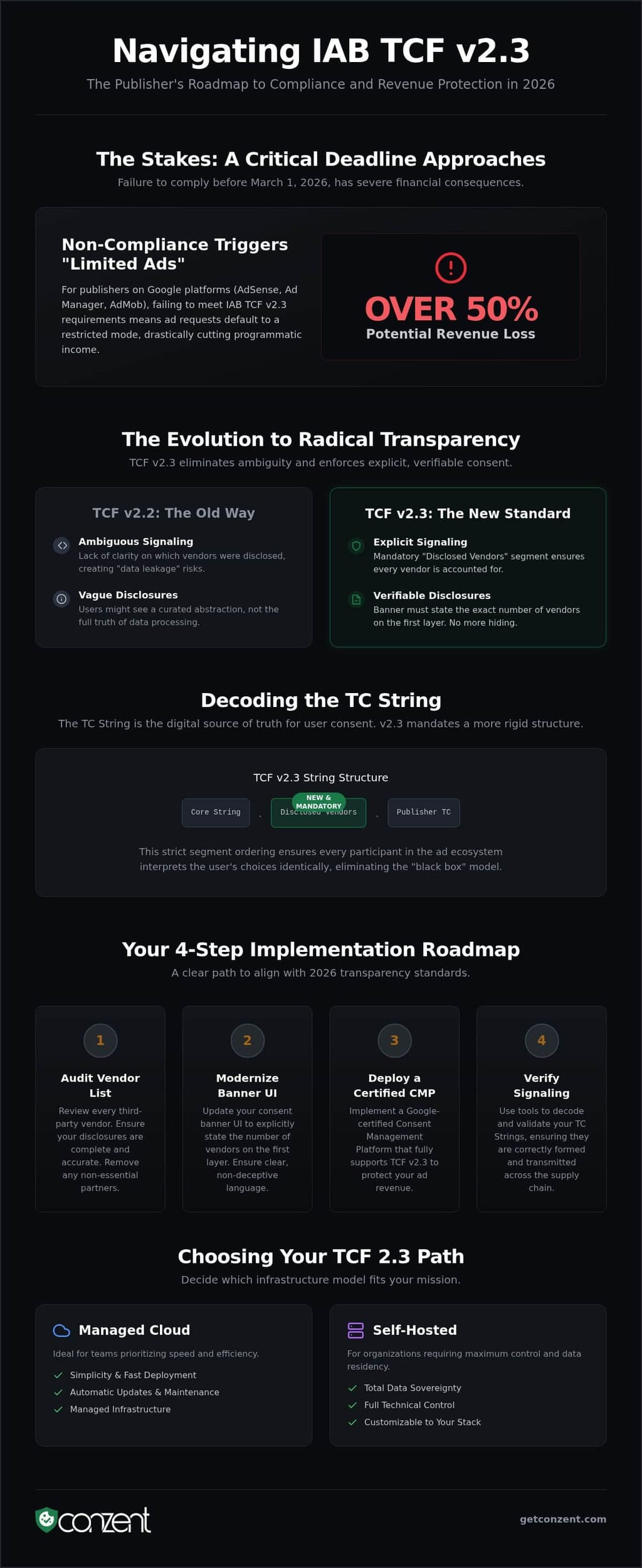
Missing the March 1, 2026 enforcement deadline isn't just a technical oversight. It's a revenue cliff. For publishers relying on Google platforms, failing to meet the latest IAB TCF v2.3 requirements means ad requests default to "Limited Ads," potentially slashing your programmatic income by over 50%. This isn't about adding another layer of complexity for the sake of it. It's about a necessary shift toward radical transparency. The industry is moving away from the "black box" model. We're entering an era where every vendor disclosure must be explicit, mandatory, and verifiable.
You probably feel like the goalposts for compliance are constantly shifting. It's exhausting to balance technical signaling with the need for high opt-in rates. We understand that frustration. This guide provides a clear roadmap to navigate these technical and legal shifts. You'll learn how to protect your ad revenue while ensuring your user signaling is bulletproof.
We'll examine the technical delta of v2.3, specifically the mandatory Disclosed Vendors segment and the requirements for Google-certified implementation. We'll also show you how to maintain transparency without sacrificing the performance of your consent banner.
Key Takeaways
- Understand why v2.3 moves beyond vague consent to a model of radical transparency that protects both users and publishers.
- Master the technical IAB TCF v2.3 requirements, specifically the mandatory segment ordering and the inclusion of disclosed vendors.
- Secure your ad revenue by aligning with Google’s mandatory certification rules for Consent Management Platforms before the enforcement deadline.
- Use our implementation roadmap to audit your vendor list and modernize your banner UI to meet 2026 transparency standards.
- Decide if managed cloud or self-hosted infrastructure fits your mission for data sovereignty and technical efficiency.
Table of Contents
What is IAB TCF v2.3? Evolution of Transparency
TCF v2.3 isn't just a minor technical patch. It's the industry's response to a growing demand for accountability and moral clarity in digital advertising. Developed by the Interactive Advertising Bureau (IAB) Europe, this framework creates a universal language for privacy. It's a technical standard. It's also a statement of intent. It tells users that their data isn't a commodity to be traded in the dark. By synchronizing how consent is signaled, the framework ensures that a user's privacy choices are respected across the entire supply chain.
When a user makes a choice on your banner, that choice is encoded into a Transparency and Consent (TC) String. This string travels through the ad tech ecosystem, telling every vendor exactly what they can and cannot do. Under the new IAB TCF v2.3 requirements, this signaling becomes far more precise. It removes the "maybe" from the equation. For anyone using Google AdSense, Ad Manager, or AdMob, compliance is now a prerequisite for revenue. Google requires a certified CMP that supports these specific updates. It's no longer enough to simply have a banner; you need a system that speaks the correct version of the TCF language.
The Core Purpose of TCF v2.3
TCF v2.3 exists to standardize the chaos of data processing. It defines specific "purposes" for data use, such as ad personalization or measurement. By using a shared vocabulary, publishers and vendors avoid legal friction. It isn't just about checkboxes. It's about providing a technical bridge that ensures a user's "No" is final. This version focuses on non-deceptive disclosures. It ensures that when a user sees a vendor list, they're seeing the truth rather than a curated abstraction. This level of transparency is a necessary standard for modern digital rights.
Why the Transition from v2.2 to v2.3 Matters
The shift from v2.2 to v2.3 is primarily about eliminating signaling ambiguity. In previous versions, there was sometimes a lack of clarity regarding which vendors were actually disclosed during a specific consent event. This created "data leakage" risks where vendors might process data without a clear signal of disclosure. The new IAB TCF v2.3 requirements solve this by making the "Disclosed Vendors" segment mandatory within the TC String.
This update also enforces stricter UI/UX patterns for consent banners. Your banner must now state the exact number of vendors seeking access on the very first layer. It's about honesty at scale. You can find more details on how we handle these technical shifts on our IAB TCF compliance page. By removing ambiguity, v2.3 protects publishers from the liability of silent data processing while building genuine trust with the audience.
Technical Requirements: Decoding the TC String and Signaling
The Transparency and Consent (TC) String is the technical heartbeat of the framework. It is not just a collection of metadata; it is a compressed, base64-encoded payload that acts as the digital source of truth for user privacy. Under the new IAB TCF v2.3 requirements, the structure of this string is more rigid to ensure that no vendor can claim ignorance of a user's choice. While previous versions allowed some flexibility in how data segments were organized, v2.3 mandates a specific ordering. This standardization is a necessary step toward global interoperability, ensuring that every participant in the ad tech ecosystem interprets the user's intent identically.
One critical technical baseline is the integration of the TCF TypeScript Library (iabtcf-es). This toolset allows developers to encode and decode TC Strings with precision, reducing the risk of malformed signals that could lead to ad delivery failures. Your Consent Management Platform (CMP) must also distinguish clearly between "Consent" and "Legitimate Interest" signals. It is not enough to simply fire a tag; the CMP must signal the specific legal basis for each processing purpose. If the signal is ambiguous, the ad request may be rejected by downstream partners who adhere to strict IAB industry standards.
New Signaling Nuances in v2.3
The most significant shift in v2.3 is the mandatory inclusion and specific placement of the "Disclosed Vendors" segment. This change ensures that a vendor's presence in the string is directly tied to their disclosure on the user interface. It eliminates the "black box" signaling that previously allowed for vendor ambiguity. Additionally, v2.3 introduces enhanced signaling for "Special Features," such as the use of precise geolocation data. Publishers now have more granular control within their UI to restrict specific vendors from using these features, even if the vendor has a global permission. This puts the power back into the hands of the publisher to curate a safe, transparent environment for their users.
API Integration for Developers
For developers, the `__tcfapi` is the primary interface for interacting with the CMP. It allows you to query the current consent state directly from the client side, ensuring that ad tags or tracking scripts only load after a valid TC String is generated. This asynchronous approach is vital for maintaining compliance without sacrificing page performance. You can explore more technical details in The Developer’s Guide to IAB TCF 2.3 API Integration. By utilizing these standardized commands, you ensure that your site remains functional and compliant as IAB TCF v2.3 requirements become the new industry benchmark. If you're looking for a platform that handles these technical complexities out of the box, you can compare our flexible implementation options to see which fits your infrastructure best.
The Google Factor: TCF v2.3 and Google Consent Mode v2
Google isn't just a participant in the privacy conversation; they are the primary enforcement arm for digital publishers. If you serve ads via AdSense, Ad Manager, or AdMob in the EU, EEA, or UK, compliance with IAB TCF v2.3 requirements is a mandatory prerequisite for doing business. Google has made it clear that they will only accept consent signals from certified Consent Management Platforms (CMPs). This is not a suggestion. It is a technical gate. Without a certified signal, your ad requests will default to "Limited Ads," which can slash programmatic revenue by over 50% overnight.
It is vital to understand that the IAB TCF and Google Consent Mode (GCM) v2 are distinct tools that must work in perfect synchronization. The TCF provides the standardized framework for the entire ad tech ecosystem, while GCM v2 is Google’s specific method for adjusting how its own tags behave based on user choices. Failing to sync these two systems creates a "consent gap." In this scenario, a user might grant consent on your banner, but if that signal isn't correctly translated into Google's specific parameters, Google’s servers will treat the interaction as unconsented. This leads to total revenue loss on those impressions and broken attribution models.
Certified CMPs: A Non-Negotiable Requirement
Google maintains a strict list of certified CMPs that publishers must use to maintain ad serving in regulated regions. This certification ensures that the CMP correctly implements the technical nuances of the framework, including the new mandatory segments in the TC String. We designed Conzent to meet these certification standards out of the box, removing the guesswork from your setup. You can learn more about our IAB TCF compliance to see how we handle these technical handshakes. Using a non-certified solution in 2026 is a gamble that risks your entire monetization strategy.
Mapping TCF Purposes to Google Consent States
The technical core of this integration lies in mapping. Under IAB TCF v2.3 requirements, specific data processing "Purposes" must trigger corresponding "Consent States" in Google’s ecosystem. For example, TCF Purpose 1, which covers the storage of information on a device, maps directly to Google’s ad_storage parameter. If Purpose 1 is rejected by the user, ad_storage must be set to "denied." Similarly, more recent requirements for ad_user_data and ad_personalization must be signaled based on the user’s TCF choices. For a detailed breakdown of this logic, see our guide on Google Consent Mode v2 implementation. Precision here is the difference between a compliant, high-revenue site and one that is effectively dark to advertisers.
Implementation Roadmap: Moving to TCF v2.3
Transitioning to the latest version isn't a passive update. It's a proactive audit of your digital ecosystem. It requires a shift from "collecting everything" to "disclosing exactly what is necessary." This roadmap isn't about checking boxes. It's about cleaning up your supply chain to ensure every byte of data processing is accounted for. Under the new IAB TCF v2.3 requirements, your implementation must be precise. There is no room for technical debt or silent vendors.
The first step is a fundamental cleanup. Many publishers suffer from "vendor bloat." This happens when hundreds of processors are active on a site, but only a handful drive actual value. This bloat creates liability. It slows down your page. It erodes user trust. Curate your partners. If a vendor doesn't contribute to your revenue or user experience, remove them. A leaner vendor list makes your consent banner more readable and your TC String more efficient.
Auditing Your Vendor List
The Global Vendor List (GVL) is the definitive registry of ad tech participants that have signed the framework's governing terms, and as of the February 28, 2026 deadline, all active vendors must be registered under the v2.3 specifications. Don't just accept the default list. Review every vendor's declared purposes. Ensure they align with your site's actual data practices. This isn't just a legal chore. It's a technical optimization. A shorter GVL results in a smaller TC String, which improves interoperability with downstream ad partners.
Testing and Validation
Once you've updated your banner UI to show the exact number of vendors on the first layer, you must validate the output. Testing is the only way to ensure your signaling is valid. Use the browser console to query the API directly. Run the command __tcfapi('getTCData', 2, (data) => { console.log(data); }); to inspect the generated string. You are looking for the mandatory "Disclosed Vendors" segment. If this segment is missing or malformed, your signals will be ignored by major ad networks.
Beyond manual console checks, monitor your Google Ad Manager reports for specific TC String errors. These reports identify exactly where your signals are failing. Common issues include version mismatches or incorrect mapping of legitimate interest. Achieving a high standard of GDPR compliance for publishers requires this level of granular technical scrutiny. It's about ensuring your "Consent" signal actually reaches the advertiser without being stripped away by a validation error. Ready to streamline your transition? Explore our certified implementation plans to ensure your site meets every 2026 standard without the manual headache.
Managed Cloud vs. Self-Hosted: Choosing Your TCF 2.3 Path
Infrastructure is a moral choice. It is not just a technical deployment. How you handle your consent data reflects your commitment to user rights and data sovereignty. In an industry where compliance often feels like a tax on growth, we believe privacy should be a universal standard. It shouldn't be a luxury reserved for those with the largest legal budgets. Whether you choose a managed service or a self-hosted environment, meeting the IAB TCF v2.3 requirements must be efficient, transparent, and absolute. Your choice of infrastructure determines if your compliance is a "set and forget" process or a deeply integrated part of your own tech stack.
Managed cloud is about speed. Self-hosting is about control. One removes the maintenance burden; the other removes the vendor lock-in. Both paths are valid, but they serve different operational philosophies. Conzent supports both, ensuring that the shift to v2.3 is accessible to every publisher, regardless of their resource level or technical preference.
The Case for Managed Cloud
For many publishers, the technical overhead of maintaining a Google-certified CMP is a distraction from their core mission. Managed Cloud is the solution for those who prioritize compliance security without the maintenance headache. It handles the automatic injection of GVL updates and ensures your TC Strings always meet the latest IAB TCF v2.3 requirements. This path also provides access to Revenue Impact Analytics. You don't just stay compliant; you see exactly how your TCF settings influence your bottom line. It's the principled choice for publishers who want a robust, certified solution that works out of the box. You can explore the details on our Managed Cloud Pricing page.
The Case for Self-Hosted OCI
Privacy-first organizations often demand total data sovereignty. They don't want their users' consent signals passing through a third-party "black box." Our Self-Hosted Open Consent Infrastructure (OCI) is designed for developers and DevOps teams who prioritize transparency. Because the code is source-available, your team can perform deep audits and create custom integrations that a standard SaaS simply can't offer. You get the benefit of a certified TCF v2.3 framework without the recurring monthly fees or the risk of vendor dependency. It's a provider of a public good, allowing you to self-host our Open Consent Infrastructure while maintaining full control over your data environment. This approach is the ultimate refinement of transparency, proving that you don't need to sacrifice sovereignty for compliance.
Future-Proof Your Ad Revenue and User Trust
Compliance is not a burden; it is a baseline for ethical publishing. You've seen how the shift to v2.3 removes signaling ambiguity and why Google's certification is now a hard requirement for monetization. By auditing your vendor list and mastering the technical nuances of the TC String, you transform a regulatory hurdle into a competitive advantage. This is about more than just checking boxes. It is about building a sustainable, transparent relationship with your audience.
Meeting the IAB TCF v2.3 requirements ensures your programmatic income remains stable while you take full ownership of your data ecosystem. Whether you prioritize the ease of a managed cloud or the total sovereignty of source-available infrastructure, the tools you use should reflect your values. We provide a Google Certified CMP that includes Revenue Impact Analytics to help you navigate this transition with confidence.
Get Started with a TCF v2.3 Certified CMP and secure your digital future today. You have the roadmap. It's time to lead the way in digital rights and technical efficiency.
Frequently Asked Questions
Is IAB TCF v2.3 mandatory for all websites?
It isn't mandatory for every site on the internet, but it's a requirement for any publisher monetizing through programmatic advertising in the EU, EEA, or UK. If you don't use ads or track users in these regions, you don't need it. However, if you rely on the global ad tech ecosystem, this framework is the only standardized way to communicate consent signals to thousands of vendors simultaneously.
What happens if I don’t upgrade to TCF v2.3 by the deadline?
Missing the February 28, 2026 deadline means your consent signals will be considered invalid by major ad networks. Starting March 1, 2026, Google and other partners will stop serving personalized ads to your users. Instead, they'll default to "Limited Ads." This change isn't just a warning; it’s a technical block that prevents vendors from processing data without a valid v2.3 TC String.
Does TCF v2.3 make my website automatically GDPR compliant?
No, TCF v2.3 is a technical tool, not a legal guarantee. It helps you manage and signal user choices, but compliance also depends on your privacy policy, data storage practices, and how you handle first-party data. Think of it as the plumbing for your privacy signals. You still need to ensure your overall business operations align with the broader principles of the GDPR.
Can I use TCF v2.3 with non-IAB vendors?
You can list non-IAB vendors on your banner, but they won't receive signals through the standard TC String. These vendors operate outside the framework's technical specifications. To manage them, you'll need a CMP that can handle custom vendors alongside the official Global Vendor List. This ensures you still capture and respect user choices for every partner on your site, regardless of their IAB status.
What is the difference between TCF v2.2 and v2.3?
The primary difference lies in technical precision and transparency. In v2.3, the "Disclosed Vendors" segment is now mandatory within the TC String. This update eliminates the ambiguity of whether a vendor was actually shown to the user. It also introduces stricter requirements for segment ordering and mandates that the exact number of vendors must appear on the banner's first layer to meet IAB TCF v2.3 requirements.
Does Google require a certified CMP for TCF v2.3?
Yes, Google requires all publishers using AdSense, Ad Manager, or AdMob in regulated regions to use a certified CMP. This CMP must support the latest IAB TCF v2.3 requirements to ensure signals are interpreted correctly. Using a non-certified solution will result in a total loss of personalized ad serving. Google’s certification process verifies that the platform handles TC Strings and Consent Mode v2 without errors.
How does TCF v2.3 affect my ad revenue?
Compliance protects your revenue from the "Limited Ads" cliff. If your CMP doesn't signal consent correctly under v2.3, ad networks can't bid on your inventory using personalized data. This can slash programmatic revenue by over 50% for publishers on Google platforms. By upgrading, you ensure that high-value advertisers can continue to reach your audience while respecting the stricter transparency rules enforced in 2026.
Can I self-host a TCF v2.3 compliant consent banner?
You can absolutely self-host your infrastructure while remaining compliant. We believe data sovereignty is a right, not a luxury. A self-hosted approach allows you to keep consent records on your own servers and perform deep audits of the source-available code. As long as your implementation follows the technical specifications and maintains certification, self-hosting is a powerful way to meet 2026 standards without relying on a third-party cloud.