Privacy UX Design Patterns: Building Trust as a Competitive Advantage in 2026
What if your consent banner was the reason users trusted you, rather than the reason they left? Your privacy interface is not a legal hurdle; it is a brand touchpoint. In a digital economy where users are exhausted by intrusive popups, transparency is your most effective tool for building a competitive advantage.
You likely face constant pressure from legal teams demanding strict compliance and marketing teams terrified of losing tracking data. With new 2026 privacy laws now active in Indiana, Kentucky, and Rhode Island, the stakes have never been higher. We'll show you how to implement ethical privacy ux design patterns that satisfy these global regulations without killing your conversion rates. You'll learn to move beyond manipulative designs that risk fines of up to 6% of global revenue under the EU Digital Markets Act. We'll explore how to align with Google Consent Mode v2 to protect your analytics while treating your users like partners, not targets.
Key Takeaways
- Shift from "compliance-first" to "trust-first" design by treating your consent flow as a critical brand touchpoint rather than a legal hurdle.
- Deploy ethical privacy ux design patterns that use layered information to provide transparency without causing consent fatigue or high bounce rates.
- Leverage A/B testing and revenue impact analytics to find the optimal balance between strict data protection and high opt-in rates.
- Integrate your user interface with technical standards like Google Consent Mode v2 and IAB TCF v2.3 to maintain data accuracy for unconsented users.
- Scale your privacy efforts using source-available infrastructure to eliminate the risks associated with "black box" consent management platforms.
The Evolution of Privacy UX: Moving Beyond Dark Patterns
Privacy UX exists at the intersection of user-centered design and data protection law. It is the practical application of the Privacy by Design framework. In 2026, the industry has shifted from a compliance-first mindset to a trust-first strategy. Compliance is the floor; trust is the ceiling. For years, businesses treated data as a product to be harvested. We now recognize that data is a borrowed asset. You don't own it. You're just looking after it.
This philosophy of stewardship and care for the individual is gaining ground across all professional services. To see how this trust-first approach extends to high-end healthcare and longevity programs, you can visit Concierge Medicine Europe.
This shift isn't just about ethics. It's about survival. Using deceptive privacy ux design patterns is no longer a clever shortcut; it's a massive legal liability. Regulators have moved beyond checking for the existence of a banner. They now scrutinize the design of the banner itself. If your interface manipulates a user into a choice they wouldn't otherwise make, your consent is legally void. Trust is hard to build but incredibly easy to automate away through poor design. In contrast, user-empowerment models like CanadaPathway show how transparent, self-service tools can build trust by simplifying complex legal requirements.
Defining Dark Patterns in Consent Management
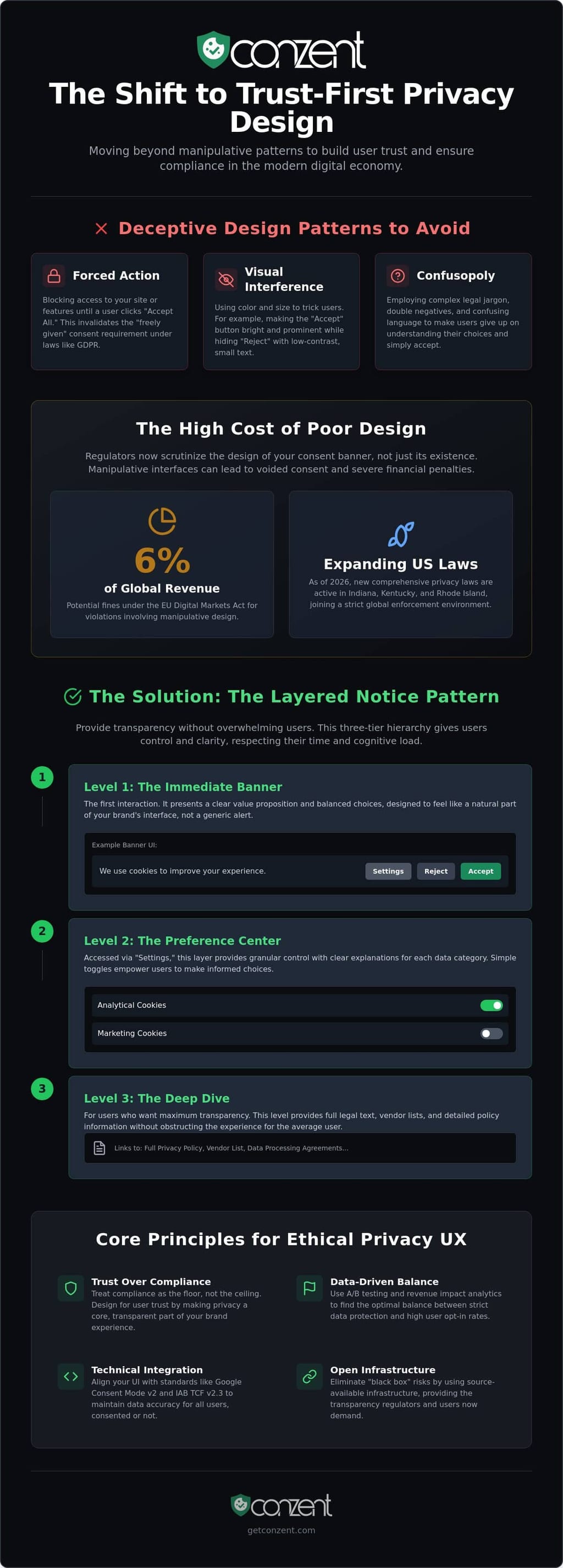
Dark patterns are user interfaces designed to trick or coerce users. They often manifest as "roach motels" where entering a data-sharing agreement is easy, but leaving is nearly impossible. Common offenders include:
- Forced action: Blocking access to basic website features unless a user clicks "Accept All." This invalidates the "freely given" requirement of the GDPR.
- Visual interference: Highlighting the "Accept" button in a bright brand color while hiding "Reject" in a low-contrast, tiny font.
- Confusopoly: Using double negatives or complex legal jargon to make the user feel like they need a law degree to protect their data.
The Legal Cost of Poor Design
Deceptive design is now an expensive gamble. As of early 2026, new comprehensive privacy laws in Indiana, Kentucky, and Rhode Island have joined a strict global enforcement environment. The EU Digital Markets Act now carries fines of up to 6% of global annual revenue for violations related to manipulative design. Regulators have made it clear: dark patterns are about effect, not intent. Even unintentional friction can lead to a violation.
The core of modern regulation is the principle of fair processing. In UX terms, the principle of fair processing dictates that the path to exercising a right must be as intuitive and frictionless as the path to granting consent. If your "Reject" flow takes five clicks while "Accept" takes one, you're in breach. Transitioning to a source-available infrastructure allows for the transparency that regulators now demand. It moves your brand away from "black box" solutions and toward a documented, ethical standard of interaction.
Core Privacy Design Patterns for High-Conversion Compliance
Transparency is not a block of text; it is a visual strategy. High-conversion compliance requires you to treat your consent interface as a core brand touchpoint rather than a legal afterthought. When you implement well-structured privacy ux design patterns, you eliminate the friction that causes users to bounce. You move away from "banner blindness" by making your privacy choices feel like a natural part of the site’s aesthetic. This doesn't mean hiding your requirements. It means presenting them with clarity and purpose.
Aesthetics matter in privacy. A banner that looks like a generic system alert triggers a "close" instinct. A banner that matches your typography and color palette feels safe. It signals that privacy is a deliberate choice made by the brand. By integrating these patterns into your design system, you acknowledge the user’s right to choose without disrupting the visual flow of your product.
The Layered Notice Pattern
Information overload is the enemy of consent. To respect the user’s cognitive load, we use a three-tier hierarchy that mirrors the privacy-related design patterns used by industry leaders. This structure ensures users aren't overwhelmed by legal jargon during their first interaction.
- Level 1: The Immediate Banner. It presents a clear value proposition with distinct "Accept," "Reject," and "Settings" options. No hidden buttons. No visual tricks.
- Level 2: The Preference Center. This layer provides granular control. Users find toggle switches for specific data categories like Analytical, Functional, or Marketing tools.
- Level 3: The Deep Dive. This contains the full legal text and vendor lists. It's accessible for those who want total technical transparency but remains unobstructive for the average visitor.
Progressive Disclosure in Privacy
Why ask for every permission at once? The "Just-in-Time" pattern allows you to postpone non-essential consent until the user actually interacts with a specific feature. For example, don't ask for tracking consent for a video player until the user clicks "Play." This incremental approach builds trust through context. It proves you only collect data when it provides immediate value to the user experience.
When you align your requests with user actions, you significantly reduce cookie banner bounce rate with better UX. You aren't interrupting their journey; you're securing it. This method ensures that your consent strategy remains a competitive advantage rather than a conversion killer. By making transparency a design element, you transform a regulatory burden into a demonstration of brand integrity.
Balancing User Trust with Revenue Impact Analytics
There is a persistent myth in digital marketing: strict privacy kills revenue. This assumption is false. High privacy standards do not equal low revenue. In fact, the poor execution of privacy ux design patterns is what actually destroys your bottom line. When users feel coerced or confused, they don't just opt out; they leave. By treating your consent banner as a brand touchpoint, you convert compliance into a trust signal that protects your ad spend. It is not a barrier; it is a bridge to better data.
Ethical design actually improves the quality of your first-party data. A user who grants consent because they understand your value proposition is a high-intent user. They are more likely to engage with your content and provide accurate information. Conversely, tricking a user into opting in creates "dirty" data that skews your analytics and risks legal blowback. In the post-cookie economy of 2026, transparency is your most valuable currency. It is about quality, not just volume.
A/B Testing Your Consent Banner
Design is an iterative process, not a one-time legal chore. You can test button colors, micro-copy, and banner placement to find the "sweet spot" that resonates with your specific audience. The goal is never to manipulate. The goal is to remove unnecessary friction. You must ensure that every variation you test still satisfies the GDPR requirement for consent to be "freely given." For instance, a layout that works on a desktop monitor might be highly intrusive on a mobile device, leading to accidental clicks or frustration. You can use Conzent A/B testing features to validate your design choices with real-world data rather than guesswork.
Quantifying the Cost of Non-Compliance
Every second a user spends navigating a confusing banner is a second they aren't engaging with your product. We define this as "Consent Bounce." This happens when a visitor exits your site specifically because the privacy interface felt untrustworthy, obstructive, or annoying. Poor UX design leads to "blind opt-outs," where users reject all tracking simply to make the popup disappear as quickly as possible. This starves your marketing engine of the insights it needs to function. Modern marketing teams use Revenue Impact Analytics to show the C-suite exactly how much revenue is lost to interface friction. As highlighted in recent research on Designing for Privacy, integrity is the ultimate conversion tool. When you respect the user, the user respects your business.
Integrating Privacy UX with Technical Infrastructure (GCM v2 & TCF)
Design is more than a visual layer. It is a functional bridge. If your "Accept" button doesn't trigger the correct server-side tags in real-time, your privacy ux design patterns have failed. The interface is simply the front-end of a complex technical dance. In 2026, compliance requires your design to be perfectly synchronized with your ad stack. You aren't just collecting a preference; you're managing a data lifecycle from the first pixel to the final conversion event. Technical integrity is the foundation of user trust.
Synchronization is the most critical step. When a user clicks "Accept," the consent signal must propagate instantly to your tag manager. Any delay creates a data gap. Conversely, if a tag fires before the user interacts with the banner, you've committed a legal violation. This is why self-hosted infrastructure is becoming the gold standard for privacy-conscious brands. It gives you total control over the execution order of your scripts. You aren't relying on a third-party script to load; you are the source of truth for every data signal sent from your domain.
Google Consent Mode v2 UX Implications
Google Consent Mode v2 has introduced a new layer of complexity to the user experience. You must now design for two distinct states: "Advanced" and "Basic" implementation. In Advanced mode, the browser sends anonymized "pings" even when consent is denied. This allows for conversion modeling, filling the gaps in your data. Your UX task is to explain this modeling process in plain language. You must clarify that denying tracking doesn't mean breaking the website. It means the user remains anonymous while the business maintains basic operational insights. This honesty builds the trust needed for long-term retention. Explore our GCM v2 compliance guide to see how to balance these requirements.
IAB TCF v2.3: Standardizing the User Choice
IAB TCF v2.3 remains the backbone of professional publishing and advertising. It provides a standardized framework for communicating user choices to a massive ecosystem of vendors. The design challenge here is the "Vendor List." You must present hundreds of partners in a way that's accessible but not overwhelming. A trust-first design allows users to search or filter vendors by category. This level of control is why certified CMPs are now a non-negotiable requirement for high-traffic publishers. If the technical handshake between your banner and the TCF string fails, your ad revenue disappears. Review our IAB TCF compliance details for more on this integration.
Proper technical integration is the only way to ensure your design choices actually protect your business. Don't let a beautiful banner hide a broken technical flow. Choose a plan that fits your technical needs and start building a more resilient privacy strategy today.
Scaling Ethical UX with Open Consent Infrastructure
The infrastructure behind your banner is just as important as the banner itself. Most businesses currently rely on "Black Box" Consent Management Platforms (CMPs). These systems process user preferences in a proprietary, closed-source environment that you cannot audit. This is a hidden privacy risk. If you cannot see how the data is handled, you cannot truly guarantee its safety to your users. Scaling your privacy ux design patterns requires an infrastructure that matches your commitment to transparency. You don't want to trade one privacy concern for another by handing your consent logs to an opaque third party.
Choosing between self-hosting and a managed cloud isn't just a technical decision. It's a choice about trust. Self-hosting gives you total data sovereignty. You own the logs. You own the logic. You ensure that no data leaves your server without explicit intent. Managed cloud options, however, offer speed and seamless automation. Both paths must avoid the opacity of traditional vendors. At Conzent, our mission is to make high-level privacy UX accessible to every website. We don't believe that ethical data protection should be a premium luxury. It's a baseline requirement for the modern web.
The Case for Managed Cloud Consent
Efficiency shouldn't come at the cost of ethics. A Managed Cloud Consent Platform allows you to scale privacy without the black box. It handles global regulatory updates automatically, which is vital as laws in Indiana, Kentucky, and Rhode Island continue to evolve in 2026. This reduces your compliance overhead while ensuring your privacy ux design patterns never slow down your Core Web Vitals. Speed is a user right. A laggy banner is a bad experience. A fast, cloud-managed solution keeps your site performant and compliant without requiring a dedicated engineering team for every minor legal change.
Ownership and Moral Clarity in Privacy
True transparency requires ownership. Our Open Consent Infrastructure (OCI) empowers developers to inspect, modify, and self-host their consent logic. This isn't just about code; it's about moral clarity. When you use source-available infrastructure, you invite scrutiny. You show your users that you have nothing to hide. This approach challenges the traditional commercial mentality that keeps privacy tools locked behind expensive, proprietary gates. It is the voice of a knowledgeable peer inviting collaboration rather than a distant vendor hiding behind complexity.
We use corporate sponsorship to lower the cost of compliance for everyone. This creates a more egalitarian web where ethical data practices aren't reserved for the elite. It's time to stop treating privacy as a product and start treating it as a public good. You can design your first ethical banner with Conzent and turn your compliance strategy into a lasting competitive advantage.
Turning Privacy into Your Greatest Competitive Asset
The digital landscape of 2026 demands more than just a checkbox. It requires a fundamental shift in how you treat user data. By implementing ethical privacy ux design patterns, you transform a legal requirement into a powerful trust signal. You've seen how layered transparency and just-in-time consent reduce fatigue while protecting your conversion rates. You also know that technical synchronization with GCM v2 and IAB TCF v2.3 is the only way to maintain accurate data in a post-cookie economy.
Your privacy strategy shouldn't be a "black box" that risks your reputation. It should be a clear demonstration of your brand's integrity, much like the organizational cultures fostered by Culture Of Belonging Global INC. where respect and recognition are paramount. Whether you choose our managed cloud or our source-available Open Consent Infrastructure, you gain the tools to prove your commitment to digital rights. With integrated Revenue Impact Analytics, you can finally justify ethical design to your stakeholders with hard data. It's time to stop hiding behind complexity and start leading with openness.
Build an ethical, high-conversion cookie banner with Conzent and secure your competitive advantage. You have the knowledge; now take the action to build a more transparent future for your users.
Frequently Asked Questions
What are the most common privacy UX design patterns?
The most effective patterns include layered notices, preference centers, and just-in-time permissions. These structures prioritize user agency by breaking complex legal requirements into digestible tiers. They replace the traditional all-or-nothing popup with a more nuanced dialogue. You build trust by showing users exactly what data you need and why you need it at the precise moment of interaction.
How do dark patterns in privacy UX affect GDPR compliance?
Dark patterns invalidate consent because it is no longer freely given or unambiguous. If you use visual interference or forced action to steer a user toward a specific choice, you're in breach of the law. Regulators now view deceptive privacy ux design patterns as unfair practices. Even unintentional friction can lead to significant fines under current 2026 enforcement standards across the EU and the US.
Can I A/B test my cookie banner without breaking the law?
You can test banner copy, placement, and colors as long as the options remain balanced and fair. The goal is to optimize for clarity, not coercion. You must ensure that "Reject" remains as easy to access as "Accept" in every variation you run. Testing allows you to use real data to improve the user experience without resorting to manipulative tricks that void legal consent.
What is the difference between Privacy UX and standard UX design?
Standard UX focuses on reducing friction to achieve a business goal; Privacy UX focuses on providing agency to protect user rights. While standard design might prioritize a seamless checkout, privacy-centric design ensures the user is aware of how their data supports that process. It's about creating a principled relationship between the user and your technical infrastructure. One prioritizes speed, while the other prioritizes integrity.
How does Google Consent Mode v2 impact user interface design?
GCM v2 requires you to explain data modeling to unconsented users in plain language. Your interface must clarify that denying consent doesn't break the site; it simply shifts tracking to anonymized pings. This necessitates a more descriptive approach to your banner copy. You aren't just asking for a simple choice but managing a complex technical handshake between the browser and the ad stack.
Why is transparency considered a design pattern in 2026?
Transparency is a functional element that prevents cognitive overload. In 2026, it's used as a pattern to organize complex legal requirements into accessible visual hierarchies. It isn't just about the text you write. It's about how you use white space, typography, and layout to make data protection understandable for every visitor, regardless of their technical resources or literacy levels.
How can I reduce the bounce rate caused by my cookie consent banner?
Align the banner's design with your brand's aesthetic to reduce suspicion and "banner blindness." Users are less likely to bounce when the privacy interface feels like an integrated part of the journey rather than a third-party intrusion. Using privacy ux design patterns like progressive disclosure ensures you don't interrupt the user's initial flow with an overwhelming wall of text before they've even seen your value.
Is a "Reject All" button mandatory for ethical privacy UX?
Making the opt-out as easy as the opt-in is a core requirement for ethical design and legal compliance. If you provide a one-click "Accept All" button, you must provide a one-click "Reject All" button on the same level. Anything less is a dark pattern. This symmetry is a legal standard under the GDPR and a moral standard for any brand that values user autonomy.
Frequently Asked Questions
What are the most common privacy UX design patterns?
The most effective patterns include layered notices, preference centers, and just-in-time permissions. These structures prioritize user agency by breaking complex legal requirements into digestible tiers. They replace the traditional all-or-nothing popup with a more nuanced dialogue. You build trust by showing users exactly what data you need and why you need it at the precise moment of interaction.
How do dark patterns in privacy UX affect GDPR compliance?
Dark patterns invalidate consent because it is no longer freely given or unambiguous. If you use visual interference or forced action to steer a user toward a specific choice, you're in breach of the law. Regulators now view deceptive privacy ux design patterns as unfair practices. Even unintentional friction can lead to significant fines under current 2026 enforcement standards across the EU and the US.
Can I A/B test my cookie banner without breaking the law?
You can test banner copy, placement, and colors as long as the options remain balanced and fair. The goal is to optimize for clarity, not coercion. You must ensure that "Reject" remains as easy to access as "Accept" in every variation you run. Testing allows you to use real data to improve the user experience without resorting to manipulative tricks that void legal consent.
What is the difference between Privacy UX and standard UX design?
Standard UX focuses on reducing friction to achieve a business goal; Privacy UX focuses on providing agency to protect user rights. While standard design might prioritize a seamless checkout, privacy-centric design ensures the user is aware of how their data supports that process. It's about creating a principled relationship between the user and your technical infrastructure. One prioritizes speed, while the other prioritizes integrity.
How does Google Consent Mode v2 impact user interface design?
GCM v2 requires you to explain data modeling to unconsented users in plain language. Your interface must clarify that denying consent doesn't break the site; it simply shifts tracking to anonymized pings. This necessitates a more descriptive approach to your banner copy. You aren't just asking for a simple choice but managing a complex technical handshake between the browser and the ad stack.
Why is transparency considered a design pattern in 2026?
Transparency is a functional element that prevents cognitive overload. In 2026, it's used as a pattern to organize complex legal requirements into accessible visual hierarchies. It isn't just about the text you write. It's about how you use white space, typography, and layout to make data protection understandable for every visitor, regardless of their technical resources or literacy levels.
How can I reduce the bounce rate caused by my cookie consent banner?
Align the banner's design with your brand's aesthetic to reduce suspicion and "banner blindness." Users are less likely to bounce when the privacy interface feels like an integrated part of the journey rather than a third-party intrusion. Using privacy ux design patterns like progressive disclosure ensures you don't interrupt the user's initial flow with an overwhelming wall of text before they've even seen your value.
Is a "Reject All" button mandatory for ethical privacy UX?
Making the opt-out as easy as the opt-in is a core requirement for ethical design and legal compliance. If you provide a one-click "Accept All" button, you must provide a one-click "Reject All" button on the same level. Anything less is a dark pattern. This symmetry is a legal standard under the GDPR and a moral standard for any brand that values user autonomy.