
Scalable Cookie Consent Reporting for Agencies: Portfolio Compliance in 2026

Your agency’s compliance debt isn't a legal problem. It’s an infrastructure failure. When you're managing 50 or more client sites, manual banner updates and fragmented data aren't just annoying. They’re a direct threat to your profitability. You likely recognize the frustration of chasing misconfigured Google Consent Mode v2 settings while watching ad revenue dip. It’s a cycle of reactive fixes that scales costs faster than your client revenue.
We believe privacy shouldn't be a premium luxury or a technical nightmare. This guide shows you how to implement scalable cookie consent reporting for agencies to reclaim your time and protect your margins. You’ll discover how a centralized dashboard provides a single source of truth for your entire portfolio, ensuring every client stays audit-ready. We’ll explore how to maintain verified compliance with IAB TCF v2.3 and GCM v2 without the black-box complexity of traditional vendors. We're moving from manual chaos to a streamlined, ethical architecture that treats digital rights as a standard rather than an afterthought. This is about predictable growth and technical transparency.
Key Takeaways
- Centralize your portfolio management with cookie consent reporting for agencies to eliminate manual banner updates across 50 or more client sites.
- Secure client ad revenue through native Google Consent Mode v2 and IAB TCF v2.3 integrations that align technical signals with user choices.
- Choose the infrastructure that fits your agency, whether it's a zero-maintenance Managed Cloud Platform or source-available Self-Hosted Open Consent Infrastructure.
- Move to a sponsorship-driven pricing model that keeps your margins predictable and scales profitably alongside your client list.
- Implement a standardized roadmap to audit your portfolio and deploy consistent, compliant consent templates across all domains.
The Agency Compliance Debt: Why Manual Consent Fails at Scale
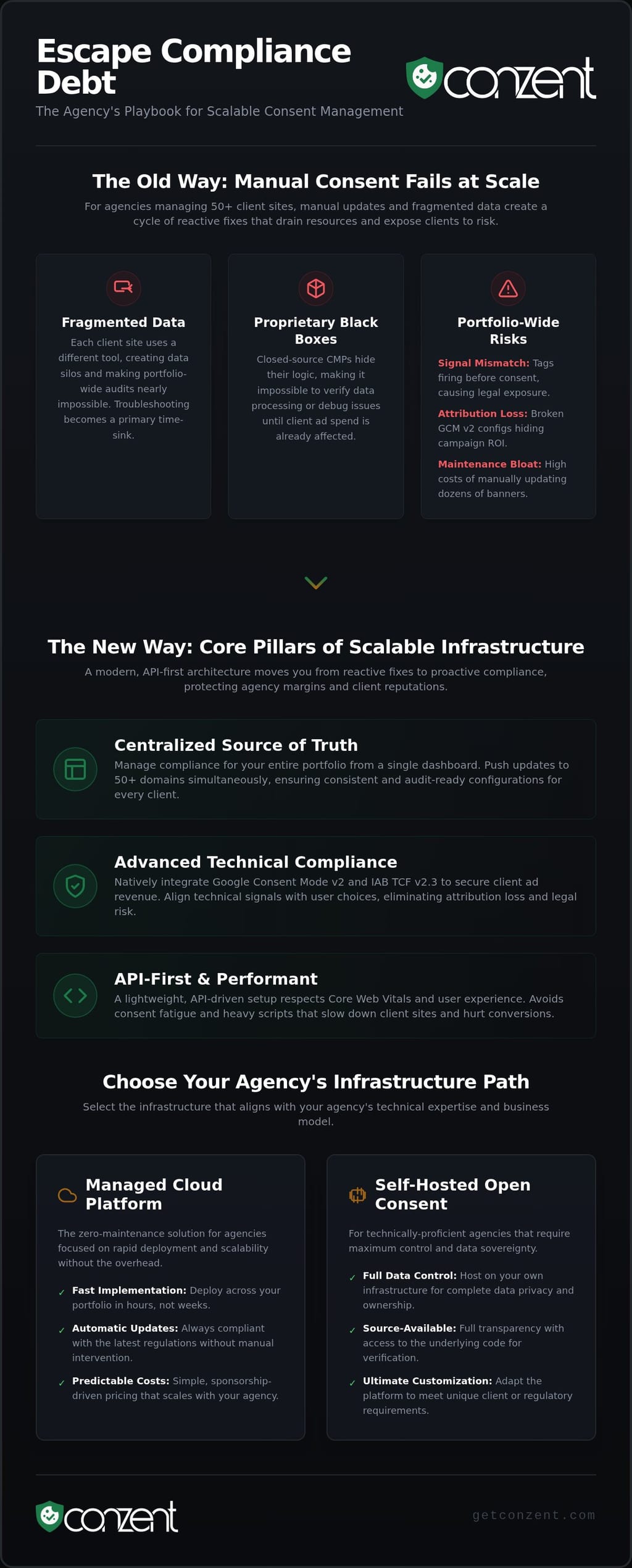
Many agencies treat cookie banners as a "set and forget" task. You install a plugin, pick a template, and move on. This approach is a trap. It builds compliance debt that eventually comes due. In 2026, the regulatory environment has shifted from simple notification to technical enforcement. If you're managing 50 sites, manual updates aren't just slow; they're impossible. Relying on manual cookie consent reporting for agencies creates a bottleneck that drains your team's billable hours and leaves clients exposed.
Fragmented data is a liability. When every client uses a different tool or logic, your team spends more time troubleshooting than optimizing. Proactive compliance means catching errors before a regulator does. It requires a single source of truth across all domains. You need to move from reactive fixes to a centralized infrastructure that protects your agency's margins and your clients' reputations.
The Problem with Proprietary Black Boxes
Closed-source Consent Management Platforms (CMPs) are often black boxes. They hide technical errors until they've already nuked your client's ad spend. You can't see the underlying logic. You can't verify how data is processed. This lack of transparency erodes the trust between you and your clients. A "one-size-fits-all" banner isn't a solution; it's a compromise. It often fails to meet specific UX requirements, making the site look unprofessional and decreasing opt-in rates. We prefer technical transparency over proprietary mystery. Standards like IAB TCF v2.3 shouldn't be hidden behind a paywall of complexity.
Portfolio-Wide Risks in 2026
The era of "banner compliance" is dead. Data protection authorities now conduct systematic reviews of high-traffic sites. They look for true technical enforcement under the ePrivacy Directive and GDPR. Incorrect consent signals are a silent killer for performance. If Google Consent Mode v2 is misconfigured, your conversion tracking breaks. Your Meta Pixel data becomes garbage.
Agencies must treat consent as a core growth metric. It's not a footer link; it's the foundation of your ad revenue. Portfolio-wide risks include:
- Signal Mismatch: Tags firing before consent is granted, leading to legal risk.
- Attribution Loss: Broken GCM v2 configurations that hide the true ROI of your campaigns.
- Maintenance Bloat: The high cost of updating dozens of individual banners manually every time a new regulation drops.
Proving compliance ROI starts with reliable revenue impact analytics. Without centralized reporting, you're guessing. With it, you're providing a professional, high-standard service that justifies your agency's value.
Core Pillars of Scalable Consent Infrastructure
Scaling a portfolio requires moving past individual site plugins. A decentralized approach is a recipe for maintenance bloat. Efficient cookie consent reporting for agencies relies on a unified, API-first architecture. This allows your team to push updates and manage compliance across 50 or more domains from a single dashboard. It's about creating a repeatable standard that works everywhere, rather than reinventing the wheel for every new client project.
Infrastructure should be invisible to the end user but robust for the developer. Automated multi-language support is a baseline requirement for global portfolios. It ensures that a client's expansion into new markets doesn't trigger a manual translation project for your team. By automating these technical hurdles, you protect your agency's margins and provide a more professional service.
Centralizing the Source of Truth
A unified backend simplifies cross-domain consent for multi-brand clients. It allows you to synchronize user choices across different environments without complex custom coding. This isn't just a legal win; it's a performance win. Many legacy banners are heavy, adding unnecessary weight to the page. A streamlined, API-driven setup helps maintain Core Web Vitals by reducing script execution time. It also prevents "consent fatigue" by ensuring the logic is consistent and respectful of the user's journey. You're building trust through technical efficiency, not just checking a box.
Advanced Technical Compliance
Implementing Google Consent Mode v2 is a technical necessity in 2026. It shouldn't break your existing tag manager setups. When properly integrated, it allows Google's tags to adjust their behavior based on the user's consent status, preserving conversion modeling even when cookies are rejected. For clients with ad-heavy sites or publishing models, IAB TCF v2.3 certification is equally critical. It ensures programmatic revenue remains stable by providing a standardized way to communicate consent to ad tech vendors.
Following the ICO guidance on cookies is the best way to ensure your technical signals match regulatory expectations. This level of precision is what separates a knowledgeable agency from a generic vendor. If you're deciding between different deployment models, our guide on the Managed Cloud Consent Platform: Scaling Privacy Without the Black Box offers a deeper dive into infrastructure choices. To see how these features fit into your budget, you can view our sponsorship-driven plans designed specifically for agency growth.
Managed Cloud vs. Self-Hosted: Choosing Your Agency Path
Proprietary SaaS vendors often claim that managed cloud is the only enterprise-ready model. This is a false choice. We believe agencies deserve technical transparency and the freedom to choose where their data lives. Choosing between a managed service and self-hosting isn't just a technical preference. It's a strategic decision about how you manage risk, margins, and data sovereignty across your portfolio. Reliable cookie consent reporting for agencies must be accurate regardless of the infrastructure beneath it.
The total cost of ownership (TCO) of your compliance stack includes more than just a monthly subscription. It includes the billable hours your team spends on maintenance, updates, and troubleshooting. A hybrid approach often works best for growing agencies. You might use managed cloud for smaller clients who need a hands-off solution, while reserving self-hosting for enterprise clients with strict security requirements. This flexibility ensures you aren't locked into a single vendor's roadmap.
The Case for Managed Cloud Hosting
Agencies often prefer Managed Cloud to eliminate DevOps overhead. You don't need a dedicated engineer to manage privacy infrastructure when the platform handles the heavy lifting. This model provides zero-maintenance compliance. Updates for new Google Consent Mode v2 requirements or IAB TCF v2.3 standards happen automatically. You get the benefit of instant, portfolio-wide updates without touching a single line of code. It’s the fastest way to scale without adding technical debt to your team's plate. You can view our transparent pricing for managed services to see how this fits your agency's budget.
When to Choose Self-Hosted OCI
Self-hosting is the antidote to the black-box mentality. For clients in sensitive industries like healthcare or finance, data sovereignty is a non-negotiable requirement. They need to know exactly where consent logs are stored and who has access to them. Self-hosting allows you to integrate consent directly into the client’s existing cloud infrastructure. It removes the mystery of third-party data processing. You gain total control over the environment, ensuring the consent logic aligns perfectly with high-security internal projects. This model is built for agencies that value technical independence and want to offer a premium, secure service. Learn more about our Self-Hosted Open Consent Infrastructure to see if it’s the right fit for your high-security accounts.
Ultimately, your infrastructure should serve your agency's goals. Whether you choose the speed of the cloud or the control of self-hosting, the objective remains the same. You need a centralized system that proves compliance and protects ad revenue without creating a bottleneck for your developers. This is how you move from being a vendor to becoming a trusted technical partner for your clients.
Implementation Roadmap: Scaling Compliance Across Clients
Compliance isn't a one-time event; it's a continuous technical process. Most vendors tell you to just paste a snippet and forget it. That's a mistake for a high-volume agency. You need a structured path to move 50 or more clients into a unified system without breaking their sites. Centralized cookie consent reporting for agencies only works when the underlying data is clean and the implementation is consistent across every domain you manage.
Standardization is your best friend. Create a master consent template that reflects your agency's high standards for UX and technical precision. Once the template is ready, begin a phased migration. Start with lower-traffic properties to refine your workflow before rolling out to your largest enterprise accounts. This minimizes downtime and ensures that ad signals remain steady throughout the transition. You're moving from a collection of fragmented plugins to a single, professional infrastructure.
Auditing the Portfolio
Start with a website cookie compliance audit to identify which clients are carrying the most risk. You'll likely find legacy scripts that conflict with modern consent modes or banners that don't actually block anything. These technical gaps are often hidden in the "black box" of proprietary tools. Setting a baseline for current opt-in rates is essential. It gives you the raw data needed to prove that your new infrastructure is a measurable improvement, not just a lateral move.
Proving Value with Revenue Analytics
Compliance shouldn't be a cost center. Use Revenue Impact Analytics to show clients exactly how privacy settings affect their bottom line. It turns a "legal requirement" into a performance optimization conversation. By running Consent A/B Testing, you can find the specific banner designs that maximize opt-ins while staying ethical. You aren't just managing a footer link; you're protecting their ability to run ads in a regulated market.
This data-driven approach changes the agency-client dynamic. Accurate cookie consent reporting for agencies becomes a competitive advantage for the brands you manage. It proves they are responsible stewards of user data who don't sacrifice performance for privacy. To start building this infrastructure for your portfolio, explore our agency-focused pricing plans and reclaim your team's billable hours.
The Conzent Advantage: Scaling Without the Overhead
Proprietary vendors want you to believe that complexity is a sign of value. We disagree. Transparency is the only standard that matters in privacy. By choosing source-available infrastructure, you're rejecting the black-box model that hides technical flaws and inflates costs. We've built a platform that scales cookie consent reporting for agencies without the traditional overhead of corporate gatekeeping. Our Danish roots guide this principled approach. We prioritize digital rights and technical efficiency for a global market.
Our sponsorship model is a direct challenge to the industry's profit-first mentality. As community sponsorships increase, our pricing drops for everyone. It's an egalitarian system designed to support agency margins rather than squeeze them. Whether you're running WordPress, Drupal, or a custom headless stack, the integration is seamless. You're not just buying a tool; you're investing in a public good that evolves with the web. It's a necessary standard, not a premium luxury.
Built for Developers, Managed for Agencies
Technical transparency isn't a feature; it's a necessity. By leveraging the Open Consent Infrastructure (OCI), your developers can build custom solutions without being restricted by proprietary APIs. You get access to world-class documentation and support that speaks your language. This isn't corporate coldness. It's a knowledgeable peer helping you succeed. Principled privacy builds long-term client trust. It lowers churn because clients see you as a protector of their data, not just a middleman for a third-party script. You’re delivering a high-impact solution that respects the reader's time and the user's rights.
Next Steps for Your Agency
You don't have to migrate your entire portfolio overnight. Start with a single client. Test the reporting. See the revenue impact. Once you experience the efficiency of a centralized dashboard, scaling to 50 or more sites becomes a logical next step. We invite you to schedule a demo of our Managed Cloud platform to see how we’ve simplified the most complex aspects of GCM v2 and TCF v2.3. It's time to move beyond manual updates and fragmented data. Scale your agency compliance with Conzent today and join a community that values openness over ambiguity.
Future-Proof Your Agency's Compliance Strategy
Managing privacy at scale isn't about adding more banners. It's about building a technical foundation that respects both user rights and agency margins. You've seen how manual updates create a bottleneck that drains billable hours and risks client ad revenue. By centralizing your operations, you move from reactive firefighting to a proactive, high-standard service model. Implementing reliable cookie consent reporting for agencies ensures every client in your portfolio remains audit-ready without increasing your team's DevOps burden.
The transition to a unified infrastructure is a strategic investment in long-term trust. Whether you choose the zero-maintenance cloud or the total control of a self-hosted setup, the goal remains the same: accuracy through transparency. Our platform is IAB TCF v2.3 Certified and Google Consent Mode v2 Ready, providing the Danish-engineered transparency your clients expect in a regulated market. It's a necessary standard that protects your growth and their data.
Scale your agency compliance with the Managed Cloud Consent Platform today. You don't have to navigate these technical requirements alone. We're here to help you turn privacy into a competitive advantage for your entire portfolio.
Frequently Asked Questions
How does scalable consent management differ from a standard cookie banner?
Standard banners are isolated site level plugins that require individual maintenance. Scalable management uses a centralized infrastructure to synchronize logic across hundreds of domains. It replaces manual, repetitive tasks with an API-first approach. This allows agencies to push updates portfolio-wide rather than logging into every client’s CMS individually. It’s the difference between managing a collection of tools and owning a unified compliance architecture.
Can I white-label the Conzent platform for my agency?
We prioritize technical transparency and community ownership over cosmetic branding. While our platform focuses on source-available infrastructure and ethical standards, we provide the tools for you to present a professional, high-standard compliance solution to your clients. You can customize the user interface to align with client UX requirements. This ensures the technical enforcement of digital rights remains visible and trustworthy rather than hidden behind generic corporate branding.
Is Google Consent Mode v2 mandatory for all my clients in 2026?
Google Consent Mode v2 is a technical requirement for any business running Google Ads in the European Economic Area. It’s essential for accurate conversion modeling and maintaining ad performance. Without it, your clients risk losing data attribution and conversion tracking. We treat this integration as a necessary standard for modern cookie consent reporting for agencies. It ensures that advertising signals remain compliant with current platform requirements.
What is the difference between source-available and traditional open-source?
Source-available software provides total technical transparency while maintaining a sustainable business model. Unlike traditional open-source, which can sometimes lack commercial support, source-available code allows you to inspect and modify the infrastructure while benefiting from a managed roadmap. It prevents the black box problem of proprietary vendors. You gain the security of knowing exactly how data is processed without the risks of abandoned community projects.
How does the sponsorship model affect my monthly subscription fees?
Our sponsorship model is designed to lower costs as our community grows. When more organizations sponsor the platform, the operational expenses are shared across a wider base. This allows us to reduce subscription fees for all users. It’s an egalitarian approach that prioritizes public goods over maximum profit. You get a high-quality managed service that becomes more affordable as more agencies adopt the standard.
Does Conzent support IAB TCF 2.3 for all client sites?
Yes, we provide IAB TCF v2.3 integration as a core feature for all deployments. This is critical for publishers and clients who rely on programmatic advertising revenue. The framework standardizes how consent signals are passed to ad tech vendors, ensuring technical compliance across the entire advertising ecosystem. We maintain this certification to keep your clients’ revenue streams stable and their data processing transparent.
How long does it take to migrate 50+ clients to a managed platform?
Migration speed depends on your current setup, but a phased rollout usually takes a few weeks. We recommend starting with a small group of sites to standardize your templates and audit your existing scripts. Once you establish your master configuration, deploying to the rest of your portfolio becomes a repeatable process. Our API-driven infrastructure is built to handle high-volume migrations without disrupting your team's billable hours.
Can I self-host the platform for some clients while using the cloud for others?
You can utilize a hybrid model that combines our Managed Cloud with Self-Hosted Open Consent Infrastructure. This flexibility is essential for efficient cookie consent reporting for agencies. You might use the cloud for standard business sites while self-hosting for enterprise clients with strict data sovereignty needs. This ensures you can meet specific security requirements without forcing every client into a one-size-fits-all infrastructure.